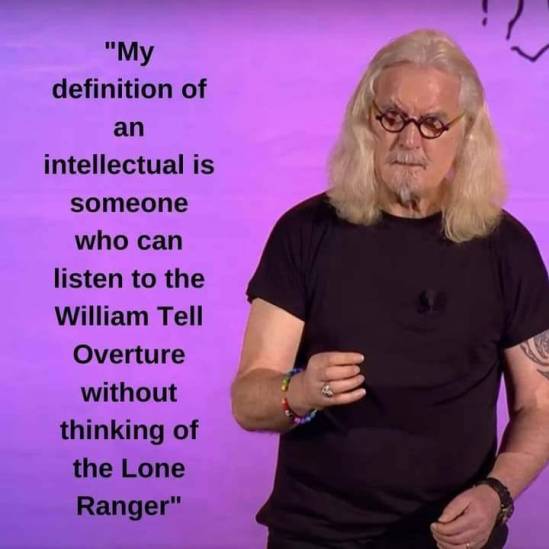
Today, we’ll be listening to the end of the William Tell Overture by Gioachino Rossini. This piece, originally the overture to an opera, has been arranged for piano and is in several method books, including Piano Pronto Movements 1 and 2. It’s also in Bastien Book 4 and Piano Maestro.
The original story
Maybe your grandparents watched the original Lone Ranger
Or you saw the newer Lone Ranger with Johnny Depp
Here’s the entire William Tell Overture played by an orchestra
Piano Solo
Franz Liszt made a really hard version for piano solo. See if you can follow along!
Piano Duet (1 piano, 4 hands)
Piano Duet arranged by Louis Moreau Gottschalk
Piano Duo (2 pianos, 8 hands)
Piano Quartet (4 pianos, 16 hands)
For pipe organ
For synthesizer
And then things get nuts with cartoons. Lots of cartoons used this music. Here are Mickey Mouse and friends
And Spike Jones
Handbells…
Poor Rossini – I think he’d have a fit if he knew how is music was being used.
It will be fun watching your child improve their piano skills all while having fun using Piano Maestro in lessons each week!
As your child’s teacher (or YOUR teacher!), I’m looking forward to seeing the progress they will make when they start using it at home each day. This guide will help you understand how this app will benefit your child and how to get it set up on your own iPad.
Overview What is Piano Maestro?
Piano Maestro is the ultimate piano practice tool that will have students quickly playing their favorite classical, pop, rock, TV and video game songs and themes. It is available in the App Store and works on the iPad.
What skills does it improve?
• Note reading
• Sight reading
• Rhythm
• Inner pulse
• Confidence
What makes it so fun?
• Upbeat background tracks
• Stunning graphics
• Instant rewards and feedback
• Satisfaction of playing REAL music
It works with an acoustic piano?
Yes! Your child practices on your real acoustic or digital piano. Piano Maestro listens from the iPad’s built-in microphone. No wires needed.
I’m already paying for lessons. What value does this add?
Sometimes I wish I could be there with your child to encourage them to keep practicing daily. I’m sure it’s not always easy, as unforeseen challenges will arise.
Since our time each week is just too short, this app will give me eyes on the ground and it will keep them practicing longer and improving more quickly.
How will it be used in lessons?
I will spend a few minutes of each lesson helping your child master a couple of new songs all while having fun! I will also teach them how to use the practice options at home.
At the end of the lesson, we will choose Home Challenge assignments within the app that will show up in your account at home. I’ll get updates when progress is made.
Getting Started
Wow, this sounds awesome. Now, how do I get started?
1) Download Piano Maestro on your iPad from the AppStore
2) Create a JoyTunes account with a parent’s email, under which, you can have multiple profiles for each member of the family.
3) Create a profile for each family member (that means you too Mom and Dad!) inside the Parent/Teacher zone (top right-hand corner of the main screen)
4) Connect to your teacher, me! After creating a profile in the “profiles” tab of the parent/teacher zone, select the student’s profile and click “connect to teacher.” Once I approve the connection to your child, they will receive full access to all content for FREE! I will then also begin receiving weekly progress reports.
5) Start Playing – I will now start assigning you homework, meanwhile, get started on Journey Mode.
When you connect to the O’Connor Music Studio, Piano Maestro is free for as long as you study here.
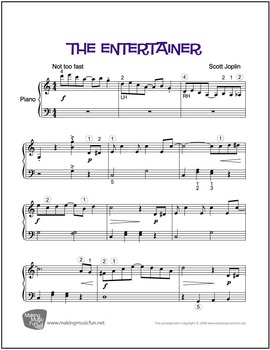
“The Entertainer” is a 1902 classic piano rag written by Scott Joplin. It was sold first as sheet music, and in the 1910s as piano rolls that would play on player pianos.
It was used as the theme music for the 1973 Oscar-winning film The Sting by composer and pianist Marvin Hamlisch.
The Sting was set in the 1930s, a full generation after the end of ragtime’s mainstream popularity, thus giving the inaccurate impression that ragtime music was popular at that time.
Find the sheet music in a variety of levels including Songs I Love to Play, Volume 1 and Alfred Premier Piano Course Book 4. It’s also available in Piano Maestro and to borrow from the O’Connor Music Studio
Today, we’ll listen to the Symphony No. 5 in C minor, Op. 67, of Ludwig van Beethoven. It was written between 1804–1808. It is one of the best-known compositions in classical music, and one of the most frequently played symphonies. As is typical of symphonies in the classical period, Beethoven’s Fifth Symphony is in four movements.
I’m sure you’ve heard the first 8 notes before…
Since it was written for orchestra, each instrument has its own line:
A piano version, transcribed by Liszt
From Disney’s Fantasia 2000:
Pink learns to play the violin, and interrupts a performance of Beethoven’s Fifth Symphony with the Pink Panther theme played on various instruments.
Beethoven’s Wig:
Arrangements of Beethoven’s Fifth Symphony can be found in Piano Maestro and lots of books including Piano Pronto’s Movement 2, Movement 5 (Victory Theme) and Beethoven: Exploring His Life and Music.
Today’s Listening Assignment is Country Gardens by Percy Grainger.
“Country Gardens” is an English folk tune collected by Cecil Sharp from the playing of William Kimber and arranged for piano in 1918 by Percy Grainger.
The tune and the Grainger arrangement for piano and orchestra is a favorite with school orchestras, and other performances of the work include morris dancing.
A piano version:
Piano duet (four-hands)
Clarinet solo
Orchestra
The Ambrosian Children’s Choir
From the Muppets
And, how a Morris Dance is done:
Find Country Gardens on IMSLP, Piano Maestro (under the method book section) and Piano Pronto: Movement 2
Johann Sebastian Bach’s towering monument of organ music, with its deep sense of foreboding, will forever be associated with Halloween.
Get a free copy of the sheet music at IMSLP or borrow a copy from the O’Connor Music Studio. I have this arranged for organ, piano, duet, 2-piano, simplified…
It’s also available in Piano Maestro, Piano Pronto Encore and Coda
Korobeiniki is a nineteenth-century Russian folk song that tells the story of a meeting between a peddler and a girl, describing their haggling over goods in a veiled metaphor for courtship.
Outside Russia, “Korobeiniki” is widely known as the Tetris theme.
Piano duet:
Orchestral version:
For Boomwhackers:
Vocal:
Ragtime:
Balalaika:
Two bassoons:
The Red Army Choir:
Korobeiniki/Tetris is available in Piano Maestro on the iPad and I have several levels of sheet music for anyone who is interested.
“Ode to Joy” was written in the summer of 1785 by German poet, playwright, and historian Friedrich Schiller and published the following year in Thalia. A slightly revised version appeared in 1808, changing two lines of the first and omitting the last stanza.
“Ode to Joy” is best known for its use by Ludwig van Beethoven in the final (fourth) movement of his Ninth Symphony, completed in 1824. This was Beethoven’s final symphony and lasts over an hour for the whole thing.
The entire final movement:
Beethoven’s text is not based entirely on Schiller’s poem, and introduces a few new sections. His melody (but not Schiller’s words) was adopted as the Anthem of Europe by the Council of Europe in 1972 and subsequently by the European Union.
If your student is in Wunderkeys, this is a classical pop piano solo based on Beethoven’s 9th Symphony. This Level 4 piano solo is from the book The Beethoven Sessions; a collection of 7 classical pop piano solos inspired by the music of Beethoven.
It is often called Joyful, Joyful We Adore Thee (You) in hymnbooks.
Find Ode to Joy in Piano Maestro, Prelude, Beethoven: Exploring His Life and Music and several hym books.
By now, you know I love flashmobs:
And Muppets (note the metronome going wild!):
And Barbershop:
An animated score:
Boomwhackers:
The Piano Guys combined Ode to Joy with Joy to the World for a new Christmas arrangement:
As the European Anthem:
And, finally Joyful, Joyful we Adore Thee by the Mormon Tabernacle Choir.
Do a search on youtube – lots and lots of people have played this famous Beethoven melody.
Today’s piece is slow and easy-going. The name “Largo” itself means slow. Antonin Dvorák wrote this as a part of his Symphony No. 9 in E minor, also known as From the New World, Op. 95, B. 178, or just the New World Symphony.
Popularly known as the New World Symphony, it was composed in 1893 while Dvořák was the director of the National Conservatory of Music. It is by far his most popular symphony, and one of the most popular of all symphonies. In older literature and recordings, this symphony was often numbered as Symphony No. 5.
Astronaut Neil Armstrong took a tape recording of the New World Symphony along during the Apollo 11 mission, the first Moon landing, in 1969.
Find Largo in Keyboard Kickoff, Prelude (it’s called River Road), Movement 2 and Piano Maestro
And orchestra
The theme from the Largo was adapted into the spiritual-like song “Goin’ Home”, often mistakenly considered a folk song or traditional spiritual, by Dvořák’s pupil William Arms Fisher, who wrote the lyrics in 1922.
.
Pipe Organ
Recorder
And sung
Whenever I think of slow things, I’m reminded of this clip from the old TV Show, Taxi
If your student is in the Wunderkeys series, “Enchanted” from Elementary 2A s a pop twist on the New World Symphony by Dvořák. In this solo students explore dotted quarter rhythms, two half-notes as a LH accompaniment, and gain further comfort in the G Major pentascales.






 MaryO'Studio