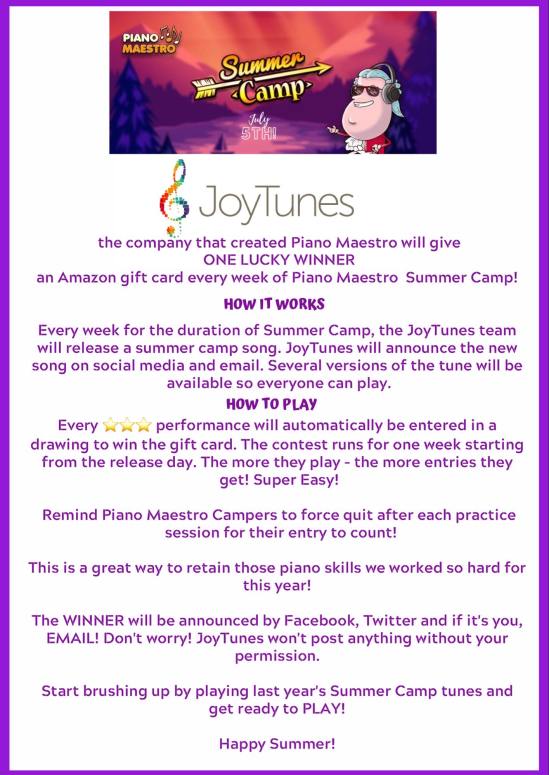
This week’s Summer Camp piece is I Got You (I Feel Good) by James Brown. There are 3 levels – Just the Melody Line, Simplified and the whole piece in d minor. The sharps are written in.


This week’s Summer Camp piece is I Got You (I Feel Good) by James Brown. There are 3 levels – Just the Melody Line, Simplified and the whole piece in d minor. The sharps are written in.

Today’s Listening Assignment is Country Gardens by Percy Grainger.
“Country Gardens” is an English folk tune collected by Cecil Sharp from the playing of William Kimber and arranged for piano in 1918 by Percy Grainger.
The tune and the Grainger arrangement for piano and orchestra is a favorite with school orchestras, and other performances of the work include morris dancing.
A piano version:
Piano duet (four-hands)
Clarinet solo
Orchestra
The Ambrosian Children’s Choir
From the Muppets
And, how a Morris Dance is done:
Find Country Gardens on IMSLP, Piano Maestro (under the method book section) and Piano Pronto: Movement 2


Summer Camp is where the Home Challenge usually is, with HC right underneath.

Piano Maestro Summer Camp has begun with 2 levels of Sweet Home Alabama. Learn mode is available if necessary.


“Ode to Joy” was written in the summer of 1785 by German poet, playwright, and historian Friedrich Schiller and published the following year in Thalia. A slightly revised version appeared in 1808, changing two lines of the first and omitting the last stanza.
“Ode to Joy” is best known for its use by Ludwig van Beethoven in the final (fourth) movement of his Ninth Symphony, completed in 1824. This was Beethoven’s final symphony and lasts over an hour for the whole thing.
The entire final movement:
Beethoven’s text is not based entirely on Schiller’s poem, and introduces a few new sections. His melody (but not Schiller’s words) was adopted as the Anthem of Europe by the Council of Europe in 1972 and subsequently by the European Union.
It is often called Joyful, Joyful We Adore Thee (You) in hymnbooks.
Find Ode to Joy in Piano Maestro, Prelude, Beethoven: Exploring His Life and Music and several hym books.
By now, you know I love flashmobs:
And Muppets (note the metronome going wild!):
And Barbershop:
An animated score:
Boomwhackers:
The Piano Guys combined Ode to Joy with Joy to the World for a new Christmas arrangement:
As the European Anthem:
And, finally Joyful, Joyful we Adore Thee by the Mormon Tabernacle Choir.
Do a search on youtube – lots and lots of people have played this famous Beethoven melody.
Today’s piece is slow and easy-going. The name “Largo” itself means slow. Antonin Dvorák wrote this as a part of his Symphony No. 9 in E minor, also known as From the New World, Op. 95, B. 178, or just the New World Symphony.
Popularly known as the New World Symphony, it was composed in 1893 while Dvořák was the director of the National Conservatory of Music. It is by far his most popular symphony, and one of the most popular of all symphonies. In older literature and recordings, this symphony was often numbered as Symphony No. 5.
Astronaut Neil Armstrong took a tape recording of the New World Symphony along during the Apollo 11 mission, the first Moon landing, in 1969.
Find Largo in Keyboard Kickoff, Prelude (it’s called River Road), Movement 2 and Piano Maestro
For Piano
And orchestra
The theme from the Largo was adapted into the spiritual-like song “Goin’ Home”, often mistakenly considered a folk song or traditional spiritual, by Dvořák’s pupil William Arms Fisher, who wrote the lyrics in 1922.
.
Pipe Organ
Recorder
And sung
Whenever I think of slow things, I’m reminded of this clip from the old TV Show, Taxi
So, since today is Saturday…

Note: As of March 16, 2020, All FCPS school buildings are closed until further notice.
What Will Happen If Schools Close In Fairfax County?
Piano lessons will continue because we have a plan!
Please note that I clean the piano and keyboard keys with Clorox wipes between each student. Students are expected to wash hands before lessons and after using the restroom. Hand sanitizer is available.
I am continuously monitoring press releases from public health officials both locally and nationwide and have developed a plan for continuity in piano lessons should we need to implement it.
If any of the school districts that students in our studio attend close down or the health department provides suggestions to more seriously limit interaction and engage in social distancing, piano lessons will continue for students of ALL ages.
Our contingency plan if Fairfax County Schools close is to:
Your payment will still be due at the same time. All assignments are due by the beginning of the student’s regularly scheduled lesson time and new ones along with comments about the past week will be given during the regular lesson time. Students will still be expected to continue practicing, completing all assignments and demonstrating progress.
If you have an underlying health concern or family member who has one that you believe puts you in a high-risk group and you would like to take steps ahead of time to mitigate your exposure, please let me know and I will set up online lessons for you (see #10 above).
Did I forget anything? Questions or comments?

Since we had the Bridal Chorus a couple days ago, it’s time to march the bride and groom back up the aisle with the Wedding March by Felix Mendelssohn.
This Wedding March comes from Mendelssohn’s incidental music to A Midsummer Night’s Dream. It became customary to play this at marriage ceremonies from about the mid 19th Century, and particularly after the daughter (also called Victoria) of Queen Victoria chose the piece for her own wedding in 1858.
Notice all the triplets (3)! If you don’t know what they are, be sure to ask at your next lesson.
Find this in Movement 2 and Piano Maestro.
Franz Liszt and Vladimir Horowitz added some variations
On an organ
An organist who needed a bit more practice
With an orchestra
See you tomorrow!
It’s wedding season! Today and tomorrow, we’ll be looking at, and listening to, the music most associated with weddings.
The “Bridal Chorus” from the 1850 opera Lohengrin by German composer Richard Wagner is a march played for the bride’s entrance at many formal weddings throughout the Western world.
The piece was made popular when it was used as the processional at the wedding of Victoria the Princess Royal to Prince Frederick William of Prussia in 1858.
This piece is available in Keyboard Kickoff, Movement 2 and Piano Maestro.
The original from the opera
A piano version (this book is available for loan, if interested)
Handbells (rehearsal)
On accordion
And pipe organ
A very different wedding entrance in Denmark