This summer, I’ve decided to add a new feature to piano lessons. I know that many families travel during the summer months and it’s sometimes difficult to practice.
These daily assignments, June through August will help you and your students learn a bit more about the pieces they’re learning during the year – or maybe give ideas for something that they’d like to learn.
Each piece has a bit of composer info and several different interpretations, some of which are very humorous. Some of the assignments appear in Piano Maestro so be sure to have that handy, if your student uses that.
Some days give hints that the assignment of the day may be played (or reviewed) at the next lesson so please be sure that your student takes note of that (no pun intended!)
Each year on May 22 we observe National Buy a Musical Instrument Day. The day is all about playing music. If you are a musician, it might be time for a new instrument. Maybe you can learn to play a second or third one. If you have never played an instrument before, National Buy A Musical Instrument Day might be the motivation you need to start.
Naturally, here at the O’Connor Music Studio, a piano, keyboard with weighted keys (and 88 of them!) or organ is recommended but this day is for all types of instruments and is for people of all ages. Grandpa can play his ukulele while the grandkids play the drums, trombone, and flute. Together they can all make terrific music!
Now and then, our studio gets asked if we offer bi-weekly lessons. I mean, doesn’t it make sense that if you take lessons every other week, you have half the number of trips into the studio, you have double the amount of time to practice, and you can save some money, right?
WRONG.
Aside from the fact that it is a scheduling nightmare for the teacher and studio, I want to outline a few reasons why (in most cases) bi-weekly lessons do not work.
As all my students know, I teach theory with all piano and organ lessons. Sometimes, it’s from a theory book that matches a lesson book, sometimes on the fly on an “as needed” basis.
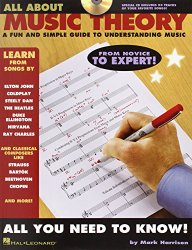
This book looks like it would be interesting to use as a review or to look ahead and see what’s coming. I have just ordered a copy for the studio if you want to check it out at the next lesson.
If you wish there was a fun and engaging way to help you understand the fundamentals of music, then this is it. Whether it’s learning to read music, understanding chords and scales, musical forms, or improvising and composing, this enjoyable guide will help you to finally start understanding the structure and design of music.
This fun-filled, easy-to-use guide includes:
* Music notation
* Scales and modes
* Melody harmonization and counterpoint
* Chord progressions
* Song form and structure
Listen and learn with the CD that has 90 tracks, including over 50 popular songs such as:
* Beauty and the Beast
* Candle in the Wind
* Imagine
* In the Air Tonight
* Killing Me Softly with His Song
* Let It Be
* Message in a Bottle
* Misty
* Satin Doll
* Take the ‘A’ Train
* Unchained Melody
* What’d I Say
* and more!
What Will Happen If Schools Close In Fairfax County?
Piano lessons will continue because we have a plan!
Please note that I clean the piano and keyboard keys with Clorox wipes between each student.Students are expected to wash hands before lessons and after using the restroom. Hand sanitizer is available.
I am continuously monitoring press releases from public health officials both locally and nationwide and have developed a plan for continuity in piano lessons should we need to implement it.
If any of the school districts that students in our studio attend close down or the health department provides suggestions to more seriously limit interaction and engage in social distancing, piano lessons will continue for students of ALL ages.
Our contingency plan if Fairfax County Schools close is to:
Close the physical studio temporarily
Provide online lesson options completely customized towards each student using an app/website called Tonara.All students have been assigned user names and passwords already.Your log-in information is in your student’s notebook or I will send it to you.
All assignments are due by the beginning of the student’s regularly scheduled lesson time and new ones along with comments about the past week will be given during the regular lesson time. Students will still be expected to continue practicing, completing all assignments and demonstrating progress.
We started using Tonara March 11, 2020 for assignments so that students will be accustomed to it is needed for real. https://youtu.be/eFCaRZhRKm4
There will be assigned theory games using an app called SproutBeat.You can download this in the app store. All students have been assigned user names and passwords already.Your log-in information is in your student’s notebook or I will send it to you.
There may be assigned theory games using a website called SproutBeat Leap.You use it in a browser window at https://leap.sproutbeat.com/home . All students have been assigned user names and passwords already.Your log-in information is in your student’s notebook or I will send it to you.
There may be written theory work from your assigned theory bookIf so, please take a picture of it in Tonara and upload it along with other assignments.It could also be scanned and emailed to maryoconnor@gmail.com
For students with iPads, please be sure that you have downloaded PianoMaestro.There will be weekly assignments listed under “Home Challenge”.Please try to get 3 stars.It is possible to slow the pieces down but you may lose points/stars doing so.If it’s really hard, try the Learn Mode.
For students without iPads, I will assign at least one or two pieces to be videoed in the Tonara app/website and submitted to me for feedback.These will be due by the beginning of the student’s regularly scheduled lesson time and new (or review) ones will be given during the regular lesson time. Feedback will also be provided during the scheduled lesson time.
Depending on how long school is canceled, we may have online lessons using StreamYard as a virtual piano studio during the regularly scheduled lesson time.I will create a ‘broadcast’ for the day and send the same link to all my students.When a student clicks in I see them “backstage” and add them to the lesson, so we can both see/hear each other.Then when the lesson is over the next one has already arrived.I click that one through and the 3 of us are there for a minute. they say hello/goodbye just like in a live lesson.
Other Apps you might want to try at home:
Theory: Music Theory Pro – a great tool for preparing for auditions: scales, chords, intervals and more
Theory: Jungle Journey
Rhythm: Rhythm Swing – a fun, interactive game that covers basic note values
Rhythm: Rhythm Lab – assign rhythms for students to practice and tap- hands alone or together
Rhythm: Rhythm Cat
Note-Reading: Flashnote Derby – a customizable game where students ‘race’ to select the correct note
Note-Reading: Note Squish: think whac-a-mole with notes. Also customizable by clef (includes alto clef!)
Note-Reading: Noteworks
Note-Reading: Staff Wars
Note-Reading: Note Rush:great for keyboard geography. Students have to play the note that pops up
Note-Reading: Treble Cat
Note-Reading: Bass Cat
Ear Training: Beat Melody – great intro to ear training
Ear Training: Ear Cat
Your payment will still be due at the same time. All assignments are due by the beginning of the student’s regularly scheduled lesson time and new ones along with comments about the past week will be given during the regular lesson time. Students will still be expected to continue practicing, completing all assignments and demonstrating progress.
If you have an underlying health concern or family member who has one that you believe puts you in a high-risk group and you would like to take steps ahead of time to mitigate your exposure, please let me know and I will set up online lessons for you (see #10 above).
In music, a scale is any set of musical notes ordered by fundamental frequency or pitch.
An arpeggio (it. /arˈpeddʒo/) is a musical technique where notes in a chord are played or sung in sequence, one after the other, rather than being played together like a chord. This word comes from the Italian word “arpeggiare”, which means “to play on a harp”. An alternative translation of this term is “broken chord”.
Since the first release of this classic Schirmer edition over 100 years ago, almost anyone who has taken piano lessons for more than two years has played from The Virtuoso Pianist.
Most anyone who has ever played piano has a love-hate relationship with the “Hanon”.
The Virtuoso Pianist (Le Pianiste virtuose) by Charles-Louis Hanon, is a compilation of sixty exercises meant to train the pianist in speed, precision, agility, and strength of all of the fingers and flexibility in the wrists.
First published in Boulogne, in 1873, The Virtuoso Pianist is Hanon’s most well-known work, and is still widely used by piano instructors and pupils although some teachers are getting away from the mechanical playing these can produce.
Personally, I’ve sometimes played these on “auto-pilot” since all one really needs is to get the first pattern going, then move up a step, up a step…
Notes by C. L. Hanon: Preparatory exercises for the Acquirement of Agility, Independence, Strength and Perfect Evenness in the Fingers. For studying the 20 exercises, begin with the metronome set at 60, gradually increasing the speed up to 108.
The exercises are intended to address common problems which could hamper the performance abilities of a student. These include “crossing of the thumb”, strengthening of the fourth and fifth fingers, and quadruple- and triple-trills.
The exercises are meant to be individually mastered and then played consecutively in the sections they are placed in.
Apart from increasing technical abilities of the student, when played in groups at higher speeds, the exercises will also help to increase endurance. The exercises are divided in three parts:
Exercises 1 – 20: Labeled “preparatory exercises”, these are also the most famous exercises, and are used to develop finger strength and independence. Each exercise contains a sequence of 8 semiquavers, beginning on C, which is then repeated starting on D, and so on across two octaves. The exercise is then repeated in reverse down two octaves to the starting C. The exercises are intended to be practiced in groups of three, except for the first two which are practiced together.
Exercises 21 – 43: Labeled “further exercises for the development of a virtuoso technique.” This more difficult section is meant to be played after the pianist has fully mastered Part 1. Part 2 includes scales and arpeggios.
Exercises 44 – 60: Labeled “virtuoso exercises for mastering the greatest technical difficulties.” Since this section is considerably more difficult, Hanon recommends the mastery of both previous parts before proceeding to this one. This part includes repeated notes,, and more.
After all three parts are mastered, Hanon recommends all exercises be played through daily to retain technique.
The O’Connor Music Studio has several editions of this work, including:
Hanon: The Virtuoso Pianist in Sixty Exercises, Complete. Since the first release of this classic Schirmer edition over 100 years ago, almost anyone who has taken piano lessons for more than two years has played from The Virtuoso Pianist . Millions of copies have been sold of these progressive exercises which guide a player’s technique, building finger independence and strength. This was the first American edition released of this music, and remains a classic at a remarkably affordable price.
Junior Hanon (Alfred Masterwork Edition). A slight condensation of Hanon’s first exercises. The simplification in layout and range make the exercises appear less difficult to a young student. Includes the complete Book 1 and excerpts from Books 2 & 3 of C. L. Hanon’s famous studies, The Virtuoso Pianist in 60 Exercises.
Hanon for Students, Bk 1: 6 Varied Exercises from The Virtuoso Pianist for Late Elementary Pianists. Hanon for Students, Book 1, contains the first six exercises from The Virtuoso Pianist, Book 1. The exercises are notated in eighth notes for one octave so that students may begin to use them effectively at the late-elementary level. Each exercise appears five times to be played with a legato touch, varied articulation, varied dynamics, varied rhythm, and transposed to F or G.
Jazz Hanon. Inspired by Charles-Louis Hanon’s The Virtuoso Pianist the essential technical method for any classical player these new volumes present a modern-day equivalent for the musician seeking to play the key piano styles of the 20th century. Each book develops basic technique and true facility in each genre through authentic, progressive exercises and etudes. The music in these books is fun to play for pianists at every level, building the necessary skills in each style while providing extensive musical and stylistic insight.