Redditor NeokratosRed had an idea: depict the hands of great composers and pianists, according to the characteristics of their music. He shared it on the social media site, and also punted for suggestions of more. It has since received over 300,000 images views, and lots of further suggestions from fellow Redditors and piano geeks.
Whisks for Chopin’s elegant pianistic souffles, feather dusters for the gentle impressionism of Debussy, instruments of trade for the composer of the thunderous Hammerklavier sonata.
Piano, and the internet – top marks to the both of you.
Stephen Powers first thought of his grand piano as an impressive piece of furniture.
But he enjoyed listening to music so much when friends played at parties at his home in North Wilmington that he began taking lessons.
“I enjoy having a couple of songs under my belt,” says Powers, a 52-year-old banker. “I play Happy Birthday. I play Getting to Know You for my mom.”
Powers is part of a boomlet of adults who are studying piano. Many took lessons briefly as children and regret giving it up. Some simply enjoy music. Others gravitated toward the keyboard because studies suggest piano improves mental acuity while reducing the odds of dementia.
A Swedish study published in 2014 in the International Journal of Alzheimer’s Disease found that when a twin played a musical instrument later in life, he or she was 64 percent less likely to develop dementia than the twin who did not play.
A study published in Frontiers in Psychology in 2013 evaluated the impact of piano lessons on cognitive function, mood and quality of life in adults age 60 to 84.
The group that studied piano showed significant improvement in tests that measure executive function, controlling inhibitions and divided attention, as well as enhanced visual scanning and motor ability. Piano students also reported a better quality of life.
Some grownups simply relish a challenge.
In the United Kingdom, Alan Rusbridger, editor of the Guardian, took to the keyboard at age 56. He chronicled the year he spent learning Chopin’s demanding No. Ballade 1 in G Minor in the book Play It Again: An Amateur Against the Impossible.
Richard Swarmer, 57, of Lewes, played the trumpet from grade school through college. He has sung in several choirs. This year, he began piano lessons.
Learning the piano isn’t easy even for someone with a musical background. Still, Swarmer appreciates that the creative thought process is different from the focus required by his job for a medical benefits company.
“I have thoroughly enjoyed taking piano lessons as an adult,” he says. “It provides a welcome respite from the demands of my job.”
Ethel Thirtel of North Wilmington is 71 and a student at the Music School of Delaware. She is also taking French lessons to help keep her intellect sharp.
“Both pursuits involve active studying and practice to master new skills,” she says.
To meet rising demand, the Music School of Delaware offers adults-only evening group classes to accommodate working people, says Matthew Smith, student and alumni relations officer. The school also provides instruction for adults 50 and older through the Osher Lifelong Learning Institute at University of Delaware.
“In addition to professionals, we are getting a lot more inquiries from older adults who are retired and have time on their hands,” he says.
Geri Smith, a Julliard-trained singer, musician and composer, has taught piano to children in public schools as well as private arts centers. Her adult students include a 59-year-old writer who took up piano after the death of her husband, a gifted musician.
“Teaching children is a different experience than teaching adults,” says Smith, of Unionville. “Kids pretty much do what you ask them to do but adults ask lots of questions. They want to know why things have to be done a certain way.”
An important part of learning piano is creating new pathways in the brain. A Harvard Medical School study examined the impact of practicing the piano on synapses, the connections between neurons that encode memories and learning.
Volunteers practiced two hours a day for five days, playing a five-finger exercise to the beat of a metronome. To learn how that impacted the neurons scientists used transcranial-magnetic-stimulation (TMS), in which a wire coil sends magnetic impulses to the brain.
They discovered that after a week of practice, the stretch of motor cortex devoted to the finger exercises had expanded like crabgrass.
“Playing the piano creates new synapses,” Smith says. “Think of it as creating a conduit so your right hand can talk to your left hand.”
Meldene Gruber of Rehoboth Beach, who has taught piano for more than 40 years, has seen a surge in adult students in the past two years. Now, half her students are adults.
“A number of my adults say they think playing the piano will help with mental acuity,” she says. “Playing the piano forces you to use both sides of the brain, which is great for neuron firing.”
Most adults have specific goals in mind, such as learning to play Christmas carols or a few favorite pieces.
“You don’t get adults who are focused on becoming concert pianists,” Gruber says. “They come for the joy of playing, not because their mothers made them.”
• 1881 ~ Georges Enesco, Rumanian composer, violinist and conductor
• 1918 ~ Sgt. Irving Berlin’s musical about army life in World War I opened at the Century Theatre in New York City. Yip Yip Yaphank included songs, such as Mandy and Oh, How I Hate to Get Up in the Morning.
• 1939 ~ Ginger (Peter) Baker, Trumpeter, drummer with Cream
• 1939 ~ The Dick Jurgens Orchestra recorded Day Dreams Come True at Night on Okeh Records. Eddy Howard was the vocalist on the piece. It became Jurgens’ theme song.
• 1940 ~ Johnny Nash, American pop-reggae singer, songwriter and guitarist
• 1943 ~ Billy J. Kramer (William Ashton), Singer with The Dakotas
• 1945 ~ Ian Gillan, Singer with Deep Purple
• 1947 ~ Gerard Schwarz, American trumpeter and conductor
• 1951 ~ John Deacon, Bass with Queen, score of Flash Gordon
• 1964 ~ The Beatles began their first North American concert tour. They would visit 26 cities.
• 1972 ~ NBC-TV presented The Midnight Special for the first time. John Denver was the host for the first show. Wolfman Jack was the show’s announcer. The Midnight Special proved to be a ratings success.
• 1991 ~ Richard Maltby passed away. He was an American musician, conductor, arranger and bandleader.
• 2001 ~ Singer Betty Everett, whose recording of The Shoop Shoop Song (It’s In His Kiss) made Billboard’s Top 10 in 1964, died Sunday. She was 61.
Everett is remembered primarily for one huge hit song in the 1960s, but she also recorded many other songs and was recognized as one of the top soul singers of her time.
Starting at age 9, Everett played the piano and sang in church. She continued to sing in gospel choirs before moving to Chicago in 1957, where she recorded a string of hits on local record labels such as C.J. Cobra and OneDerful that included I’ll Be There and I’ve Got a Claim On You.
Everett signed a contract in the early 1960s with VeeJay, a record label that was then issuing recordings by The Beatles.
Everett recorded The Shoop Shoop Song in the spring of 1964, and it soared to Billboard’s Top 10.
The song was later recorded by Cher in the soundtrack for the 1990 movie Mermaids and more recently by Vonda Shepard of the Fox television show Ally McBeal.
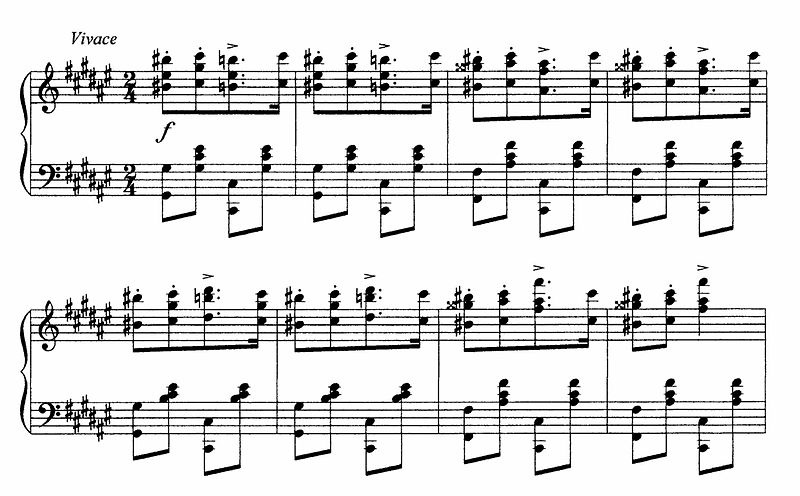
Hungarian Rhapsody No. 2, S.244/2, is the second in a set of 19 Hungarian Rhapsodies by composer Franz Liszt, and is by far the most famous of the set. Few other piano solos have achieved such widespread popularity, offering the pianist the opportunity to reveal exceptional skill as a virtuoso, while providing the listener with an immediate and irresistible musical appeal.
In both the original piano solo form and in the orchestrated version this composition has enjoyed widespread use in animated cartoons. Its themes have also served as the basis of several popular songs.
It is probable that you have heard this piece of music somewhere at one time or another because it is perhaps the most prominent piece of classical (romantic, actually) music featured in animated cartoons across the years.
Now, let the anvils fall and dynamite explode!
And, in real life, Valentina Lisitsa plays Liszt’s Hungarian Rhapsody No. 2
This piece is available in Piano Pronto Movement 5 and several anthologies of classical music.
1803 ~ Adolphe Adam, Opera Composer, composer of Oh, Holy Night
More information about Adam
• 1849 ~ Georgetown University in Washington, DC, became the first college to offer a doctor of music degree. It was presented to Professor Henry Dielman.
• 1880 ~ Ernest Bloch, Swiss-born American composer, and conductor
More information about Bloch
• 1908 ~ Cootie (Charles) Williams, Trumpeter with Echoes of Harlem born. He performed with Duke Ellington and Benny Goodman; band leader for Cootie Williams Sextet and Orchestra
• 1915 ~ Bob Eberly (Robert Eberle), Singer born. He performed with Kitty Kallen, sang with the Jimmy Dorsey Orchestra & on TV’s Top Tunes; brother of singer Ray Eberle
• 1921 ~ Billy Taylor, Jazz Piano. He was also the leader of the Billy Taylor Trio, Orchestra; co-founder of Jazzmobile ’65; the music director of The David Frost Show; and performed jazz segments on Sunday Morning with Charles Kuralt
• 1938 ~ Clarinet virtuoso and big band leader Artie Shaw recorded his now-classic, Begin the Beguine, for Bluebird Records in New York City. Shaw was married to Ava Gardner at the time.
• 1941 ~ Barbara Jean Love, Singer with Friends of Distinction
• 1942 ~ Heinz Burt, Musician, bass with The Tornados
• 1947 ~ Mick Fleetwood, British rock drummer
• 1947 ~ Peter Serkin, American pianist
• 1951 ~ Lynval Golding, Musician, guitarist with The Specials
• 1956 – After a decade together as the country’s most popular comedy team, Dean Martin, and Jerry Lewis called it quits this night. They did their last show at the Copacabana nightclub in New York City. The duo ended their relationship exactly 10 years after they had started it.
• 1958 ~ Pam Tillis, Country Singer
• 2000 ~ Violinist Oscar Shumsky, a brilliant performer who trained generations of successful younger artists, died at the age of 83 from heart disease. Shumsky displayed his musical talent at an early age, first picking up a violin when he was 3 years old. His father, an amateur player who recognized his son’s brilliance, took him to the Curtis Institute of Music, where he was accepted as a student by violinist Leopold Auer and was later taught by Efrem Zimbalist. At the age of 9, Shumsky performed with the Philadelphia Orchestra, and after graduating from Curtis in 1936, he began playing around the world to widespread critical acclaim. He later branched into conducting. Shumsky was featured at Lincoln Center’s “Great Performer Series.” He trained generations of violinists at some of the nation’s most prestigious music schools, including the Curtis Institute, the Peabody Conservatory, Yale University and, for 25 years, at the Juilliard School.
• 2001 ~ Charles Henderson, editor of The American Organist, died at the age of 84. Henderson, who edited the journal for more than a decade, starting in 1973, conducted a production of Britten’s “Noye’s Fludde” broadcast nationally on CBS television in 1964. He was on the faculty of the Union Theological Seminary’s School of Sacred Music, and from 1976 to 1983 was the organist at the First Presbyterian Church in Milford, N.J. Born in West Chester, Pa., Henderson studied music at Bucknell University, the Juilliard School, Syracuse University and the Fontainebleau School in France.
• 2016 ~ Marni Nixon, American singer (for Audrey Hepburn, Natalie Wood & Deborah Kerr), died at the age of 86. She is now well-known as the real singing voices of the leading actresses in films, including The King and I, West Side Story, and My Fair Lady, although this was concealed at the time from audiences.
• 1782 ~ Placidus Cajetan von Camerloher, Composer, died at the age of 63
• 1797 ~ Franz Schoberlechner, Composer
• 1865 ~ Robert Kahn, Composer
• 1870 ~ Josef Strauss, Austrian composer, died at the age of 42
• 1896 ~ Jean Rivier-Villemomble France, Composer
• 1898 ~ Ernest Willem Mulder, Composer
• 1898 ~ Sara Carter, Vocalist/guitarist with the Carter Family
• 1903 ~ Theodore Karyotakis, Composer
• 1906 ~ Daniel Ayala Perez, Composer
• 1915 ~ Floyd McDaniel ~ blues singer/guitarist
• 1920 ~ Isaac Stern, American concert violinist
Read quotes by and about Stern
More information about Stern
• 1920 ~ Manuel Valls Gorina, Composer
• 1921 ~ Billy Taylor, Orchestra leader on the David Frost Show
• 1922 ~ Kay Starr (Katherine Starks), Pop Singer
• 1925 ~ Lovro Zupanovic, Composer
• 1926 ~ Albert Fuller, American harpsichordist
• 1926 ~ Norman Jewison, Director of Jesus Christ, Superstar, Fiddler on the Roof
• 1927 ~ Stefan Niculescu, Composer
• 1931 ~ Leon Schidlowsky, Composer
• 1931 ~ Ted Husing was master of ceremonies for the very first CBS-TV program. The gala show featured singer Kate Smith, composer George Gershwin and New York City Mayor Jimmy Walker.
• 1935 ~ Kaye Stevens, Singer and comedienne on the Jerry Lewis Show
• 1938 ~ Anton Emil Kuerti, Composer
• 1938 ~ Paul Hindemith and Leonide Massines ballet premiered in London
• 1947 ~ Cat Stevens (Steven Demitri Georgiou) (Muslim name: Yusuf Islam), British folk-rock singer and songwriter
• 1948 ~ Donald Nichols Tweedy, Composer, died at the age of 58
• 1950 ~ Albert Riemenschneider, Composer, died at the age of 71
• 1958 ~ The last of Arthur Godfrey’s Talent Scouts programs aired on CBS-TV. Many artists got their start on Talent Scouts, including Tony Bennett, Pat Boone, The McGuire Sisters and a singer named Connie Francis, who not only sang but played the accordion, as well.
• 1969 ~ Just one day after Neil Armstrong set foot on the moon, Duke Ellington and a portion of his band performed a 10-minute composition on ABC-TV titled Moon Maiden. The work featured piano, drums, bass and vocals.
• 1973 ~ Bad, Bad Leroy Brown reached the top spot on the Billboard pop singles chart, becoming Jim Croce’s first big hit. Croce died in a plane crash two months later (September 20, 1973).
• 1976 ~ “Guys & Dolls” opened at Broadway Theater New York City for 239 performances
• 1994 ~ Dorothy Collins, Singer on Your Hit Parade, died at the age of 67
• 1995 ~ Edwin “Russell” House, Saxophonist, died at the age of 65
• 2000 ~ Iain Hamilton, the Scottish composer who turned Tolstoy’s “Anna Karenina” into an opera at the age of 78. Hamilton wrote four symphonies and dozens of orchestral and chamber works but is known best for his vocal music, which includes a cantata based on the poems of Robert Burns. “Anna Karenina” premiered at the English National Opera in 1981 to critical acclaim. His other operas include “Agamemnon”, “The Catiline Conspiracy”, based on a Ben Jonson play, and an adaptation of Peter Shaffer’s play “The Royal Hunt of the Sun”. From 1961 to 1978 he was a professor of music at Duke University in North Carolina.
• 2001 ~ Norman Hall Wright, the last surviving writer who worked on the Disney film Fantasia 2000, died at the age of 91. Wright studied at the University of Southern California before being hired by Walt Disney Productions. He started as an animator but later became a writer, producer and director. Wright developed the story of The Nutcracker Suite sequence for Fantasia 2000. He also was responsible for a sequence in Bambi. He wrote several cartoon shorts for Mickey Mouse, Donald Duck, and Goofy and also produced several Wonderful World of Disney television programs.
• 2002 ~ Gus Dudgeon, a respected music producer who worked on many of Elton John’s hit recordings, died in a car crash in western England. He was 59. Dudgeon produced Rocket Man,Goodbye Yellow Brick Road,Your Song,Daniel and Don’t Let The Sun Go Down On Me. Dudgeon also produced David Bowie’s Space Oddity and worked with other stars, including Chris Rea and Joan Armatrading. But it was his partnership with Sir Elton in the 1970s for which he will be best remembered. Dudgeon began his career in the early 1960s as a tea boy, running errands at Olympic Studios in London before joining Decca Records. He engineered the Zombies’ classic She’s Not There and the groundbreaking Blues Breakers album by John Mayall with Eric Clapton, before moving into producing.
• 2015 ~ Theodore Meir Bikel, Austrian-American actor, folk singer, musician, composer, and activist, died at the age of 91.
Today’s piece is Solfeggietto by Carl Philipp Emanuel Bach (aka C.P.E. Bach). The piece is commonly assigned to piano students and appears in many books because it fosters the playing of an even sixteenth note rhythm by alternating hands.
Bass guitar
Clarinet starting about a minute in:
On harp
Find it on IMSLP, in several anthologies of music at the O’Connor Music Studio, in Piano Pronto: Encore
Today’s Listening Assignment is Country Gardens by Percy Grainger.
“Country Gardens” is an English folk tune collected by Cecil Sharp from the playing of William Kimber and arranged for piano in 1918 by Percy Grainger.
The tune and the Grainger arrangement for piano and orchestra is a favorite with school orchestras, and other performances of the work include morris dancing.
A piano version:
Piano duet (four-hands)
Clarinet solo
Orchestra
From the Muppets
And, how a Morris Dance is done:
Find Country Gardens on IMSLP, Piano Maestro (under the method book section) and Piano Pronto: Movement 2
Today, we’ll listen to the Symphony No. 5 in C minor, Op. 67, of Ludwig van Beethoven. It was written between 1804–1808. It is one of the best-known compositions in classical music, and one of the most frequently played symphonies. As is typical of symphonies in the classical period, Beethoven’s Fifth Symphony is in four movements.
I’m sure you’ve heard the first 8 notes before…
Since it was written for orchestra, each instrument has its own line:
A piano version, transcribed by Liszt
From Disney’s Fantasia 2000:
Pink learns to play the violin, and interrupts a performance of Beethoven’s Fifth Symphony with the Pink Panther theme played on various instruments.
Beethoven’s Wig:
Arrangements of Beethoven’s Fifth Symphony can be found in Piano Maestro and lots of books including Piano Pronto’s Movement 2, Movement 5 (Victory Theme) and Beethoven: Exploring His Life and Music.
Johann Sebastian Bach’s towering monument of organ music, with its deep sense of foreboding, will forever be associated with Halloween.
Get a free copy of the sheet music at IMSLP or borrow a copy from the O’Connor Music Studio. I have this arranged for organ, piano, duet, 2-piano, simplified…
It’s also available in Piano Maestro, Piano Pronto Encore and Coda


 1803 ~ Adolphe Adam, Opera Composer, composer of


 MaryO'Studio