Finding The Right Teacher

NOT Mrs. O'Connor!

NOT Mrs. O’Connor!

See if a prospective teacher allows a trial lesson to test how the personalities mesh. And be sure to ask lots of questions. What’s the teacher’s background as a musician and as an instructor? What kinds of teaching materials and music does she use? How much practice time is expected for students, and does that vary by the student’s age? Does the teacher have access to student ensembles? What kinds of performance opportunities will he provide? Will the teacher allow the student to record the lesson? This can be a terrific practice aid, especially when it comes to remembering how something is supposed to sound. Does she teach any music theory or composition? What are the expectations for students and for their parents?

A good teacher can be a friendly, encouraging and inspiring presence — even when a student hits rough patches. He will point out the student’s weaknesses without being harsh or dismissive, suggest innovative ways to overcome challenges, and create engaging ways to tackle even rote activities like playing scales or honing fine motor skills. The instructor’s age and experience might or might not be a deciding factor; for example, I’m consistently impressed by the range of tricks my own child’s very youthful private teacher has up her sleeve to turn what could easily be drudgery into fun. Not to mention the huge helpings of good humor and patience she brings to her tiny charges!

Read more at Finding The Right Teacher For Your Music-Loving Kid : Deceptive Cadence : NPR.

Piano Lessons Not Just For Kids

~~~

By Diana Greenburg 

When Paula Fay started taking piano lessons for the first time in her late fifties, it fulfilled a lifelong dream.

“I always wanted to learn how to play as a child, but my parents couldn’t afford it,” she said.

Today, four years later, Paula can play some of her favorite tunes. And she’s loving every minute of it.

Some adults may groan at childhood memories of lesson after lesson, practice after practice and a lot of teacher nagging, but many wish those days were back.

And more and more, these adults are turning wishful thinking into reality. According to the National Piano Foundation, adults ages 25-55 are the fastest-growing segment of people learning piano.

When Ruth Ann Laye started teaching an adult piano class at Mandarin’s Keyboard Connection, there was only one weekday class. Now, she’s up to seven classes. And of her own private practice of 28, 11 are adults.

One of her students is Belinda May from St. Augustine, who is in her 60s and in her second year of piano lessons.

Though her brothers played piano, she was more athletically inclined than musical. Then after years of “picking” at the pianos in her house, she recently resolved to start taking lessons. A beginner when she started, “now I’m playing Christmas carols,” she said.

“It tells me that you’re never too old to learn something new.”

Maureen Rhodes, a piano teacher on the Southside, would likely agree. She has more adults in her practice than she did 20 years ago.

“I think baby boomers are looking for ways to stay active,” she said. “Sometimes, kids come to me for lessons and then when they grow up and leave, their mother starts to take lessons,” says Rhodes. “Other adults have a specific goal in mind, like they want to play in church or accompany their grandson.”

Sandra Stewart, outgoing president of the Jacksonville Music Teachers Association and adjunct professor teaching a non-degree adult piano course at Florida State College, believes technology is a big part of the reason for the greater interest in piano among adults.

“Keyboards are more affordable, and that’s made all the difference,” she says.

But the piano is not always a succession of high notes for the adult student. Says Stewart: “Adults can have problems with finger dexterity. If they never played before, this can be frustrating. People who use computer a lot have an advantage. But if they don’t have this experience, they have to get over that hurdle.”

And some adults expect to transform into Mozart overnight.

“They may be symphony patrons or just love classical music and want to play instantly and do it like the pros,” Rhodes says. “But they have to develop the skills first, and it takes a lot of patience.”

But for adults committed to learning, it can be very satisfying for student and teacher alike.

“Adults are there for their own pleasure,” said Marc Hebda, president of the Florida State Music Teachers Association. “They have wonderful enthusiasm; it’s fun to see them get excited. It’s also interesting that with the economic downturn, they are not cutting back on lessons or buying instruments. Piano is a constant source of entertainment and personal development.”

The key to any student learning well, whether that student is an adult or child, is finding the right teacher. Hebda stresses the importance of taking lessons from a teacher with a music degree.

“Some people who took piano figure it’s easy to teach. But credentials are very important. You wouldn’t go to a doctor without certification or a lawyer who didn’t pass the bar. All our teachers have a music degree or demonstrate teaching ability.”

Hebda also notes that rapport between teacher and student is important.

“The student should interview the teacher, because not all students and teachers are a good match.”

For those who want to fast-track the learning process, there are alternatives. “The Piano Guy,” Scott Houston, has been teaching piano using a non-traditional method through his shows on public station WJCT.

“It seemed like there was a single path to the world of piano: this long process of taking lessons,” he said. “But people want to play the tunes they know.”

So Houston came up with a simple way for adults to learn quickly, based on the concept behind “lead sheets,” which are used by professional musicians. Houston’s technique is to teach adults a single line of notes on the treble clef with their right hand and chords with their left.

“My goal is not to teach adults to be the greatest players but to be able to play the tunes they want to play,” Houston says.

His approach has clearly struck a chord, as his book has sold 300,000 copies and he has taught many adults through his workshops in Indiana and master class “piano camp” from his beach home in Fort Myers.

There’s also a new trend gaining traction called “recreational music making” — RMM — which like Houston’s approach focuses on a simplified method to teaching music. The goal is not for a student to become accomplished at the piano and perform, but rather to just have fun making music. It is often taught to adults in group settings, such as music stores, churches and senior centers.

“Research has found that RMM is very helpful for seniors, promotes hand/eye coordination and keeps the brain working,” said Erin Bennett, assistant professor of piano and pedagogy at the University of North Florida. “Its asset is the ability to reach more people; it’s more inclusive and easier for the non-experienced.”

Whether learning piano through traditional or nontraditional means, its many benefits include boosting self-confidence.

“When I first started, I didn’t think I could do it,” Fay said. “And my friends and family were in disbelief that I was taking lessons. Then they wanted to hear a concert. In another year, I might just do it.”

She gets some measure of satisfaction in surprising those around her.

“Society puts restrictions on us as we get older that we stop learning,” she says. “But we are wiser, more patience and accept our limitations.”

Read more at Jacksonville.com: http://jacksonville.com/entertainment/music/2011-10-27/story/piano-lessons-not-just-kids#ixzz1l14hSFaV

Clementi Added to Piano Maestro!

Piano Mania


New song just released!

After receiving many requests for more early intermediate songs JoyTunes has added:

Sonatina in C Major (Op.36) By Muzio Clementi.

Although the song has 3 movements, they’ve added only the first movement and hope to add the other 2 soon!

You can find the piece in the Library under “Classical and Opera”.

clementi

The O’Connor Music Studio has several editions of Clementi’s Sonatinas available in the Lending Library.

Piano lessons possibly on the decline

piano-teacher

Growing up, many people remember taking piano lessons, or having several friends who learned the instrument.

But as generations change, some hobbies evolve too…

When it comes to the amount of people learning to play the piano, is it really on the decline?

“I don’t think you see it quite as much today just because there’s so much more distraction nowadays,” Steve Buckman, a piano instructor at Vancil Performing Arts Center said.

Buckman says when it comes to taking lessons it’s very different than 50 years ago.

He says between video games, social media, and other hobbies, the piano can sometimes take a back seat when it comes deciding what to spend your free time on.

Another factor is something that typically has a large weight in our decision making…money.

Read more at Piano lessons possibly on the decline : News : ConnectTriStates.com.

The best age to start piano lessons is now

child-piano


I think that parents are pulled in many directions when it comes to extracurricular activities and educational enrichment for children. Music is supposed to be fun. It’s not really meant to be your secret solution to passing math with flying colors one day. As long as parents maintain a patient approach to music lessons, children will see it as fun.

Music should always be fun, but it is a hard to learn. It does need to be taken seriously. A teacher has to know the right tone to use for each individual student. Some students respond to playful rewards, while others need a stern approach. Regardless, the expectation to pay attention and practice is necessary. Whether a child is a toddler or entering middle school, the basic process to learn music is the same – practice, practice, practice.

Smaller children, however, learn to sit still and listen. They also learn to retain information and ask for help from a grown-up. For preschool children, private lessons is a great first step to learning how to be a student. Private lessons are ideal, but if they are too expensive, many music schools and teachers offer group lessons for beginners as introduction courses.

The most important thing is to explore a child’s interest. Whether a child excels in their interest or not is irrelevant. They should still be given a chance to find something they love to do. With music, it could be a great source of expression for them throughout their lives, even if they are not interested in performing. That being said, the best time to start piano lessons for children is simply right now.

via The best age to start piano lessons is now | NJ.com.

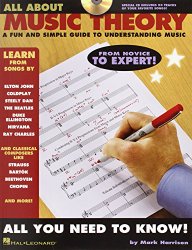
All About Music Theory: A Fun and Simple Guide to Understanding Music

theory


As all my students know, I teach theory with all piano and organ lessons.  Sometimes, it’s from a theory book that matches a lesson book, sometimes on the fly on an “as needed” basis.

This book looks like it would be interesting to use as a review or to look ahead and see what’s coming.  I have just ordered a copy for the studio if you want to check it out at the next lesson.

From amazon.com:

 If you wish there was a fun and engaging way to help you understand the fundamentals of music, then this is it. Whether it’s learning to read music, understanding chords and scales, musical forms, or improvising and composing, this enjoyable guide will help you to finally start understanding the structure and design of music.

This fun-filled, easy-to-use guide includes:
* Music notation
* Scales and modes
* Melody harmonization and counterpoint
* Chord progressions
* Song form and structure

Listen and learn with the CD that has 90 tracks, including over 50 popular songs such as:
* Beauty and the Beast
* Candle in the Wind
* Imagine
* In the Air Tonight
* Killing Me Softly with His Song
* Let It Be
* Message in a Bottle
* Misty
* Satin Doll
* Take the ‘A’ Train
* Unchained Melody
* What’d I Say
* and more!

maryOivoryandroses

Minot piano teacher prizes more than 50 years with students

piano-teacher

Someone once said that music can change the world because it can change people.

Arnola Leverson, longtime piano teacher and accompanist for countless students and groups in Minot, is living proof of this simple quote.

Leverson began taking piano lessons when she was just 7 years old and has since taught lessons to more than 250 students and accompanied thousands.

As a child, Leverson would trek across the street to her piano teacher’s house, schoolbooks in hand. Having grown up in a musical family, Leverson said she and all four siblings were encouraged to take piano lessons. Her mother did not play piano herself but loved music and wanted her children to grow up experiencing it. While Leverson also played the flute and auxiliary percussion in her lifetime, piano was always her favorite.

In eighth grade, Leverson began taking lessons from Doris Schroder, a piano teacher who would greatly impact her life. While Schroder was an avid piano player in her youth, she had developed arthritis and couldn’t play anymore. Because of this, she could teach her students but could not demonstrate by playing any songs.

Leverson said Schroder was the first person who encouraged her to begin accompanying groups, which she quickly grew to love, and was eye-opening in the delight of being able to demonstrate. Now, Leverson demonstrates songs as much as possible for her students “because I can.”

The very first group Leverson accompanied was the boy’s chorus in Mohall when she was only in ninth grade. In the years following, Leverson has accompanied or still accompanies the Erik Ramstad Jr. High choir, Magic City groups and singers, Central Campus, Jim Hill Jr. High and many festivals in towns nearby. She also plays the piano for her church, First Lutheran, and has been involved in the production of “Messiah” for more than 50 years.

In addition, Leverson is president of the Minot Piano Teachers group, has been a member of the Minot Symphony Orchestra and has been chairman of the Gold Cup Piano Festival for 38 years.

“There are so many great piano players in the city of Minot but so many of them are not available to do what I have made myself available to do,” said Leverson, who dedicated her life to piano after receiving her bachelor’s degree from Minot State in elementary education and music.

Along with accompanying and being a member of the aforementioned groups, Leverson has been teaching piano lessons to students for 52 years, beginning at the impressive age of 16.

And still, Leverson’s love for piano is just as strong as it was more than half a century ago. “There’s not a day that goes by that I’m not happy to play piano,” she said.

Even Leverson’s grandchildren are learning to play. “The plan was always that they would take lessons from grandma,” she said with a smile.

Leverson said that because being able to play the piano is the basis of many other instruments, it teaches kids rhythm, names of notes and the discipline of being with a teacher. “It is also such a great way to communicate,” she said. “For me, piano playing has always been an outlet for my mood, and I encourage students to use piano for this as well.”

Because the lives of students are usually busy, Leverson said that she never wants a student to have to choose between piano and a sport. Though she usually teaches lessons during the weekdays, she said that she is flexible and will teach on the weekends if that is the only time a student can meet. She said that if seniors in high school, for example, have stayed in piano for as long as they have regardless of busy lives, she will work with their schedules as much as she can.

“The most important thing is the student,” Leverson said, beaming as she told many stories of students who came in to her class shy and nervous and left with excitement and “their true selves shining through.”

At 68 years old, Leverson said she would not change her dedication to piano for the world.

“It has given me a really interesting life,” she said. “It is something I’ve found great pleasure in doing, and through it I have met so many great musicians, had the chance to work with wonderful people and it has even given me the opportunity to travel. My life would not be what it is today without it.”

via Minot piano teacher prizes more than 50 years with students.