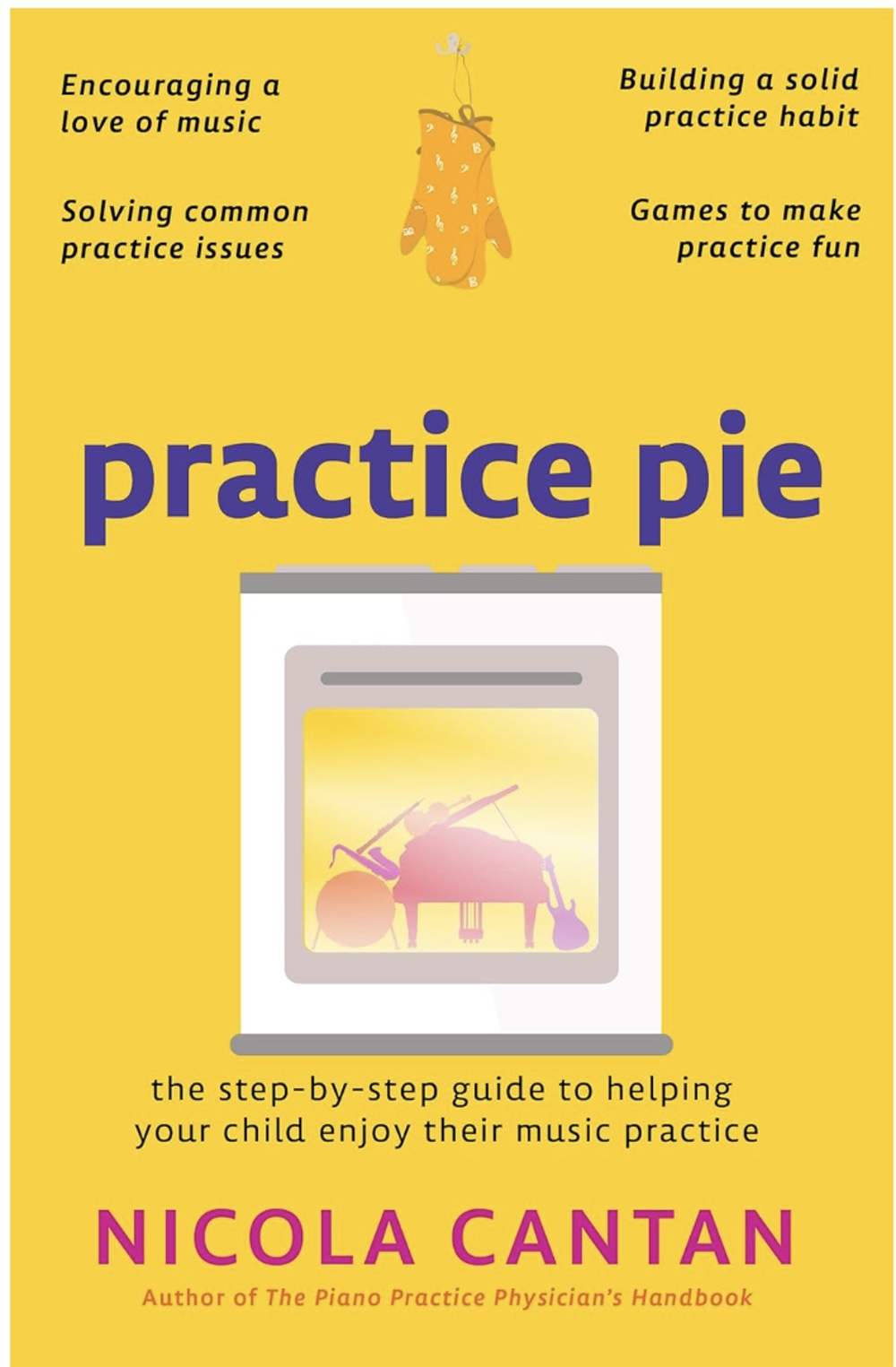
Practice Pie: The Step-By-Step Guide To Helping Your Child Enjoy Their Music Practice


Music practice arguments in families are seemingly so ubiquitous that it’s become a trope used in sitcoms. But it doesn’t have to be this way. Your child can have a wonderful experience with music and you can enjoy watching their progress without practice becoming a battlefield.

In Practice Pie, I’ll teach you how to support your child in their musical journey. I can’t promise it will be as easy as pie (but then, is pie really easy?) but I can promise to make it quick and practical, with a little humour thrown in for good measure.

You signed your child up for lessons because you wanted them to enjoy and appreciate music. You deserve a taste of that fun, too. Let’s get baking so we can take a bite of some delicious music practice pie!

Practice Pie is a charming and accessible book that teachers, parents and students will gain immense benefit from reading! It is full of wisdom and practical advice. I plan to make it required reading for all my piano families!
– Katherine Fisher, co-author of Piano Safari, pianosafari.com

“Learning to play an instrument takes practice and learning to practice takes practice. Nicola Cantan’s ‘Practice Pie’ is the perfect recipe for showing parents how to create tasty practice sessions at home with their children.”

– Shelly Davis, Piano Parent Podcast, pianoparentpodcast.com

5 Things Parents Should Do Before Driving To Piano Lessons

  1. Don’t Make Piano Lessons The Bad Guy: While not always possible, it is best if parents attempt to keep “Piano Lesson Day” as “Piano Lesson Day” only. They should avoid pulling their children away from another beloved activity, interrupting playdates, packing up from a picnic, leaving early from other extracurricular activities, and even abruptly turning off a favorite TV show. All of these situations cause children to feel as though they are missing out on something by attending piano lessons. If, however, piano lessons are the chosen activity for the day, they become the opportunity for fun and excitement.
  2. Don’t “Rush and Cram”: Parents should avoid having their children cram in a rushed practice session right before a piano lesson. Children won’t have adequate time for the practice session process, making their mistakes seem magnified under a ticking time-limit and causing stress. Children who haven’t already just spent 30 minutes at the piano at home are more focused students in lessons.
  3. Set Them Up For Success: Children who are well-rested and well-fed learn best. When possible, parents should allow after-school time for their children to decompress, eat a healthy, protein-filled snack and receive one-on-one parental attention. A physically, mentally and emotionally balanced child is a happy piano student.
  4. Keep Up With Current Events: Before leaving for piano lessons, parents should remind their children of all the fun things that will be happening in their lessons. To be able to accomplish this task, parents need to read their children’s lesson notes and weekly communications to gain insight into studio activities.
  5. Address Unrelated Anxieties: Unaddressed anxiety can be debilitating for a child and confusing for an uninformed teacher. If piano parents have children who experience separation anxiety, school-based stress, or family-related challenges, it is important that these issues are addressed prior to a piano lesson. Bringing calm and clear children to the studio is essential for musical development. And, if calm and clear children are not always a possibility, then piano parents should inform the teacher of problems and challenges so support and understanding is easier to provide.

Adapted from https://www.teachpianotoday.com/2018/03/19/5-things-piano-parents-should-do-before-driving-to-piano-lessons/

The best age to start piano lessons is now

child-piano


I think that parents are pulled in many directions when it comes to extracurricular activities and educational enrichment for children. Music is supposed to be fun. It’s not really meant to be your secret solution to passing math with flying colors one day. As long as parents maintain a patient approach to music lessons, children will see it as fun.

Music should always be fun, but it is a hard to learn. It does need to be taken seriously. A teacher has to know the right tone to use for each individual student. Some students respond to playful rewards, while others need a stern approach. Regardless, the expectation to pay attention and practice is necessary. Whether a child is a toddler or entering middle school, the basic process to learn music is the same – practice, practice, practice.

Smaller children, however, learn to sit still and listen. They also learn to retain information and ask for help from a grown-up. For preschool children, private lessons is a great first step to learning how to be a student. Private lessons are ideal, but if they are too expensive, many music schools and teachers offer group lessons for beginners as introduction courses.

The most important thing is to explore a child’s interest. Whether a child excels in their interest or not is irrelevant. They should still be given a chance to find something they love to do. With music, it could be a great source of expression for them throughout their lives, even if they are not interested in performing. That being said, the best time to start piano lessons for children is simply right now.

via The best age to start piano lessons is now | NJ.com.