It’s wedding season! Today and tomorrow, we’ll be looking at, and listening to, the music most associated with weddings.
The “Bridal Chorus” from the 1850 opera Lohengrin by German composer Richard Wagner is a march played for the bride’s entrance at many formal weddings throughout the Western world.
The piece was made popular when it was used as the processional at the wedding of Victoria the Princess Royal to Prince Frederick William of Prussia in 1858.
This piece is available in Keyboard Kickoff, Movement 2 and Piano Maestro.
The original from the opera
A piano version (this book is available for loan, if interested)
This is a more advanced piece but I really like it. Some students may have heard this since it’s an alarm tone on my phone. My dog, Mimi, recognizes this music as her signal to go out for a walk!
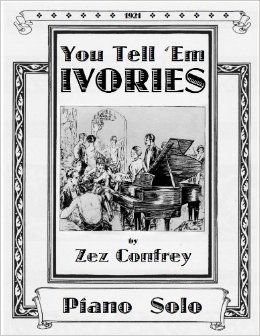
I just love Zez Confrey’s music. It’s not overplayed like some of Scott Joplin’s works but it’s just as much fun.
This is a piece I have often played in recitals and just for fun.
If any of my students are interested in tackling this piece, just let me know and we’ll start learning!
In 1921 Confrey wrote his novelty piano solo “Kitten on the Keys”, inspired by hearing his grandmother’s cat walk on the keyboard of her piano. It became a hit, and he went on to compose many other pieces in the genre.
Considered to be one of the fastest and most challenging of all “novelty” piano solos, “Dizzy Fingers” was composed in 1923. and was Confrey’s other biggest seller.
He left behind more than a hundred piano works, songs and miniature operas, and numerous piano rolls, music publications and sound recordings.
Not surprisingly, this piece is not available on Piano Maestro!
“This collection represents a cross-section of Confrey’s works and encompasses the broad range of his styles. Besides his famous 1920s novelty works (including Kitten on the Keys), there are many wonderful, lesser-known gems of remarkable quality included here from later in his career. Appearing for the first time in print are transcriptions of one of his disc recordings (Poor Buttermilk) and two of his player piano roll arrangements (My Pet and Humorestless). Many of Confrey’s later works have long been out of print and are included here for the first time in decades.”
Today, we’ll be listening to the end of the William Tell Overture by Gioachino Rossini. This piece, originally the overture to an opera, has been arranged for piano and is in several method books, including Piano Pronto Movements 1 and 2. It’s also in Bastien Book 4 and Piano Maestro.
The original story
Maybe your grandparents watched the original Lone Ranger
Or you saw the newer Lone Ranger with Johnny Depp
Here’s the entire William Tell Overture played by an orchestra
Piano Solo
Franz Liszt made a really hard version for piano solo. See if you can follow along!
Piano Duet (1 piano, 4 hands)
Piano Duet arranged by Louis Moreau Gottschalk
Piano Duo (2 pianos, 8 hands)
Piano Quartet (4 pianos, 16 hands)
For pipe organ
For synthesizer
And then things get nuts with cartoons. Lots of cartoons used this music. Here are Mickey Mouse and friends
And Spike Jones
Handbells…
Poor Rossini – I think he’d have a fit if he knew how is music was being used.
I’m sure many have you have learned Twinkle, Twinkle Little Star by now. Did you know its’ the same melody as the ABC Song? You know…
Don’t believe it? Sing them both in your head or out loud.
The French melody first appeared in 1761, and has been used for many children’s songs, such as “Twinkle, Twinkle, Little Star”, “Baa, Baa, Black Sheep” and the “Alphabet Song”.
This is one of the first pieces a student learns in piano methods, since it has them reach just a bit outside their accustomed hand position on the word “little”.
I try to remember to let students know that Wolfgang Amadeus Mozart composed a set of twelve variations on the theme “Ah, vous dirai-je, Maman” for the piano and it started as the same basic Twinkle tune.
The sheet music is available at the O’Connor Music Studio if you want to borrow it or download it here about 1/3 of the way down the page under “Scores”.
I always enjoy these graphical scores. Watch the colors as the melody gets more and more complex:
This is the month for graduations of all sorts, college, high school, even preschool. Perhaps you know someone who is graduating this year. Maybe it’s you!
This piece by Sir Edward Elgar is called Pomp and Circumstance and usually heard at graduations. It was featured in Disney’s Fantasia 2000.
Edward Elgar’s father was a musician who tuned pianos, owned a music shop and was employed as a church organist. The young Edward learned to play the organ and violin at a young age and composed his first short piece at the age of 10. His first job was as assistant organist to his father. His main love was composition, although his music was not successful until his Enigma Variations were published in 1899. This work made him famous.
Until Elgar, there had not been a major creative composer in England since Handel’s death in 1759. He became known as England’s greatest composer and was widely recognized in his day. Unfortunately, Elgar’s fame waned at the end of his life – he composed little music during his last fifteen years and withdrew from almost all musical contact. It was not until the 1960’s that his music again became popular.
Today, we start with Spring from the Four Seasons by Vivaldi. Many OCMS students have played this already in one of their Piano Pronto books. It’s also available in Piano Maestro.
If you have it in your piano book, today would be a great day to review it. (HINT – there might be a quick review at your next lesson!)
Vivaldi was born in Venice, Italy, March 4, 1678 and spent most of his life there. His father taught him to play the violin, and the two would often perform together.
He taught at an orphanage for girls and wrote a lot of music for the girls to play. People came from miles around to hear Vivaldi’s talented students perform the beautiful music he had written.
Many people think Vivaldi was the best Italian composer of his time. He wrote concertos, operas, church music and many other compositions. In all, Antonio wrote over 500 concertos.
His most famous set of concertos is The Four Seasons which is a group of four violin concerti. Each of which gives a musical expression to a season of the year. They were written about 1721 and were published in 1725 in Amsterdam.
Here’s a piano version similar to the one in Movement 1 but in a different key.
And the original with Itzhak Perlman playing and conducting!
Want to play a version of this but aren’t using these books? Just ask!
As all my students know, I teach theory with all piano and organ lessons. Sometimes, it’s from a theory book that matches a lesson book, sometimes on the fly on an “as needed” basis.
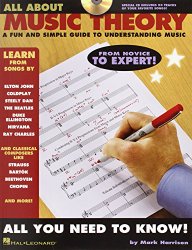
This book looks like it would be interesting to use as a review or to look ahead and see what’s coming. I have just ordered a copy for the studio if you want to check it out at the next lesson.
If you wish there was a fun and engaging way to help you understand the fundamentals of music, then this is it. Whether it’s learning to read music, understanding chords and scales, musical forms, or improvising and composing, this enjoyable guide will help you to finally start understanding the structure and design of music.
This fun-filled, easy-to-use guide includes:
* Music notation
* Scales and modes
* Melody harmonization and counterpoint
* Chord progressions
* Song form and structure
Listen and learn with the CD that has 90 tracks, including over 50 popular songs such as:
* Beauty and the Beast
* Candle in the Wind
* Imagine
* In the Air Tonight
* Killing Me Softly with His Song
* Let It Be
* Message in a Bottle
* Misty
* Satin Doll
* Take the ‘A’ Train
* Unchained Melody
* What’d I Say
* and more!
Since the first release of this classic Schirmer edition over 100 years ago, almost anyone who has taken piano lessons for more than two years has played from The Virtuoso Pianist.
Most anyone who has ever played piano has a love-hate relationship with the “Hanon”.
The Virtuoso Pianist (Le Pianiste virtuose) by Charles-Louis Hanon, is a compilation of sixty exercises meant to train the pianist in speed, precision, agility, and strength of all of the fingers and flexibility in the wrists.
First published in Boulogne, in 1873, The Virtuoso Pianist is Hanon’s most well-known work, and is still widely used by piano instructors and pupils although some teachers are getting away from the mechanical playing these can produce.
Personally, I’ve sometimes played these on “auto-pilot” since all one really needs is to get the first pattern going, then move up a step, up a step…
Notes by C. L. Hanon: Preparatory exercises for the Acquirement of Agility, Independence, Strength and Perfect Evenness in the Fingers. For studying the 20 exercises, begin with the metronome set at 60, gradually increasing the speed up to 108.
The exercises are intended to address common problems which could hamper the performance abilities of a student. These include “crossing of the thumb”, strengthening of the fourth and fifth fingers, and quadruple- and triple-trills.
The exercises are meant to be individually mastered and then played consecutively in the sections they are placed in.
Apart from increasing technical abilities of the student, when played in groups at higher speeds, the exercises will also help to increase endurance. The exercises are divided in three parts:
Exercises 1 – 20: Labeled “preparatory exercises”, these are also the most famous exercises, and are used to develop finger strength and independence. Each exercise contains a sequence of 8 semiquavers, beginning on C, which is then repeated starting on D, and so on across two octaves. The exercise is then repeated in reverse down two octaves to the starting C. The exercises are intended to be practiced in groups of three, except for the first two which are practiced together.
Exercises 21 – 43: Labeled “further exercises for the development of a virtuoso technique.” This more difficult section is meant to be played after the pianist has fully mastered Part 1. Part 2 includes scales and arpeggios.
Exercises 44 – 60: Labeled “virtuoso exercises for mastering the greatest technical difficulties.” Since this section is considerably more difficult, Hanon recommends the mastery of both previous parts before proceeding to this one. This part includes repeated notes,, and more.
After all three parts are mastered, Hanon recommends all exercises be played through daily to retain technique.
The O’Connor Music Studio has several editions of this work, including:
Hanon: The Virtuoso Pianist in Sixty Exercises, Complete. Since the first release of this classic Schirmer edition over 100 years ago, almost anyone who has taken piano lessons for more than two years has played from The Virtuoso Pianist . Millions of copies have been sold of these progressive exercises which guide a player’s technique, building finger independence and strength. This was the first American edition released of this music, and remains a classic at a remarkably affordable price.
Junior Hanon (Alfred Masterwork Edition). A slight condensation of Hanon’s first exercises. The simplification in layout and range make the exercises appear less difficult to a young student. Includes the complete Book 1 and excerpts from Books 2 & 3 of C. L. Hanon’s famous studies, The Virtuoso Pianist in 60 Exercises.
Hanon for Students, Bk 1: 6 Varied Exercises from The Virtuoso Pianist for Late Elementary Pianists. Hanon for Students, Book 1, contains the first six exercises from The Virtuoso Pianist, Book 1. The exercises are notated in eighth notes for one octave so that students may begin to use them effectively at the late-elementary level. Each exercise appears five times to be played with a legato touch, varied articulation, varied dynamics, varied rhythm, and transposed to F or G.
Jazz Hanon. Inspired by Charles-Louis Hanon’s The Virtuoso Pianist the essential technical method for any classical player these new volumes present a modern-day equivalent for the musician seeking to play the key piano styles of the 20th century. Each book develops basic technique and true facility in each genre through authentic, progressive exercises and etudes. The music in these books is fun to play for pianists at every level, building the necessary skills in each style while providing extensive musical and stylistic insight.
I have a copy of this music (Faerie’s Aire and Death Waltz) if anyone is interested in playing it!
The music above has been played:
The drive you need to accomplish whatever you’re attempting—big or small—needs fuel. Instead of letting slip-ups set you back, psychologist and author John Norcross recommends you make them the fuel:
“If you are learning to play the piano, you don’t give up because you miss a note. It’s not whether you slip, it’s how you respond to the slip.“
Cut yourself some slack and remember that things take time and hard work. Listen to the sound of your “missed note” and let that push you forward. You missed that note yesterday, but that doesn’t mean you’ll miss it today.






 MaryO'Studio