Why is Theory Important for Piano Students?

Music_Theory


Students at the O’Connor Music Studio know that music theory is always a part of lessons.  I strongly believe that theory is needed so that students understand what they are playing and why.

To me, theory work is just as important as playing.  A firm knowledge of musical structure makes playing everything easier.

Music knowledge learned through piano lessons transfers easily to other  musical activities.  Students in Fairfax County Public Schools, students learn to play recorder.  Students are sometimes surprised to learn that they already know all the notes – from their piano lessons!

When you sing in a choir, harmonize with Sweet Adelines, play an instrument in your school or community band/orchestra, join your church’s handbell choir (note:  Pender UMC has an excellent Handbell program), teach yourself guitar – theory will help in every instance. By learning to read, write, and understand this musical language, many more musical opportunities will be made available the rest of your life.

Most piano methods come with a theory book that matches page by page what concepts are being learned in the lesson books.  I actually recommend that students do the theory first when they get home, while the concepts are still fresh in their minds.

If the student is not in a piano method, I’m starting to use the Theory Time series.  Book One covers music alphabet, introduction to keyboard and staff, stem rule, steps & skips on a keyboard and staff, repeated notes, dynamics, treble clef lines & spaces, bass clef lines & spaces, quarter note & rest, half note & rest, whole note & rest, dotted half note, bar lines, double bar line, measures, time signatures, rhythm drill, vocabulary, ear training and a review test. Free ear training videos for each ear training exercise are hosted on the Theory Time YouTube channel. The Grade One workbook is appropriate for beginning 1st, 2nd or 3rd grade students. This workbook includes 51 pages, 13 lessons and 8 Fun Sheets.

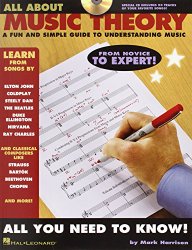
For adults and more advanced students, I have a copy of All About Music Theory: A Fun and Simple Guide to Understanding Music which can be used as a review or a “try before buy”.

Stop procrastinating and go do your theory!

February 19 ~ Today in Music History

today

. Luigi Boccherini, Italian composer
More information on Boccherini

boccherini-minuet

. 1878 ~ Thomas Alva Edison, famed inventor, patented a music player at his laboratory in Menlo Park, NJ. This music device is the one we know as the phonograph. Edison paid his assistant $18 to make the device from a sketch Edison had drawn. Originally, Edison had set out to invent a telegraph repeater, but came up with the phonograph or, as he called it, the speaking machine.

. 1902 ~ John Bubbles (John William Sublett), An actor: Porgy and Bess (1935 Broadway version), films: Cabin in the Sky, Variety Show, A Song Is Born, No Maps on My Taps; dancer: credited with creating ‘rhythm tap’

. 1912 ~ Stan Kenton, American jazz pianist, composer and Grammy Award-winning bandleader

. 1927 ~ Robert Fuchs, Austrian composer and music teacher. As Professor of music theory at the Vienna Conservatory, Fuchs taught many notable composers, while he was himself a highly regarded composer in his lifetime.

. 1940 ~ “Smokey” Robinson, American rhythm-and-blues singer and songwriter

. 1942 ~ If there was ever such a thing as a jam session, surely, this one was it: Tommy Dorsey and his orchestra recorded I’ll Take Tallulah (Victor Records). Some other musical heavyweights were in the studio too, including Frank Sinatra, Jo Stafford and the Pied Pipers, Ziggy Elman and drummer extraordinaire, Buddy Rich.

. 1981 ~ George Harrison was ordered to pay ABKCO Music the sum of $587,000 for “subconscious plagiarism” between his song, My Sweet Lord and the Chiffons early 1960s hit, He’s So Fine.

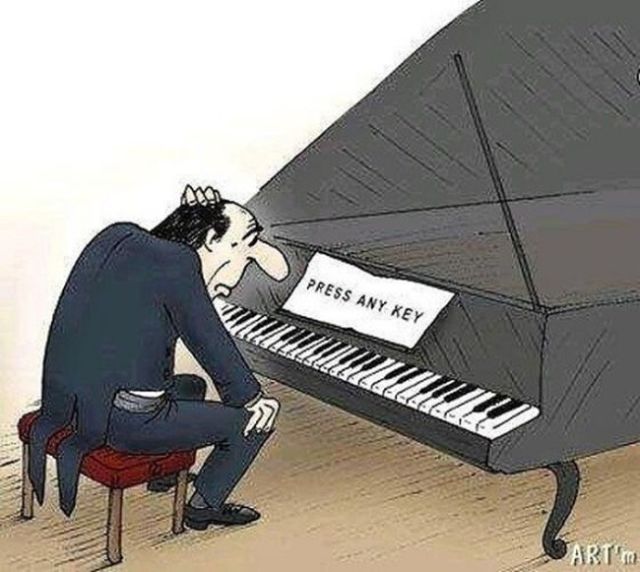
Some Music Humor :)

any-key


So a C, an E-flat and a G walk into a bar. The bartender says, “sorry, but we don’t serve minors.” So E-flat leaves, and C and G have an open fifth between them. After a few drinks, the fifth is diminished and G is out flat. F comes in and tries to augment the situation, but is not sharp enough.

A D comes in and heads for the bathroom saying, “Excuse me. I’ll just be a second.” Then A comes in, but the bartender is not convinced that this relative of C is not a minor. Then the bartender notices B-flat hiding at the end of the bar and says, “Get out! You’re the seventh minor I’ve found in this bar tonight.”

E-Flat comes back the next night in a three-piece suit with nicely shined shoes. The bartender says, “you’re looking sharp tonight. Come on in, this could be a major development.” Sure enough, E-flat soon takes off his suit and everything else, and is au natural. Eventually, C, who had passed out under the bar the night before, begins to sober up and realizes in horror that he’s under a rest.

So, C goes to trial, is convicted of contributing to the diminution of a minor and sentenced to 10 years of DS without Coda at an up scale correctional facility. The conviction is overturned on appeal, however, and C is found innocent of any wrongdoing, even accidental, and that all accusations to the contrary are bassless.

The bartender decides, however, that since he’s only had tenor so patrons, the soprano out in the bathroom and everything has become alto much treble, he needs a rest and closes the bar.


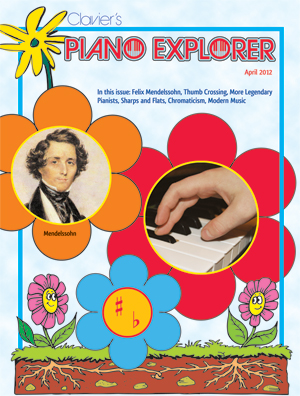
Piano Explorer ~ October 2015

piano-explorer


Each month, young students will receive a copy of Piano Explorer magazine.  It is available to adults, on request.

Included are

Composer biographies
• Music history
• Instruments
• Theory, practice tips, composing ideas
• Beginner’s Corner
• Music Corner (featuring student compositions)

Colorful pictures, timelines, and maps capture students’ attention. At the end of each magazine is a quiz to test students’ comprehension of the material. Games, puzzles, riddles, and student contributions round out the magazine and keep things fun.

Additional Features: Check out our website for additional material. The student page includes links to music mentioned in the issue, additional quizzes, and other interesting information.

The October issue includes information about

  • Franz Schubert
  • Practice tips
  • Dynamics
  • Voice
  • E Major
  • Antonio Salieri

Please note that students will have assignments from each issue.

Free Today! Music Theory in One Lesson: Discover How Easy Music Theory Can Be!

music-theory-1-lesson


Music Theory in One Lesson was developed to make music theory more approachable than ever before. This book is packed and carefully formatted with rich, easy to understand diagrams. The use of space and visual learning really sets this book apart from the rest. The ability to read music is not required at any point in this book, so anyone can learn! The book is short and sweet, giving you the tools necessary to explore music in any direction you please.

Audio Examples are provided on the Music Theory in One Lesson website.

“As a music major, I’ve had to complete four semesters of college music theory. I can honestly say that in those four semesters I did not learn, much less understand, a fraction of what I did reading Music Theory in One Lesson. Each topic is expertly condensed and explained in a refreshing and enlightening way. This text takes all the pain so typically associated with learning music theory and replaces it with one exciting ‘Eureka!’ after another. I highly recommend it.”

— Therese Carmack

Finding The Right Teacher

NOT Mrs. O'Connor!

NOT Mrs. O’Connor!

See if a prospective teacher allows a trial lesson to test how the personalities mesh. And be sure to ask lots of questions. What’s the teacher’s background as a musician and as an instructor? What kinds of teaching materials and music does she use? How much practice time is expected for students, and does that vary by the student’s age? Does the teacher have access to student ensembles? What kinds of performance opportunities will he provide? Will the teacher allow the student to record the lesson? This can be a terrific practice aid, especially when it comes to remembering how something is supposed to sound. Does she teach any music theory or composition? What are the expectations for students and for their parents?

A good teacher can be a friendly, encouraging and inspiring presence — even when a student hits rough patches. He will point out the student’s weaknesses without being harsh or dismissive, suggest innovative ways to overcome challenges, and create engaging ways to tackle even rote activities like playing scales or honing fine motor skills. The instructor’s age and experience might or might not be a deciding factor; for example, I’m consistently impressed by the range of tricks my own child’s very youthful private teacher has up her sleeve to turn what could easily be drudgery into fun. Not to mention the huge helpings of good humor and patience she brings to her tiny charges!

Read more at Finding The Right Teacher For Your Music-Loving Kid : Deceptive Cadence : NPR.

Why Work on Music Theory?

Music_Theory


Students at the O’Connor Music Studio know that music theory is always a part of lessons.  I strongly believe that theory is needed so that students understand what they are playing and why.

To me, theory work is just as important as playing.  A firm knowledge of musical structure makes playing everything easier.

Music knowledge learned through piano lessons transfers easily to other  musical activities.  Students in Fairfax County Public Schools, students learn to play recorder.  Students are sometimes surprised to learn that they already know all the notes – from their piano lessons!

When you sing in a choir, harmonize with Sweet Adelines, play an instrument in your school or community band/orchestra, join your church’s handbell choir (note:  Pender UMC has an excellent Handbell program), teach yourself guitar – theory will help in every instance. By learning to read, write, and understand this musical language, many more musical opportunities will be made available the rest of your life.

Most piano methods come with a theory book that matches page by page what concepts are being learned in the lesson books.  I actually recommend that students do the theory first when they get home, while the concepts are still fresh in their minds.

If the student is not in a piano method, I’m starting to use the Theory Time series.  Book One covers music alphabet, introduction to keyboard and staff, stem rule, steps & skips on a keyboard and staff, repeated notes, dynamics, treble clef lines & spaces, bass clef lines & spaces, quarter note & rest, half note & rest, whole note & rest, dotted half note, bar lines, double bar line, measures, time signatures, rhythm drill, vocabulary, ear training and a review test. Free ear training videos for each ear training exercise are hosted on the Theory Time YouTube channel. The Grade One workbook is appropriate for beginning 1st, 2nd or 3rd grade students. This workbook includes 51 pages, 13 lessons and 8 Fun Sheets.

For adults and more advanced students, I have a copy of All About Music Theory: A Fun and Simple Guide to Understanding Music which can be used as a review or a “try before buy”.

Stop procrastinating and go do your theory!

All About Music Theory: A Fun and Simple Guide to Understanding Music

theory


As all my students know, I teach theory with all piano and organ lessons.  Sometimes, it’s from a theory book that matches a lesson book, sometimes on the fly on an “as needed” basis.

This book looks like it would be interesting to use as a review or to look ahead and see what’s coming.  I have just ordered a copy for the studio if you want to check it out at the next lesson.

From amazon.com:

 If you wish there was a fun and engaging way to help you understand the fundamentals of music, then this is it. Whether it’s learning to read music, understanding chords and scales, musical forms, or improvising and composing, this enjoyable guide will help you to finally start understanding the structure and design of music.

This fun-filled, easy-to-use guide includes:
* Music notation
* Scales and modes
* Melody harmonization and counterpoint
* Chord progressions
* Song form and structure

Listen and learn with the CD that has 90 tracks, including over 50 popular songs such as:
* Beauty and the Beast
* Candle in the Wind
* Imagine
* In the Air Tonight
* Killing Me Softly with His Song
* Let It Be
* Message in a Bottle
* Misty
* Satin Doll
* Take the ‘A’ Train
* Unchained Melody
* What’d I Say
* and more!

maryOivoryandroses

‘Seymour’: Ethan Hawke Makes an Introduction

sbernstein

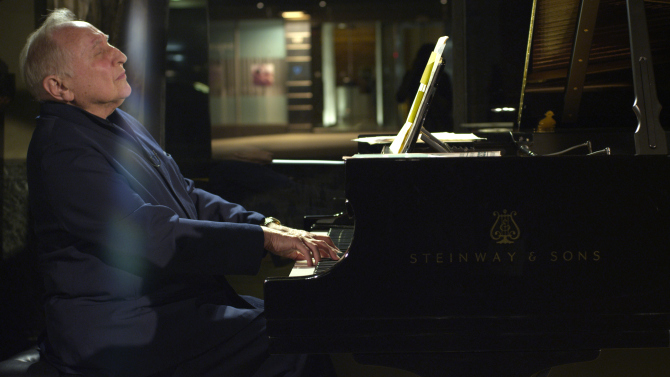
Seymour Bernstein might have ranked alongside such classical pianists as Alfred Brendel and Van Cliburn. His recitals were glowingly reviewed and he had a highly supportive patron. Yet, at the significant age of 50, he voluntarily withdrew from the world of public performance to concentrate on teaching.

When it comes to piano technique and music theory, he clearly has much to offer. But he also has insight into how one best pursues an artistic career in general, or at least that is what one future Oscar nominee thought when he happened to meet Bernstein at a dinner party. The music teacher gets a low-key but satisfying ovation in Ethan Hawke’s documentary profile, “Seymour: An Introduction.”

Evidently, Hawke found in Bernstein an empathetic counselor-guru who could well understand his bouts of stage fright and the general career uncertainty that was plaguing him. Perhaps he was also frustrated about that film he had spent over 10 years on, but had yet to come out. Regardless, Bernstein had a knack for saying reassuring things.

In a variety of master classes and private lessons, we observe Bernstein at work. He is indeed a calm and constructive instructor, but also firm and specific. If you have the talent, he will refine it. Should you doubt it, several of his former students, including pianists Joseph Smith and Kimball Gallagher, offer their reminiscences and insights into Bernstein’s lasting influence on their careers.

For his documentary directorial debut, Hawke was not out to rake any muck. While not exactly hagiography, his “Introduction” is unflaggingly nice and polite. Fortunately, Bernstein is a New Yorker (albeit a really pleasant one), whose experienced, down-to-earth personality keeps it all real and grounded.

Anyone who knows pianos will not be surprised to see the prime placement for American Steinway in “Seymour.” As always, their concert models look and sound lovely. It is also cool to see that they still consider Bernstein a Steinway artist 30-some years after his last public performance. Fittingly, Hawke coaxes Bernstein into a return performance in the Steinway Rotunda on 57th Street, which naturally serves as the closing sequence for the film. Obviously, he still has his touch.

“Seymour: An Introduction” has surely received considerably more attention because of Hawke’s involvement than it otherwise would have, but that is a fine way for him to spend some of his accrued “Boyhood” and “Before Midnight” capital in a way that will generate further good will. It is a very refined and civilized film that will probably have a number of viewers checking out YouTube for Bernstein’s original compositions. (He has a number of them posted, including “The Hawke.”)

Respectfully recommended for classical connoisseurs, Hawke fans, and Steinway admirers, the Salingerishly titled “Seymour: An Introduction” opens this Friday, March 13, in New York at the IFC Center.

From ‘Seymour’: Ethan Hawke Makes an Introduction.