The 62,000-strong audience claps politely when Simon Rattle and the London Symphony Orchestra strike up Vangelis’s Chariots of Fire theme – but their roar of approval when the cameras pan to an unexpected keyboard soloist is nothing short of heartwarming.
A global television audience of 1 billion+ also loved Rowan Atkinson’s side-splitting performance as Mr Bean, if the subsequent YouTube hits are anything to go by.
Students at the O’Connor Music Studio know that music theory is always a part of lessons. I strongly believe that theory is needed so that students understand what they are playing and why.
To me, theory work is just as important as playing. A firm knowledge of musical structure makes playing everything easier.
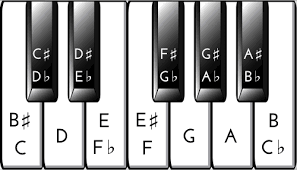
Music knowledge learned through piano lessons transfers easily to other musical activities. Students in Fairfax County Public Schools, students learn to play recorder. Students are sometimes surprised to learn that they already know all the notes – from their piano lessons!
When you sing in a choir, harmonize with Sweet Adelines, play an instrument in your school or community band/orchestra, join your church’s handbell choir (note:Pender UMC has an excellent Handbell program), teach yourself guitar – theory will help in every instance. By learning to read, write, and understand this musical language, many more musical opportunities will be made available the rest of your life.
Most piano methods come with a theory book that matches page by page what concepts are being learned in the lesson books. I actually recommend that students do the theory first when they get home, while the concepts are still fresh in their minds.
If the student is not in a piano method, I’m starting to use the Theory Time series. Book One covers music alphabet, introduction to keyboard and staff, stem rule, steps & skips on a keyboard and staff, repeated notes, dynamics, treble clef lines & spaces, bass clef lines & spaces, quarter note & rest, half note & rest, whole note & rest, dotted half note, bar lines, double bar line, measures, time signatures, rhythm drill, vocabulary, ear training and a review test. Free ear training videos for each ear training exercise are hosted on the Theory Time YouTube channel. The Grade One workbook is appropriate for beginning 1st, 2nd or 3rd grade students. This workbook includes 51 pages, 13 lessons and 8 Fun Sheets.
My piano teacher friend, Michelle, posted pictures of her students the other day. Apparently, they participated in some type of competition/recital, and with pride their teacher shared the results.
They stood smiling into the camera each holding a certificate that announced his or her status in the competition. Seeing them brought back my own memories of piano lessons and recitals. I smiled as I looked into the bright faces of those talented young people.
When I was a kid I wanted nothing more than to learn to play the piano. I had a favorite aunt who played so well and my daddy played by ear better than some folks who read music.
Oh yes, I imagined myself sitting at the keyboard, fingers flying while the family sang along to some favorite hymn or Christmas carol. Daddy would grin with pride and maybe join in playing his harmonica.
It was lovely dream. There was only one little glitch in this plan. I needed lessons in order to make it come true.
So, my parents signed me up with Mrs. Simmons who lived across the street. She was one of the best piano teachers in town and lucky me, all I had to do was cross the street for my lessons.
I’m not sure what I expected, but it was with great disappointment I realized I was not going to produce a beautiful song after only one lesson. Heck, I wasn’t going to produce much more than a repetitive playing of the scales after several lessons.
I recited, Every — Good — Boy — Does — Fine, All — Cars — Eat — Gas, FACE, GBDFA to help me remember the treble and clef lines and spaces. And I played the notes over and over until the sand in the hourglass timer told me it was time to stop. (I’m pretty sure Mother was overjoyed when that last piece of sand fell through the hole.)
When I finally got to the point of making a noise that sounded like something musical, it was, if I remember correctly, a little ditty about a frog — not exactly the moving hymn I imagined playing.
Eventually, I progressed to playing an entire piece of music. That meant I was ready to take part in the annual piano recital. I’d love to say I was excited at the prospect of publicly showing the great strides I’d made in piano playing. In truth, I was more excited about getting to wear an evening gown and lipstick.
For three years, I stuck with the lessons and with the practicing. For three years, I showed up for the recital and played the piece my teacher assigned. I have a picture of myself seated at the piano in my parents’ living room on the night of one of those recitals.
My hair is a perfect flip and I’m wearing a white gown that I imagined made me look like a cross between an angel and a fairy. I have my hands resting on the keys and I’m smiling into the camera like some diva about to launch into a classical masterpiece.
At some point, (probably had something to do with being a teenager and boys) I let go of my dreams of tickling the ivories. I did learn one Christmas carol, which my family heard until they were pretty much sick of it.
As I looked at Michelle’s students holding their certificates, I thought about the dedication it took for them to play so well. I also thought about all those teachers, like my friend and like Mrs. Simmons, who have the calling and the incredible patience it takes to try to teach another human to play a piano, especially when the student is not realistic about what it takes to master the instrument and more interested in evening gowns.
The thought-provoking talk on February 10th was given by Keith Pascoe, second violinist of the Vanbrugh Quartet, in connection with tomorrow night’s violin and piano recital by Ray Chen and Julien Quentin. Pascoe came up with a great title, David and Goliath, The Ballet of Unequals: A Stradivari and Model D Steinway Recital. Using videos from YouTube as illustrations (which unfortunately allowed in snippets of a couple of unwanted advertisements), Pascoe began at the beginning, with the emergence of the piano and violin as instruments in their own right, and traced some of the changes they have both undergone in the centuries since.
The piano has become bigger, stronger and louder. Not only were extra notes added to the keyboard, but the early wooden frames were replaced with cast iron. The violin may not have grown externally, but the shape of the body was remoulded, the neck and fingerboard realigned, and internal buttressing extended, all with the intention of producing greater sound.
What composers did with the combination of violin and piano – and before that, violin and harpsichord – changed too. In the typical baroque violin sonata, the violin was to the fore. In the classical era, the roles were reversed, although this reversal has long been dishonoured by performers. And in the 19th century, the balance as we know it today began to take hold. That balance usually presents the two performers in a master-servant relationship, the violinist usually the boss whose bidding is carried out by the pianist.
. 1922 ~ Betty White, Emmy Award-winning actress on The Mary Tyler Moore Show, singer
. 1926 ~ Moira Shearer, Ballerina
. 1927 ~ Eartha Kitt, Singer. Kitt’s birth certificate listing her actual birthdate as 1/17/27 was found in 1997. She has celebrated her birthday as Jan. 26 (1928) all of her life and says, “It’s been the 26th of January since the beginning of time and I’m not going to change it and confuse my fans.”
. 1941 ~ Gene Krupa and his band recorded the standard, Drum Boogie, on Okeh Records. The lady singing with the boys in the band during the song’s chorus was Irene Daye.
. 1944 ~ Chris Montez, Singer
. 1948 ~ Mick Taylor, Singer, rhythm guitar with The Rolling Stones
. 1955 ~ Steve Earle, Songwriter, singer, guitar
. 1956 ~ Paul Young, Singer
. 1959 ~ Susanna Hoffs, Singer, guitar with The Bangles
. 1960 ~ John Crawford, Singer, bass with Berlin
. 1969 ~ Lady Samantha, one of the very first recordings by Reginald Kenneth Dwight (aka Elton John), was released in England on Philips records. The song floundered, then bombed. The rock group, Three Dog Night, however, recorded it for an album.
. 2001 ~ Pianist and singer Emma Kelly, the “Lady of 6,000 Songs” made famous by the book “Midnight in the Garden of Good and Evil,” died from a liver ailment at the age of 82. Kelly’s nightclub act, in which she tapped her vast repertoire of American popular standards five nights a week until she became ill a month ago, was a must-see for Savannah tourists itching to meet a real-life character from author John Berendt’s Southern Gothic best seller. Though the book helped her book performances from New York to Switzerland, Kelly continued to crisscross south Georgia to play church socials and high school graduations, Kiwanis luncheons and wedding receptions. Berendt devoted an entire chapter to Kelly in the 1994 book, describing her as a teetotaling Baptist who would play smoky cocktail lounges Saturday nights and Sunday school classes the next morning. Kelly performed at her own nightclub, Emma’s, in Savannah, for five years in the late 1980s. She then bounced between lounges near the downtown riverfront. She also independently recorded three albums, the last of which were released posthumously, her son said.
. 2001 ~ Jazz musician, composer and conductor Norris Turney, who played alto sax and flute with the Duke Ellington Orchestra and led the Norris Turney Quartet, died of kidney failure at the age of 79. Turney recorded with a number of bands over the years, and toured with BillyEckstine, Ray Charles and others. He was an original member of the LincolnCenterJazz Orchestra directed by Wynton Marsalis. Turney’s lone CD as a band leader, “Big, Sweet ‘N Blue,” was warmly received by jazz critics.
. 2002 ~ Edouard Nies-Berger, the veteran organist and protege of AlbertSchweitzer, died at the age of 98. Nies-Berger, who played with the New York Philharmonic, was a native of Strasbourg in Alsace. His father, a church organist, was an associate of Schweitzer. The doctor, philosopher and Nobel laureate was pastor of a nearby church where the teen- age Nies-Berger played occasionally. Nies-Berger moved to New York in 1922 and for the next 15 years played the organ in houses of worship across the country. By the mid-’30s he settled in Los Angeles and performed in the soundtracks of several films, including “The Bride of Frankenstein” and “San Francisco.” He returned to Europe in 1937 to study conducting with Bruno Walter in Salzburg, Austria. After conducting for two years in Latvia and Belgium he returned to the United States. He was named organist of the New York Philharmonic, where he played under the direction of such conductors as Walter, George Szell and Leonard Bernstein. Nies-Berger was reunited with Schweitzer in 1949, when the humanitarian visited the United States. For six years they collaborated on the completion of Schweitzer’s edition of the organ music of Johann Sebastian Bach. After serving at St. Paul’s in Richmond, Nies-Berger returned to Europe for several years to perform as a recitalist and write several books, including a memoir of Schweitzer. In 1991 he was awarded the gold medal of the Art Institute of Alsace, and in 1993 was named a knight of the arts and letters by the French Ministry of Education and Culture.
Jim Vogelman, President of JMV Classics, a Florida-based piano design company that specializes in creating unique, custom art case pianos, offers helpful tips on piano maintenance:
Maintaining one’s piano may also help maintain one’s well-being
Recent studies show that active participation in music learning can preserve a person’s mental and physical health, so whether playing or listening to the piano during the holidays, one can expect to experience the joy of the instrument as well as the joy of the season.
Tuning: The amount of tuning depends on use and environment. We advise that a new or restrung piano may take up to four to six tunings during the first year, but in general, it’s best to have it tuned at least twice a year. A good rule of thumb is to tune when the seasons change. If planning for a professional pianist at a holiday party, be sure the piano is well tuned and in good working order.
Polish: If the piano has been protected using a high gloss finish, dust with a soft, dry cloth, free of chemicals. Use a cloth dipped in mild dish soap and water to clean, but wring the cloth tightly and follow with a dry, soft cloth. For satin finish, dust with a soft, dry chemical-free cloth. Any high quality polish or lemon oil can be used as a wood preserving step, especially if holiday cheer might be spilled during the festivities. For the hand painted finish of an art case piano, we recommend employing a highly skilled, professional art cleaner, as these finishes can be as delicate and important as any fine work of art and as treasured as any museum quality piece.
The Keys: Keep keys dust free, but clean only when necessary, using a moist cloth, then immediately wipe dry. Never spray keys with a commercial cleaner–too much moisture may cause the wood to swell. This season, best to keep children’s sticky fingers or hands heavy with hors d’oeuvres at bay!
Humidity: Humidity is perhaps the single most potentially destructive climate challenge for a piano. Damp chasers only work when the piano lid is closed. For areas where high humidity is a way of life, air conditioning or a dehumidifier in a closed space is always the best solution, especially if used on a regular basis. Once a month, open the piano lid for a few days while the A/C is running to allow for dry air circulation. In dry weather, open the lid and the windows, allowing fresh flowing air to circulate around the piano.
Maintaining one’s piano may also help maintain one’s well-being,” Vogelman says. “Recent studies show that active participation in music learning can preserve a person’s mental and physical health, so whether playing or listening to the piano during the holidays, one can expect to experience the joy of the instrument as well as the joy of the season.”
Even these days, when cheap secondhand pianos are in plentiful supply, having been tossed aside to make way for compact, sophisticated keyboards, not many people can brag about owning a Steinway. Fewer own one that’s not worth bragging about. And then there’s the guy who actually went out of his way to buy one that’s not worth bragging about.
So gather ’round my 133-year-old Steinway upright, and hear a little ditty about a man with a laptop, a rental van and impulse-spending issues.
My tune is not quite a dirge, I suppose, since this piano is actually an improvement on the troll it displaced from my living room. But I’d have endured far less angst, and gotten more piano for my money, if I had listened to the experts before leaping at my “bargain” discovery…
The following ornament table is a transcription of the one appearing in the Clavier-Büchlein vor Wilhelm Friedemann Bach, written by Johann Sebastian Bach for the keyboard instruction of his eldest son.
A scan of the original manuscript appears at Dave’s J.S. Bach Page.
The German title translates as “Explanation of various signs, showing how to play certain ornaments correctly.”{1} Bach gives the sign for each ornament on the upper of the paired staves, while the lower shows its execution directly beneath.
(This blog has) simply modernized the clefs in my transcription, since Bach’s manuscript uses soprano clefs, as several composers continued to do throughout the 18th century in place of the treble clef now used in all keyboard music.
After the transcription graphic showing the table, there appear clickable buttons which are keyed to AU sound files; you can click on any of the ornaments and hear a sound file play its execution.
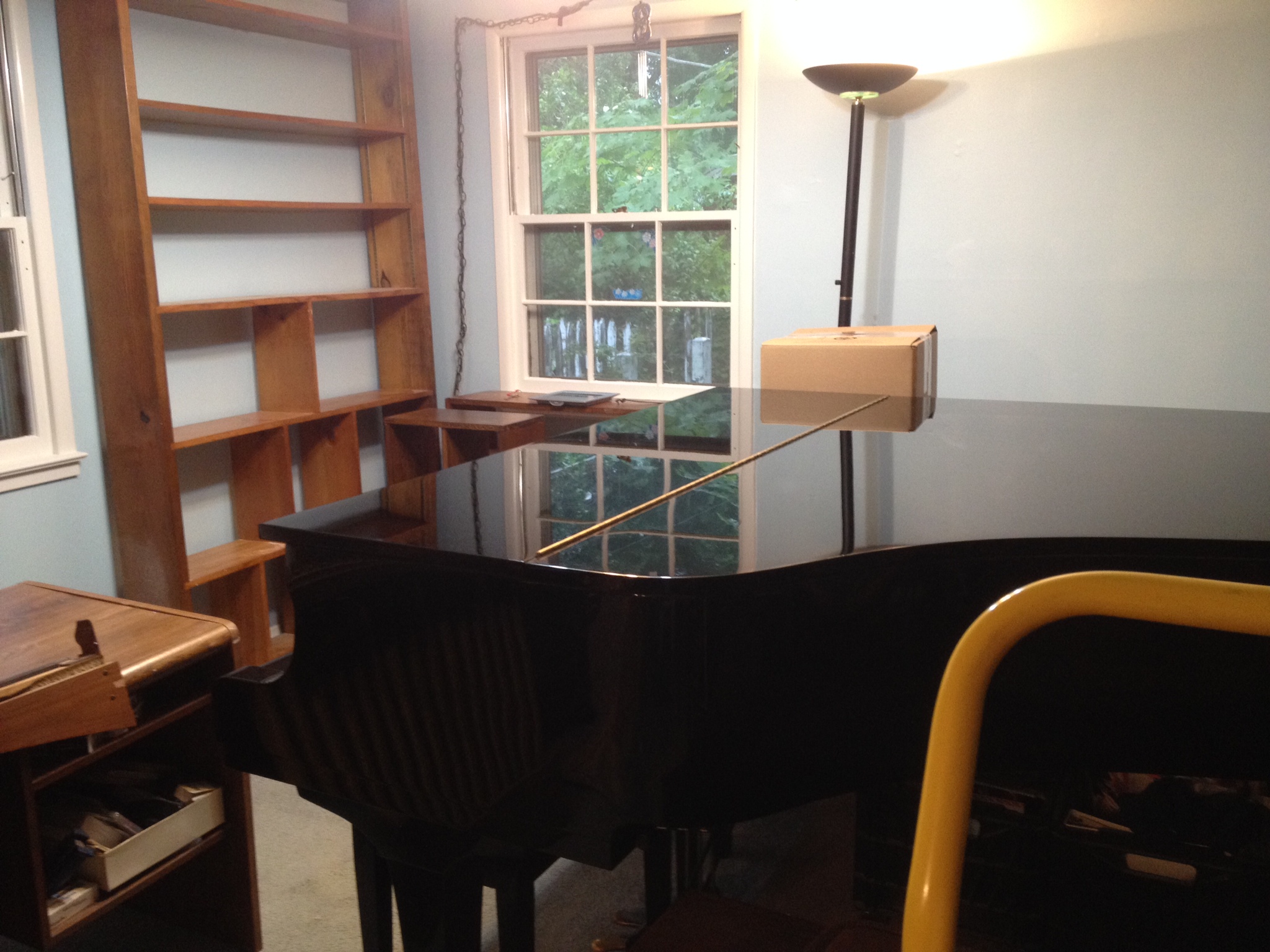
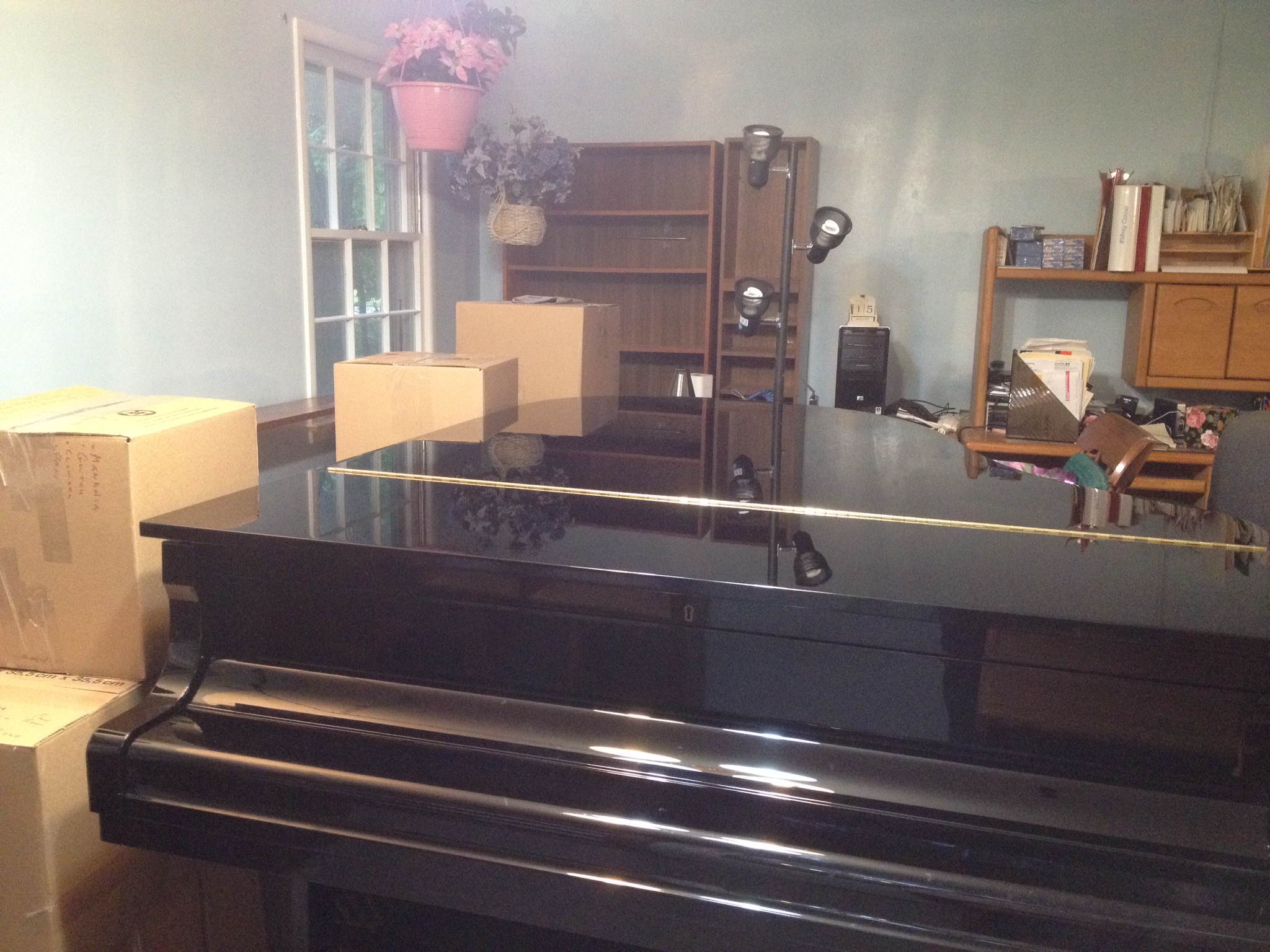
Now, it’s time to start putting the furniture back where it goes, although I think I’m leaving the piano more in the center of the room for now. It shows the piano off better and I’ll have a place to put the digital keyboard against the wall and closer to the piano.
After a lot of thought, the organs will stay in their respective places next to each other but the music for them will be moving nearer to them.
Then putting all the other books away. I have an iPad app which is a database that adds items by taking pictures of their barcodes. Hopefully, this will help organize some of my books.
It won’t be done by Monday but it will be done enough for teaching purposes!





 MaryO'Studio