Simply Piano helps you learn piano step by step, no previous knowledge required. It works with any piano or keyboard. Simply Piano is meant to teach people with little to no previous experience how to play songs and read music.
Run the app as you play and it provides real-time feedback as you progress through lessons. Just place your iPhone (or iPad) on your piano (or use your MIDI keyboard) and play, your iPhone will immediately recognize what you are playing!
The app slowly progresses from learning a few notes at a time to simple (and later, more complex) songs.
The app doesn’t let you skip ahead between lessons to maximize their effect. But not everyone has to start at square one. If you have some prior experience, you can indicate that the first time you use the app and it adjusts accordingly.
It will be fun watching your child improve their piano skills all while having fun using Piano Maestro in lessons each week!
As your child’s teacher (or YOUR teacher!), I’m looking forward to seeing the progress they will make when they start using it at home each day. This guide will help you understand how this app will benefit your child and how to get it set up on your own iPad.
Overview What is Piano Maestro?
Piano Maestro is the ultimate piano practice tool that will have students quickly playing their favorite classical, pop, rock, TV and video game songs and themes. It is available in the App Store and works on the iPad.
What skills does it improve?
• Note reading
• Sight reading
• Rhythm
• Inner pulse
• Confidence
What makes it so fun?
• Upbeat background tracks
• Stunning graphics
• Instant rewards and feed back
• Satisfaction of playing REAL music
It works with an acoustic piano?
Yes! Your child practices on your real acoustic or digital piano. Piano Maestro listens from the iPad’s built in microphone. No wires needed.
I’m already paying for lessons and books. What value does this add?
Sometimes I wish I could be there with your child to encourage them to keep practicing daily. I’m sure it’s not always easy, as unforeseen challenges will arise.
Since our time each week is just too short, this app will give me eyes on the ground and it will keep them practicing longer and improving more quickly.
How will it be used in lessons?
I will spend a few minutes of each lesson helping your child master a couple of new songs all while having fun! I will also teach them how to use the practice options at home.
At the end of the lesson, we will choose Home Challenge assignments within the app that will show up in your account at home. I’ll get updates when progress is made.
Getting Started
Wow, this sounds awesome. Now, how do I get started?
1) Download Piano Maestro on your iPad from the AppStore
2) Create a JoyTunes account with a parent’s email, under which, you can have multiple profiles for each member of the family.
3) Create a profile for each family member (that means you too Mom and Dad!) inside the Parent/Teacher zone (top right hand corner of main screen)
4) Connect to your teacher, me! After creating a profile in the “profiles” tab of the parent/teacher zone, select the student’s profile and click “connect to teacher.” Once I approve connection to your child, they will receive full access to all content for FREE! I will then also begin receiving weekly progress reports.
5) Start Playing – I will now start assigning you homework, meanwhile get started on Journey Mode.
When you connect to the O’Connor Music Studio, Piano Maestro is free for as long as you study here.
The following ornament table is a transcription of the one appearing in the Clavier-Büchlein vor Wilhelm Friedemann Bach, written by Johann Sebastian Bach for the keyboard instruction of his eldest son.
A scan of the original manuscript appears at Dave’s J.S. Bach Page.
The German title translates as “Explanation of various signs, showing how to play certain ornaments correctly.”{1} Bach gives the sign for each ornament on the upper of the paired staves, while the lower shows its execution directly beneath.
(This blog has) simply modernized the clefs in my transcription, since Bach’s manuscript uses soprano clefs, as several composers continued to do throughout the 18th century in place of the treble clef now used in all keyboard music.
After the transcription graphic showing the table, there appear clickable buttons which are keyed to AU sound files; you can click on any of the ornaments and hear a sound file play its execution.
The O’Connor Music Studio has a copy of this app if you (or your student) would like to try it during a lesson.
I see great potential with this app and think it could be useful for you at home.
It’s a fun game that can be used with a piano, the iPad or it can be hooked up to an electric keyboard.
Piano Maestro is free for all OCMS students to use on their own iPads at home. Your student’s piano lesson books are most likely included to help the student learn the pieces – accompanied by a full backing track!
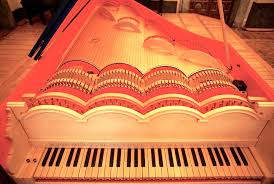
It’s startling to think of the multitude of objects Leonardo da Vinci conceptualized, and it’s a tad heartbreaking to realize he saw so few of them actualized.
But nearly 500 years after da Vinci sketched his plans for a musical instrument he dubbed the Viola Organista, Polish concert pianist Slawomir Zubrzycki spent more than 5,000 hours making da Vinci’s idea a reality.
In 2013, Zubryzcki debuted the instrument at the Academy of Music in the southern Polish city of Krakow. As reported in the Sydney Morning Herald, Zubryzcki said, “This instrument has the characteristics of three we know: the harpsichord, the organ and the viola da gamba.”
Watch the performance in the YouTube video below; you’ll recognize the pieces. And if you listen to the audio without watching Zubryzcki at the keyboard, you may think you’re hearing a small chamber ensemble rather than one person playing a single instrument.
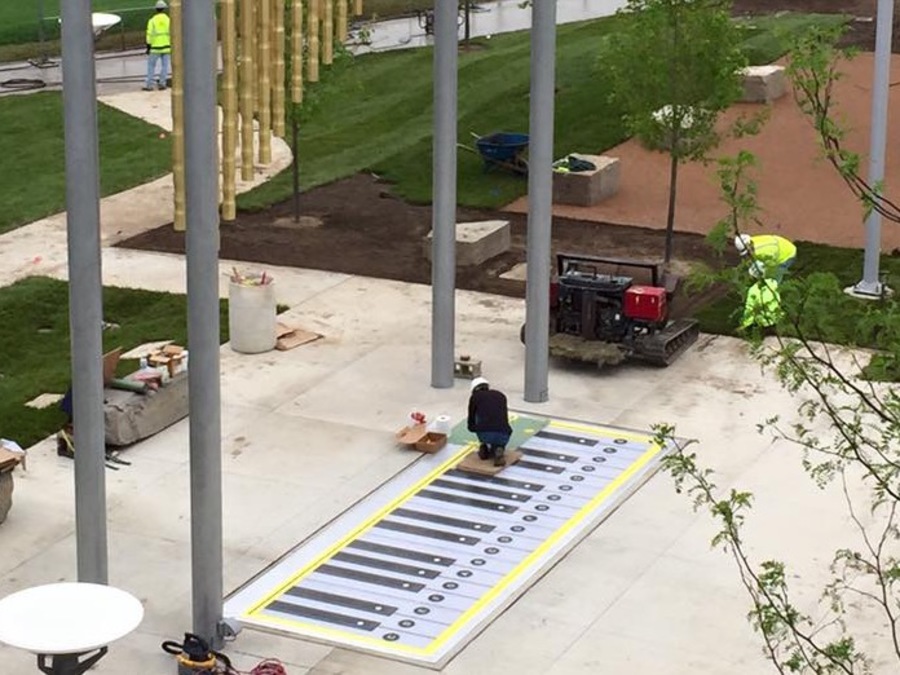
In a nearly 14-minute video released Tuesday, Smale Park project manager Dave Prather showed off that history and some of the more fun features opening soon — the “Big”gest of all probably being the giant outdoor foot piano. (Yeah, like that one from the Tom Hanks movie .)
The foot piano, created by Verdin Bell , has 32 individual chimes overhead with two and a half octaves. It’s part of the P&G go Vibrantscape, designed for people to get active in the park.
“So it’s not only a feature you can interact with, but it’s also a musical instrument,” Prather said. “Two or three can work together and play music.”
Putting final touches on the foot piano. Image courtesy Cincinnati Park Board.
Or, staff can plug in a keyboard to play it. The chimes will sound every quarter-hour and on the hour to mark the time, Prather said.
• 1911 ~ Sir William Gilbert, English librettist who together with the composer Sir Arthur Sullivan collaborated on many operettas, died of a heart attack after rescuing a woman from drowning. He was 74.
• 1911 ~ Carl M Story (1916) Fiddler
• 1912 ~ Fifteen women were dismissed from their jobs at the Curtis Publishing Company in Philadelphia, PA — for dancing the Turkey Trot while on the job!
• 1919 ~ (Walter) (Wladziu Valentino) Liberace, American concert pianist and showman. His trade mark was a candelabra on his piano.
More information about Liberace
• 1922 ~ Iannis Xenakis, Rumanian-born French theorist and composer
More information on Xenakis
• 1923 ~ Eugene Wright, Jazz musician, bass with Dukes of Swing, played with Brubeck
• 1935 ~ Josef Suk, Czech violinist and composer, died at the age of 61
• 1930 ~ Eleanor Fazan, Opera and show choreographer
• 1937 ~ Peter Kolman, Composer
• 1941 ~ Roy Crewsdon, Guitarist with Freddie and The Dreamers
• 1942 ~ The biggest selling record of all time was recorded. A little out of season, perhaps, but White Christmas, the Irving Berlin classic, was recorded by BingCrosby for Decca Records. The song was written for the film “Holiday Inn”. More than 30-million copies of Crosby’s most famous hit song have been sold and a total of nearly 70-million copies, including all versions of the standard, have been sold.
• 1943 ~ Hermann Hans Wetzler, Composer, died at the age of 72
• 1943 ~ “The Million Dollar Band” was heard for the first time on NBC radio. Charlie Spivak was the first leader of the band that featured Barry Wood as vocalist. The unusual feature of the show was the awarding each week of five diamond rings!
• 1945 ~ Gary Brooker, Keyboard player, singer
• 1948 ~ Linda Esther Gray, opera singer
• 1948 ~ Michael Berkley, Composer and broadcaster
• 1949 ~ Francis Rossi, Guitarist
• 1949 ~ Gary Brooker, Rock keyboardist with Procol Harum
• 1950 ~ Rebbie (Maureen) Jackson, Singer, oldest member of the Jackson family
• 1951 ~ Dimitrios Levidis, Composer, died at the age of 66
• 1961 ~ Uuno Kalervo Klami, Composer, died at the age of 60
• 1961 ~ Ricky Nelson reached the top spot on the “Billboard” singles chart withTravelin’ Man. It was was Nelson’s second chart-topping hit. Poor LittleFool made it to the top in August of 1958.
• 1996 ~ James George “Jimmy” Rowles, Jazz pianist, died at the age of 77
• 1997 ~ Jeff Buckley, Musician, drowned at age 30
• 2003 ~ Janet Collins, the first black prima ballerina to appear at the Metropolitan Opera and one of a few black women to become prominent in American classical ballet, died. She was 86. In 1951, Collins performed lead roles in “Aida” and Bizet’sCarmen and danced in “La Gioconda” and “Samson and Delilah” at the Met in New York City. That was four years before Marian Anderson made her historic debut as the first black to sing a principal role at the Met. Collins left the Met in 1954. During the 1950s, she toured with her own dance group throughout the United States and Canada and taught. Collins also danced in films, including the 1943 musical “Stormy Weather” and 1946’s “The Thrill of Brazil.” The Alvin Ailey American Dance Theater in 1974 paid homage to Collins and Pearl Primus as pioneering black women in dance.
• 1813 ~ (Wilhelm) Richard Wagner, German composer
Read quotes by and about Wagner
More information about Wagner
• 1820 ~ Alexander Ernst Fesca, Composer
• 1850 ~ Johann Schrammel, Composer
• 1852 ~ Emile Sauret, Composer
• 1865 ~ Enrique Morera, Composer
• 1879 ~ Eastwood Lane, Composer
• 1879 ~ Jean Emile Paul Cras, Composer
• 1884 ~ Alceo Toni, Composer
• 1885 ~ Julio Fonseca, Composer
• 1900 ~ Edwin S. Votey of Detroit, MI patented his pianola, a pneumatic piano player. The device could be attached to any piano. Batteries not included.
• 1914 ~ Sun Ra (Herman Blount), American jazz composer and keyboard player who led a free jazz big band known for its innovative instrumentation and the theatricality of its performances. He passed away in 1993.
• 1916 ~ Gordon Binkerd, Composer
• 1924 ~ Charles Aznavour, French chanteur and composer
• 1924 ~ Claude Andre Francois Ballif, French composer
• 1926 ~ Elaine Leighton, Drummer, played with Billie Holiday
• 1966 ~ Iva Davies (1955) Guitarist, singer with Icehouse
• 1958 ~ Wedding vows were taken by rock ’n’ roll star, Jerry Lee Lewis and his thirteen- year-old cousin, Myra.
• 1965 ~ The Beatles got their eighth consecutive number one hit as Ticket to Ride rode to the top of the singles list. The song topped the charts for one week and became their eighth consecutive number one hit.
• 1966 ~ Bruce Springsteen recorded his very first song at the age of 16, along with his band, The Castilles. It was titled, That’s What You’ll Get. The song was never released.
• 2003 ~ The final manuscript of Beethoven’s Ninth Symphony, which was annotated by the composer, sold at auction for $3.47 million.
The 62,000-strong audience claps politely when Simon Rattle and the London Symphony Orchestra strike up Vangelis’s Chariots of Fire theme – but their roar of approval when the cameras pan to an unexpected keyboard soloist is nothing short of heartwarming.
A global television audience of 1 billion+ also loved Rowan Atkinson’s side-splitting performance as Mr Bean, if the subsequent YouTube hits are anything to go by.
Students at the O’Connor Music Studio know that music theory is always a part of lessons. I strongly believe that theory is needed so that students understand what they are playing and why.
To me, theory work is just as important as playing. A firm knowledge of musical structure makes playing everything easier.
Music knowledge learned through piano lessons transfers easily to other musical activities. Students in Fairfax County Public Schools, students learn to play recorder. Students are sometimes surprised to learn that they already know all the notes – from their piano lessons!
When you sing in a choir, harmonize with Sweet Adelines, play an instrument in your school or community band/orchestra, join your church’s handbell choir (note:Pender UMC has an excellent Handbell program), teach yourself guitar – theory will help in every instance. By learning to read, write, and understand this musical language, many more musical opportunities will be made available the rest of your life.
Most piano methods come with a theory book that matches page by page what concepts are being learned in the lesson books. I actually recommend that students do the theory first when they get home, while the concepts are still fresh in their minds.
If the student is not in a piano method, I’m starting to use the Theory Time series. Book One covers music alphabet, introduction to keyboard and staff, stem rule, steps & skips on a keyboard and staff, repeated notes, dynamics, treble clef lines & spaces, bass clef lines & spaces, quarter note & rest, half note & rest, whole note & rest, dotted half note, bar lines, double bar line, measures, time signatures, rhythm drill, vocabulary, ear training and a review test. Free ear training videos for each ear training exercise are hosted on the Theory Time YouTube channel. The Grade One workbook is appropriate for beginning 1st, 2nd or 3rd grade students. This workbook includes 51 pages, 13 lessons and 8 Fun Sheets.