The holiday season is in full swing. The decorations are up, the presents bought (or in the process of being bought) but there’s no reason why our apps can’t get the same love this holiday.
So, without further ado, I’d like to jump into the updates we’ve made to Piano Maestro for you this holiday season!
Holiday Songs & Graphics
You’ll be able to impress your friends and family with a bunch of FREE holiday songs to play! We also added some new ones to the mix for our veteran Piano Maestro players.
You’ll find 50 free (yes, free!!) songs in this category from Christmas to Hanukkah and even New Year’s too! We just added Mariah Carey’s “All I want for Christmas is You” (because who doesn’t LOVE that Christmas classic).
Also available is the Christmas staple, “Jingle Bell Rock”.
The only thing missing is the ability for our app to make a strong cup of eggnog! We’ll try and work on that for next Christmas
The free holiday songs can be accessed from two places. As mentioned above, you can get there directly from the “Free Holiday Songs” button on the main menu as well as going to Library -> Songs -> and then choosing the “Free Holiday Songs” category.
Make sure to download the latest update of Piano Maestro.
Learning on your own? Don’t forget to download our free iPhone app, Simply Piano, and learn to play “Jingle Bells” in just 30 minutes!
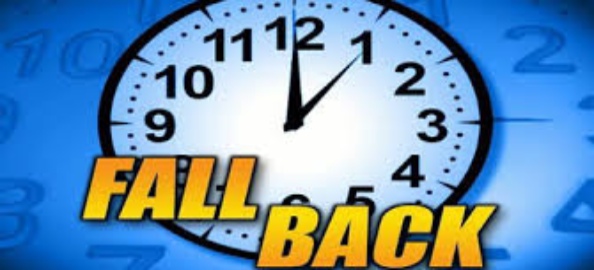
Daylight Saving Time 2015 ends for the year so the clock change for the fall takes place Sunday morning at 2 a.m. on November 1. Daylight Saving Time 2015 seems overdue, but it is the same time each year.
The clock changes on the first Sunday in November. Daylight Saving Time starts on the second Sunday in March each year.
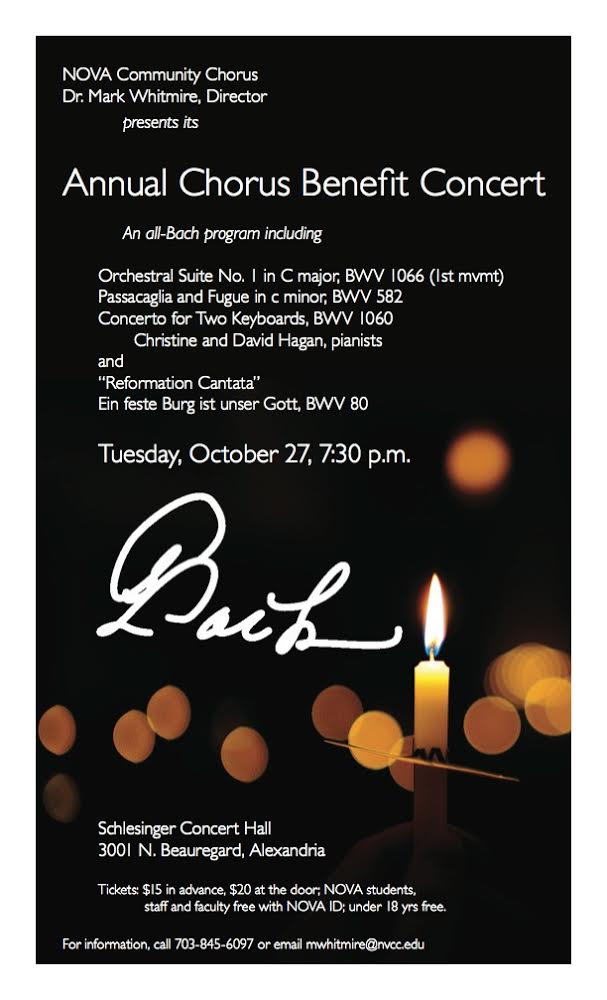
NOVA Community Chorus (Dr. Mark Whitmire, Director) will present it’s Annual Chorus Benefit Concert on Tuesday, October 27, at 7:30 pm in Schlesinger Concert Hall on the Alexandria Campus. It will be an all-Bach program including Cantata 80: Eine feste Burg ist unser Gott (A mighty fortress in our God), accompanied by orchestra.
Acclaimed duo pianists Christine and David Hagan will perform Passacaglia and Fugue in C minor and the Concerto for Two Keyboards in C Major.
NOVA students, staff and faculty are free with NOVA ID. Donations are requested. For information, call 703-845-6097 or email mwhitmire@nvcc.edu.
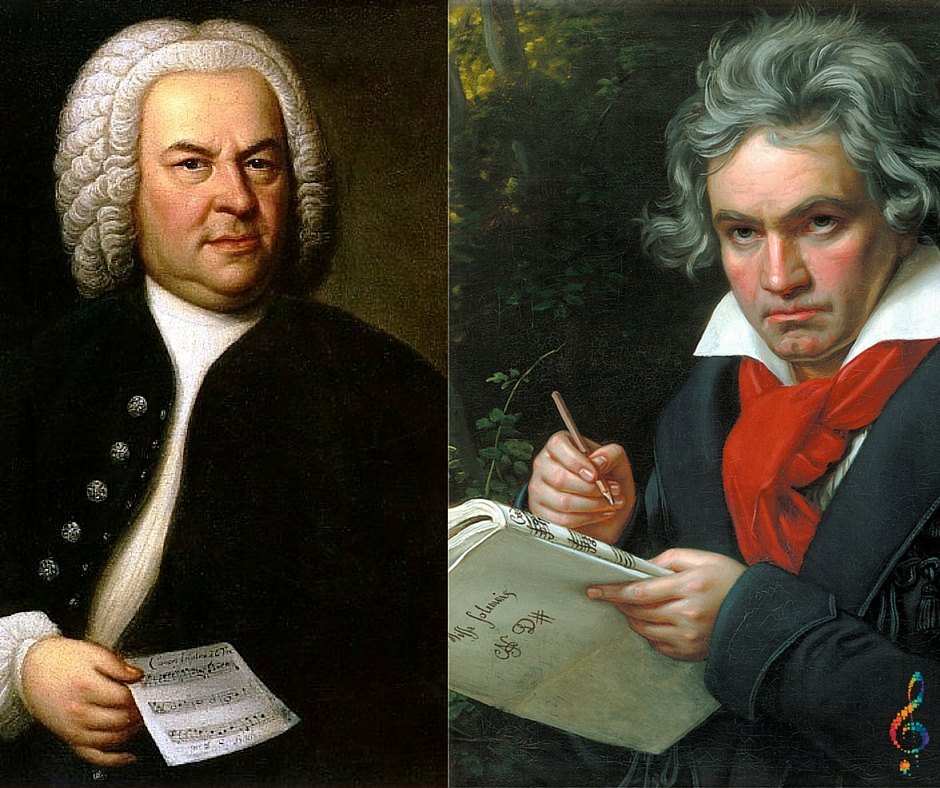
Don’t miss this chance for you and your students to hear the music of one of the greatest composers of all time.
JoyTunes (Piano Maestro) just released one of the most beautiful pearls of classical piano music, Bach’s Prelude in C major.
As a bonus, they also released the original version of Für Elise (till now we had the simplified version). You can find them in the Classical & Opera section.
Piano Maestro is available to students of the O’Connor Music Studio for no extra charge.
• 1918 ~ Henryk Szeryng, Polish-born Mexican violinist
• 1926 ~ William O. Smith, American composer and jazz clarinetist
• 1930 ~ Joni James (Joan Carmello Babbo), Singer
• 1937 ~ Red Norvo and his orchestra recorded the Russian Lullaby on the Brunswick label. Norvo did more famous work at a later date, recording with a singer named Dinah Shore.
• 1941 ~ Anna Tomowa-Sintow, Bulgarian soprano
• 1943 ~ Singer Kate Smith finished her War Bond radio appeal. For 13 continuous hours Smith had stayed on the air, collecting a whopping $39 million dollars in bond pledges.
• 1951 ~ David Coverdale, Singer with Deep Purple
• 1954 ~ Shari Belafonte, Actress, TV cohost, singer Harry Belafonte’s daughter
• 1956 ~ Debby Boone, Grammy Award-winning singer: Best New Artist in 1977, sang with The Boone Family; daughter of singers Pat and Shirley Boone
• 1962 ~ It was a hootenanny of a good time in, of all places, New York’s famed Carnegie Hall. The cast included newcomer Bob Dylan making his first appearance at Carnegie Hall.
• 1964 ~ In the tradition of the Broadway stage, the lights lowered, the curtain rose and Zero Mostel stepped into the spotlight as the fiddler played. “Tra-a–a- dition”, he sang, as he began the first of 3,242 performances of Fiddler on the Roof. The musical opened on Broadway this day. The story of Tevye (brilliantly played by Mostel), a poor Jewish milkman with five daughters, takes place in a small Russian village in the late 1890s. He sings and dances his way through the tragedies and comedies of a father fighting for tradition in a changing world. “To life”, he sang, as the music of Jerry Bock and Sheldon Harnick made the stories by Sholem Aleichem come alive. And he brought tears to audiences eyes with the poignant, Sunrise, Sunset, and laughter, too, with the memorable, If I were a Rich Man — which surely made Zero Mostel a wealthy man.
• 1980 ~ John Lennon signed with Geffen Records. The Lennon LP, Double Fantasy, was released on Geffen. (Lennon was assassinated on December 8, 1980.)
• 1985 ~ The poor of America’s Heartland … the financially troubled farmers of Middle America … got help from their friends in the music biz. Singing stars Willie Nelson,Neil Young and John Cougar Mellencamp held a benefit concert to raise funds. The stars came out and so did the money. The Farm Aid concert raised ten million dollars.
• 2001 ~ Isaac Stern, the master violinist who saved Carnegie Hall from the wrecking ball, died at the age of 81. Stern, one of the last great violinists of his generation, helped advance the careers of a new generation, including Itzhak Perlman, Pinchas Zukerman and Yo-Yo Ma. He played well over 175 performances at Carnegie Hall, America’s musical temple renown for its acoustics. The hall opened in 1891. As the city was planning Lincoln Center in the 1950s, a builder proposed an office building to replace Carnegie Hall. Using his prestige and his contacts among fellow artists and benefactors, Stern rallied the opposition, eventually securing legislation that enabled the city to acquire the building in 1960 for $5 million. On Jan. 8, 1943, he made his Carnegie Hall debut in a recital produced by the impresario Sol Hurok. Performing with pianist Alexander Zakin, who became his longtime accompanist, Stern played Mozart, Bach, Szymanowski, Johannes Brahms and Wieniawski. The performance attracted the attention of composer-critic Virgil Thomson. Writing in the New York Herald Tribune, Thomson proclaimed him “one of the world’s master fiddle players.” At his peak, Stern would perform more than 200 concerts a year. Stern boycotted Germany for years because of the Holocaust, but taught a nine-day seminar there in 1999.
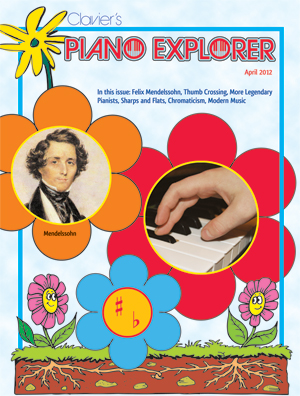
Each month, young students will receive a copy of Piano Explorer magazine. It is available to adults, on request.
Included are
Composer biographies
• Music history
• Instruments
• Theory, practice tips, composing ideas
• Beginner’s Corner
• Music Corner (featuring student compositions)
Colorful pictures, timelines, and maps capture students’ attention. At the end of each magazine is a quiz to test students’ comprehension of the material. Games, puzzles, riddles, and student contributions round out the magazine and keep things fun.
Additional Features: Check out our website for additional material. The student page includes links to music mentioned in the issue, additional quizzes, and other interesting information.
The October issue includes information about
Franz Schubert
Practice tips
Dynamics
Voice
E Major
Antonio Salieri
Please note that students will have assignments from each issue.
Vivaldi, one of the greatest baroque composers, has a very interesting story. He ran an orphanage in the 18th century in Italy that became famous all over the western world for its musically talented children. A lot of his pieces were written for specific children in his school. Vivaldi learned the violin from his father, and was trained as a priest. He was nicknamed “the red priest” for his red hair and was apparently somewhat sure of himself, having claimed once he can compose a concerto faster than it can be copied.
Vivaldi wrote over 500 pieces, most of which are lost today. He is considered one of the greatest musical landmarks in history, having inspired many composers that followed him, including J.S.Bach and others.
Labor Day is a United States federal holiday observed on the first Monday in September celebrating the economic and social contributions of workers.
The first Labor Day holiday was celebrated on Tuesday, September 5, 1882, in New York City, in accordance with the plans of the Central Labor Union. The Central Labor Union held its second Labor Day holiday just a year later, on September 5, 1883.
In 1884 the first Monday in September was selected as the holiday, as originally proposed, and the Central Labor Union urged similar organizations in other cities to follow the example of New York and celebrate a “workingmen’s holiday” on that date. The idea spread with the growth of labor organizations, and in 1885 Labor Day was celebrated in many industrial centers of the country.
It was first nationally recognized in 1894 to placate unionists following the Pullman Strike. With the decline in union membership, the holiday is generally viewed as a time for barbecues and the end of summer vacations – and time to go back to school in Fairfax County – and piano lessons!









 MaryO'Studio