Chopsticks, Again!

Chopsticks

Stephen Powers first thought of his grand piano as an impressive piece of furniture.

But he enjoyed listening to music so much when friends played at parties at his home in North Wilmington that he began taking lessons.

“I enjoy having a couple of songs under my belt,” says Powers, a 52-year-old banker. “I play Happy Birthday. I play Getting to Know You for my mom.”

Powers is part of a boomlet of adults who are studying piano. Many took lessons briefly as children and regret giving it up. Some simply enjoy music. Others gravitated toward the keyboard because studies suggest piano improves mental acuity while reducing the odds of dementia.

A Swedish study published in 2014 in the International Journal of Alzheimer’s Disease found that when a twin played a musical instrument later in life, he or she was 64 percent less likely to develop dementia than the twin who did not play.

A study published in Frontiers in Psychology in 2013 evaluated the impact of piano lessons on cognitive function, mood and quality of life in adults age 60 to 84.

The group that studied piano showed significant improvement in tests that measure executive function, controlling inhibitions and divided attention, as well as enhanced visual scanning and motor ability. Piano students also reported a better quality of life.

Some grownups simply relish a challenge.

In the United Kingdom, Alan Rusbridger, editor of the Guardian, took to the keyboard at age 56. He chronicled the year he spent learning Chopin’s demanding No. Ballade 1 in G Minor in the book Play It Again: An Amateur Against the Impossible.

Richard Swarmer, 57, of Lewes, played the trumpet from grade school through college. He has sung in several choirs. This year, he began piano lessons.

Learning the piano isn’t easy even for someone with a musical background. Still, Swarmer appreciates that the creative thought process is different from the focus required by his job for a medical benefits company.

“I have thoroughly enjoyed taking piano lessons as an adult,” he says. “It provides a welcome respite from the demands of my job.”

Ethel Thirtel of North Wilmington is 71 and a student at the Music School of Delaware. She is also taking French lessons to help keep her intellect sharp.

“Both pursuits involve active studying and practice to master new skills,” she says.

To meet rising demand, the Music School of Delaware offers adults-only evening group classes to accommodate working people, says Matthew Smith, student and alumni relations officer. The school also provides instruction for adults 50 and older through the Osher Lifelong Learning Institute at University of Delaware.

“In addition to professionals, we are getting a lot more inquiries from older adults who are retired and have time on their hands,” he says.

Geri Smith, a Julliard-trained singer, musician and composer, has taught piano to children in public schools as well as private arts centers. Her adult students include a 59-year-old writer who took up piano after the death of her husband, a gifted musician.

“Teaching children is a different experience than teaching adults,” says Smith, of Unionville. “Kids pretty much do what you ask them to do but adults ask lots of questions. They want to know why things have to be done a certain way.”

An important part of learning piano is creating new pathways in the brain. A Harvard Medical School study examined the impact of practicing the piano on synapses, the connections between neurons that encode memories and learning.

Volunteers practiced two hours a day for five days, playing a five-finger exercise to the beat of a metronome. To learn how that impacted the neurons scientists used transcranial-magnetic-stimulation (TMS), in which a wire coil sends magnetic impulses to the brain.

They discovered that after a week of practice, the stretch of motor cortex devoted to the finger exercises had expanded like crabgrass.

“Playing the piano creates new synapses,” Smith says. “Think of it as creating a conduit so your right hand can talk to your left hand.”

Meldene Gruber of Rehoboth Beach, who has taught piano for more than 40 years, has seen a surge in adult students in the past two years. Now, half her students are adults.

“A number of my adults say they think playing the piano will help with mental acuity,” she says. “Playing the piano forces you to use both sides of the brain, which is great for neuron firing.”

Most adults have specific goals in mind, such as learning to play Christmas carols or a few favorite pieces.

“You don’t get adults who are focused on becoming concert pianists,” Gruber says. “They come for the joy of playing, not because their mothers made them.”

via Chopstick therapy: how piano lessons could help us age better — NewsWorks.

July 19, 2019 ~ Daily Listening Assignment


hall-mountain


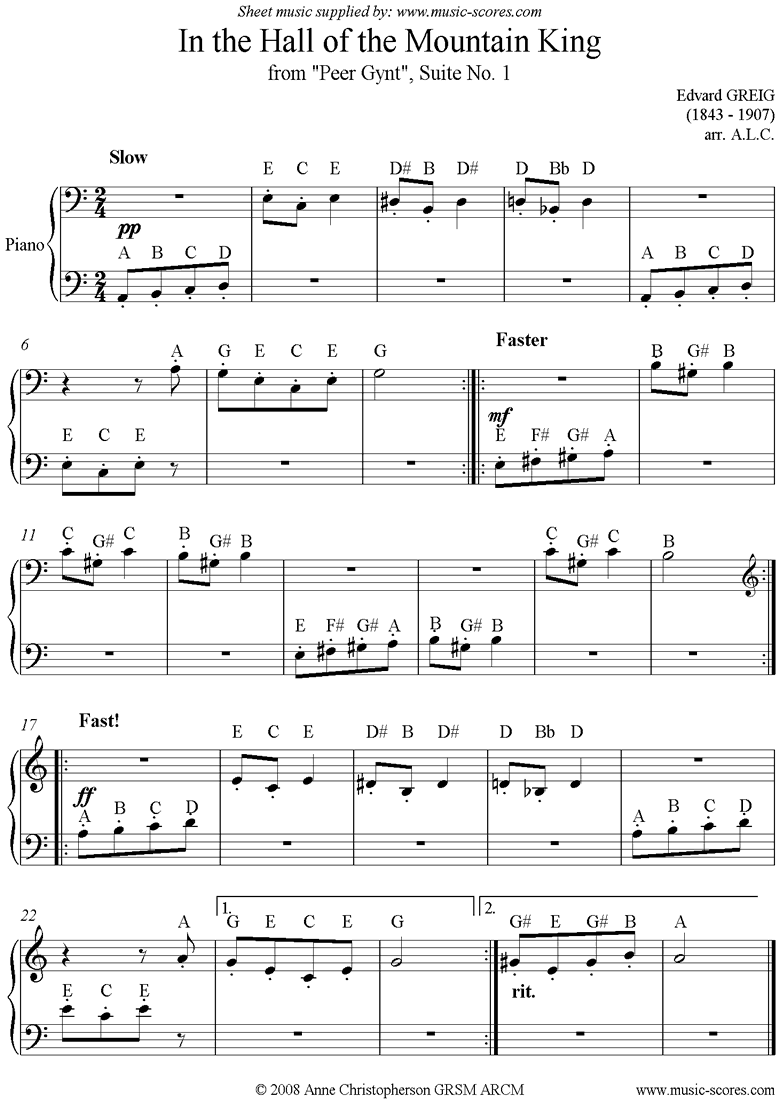
“In the Hall of the Mountain King” is a piece of orchestral music composed for the sixth scene of act 2 in Henrik Ibsen’s 1867 play Peer Gynt. It was originally part of Opus 23 but was later extracted as the final piece of Peer Gynt, Suite No. 1, Op. 46. Its easily recognizable theme has helped it attain iconic status in popular culture, where it has been arranged by many artists, including for the piano.

Borrow a copy of the sheet music from the O’Connor Music Studio.  I have this arranged for piano, duet, 2-piano, simplified…


8 part vocal orchestra (plus a tiny pair of cymbals)


Pianist Paul Barton


Solo piano sheet music – Video Score


Orchestral version

July 10, 2019 ~ Daily Listening Assignment


Today’s Listening Assignment is Country Gardens by Percy Grainger.

“Country Gardens” is an English folk tune collected by Cecil Sharp from the playing of William Kimber and arranged for piano in 1918 by Percy Grainger.

The tune and the Grainger arrangement for piano and orchestra is a favorite with school orchestras, and other performances of the work include morris dancing.

A piano version:

Piano duet (four-hands)

Clarinet solo


Orchestra

The Ambrosian Children’s Choir

From the Muppets

And, how a Morris Dance is done:

Find Country Gardens on IMSLP, Piano Maestro (under the method book section) and Piano Pronto: Movement 2


July 3, 2019 ~ Daily Listening Assignment


toccata-d-minor


Johann Sebastian Bach’s towering monument of organ music, with its deep sense of foreboding, will forever be associated with Halloween.

Get a free copy of the sheet music at IMSLP or borrow a copy from the O’Connor Music Studio.  I have this arranged for organ, piano, duet, 2-piano, simplified…

It’s also available in Piano Maestro, Piano Pronto Encore and Coda

If you want this in a book with other Bach transcriptions, amazon has this: Toccata and Fugue in D Minor and the Other Bach Transcriptions for Solo Piano, arranged by Ferruccio Busoni.

Here, Virgil Fox performs it on his Allen Digital Touring Organ.


Diane Bish plays the Massey Memorial Organ at the Chautauqua Institution and talks about this instrument.


Animated organ:

Glass harmonica

Accordion

Cartoon:


July 2, 2019 ~ Daily Listening Assignment


Today’s piece is the other one of two pieces that are so often played incorrectly that they have the distinction of being banned from competition in Northern Virginia Piano Teacher competitions.

The first was Fur Elise.  This one is Spinning Song by Albert Ellmenreich.  It’s in many, many piano method books.  When I was in 5th or 6th grade, I tore it out of my book, put it in a construction paper cover and played it for some Girl Scout talent show.  I have no idea why I couldn’t leave it in the book.

The left hand is supposed to sound like the foot pumping the wheel to make it move


This is part of a larger work called Musikalische Genrebilder, Op.14 which can be downloaded at IMSLP:

Spinnliedchen (Spinning Song), the best known item from the set, seems to be universally referred to as number four. The announcement of the first edition in Hofmeister’s Monatsberichte lists it as the fifth item. In Schirmer’s 1878 edition (see cover: here) of Op.14 it appears that items two and three were possibly combined into one number (entitled Sorrow and Consolation) so that Spinnliedchen became number four. Perhaps, this is the origin of the re-numbering.

To learn this sheet music, it’s available in Piano Pronto Movement 4 and Alfred Premier Piano Course Book 6

Here’s a sample:


A tutorial

With scrolling sheet music

For organ

How to conduct(?)

While this piece is not usually popular with other instruments, a trumpet quartet gave it a try

The DMS Percussion Ensemble

Singers from the Londonderry Middle School gave it a try:

The first half of this video is flute tuning. After that is a lovely flute duet.


For clarinet “quartet”.  Quartet is in quotes because the performer wrote “This is a ‘cover’ I did of Spinning Song by Albert Ellmenreich. I played all the parts on my clarinet, using the really crappy camera I have. So the sound quality sucks… Also, I don’t have a bass clarinet, so the low part is edited down… and it sounds like a saxophone… oh well. lol!”

I can’t take any more of these!


July 1, 2019 ~ Daily Listening Assignment


Today’s piece is Antonin Dvořák’s Humoresque #7.

Humoresques Op. 101 (B. 187), is a piano cycle by the Czech composer Antonín Dvořák, written during the summer of 1894. One writer says “the seventh Humoresque is probably the most famous small piano work ever written after Beethoven’s Für Elise.

Yo Yo Ma (cello) and Itzhak Perlman (violin)

Orchestra:


Ragtime:


Jazz with Wynton Marsalis on trumpet

Zez Confrey gave this a makeover and included Way Down Upon the Swanee River:


Find the original Humoresque on IMSLP. The O’Connor Music Studio Lending Library has versions of Humoresque available at several levels and Confey’s Humorestless played in the video above.


June 28, 2019 ~ Daily Listening Assignment


Korobeiniki is a nineteenth-century Russian folk song that tells the story of a meeting between a peddler and a girl, describing their haggling over goods in a veiled metaphor for courtship.

Outside Russia, “Korobeiniki” is widely known as the Tetris theme.


Piano duet:


Orchestral version:


For Boomwhackers:

Vocal:


Ragtime:


Balalaika:


Two bassoons:

The Red Army Choir:

Korobeiniki/Tetris is available in Piano Maestro on the iPad and I have several levels of sheet music for anyone who is interested.

Enjoy!

June 26, 2019 ~ Daily Listening Assignment


Pictures at an Exhibition is a suite of ten pieces (plus a recurring, varied Promenade) composed for the piano by Russian composer Modest Mussorgsky in 1874.

The suite is Mussorgsky’s most famous piano composition and has become a showpiece for virtuoso pianists. It has become further known through various orchestrations and arrangements produced by other musicians and composers, with Maurice Ravel’s arrangement being by far the most recorded and performed.

You can download the sheet music at IMSP or I have a copy of the book, as well as simplified sheet music.


The work opens with a brilliant touch – a “promenade” theme (above) that reemerges throughout as a transition amid the changing moods of the various pictures.

The ten pictures Mussorgsky depicts are:

  • a gnome-shaped nutcracker;
  • a troubadour plaintively singing outside an ancient castle;
  • children vigorously playing and quarreling in a park;
  • a lumbering wooden Polish ox-cart;
  • a ballet of peeping chicks as they hatch from their shells;
  • an argument between two Warsaw Jews, one haughty and vain, the other poor and garrulous;
  • shrill women and vendors in a crowded marketplace;
  • the eerie, echoing gloom of catacombs beneath Paris;
  • the hut of a grotesque bone-chomping witch of Russian folklore named Baba Yaga;
  • and a design for an entrance gate to Kiev.


The whole piece for piano.  See if you can tell which pictures are which.


Orchestrated, with the full score:


Just the Baba Yaga section:

The Emerson, Lake and Palmer version:

June 24, 2019 ~ Daily Listening Assignment


Today’s is a cheat post, partly because I ran out of time.

I’ve watched this video several times in the past few days.  It’s a great overview of the Beatles music.  And, yes, I have books of their music arranged for piano, if you want to play anything.


June 21, 2019 ~ Daily Listening Assignment

Eine Kleine Nachtmusik (Serenade No. 13 for strings in G major), K. 525, is a 1787 composition for a chamber ensemble by Wolfgang Amadeus Mozart. The German title means “a little serenade”, though it is often rendered more literally but less accurately as “a little night music.” The work is written for an ensemble of two violins, viola, and cello with optional double bass but is often performed by string orchestras and there are many arrangements for other instruments as we will see below.

Part of a full orchestral score:


Follow the score…

Easy piano sheet music might look like this:


The first movement of Mozart’s Eine Kleine Nachtmusik, with a graphical score.


One of my favorites, Barbershop-Style.  Eine Kleine Not Musik by the Gas Houe Gang tells the story of The Magic Flute (from June 19) to the music of Eine Kleine Nachtmusik.


A piano transcription

For four recorders, all played by the same person

From the Muppets: The Great Gonzo performing Eine Kleine Nachtmusik on bagpipe while sitting on a ten-foot pole!


When my son and I played Eine Kleine Nachtmusik by Mozart arranged for 2 pianos November 30, 2014 we were the last people to play in the old Steinway Hall.  Unfortunately, we didn’t have a good video camera 😦

2014-08-10 12.49.02 2014-08-09 12.20.39 2014-08-09 12.16.45 2014-08-09 12.15.17


Find this arranged for piano in Piano Pronto: Movement 2, Movement 3, Encore, Coda and Mozart: Exploring His Life and Music,