Daily Listening Assignments ~ July 14

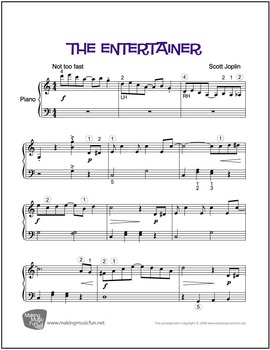
“The Entertainer” is a 1902 classic piano rag written by Scott Joplin. It was sold first as sheet music, and in the 1910s as piano rolls that would play on player pianos.

It was used as the theme music for the 1973 Oscar-winning film The Sting by composer and pianist Marvin Hamlisch.
The Sting was set in the 1930s, a full generation after the end of ragtime’s mainstream popularity, thus giving the inaccurate impression that ragtime music was popular at that time.

Find the sheet music in a variety of levels including Songs I Love to Play, Volume 1 and Alfred Premier Piano Course Book 4.  It’s also available in Piano Maestro and to borrow from the O’Connor Music Studio
As played in The Sting

Adam Swanson

Piano Duet

On an older piano

At Disney

Player piano

Harder than it needs to be

From a 4-year-old

Violin and piano

String Quartet

On guitar

Saxophone quartet

Miss Piggy sang The Entertainer

And, everyone’s favorite – the ice cream truck!

Daily Listening Assignments ~ July 9

Today’s piece is based on a collection of tales known as the One Thousand and One Nights or Arabian Nights.

The story, which was written many hundreds of years ago, tells of a Persian king who married a young girl every night. Every morning he would send his new wife to have her head chopped off. He had already killed 3000 women in this way.

When Scheherazade heard about this, she wanted to spend the night with him. She spent all night telling him a story. At the end of the night, she stopped the story at an exciting moment, like a modern-day soap opera.

The next night she finished the story and began another one, which she again stopped when it was dawn. The king had to wait another night to hear the rest of the story. Scheherazade kept this up for 1001 nights. By then, the king had fallen in love with Scheherazade and he let her live.

Rimsky-Korsakov’s best-known work is Scheherazade, an orchestral piece that describes in music the stories told by Scheherazade.

The work consists of four movements:

The Sea and Sinbad’s Ship

The Kalandar Prince

The Young Prince and The Young Princess

Festival at Baghdad. The Sea. The Ship Breaks against a Cliff Surmounted by a Bronze Horseman

Today, we’re focusing on The Young Prince and The Young Princess which can be found in Piano Pronto Movement 4

Piano duet

Orchestra

Flute ensemble

Gene Kelly dancing with a cartoon partner

The entire work

Daily Listening Assignments ~ July 8

Today, we’ll listen to the Symphony No. 5 in C minor, Op. 67, of Ludwig van Beethoven.  It was written between 1804–1808. It is one of the best-known compositions in classical music, and one of the most frequently played symphonies. As is typical of symphonies in the classical period, Beethoven’s Fifth Symphony is in four movements.

I’m sure you’ve heard the first 8 notes before…

Since it was written for orchestra, each instrument has its own line:

A piano version, transcribed by Liszt

From Disney’s Fantasia 2000:

Pink learns to play the violin, and interrupts a performance of Beethoven’s Fifth Symphony with the Pink Panther theme played on various instruments.

Beethoven’s Wig:

Arrangements of Beethoven’s Fifth Symphony can be found in Piano Maestro and lots of books including Piano Pronto’s Movement 2, Movement 5 (Victory Theme) and Beethoven: Exploring His Life and Music.

Daily Listening Assignments ~ July 7

Today’s Listening Assignment is Country Gardens by Percy Grainger.

“Country Gardens” is an English folk tune collected by Cecil Sharp from the playing of William Kimber and arranged for piano in 1918 by Percy Grainger.

The tune and the Grainger arrangement for piano and orchestra is a favorite with school orchestras, and other performances of the work include morris dancing.

A piano version:

Piano duet (four-hands)

Clarinet solo

Orchestra

The Ambrosian Children’s Choir

From the Muppets

And, how a Morris Dance is done:

Find Country Gardens on IMSLP, Piano Maestro (under the method book section) and Piano Pronto: Movement 2

Daily Listening Assignments ~ July 5

“Morning Mood” is part of Edvard Grieg’s Peer Gynt, Op. 23 was written in 1875.

The melody uses the pentatonic (five-note) scale, lending itself to beginning piano books.

Orchestra:

Music box:

Cartoon:

Flash mob(!!)

Morning Mood is available in Piano Maestro, Piano Pronto Prelude (as Morning Theme) and other books.

Daily Listening Assignments ~ July 2

toccata-d-minor

Johann Sebastian Bach’s towering monument of organ music, with its deep sense of foreboding, will forever be associated with Halloween.

Get a free copy of the sheet music at IMSLP or borrow a copy from the O’Connor Music Studio.  I have this arranged for organ, piano, duet, 2-piano, simplified…

It’s also available in Piano Maestro, Piano Pronto Encore and Coda

If you want this in a book with other Bach transcriptions, amazon has this: Toccata and Fugue in D minor and the Other Bach Transcriptions for Solo Piano, arranged by Ferruccio Busoni.

Here, Virgil Fox performs it on his Allen Digital Touring Organ.

Diane Bish plays the Massey Memorial Organ at the Chautauqua Institution and talks about this instrument.

Animated organ:

Glass harmonica

Accordion

Cartoon:

Daily Listening Assignments ~ July 1

Today’s piece is the other one of two pieces that are so often played incorrectly that they have the distinction of being banned from competition in Northern Virginia Piano Teacher competitions.

The first was Fur Elise.  This one is Spinning Song by Albert Ellmenreich.  It’s in many, many piano method books.  When I was in 5th or 6th grade, I tore it out of my book, put it in a construction paper cover and played it for some Girl Scout talent show.  I have no idea why I couldn’t leave it in the book.

The left hand is supposed to sound like the foot pumping the wheel to make it move

This is part of a larger work called Musikalische Genrebilder, Op.14 which can be downloaded at IMSLP:

Spinnliedchen (Spinning Song), the best known item from the set, seems to be universally referred to as number four. The announcement of the first edition in Hofmeister’s Monatsberichte lists it as the fifth item. In Schirmer’s 1878 edition (see cover: here) of Op.14 it appears that items two and three were possibly combined into one number (entitled Sorrow and Consolation) so that Spinnliedchen became number four. Perhaps, this is the origin of the re-numbering.

To learn this sheet music, it’s available in Piano Pronto Movement 4 and Alfred Premier Piano Course Book 6

Here’s a sample:

A tutorial

With scrolling sheet music

For organ

How to conduct(?)

While this piece is not usually popular with other instruments, a trumpet quartet gave it a try

The DMS Percussion Ensemble

Singers from the Londonderry Middle School gave it a try:

The first half of this video is flute tuning. After that is a lovely flute duet.

I can’t take any more of these!

Daily Listening Assignments ~ June 22

Today we listen to the third movement Mozart’s Piano Sonata No.11 III (Turkish March) with just a bit of the first movement near the end.

The Turkish influence on western music came through the Turkish military band music (Mehter), which was at the time was the only military band in Europe. It was once popular among western composers like Mozart to write Turkish-style (alla Turca) works, Turkish music being known at that time as Turkish band music. That’s why the Turkish-influenced music works by Mozart, Beethoven or Strauss are in march rhythm as they are called march.

A rondo is a piece of music where the musical material stated at the beginning of the piece keeps returning. This opening music can be called either the theme or the refrain; they are the same thing.  The form can be A, B, A or A, B, C, A – anything as long as the “A” theme returns

The Turkish March movement:

On guitar:

Harmonica, anyone?

Vocal:

Find the Turkish march movement of this sonata in these Piano Pronto books: Encore,  Mozart: Exploring His Life and Music,

The first movement can be found in Keyboard Kickoff, Movement 2

Daily Listening Assignments ~ June 21

Eine Kleine Nachtmusik (Serenade No. 13 for strings in G major), K. 525, is a 1787 composition for a chamber ensemble by Wolfgang Amadeus Mozart. The German title means “a little serenade”, though it is often rendered more literally but less accurately as “a little night music.” The work is written for an ensemble of two violins, viola, and cello with optional double bass but is often performed by string orchestras and there are many arrangements for other instruments as we will see below.

Part of a full orchestral score:

Follow the score…

Easy piano sheet music might look like this:

The first movement of Mozart’s Eine Kleine Nachtmusik, with a graphical score.

One of my favorites, Barbershop-Style.  Eine Kleine Not Musik by the Gas House Gang tells the story of The Magic Flute (from June 19) to the music of Eine Kleine Nachtmusik.

A piano transcription

For four recorders, all played by the same person

From the Muppets: The Great Gonzo performing Eine Kleine Nachtmusik on bagpipe while sitting on a ten-foot pole!

When my son and I played Eine Kleine Nachtmusik by Mozart arranged for 2 pianos November 30, 2014 we were the last people to play in the old Steinway Hall.  Unfortunately, we didn’t have a good video camera 😦

2014-08-10 12.49.02 2014-08-09 12.20.39 2014-08-09 12.16.45 2014-08-09 12.15.17

Find this arranged for piano in Piano Pronto: Movement 2, Movement 3, Encore, Coda and Mozart: Exploring His Life and Music.

Daily Listening Assignments ~ June 20

Today’s listening assignment is  Can-can from “Orpheus in the Underworld” by Jacques Offenbach.  This piece is very often in early method books because of the descending C Major scale.  Can you find it?

The can-can (or cancan as in the original French) is a high-energy, physically demanding dance that became a popular music hall dance in the 1840s, continuing in popularity in French cabaret to this day. Originally danced by both sexes, it is now traditionally associated with a chorus line of female dancers. The main features of the dance are the vigorous manipulation of skirts and petticoats, along with high kicks, splits, and cartwheels.

Many composers have written music for the cancan. Today’s selection is the most famous of these.

A ‘follow-along” video.  This key has 6 flats, so the scale will be in what key?

Flute ensemble:

The original, for full orchestra

An animation

A dog barking the can-can?

Find this in many student books including Piano Pronto: Movement 1

Have you ever noticed the rug by the piano?