‘The Magic Flute’ (German name: Die Zauberflöte) is Wolfgang Amadeus Mozart’s final opera, and it contains one of the most well-known arias in music. But what is ‘The Magic Flute’ all about?
An animated version:
Played as a piano/organ duo:
Arranged by Ferruccio Busoni for 2 pianos:
Why Mozart’s Magic Flute is a masterpiece – an introduction (The Royal Opera)
The accordion version:
Find this in Piano Pronto: Movement 3, Encore, Mozart: Exploring His Life and Music
Today’s assignment is a very popular piece by Johann Pachelbel called Canon in D.
A canon is a technique that employs a melody with one or more imitations of the melody played after a given duration (e.g., quarter rest, one measure, etc.). The initial melody is called the leader, while the imitative melody, which is played in a different voice, is called the follower. The follower must imitate the leader, either as an exact replication of its rhythms and intervals or some transformation thereof. Repeating canons in which all voices are musically identical are called rounds—”Row, Row, Row Your Boat” and “Frère Jacques” are popular examples.
The original version:
Can you see why the cellist is bored?
Here’s what his music looks like
And that repeats over and over for the whole piece!
“Ode to Joy” was written in the summer of 1785 by German poet, playwright, and historian Friedrich Schiller and published the following year in Thalia. A slightly revised version appeared in 1808, changing two lines of the first and omitting the last stanza.
“Ode to Joy” is best known for its use by Ludwig van Beethoven in the final (fourth) movement of his Ninth Symphony, completed in 1824. This was Beethoven’s final symphony and lasts over an hour for the whole thing.
The entire final movement:
Beethoven’s text is not based entirely on Schiller’s poem, and introduces a few new sections. His melody (but not Schiller’s words) was adopted as the Anthem of Europe by the Council of Europe in 1972 and subsequently by the European Union.
It is often called Joyful, Joyful We Adore Thee (You) in hymbooks.
Find Ode to Joy in Piano Maestro, Prelude, Beethoven: Exploring His Life and Music and several hym books.
By now, you know I love flashmobs:
And Muppets (note the metronome going wild!):
And Barbershop:
An animated score:
Boomwhackers:
The Piano Guys combined Ode to Joy with Joy to the World for a new Christmas arrangement:
As the European Anthem:
And, finally Joyful, Joyful we Adore Thee by the Mormon Tabernacle Choir.
Do a search on youtube – lots and lots of people have played this famous Beethoven melody.
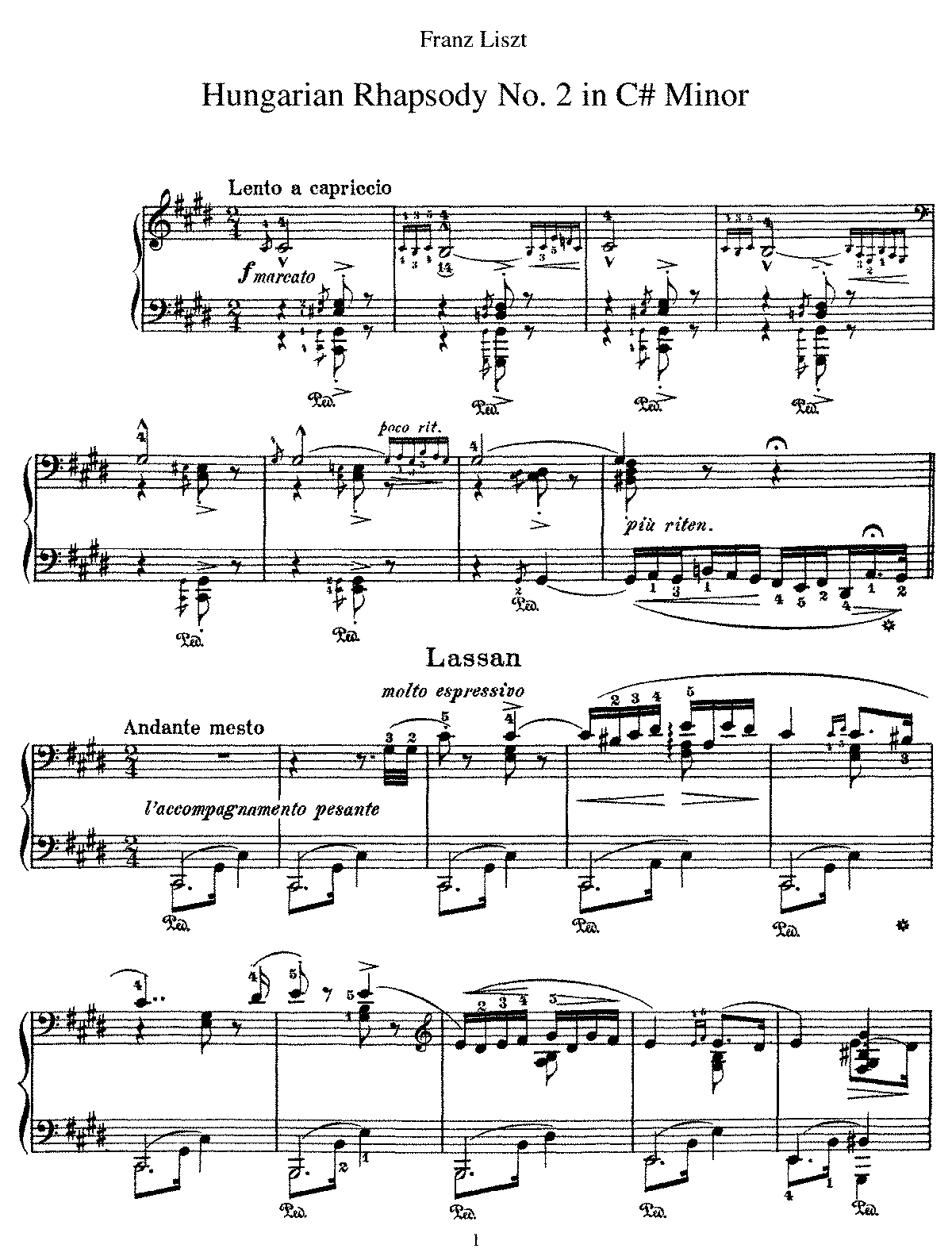
Today’s assignment is Hungarian Rhapsody No. 2 in C-sharp minor. It is the second in a set of 19 Hungarian Rhapsodies by composer Franz Liszt, and is by far the most famous of the set.
In both the original piano solo form and in the orchestrated version this composition has enjoyed widespread use in animated cartoons. Its themes have also served as the basis of several popular songs.
Above, Danish comedian and pianist Victor Borge gives every impression of having been asked to play a duet with someone whom he not only doesn’t know but doesn’t particularly like. Forced to come up with a mutually agreeable way of sharing the musical workload, he settles on the most difficult route possible.
It’s not clear why two pianists were needed for this performance of Liszt’s Hungarian Rhapsody No.2, S.244/2. I think that they did it just for the fun of it. The result is hilarious.
They’re not the only ones to tackle Liszt’s Hungarian Rhapsody No.2 as a piano duo.
We also have these guys:
The “history” of this piece in several cartoons:
This is very interesting:
As he often did, Horowitz arranged it more for his liking:
Today’s piece is slow and easy going. The name “Largo” itself means slow. Antonin Dvorák wrote this as a part of his Symphony No. 9 in E minor,also known as From the New World, Op. 95, B. 178 or just the New World Symphony.
Popularly known as the New World Symphony, it was composed in 1893 while Dvořák was the director of the National Conservatory of Music. It is by far his most popular symphony, and one of the most popular of all symphonies. In older literature and recordings, this symphony was often numbered as Symphony No. 5.
Astronaut Neil Armstrong took a tape recording of the New World Symphony along during the Apollo 11 mission, the first Moon landing, in 1969.
For Piano
And orchestra
The theme from the Largo was adapted into the spiritual-like song “Goin’ Home”, often mistakenly considered a folk song or traditional spiritual, by Dvořák’s pupil William Arms Fisher, who wrote the lyrics in 1922.
Find Largo in Keyboard Kickoff, Prelude (it’s called River Road, Movement 2 and Piano Maestro.
Whenever I think of slow things, I’m reminded of this clip from the old TV Show, Taxi
Since we had the Bridal Chorus a couple days ago, it’s time to march the bride and groom back up the aisle with the Wedding March by Felix Mendelssohn.
This Wedding March comes from Mendelssohn’s incidental music to A Midsummer Night’s Dream. It became customary to play this at marriage ceremonies from about the mid 19th Century, and particularly after the daughter (also called Victoria) of Queen Victoria chose the piece for her own wedding in 1858.
Notice all the triplets (3)! If you don’t know what they are, be sure to ask at your next lesson.
Find this in Movement 2 and Piano Maestro.
Franz Liszt and Vladimir Horowitz added some variations
It’s wedding season! Today and tomorrow, we’ll be looking at, and listening to, the music most associated with weddings.
The “Bridal Chorus” from the 1850 opera Lohengrin by German composer Richard Wagner is a march played for the bride’s entrance at many formal weddings throughout the Western world.
The piece was made popular when it was used as the processional at the wedding of Victoria the Princess Royal to Prince Frederick William of Prussia in 1858.
This piece is available in Keyboard Kickoff, Movement 2 and Piano Maestro.
The original from the opera
A piano version (this book is available for loan, if interested)
Joseph Haydn’s music contains many jokes, and the Surprise Symphony includes probably the most famous of all: a sudden very loud (fortissimo chord) at the end of the otherwise soft (piano) opening theme in the variation-form second movement. The music then returns to its original quiet dynamic, as if nothing had happened, and the ensuing variations do not repeat the joke. (In German it is commonly referred to as the Symphony “mit dem Paukenschlag”—”with the kettledrum stroke”).
In Haydn’s old age, his biographer George August Griesinger asked him whether he wrote this “surprise” to awaken the audience. Haydn replied:
No, but I was interested in surprising the public with something new, and in making a brilliant debut, so that my student Pleyel, who was at that time engaged by an orchestra in London (in 1792) and whose concerts had opened a week before mine, should not outdo me. The first Allegro of my symphony had already met with countless Bravos, but the enthusiasm reached its highest peak at the Andante with the Drum Stroke. Encore! Encore! sounded in every throat, and Pleyel himself complimented me on my idea.
The first time I saw this video during a piano lesson, both my students and I were surprised, too!
The melody is pretty basic and sometimes used to teach skips. I remember having it in one of my first books with words similar to See the Happy Little Frog, Hopping now from Log to Log.
Here’s a piano version.
Can you find the “surprise” indicated by the sforzando? Hint. It looks like this: Sforzando is one of those Italian words you get to learn in music and means a strong, sudden accent on a note or chord. Sforzando literally means subito forzando (fz), which translates to “suddenly with force.”
There’s some information about Haydn and this symphony in this video.
and this one
Beethoven’s Wig added some words
For 2 pianos, 8 hands. They’ve added their own surprise around minute 3.
This is a more advanced piece but I really like it. Some students may have heard this since it’s an alarm tone on my phone. My dog, Mimi, recognizes this music as her signal to go out for a walk!
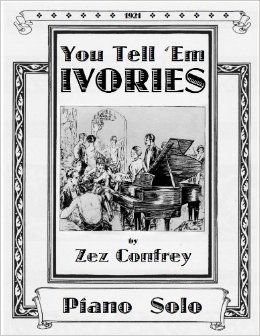
I just love Zez Confrey’s music. It’s not overplayed like some of Scott Joplin’s works but it’s just as much fun.
This is a piece I have often played in recitals and just for fun.
If any of my students are interested in tackling this piece, just let me know and we’ll start learning!
In 1921 Confrey wrote his novelty piano solo “Kitten on the Keys”, inspired by hearing his grandmother’s cat walk on the keyboard of her piano. It became a hit, and he went on to compose many other pieces in the genre.
Considered to be one of the fastest and most challenging of all “novelty” piano solos, “Dizzy Fingers” was composed in 1923. and was Confrey’s other biggest seller.
He left behind more than a hundred piano works, songs and miniature operas, and numerous piano rolls, music publications and sound recordings.
Not surprisingly, this piece is not available on Piano Maestro!
“This collection represents a cross-section of Confrey’s works and encompasses the broad range of his styles. Besides his famous 1920s novelty works (including Kitten on the Keys), there are many wonderful, lesser-known gems of remarkable quality included here from later in his career. Appearing for the first time in print are transcriptions of one of his disc recordings (Poor Buttermilk) and two of his player piano roll arrangements (My Pet and Humorestless). Many of Confrey’s later works have long been out of print and are included here for the first time in decades.”
Today, we’ll be listening to the end of the William Tell Overture by Gioachino Rossini. This piece, originally the overture to an opera, has been arranged for piano and is in several method books, including Piano Pronto Movements 1 and 2. It’s also in Bastien Book 4 and Piano Maestro.
The original story
Maybe your grandparents watched the original Lone Ranger
Or you saw the newer Lone Ranger with Johnny Depp
Here’s the entire William Tell Overture played by an orchestra
Piano Solo
Franz Liszt made a really hard version for piano solo. See if you can follow along!
Piano Duet (1 piano, 4 hands)
Piano Duet arranged by Louis Moreau Gottschalk
Piano Duo (2 pianos, 8 hands)
Piano Quartet (4 pianos, 16 hands)
For pipe organ
For synthesizer
And then things get nuts with cartoons. Lots of cartoons used this music. Here are Mickey Mouse and friends
And Spike Jones
Handbells…
Poor Rossini – I think he’d have a fit if he knew how is music was being used.






 MaryO'Studio