I’m sure many have you have learned Twinkle, Twinkle Little Star by now. Did you know its’ the same melody as the ABC Song? You know…
Don’t believe it? Sing them both in your head or out loud.
The French melody first appeared in 1761, and has been used for many children’s songs, such as “Twinkle, Twinkle, Little Star”, “Baa, Baa, Black Sheep” and the “Alphabet Song”.
This is one of the first pieces a student learns in piano methods, since it has them reach just a bit outside their accustomed hand position on the word “little”.
I try to remember to let students know that Wolfgang Amadeus Mozart composed a set of twelve variations on the theme “Ah, vous dirai-je, Maman” for the piano and it started as the same basic Twinkle tune.
The sheet music is available at the O’Connor Music Studio if you want to borrow it or download it here about 1/3 of the way down the page under “Scores”.
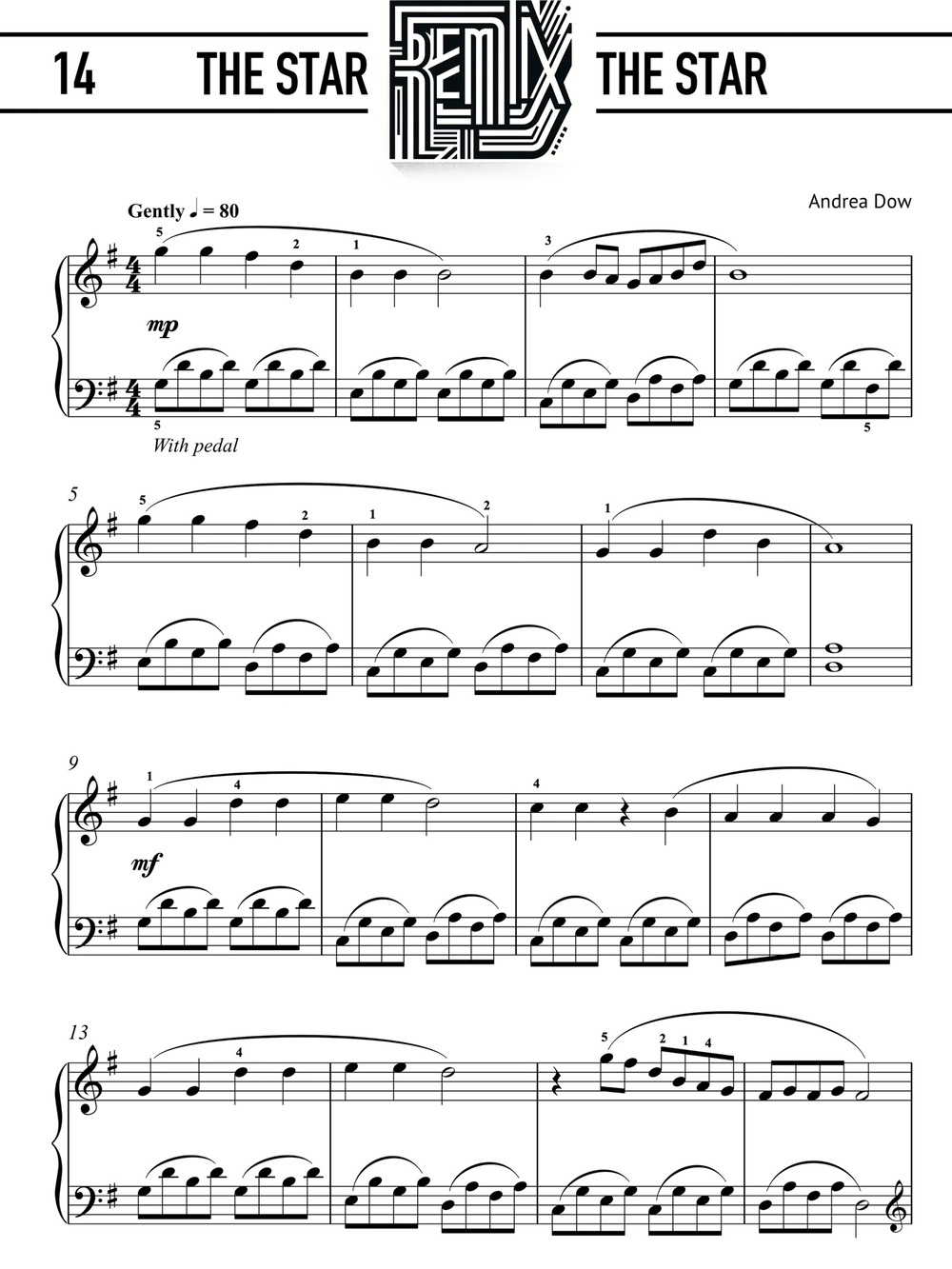
Students in Wunderkeys may play this version from Remix: Teen Hits from Kids Tunes:
I always enjoy these graphical scores. Watch the colors as the melody gets more and more complex:
This is the month for graduations of all sorts, college, high school, even preschool. Perhaps you know someone who is graduating this year. Maybe it’s you!
This piece by Sir Edward Elgar is called Pomp and Circumstance and usually heard at graduations. It was featured in Disney’s Fantasia 2000.
Edward Elgar’s father was a musician who tuned pianos, owned a music shop and was employed as a church organist. The young Edward learned to play the organ and violin at a young age and composed his first short piece at the age of 10. His first job was as assistant organist to his father. His main love was composition, although his music was not successful until his Enigma Variations were published in 1899. This work made him famous.
Until Elgar, there had not been a major creative composer in England since Handel’s death in 1759. He became known as England’s greatest composer and was widely recognized in his day. Unfortunately, Elgar’s fame waned at the end of his life – he composed little music during his last fifteen years and withdrew from almost all musical contact. It was not until the 1960’s that his music again became popular.
Today, we start with Spring from the Four Seasons by Vivaldi. Many OCMS students have played this already in one of their Piano Pronto books. It’s also available in Piano Maestro.
If you have it in your piano book, today would be a great day to review it. (HINT – there might be a quick review at your next lesson!)
Vivaldi was born in Venice, Italy, March 4, 1678 and spent most of his life there. His father taught him to play the violin, and the two would often perform together.
He taught at an orphanage for girls and wrote a lot of music for the girls to play. People came from miles around to hear Vivaldi’s talented students perform the beautiful music he had written.
Many people think Vivaldi was the best Italian composer of his time. He wrote concertos, operas, church music and many other compositions. In all, Antonio wrote over 500 concertos.
His most famous set of concertos is The Four Seasons which is a group of four violin concerti. Each of which gives a musical expression to a season of the year. They were written about 1721 and were published in 1725 in Amsterdam.
Here’s a piano version similar to the one in Movement 1 but in a different key.
Students in Wunderkeys may get this version:
And the original with Itzhak Perlman playing and conducting!
Want to play a version of this but aren’t using these books? Just ask!
As all my students know, I teach theory with all piano and organ lessons. Sometimes, it’s from a theory book that matches a lesson book, sometimes on the fly on an “as needed” basis.
This book looks like it would be interesting to use as a review or to look ahead and see what’s coming. I have just ordered a copy for the studio if you want to check it out at the next lesson.
If you wish there was a fun and engaging way to help you understand the fundamentals of music, then this is it. Whether it’s learning to read music, understanding chords and scales, musical forms, or improvising and composing, this enjoyable guide will help you to finally start understanding the structure and design of music.
This fun-filled, easy-to-use guide includes:
* Music notation
* Scales and modes
* Melody harmonization and counterpoint
* Chord progressions
* Song form and structure
Listen and learn with the CD that has 90 tracks, including over 50 popular songs such as:
* Beauty and the Beast
* Candle in the Wind
* Imagine
* In the Air Tonight
* Killing Me Softly with His Song
* Let It Be
* Message in a Bottle
* Misty
* Satin Doll
* Take the ‘A’ Train
* Unchained Melody
* What’d I Say
* and more!
The Piano Puzzlers book is available in the O’Connor Music Studio library if you’d like to give any a try. Piano Puzzlers as heard on American Public Media’s “Performance Today.” Includes 32 tunes with songs by Gershwin, Berlin, Arlen, Porter, Rodgers, Fats Waller, Lennon & McCartney, and others disguised in the styles of Bach, Handel, Haydn, Mozart, Beethoven, Brahms, Schubert, Schumann, Chopin, Janacek, Debussy, Ravel, Rachmaninoff, Stravinsky, Prokofiev, Bartok, and Copland.
Includes an introduction by Fred Child, host of “Performance Today” as well as background info by Bruce Adolphe. “Bruce Adolphe has taken a common musician’s party game and elevated it to high art and truly funny musical slapsticks. The Piano Puzzlers are a unique combination of extraordinary insight into the styles of many composers subtle, expert workmanship and great, great fun!”
If you’re a music geek (like me), I have a program for you. Now, let me be clear, to fully qualify as a music geek…you must have a fond appreciation for classical music (no, Poison, Quiet Riot, and Zepplin do not count as classical music). So, if you’re a “music geek” without an appreciation for classical music…well, I hate to burst your bubble…but, you’re not truly a music geek. Instead, you’re a music appreciator, but not a geek. So, if you just listen to indie music and scowl at anything on a label larger than Matador…don’t bother following the link I’ll provide…the fun will be lost on you…And, you probably won’t have a chance.
Every Wednesday night, on my way home from WNL, I turn on my local NPR station to listen to Piano Puzzlers on Performance Today. It’s absolutely incredible. A pianist/composer (Bruce Adolphe) takes a familiar folk or pop tune and sets it inside a classical masterpiece (or in the style of a particular composer). Sometimes it’s easy…sometimes it’s ridiculously difficult. There are days when I say, “got it” on the first pass. Then there are days when I say, “what the heck?” And, more often than not, I’m able to get either the popular/folk tune or the composer.
This is sad to admit, but there are nights when I’ll slow down on the drive home or sit in the car in the driveway to finish an episode. In fact, I get a little worked up if someone stops me after WNL…as I might miss the beginning of Piano Puzzlers (it usually hits around 8:20pm on our local station).
Take a listen to some of the archives and see if you can figure it out! It’s really cool…but probably only appreciated by music geeks (the kind of people that listen to NPR for their musical programs and not just the snipets of cool indie rock between segments on All Things Considered…which is a great show too).
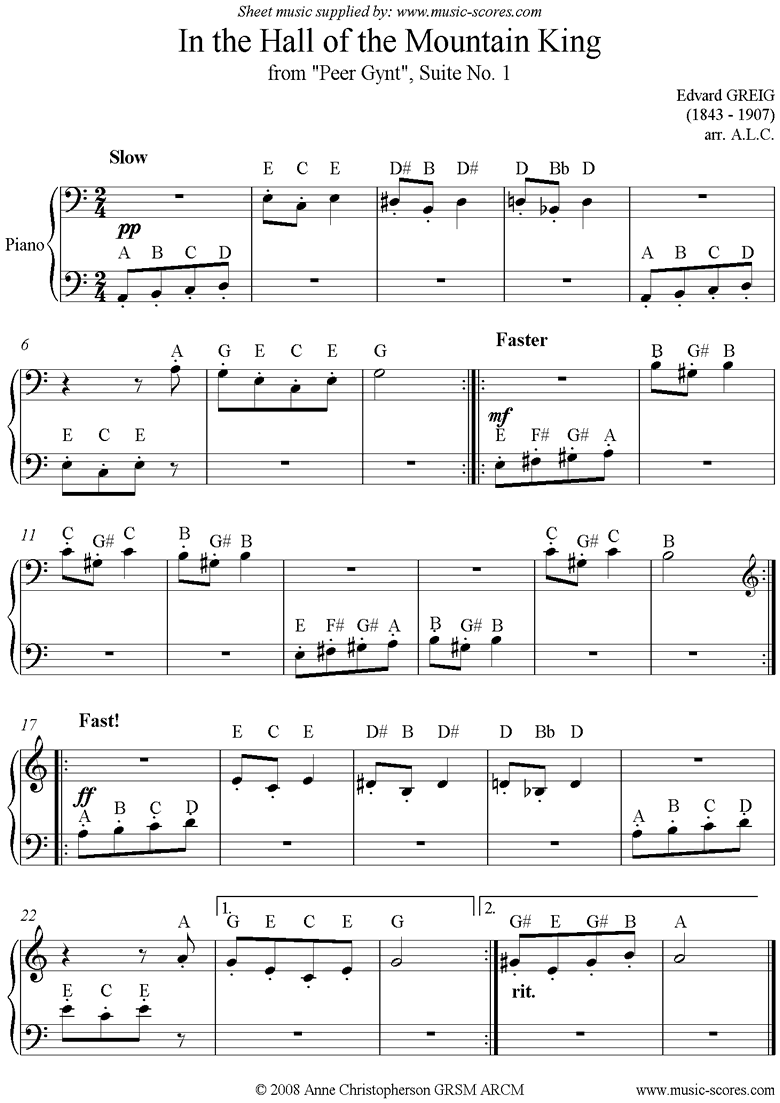
“In the Hall of the Mountain King” is a piece of orchestral music composed for the sixth scene of act 2 in Henrik Ibsen’s 1867 play Peer Gynt. It was originally part of Opus 23 but was later extracted as the final piece of Peer Gynt, Suite No. 1, Op. 46. Its easily recognizable theme has helped it attain iconic status in popular culture, where it has been arranged by many artists, including for the piano.
Borrow a copy of the sheet music from the O’Connor Music Studio. I have this arranged for piano, duet, 2-piano, simplified…
8 part vocal orchestra (plus a tiny pair of cymbals)
“The Entertainer” is a 1902 classic piano rag written by Scott Joplin. It was sold first as sheet music, and in the 1910s as piano rolls that would play on player pianos.
It was used as the theme music for the 1973 Oscar-winning film The Sting by composer and pianist Marvin Hamlisch.
The Sting was set in the 1930s, a full generation after the end of ragtime’s mainstream popularity, thus giving the inaccurate impression that ragtime music was popular at that time.
Find the sheet music in a variety of levels including Songs I Love to Play, Volume 1 and Alfred Premier Piano Course Book 4. It’s also available in Piano Maestro and to borrow from the O’Connor Music Studio
Today’s Listening Assignment is Country Gardens by Percy Grainger.
“Country Gardens” is an English folk tune collected by Cecil Sharp from the playing of William Kimber and arranged for piano in 1918 by Percy Grainger.
The tune and the Grainger arrangement for piano and orchestra is a favorite with school orchestras, and other performances of the work include morris dancing.
A piano version:
Piano duet (four-hands)
Clarinet solo
Orchestra
The Ambrosian Children’s Choir
From the Muppets
And, how a Morris Dance is done:
Find Country Gardens on IMSLP, Piano Maestro (under the method book section) and Piano Pronto: Movement 2
Today’s is a cheat post, partly because I ran out of time.
I’ve watched this video several times in the past few days. It’s a great overview of the Beatles music. And, yes, I have books of their music arranged for piano, if you want to play anything.