Daily Listening Assignments ~ July 14

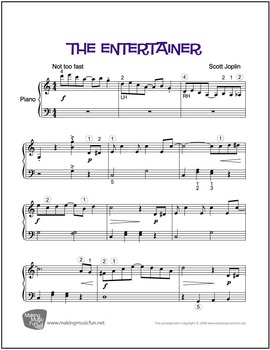
“The Entertainer” is a 1902 classic piano rag written by Scott Joplin. It was sold first as sheet music, and in the 1910s as piano rolls that would play on player pianos.

It was used as the theme music for the 1973 Oscar-winning film The Sting by composer and pianist Marvin Hamlisch.
The Sting was set in the 1930s, a full generation after the end of ragtime’s mainstream popularity, thus giving the inaccurate impression that ragtime music was popular at that time.

Find the sheet music in a variety of levels including Songs I Love to Play, Volume 1 and Alfred Premier Piano Course Book 4.  It’s also available in Piano Maestro and to borrow from the O’Connor Music Studio

As played in The Sting

Adam Swanson

Piano Duet

On an older piano

At Disney

Player piano

Harder than it needs to be

From a 4-year-old

Violin and piano

String Quartet

On guitar

Saxophone quartet

Miss Piggy sang The Entertainer

And, everyone’s favorite – the ice cream truck!

Daily Listening Assignments ~ July 9

Today’s piece is based on a collection of tales known as the One Thousand and One Nights or Arabian Nights.

The story, which was written many hundreds of years ago, tells of a Persian king who married a young girl every night. Every morning he would send his new wife to have her head chopped off. He had already killed 3000 women in this way.

When Scheherazade heard about this, she wanted to spend the night with him. She spent all night telling him a story. At the end of the night, she stopped the story at an exciting moment, like a modern-day soap opera.

The next night she finished the story and began another one, which she again stopped when it was dawn. The king had to wait another night to hear the rest of the story. Scheherazade kept this up for 1001 nights. By then, the king had fallen in love with Scheherazade and he let her live.

Rimsky-Korsakov’s best-known work is Scheherazade, an orchestral piece that describes in music the stories told by Scheherazade.

The work consists of four movements:

The Sea and Sinbad’s Ship

The Kalandar Prince

The Young Prince and The Young Princess

Festival at Baghdad. The Sea. The Ship Breaks against a Cliff Surmounted by a Bronze Horseman

Today, we’re focusing on The Young Prince and The Young Princess which can be found in Piano Pronto Movement 4

Piano duet

Orchestra

Flute ensemble

Gene Kelly dancing with a cartoon partner

The entire work

Daily Listening Assignments ~ July 8

Today, we’ll listen to the Symphony No. 5 in C minor, Op. 67, of Ludwig van Beethoven.  It was written between 1804–1808. It is one of the best-known compositions in classical music, and one of the most frequently played symphonies. As is typical of symphonies in the classical period, Beethoven’s Fifth Symphony is in four movements.

I’m sure you’ve heard the first 8 notes before…

Since it was written for orchestra, each instrument has its own line:

A piano version, transcribed by Liszt

From Disney’s Fantasia 2000:

Pink learns to play the violin, and interrupts a performance of Beethoven’s Fifth Symphony with the Pink Panther theme played on various instruments.

Beethoven’s Wig:

Arrangements of Beethoven’s Fifth Symphony can be found in Piano Maestro and lots of books including Piano Pronto’s Movement 2, Movement 5 (Victory Theme) and Beethoven: Exploring His Life and Music.

Daily Listening Assignments ~ July 7

Today’s Listening Assignment is Country Gardens by Percy Grainger.

“Country Gardens” is an English folk tune collected by Cecil Sharp from the playing of William Kimber and arranged for piano in 1918 by Percy Grainger.

The tune and the Grainger arrangement for piano and orchestra is a favorite with school orchestras, and other performances of the work include morris dancing.

A piano version:

Piano duet (four-hands)

Clarinet solo

Orchestra

The Ambrosian Children’s Choir

From the Muppets

And, how a Morris Dance is done:

Find Country Gardens on IMSLP, Piano Maestro (under the method book section) and Piano Pronto: Movement 2

Daily Listening Assignments ~ July 3

Pictures at an Exhibition is a suite of ten pieces (plus a recurring, varied Promenade) composed for the piano by Russian composer Modest Mussorgsky in 1874.

The suite is Mussorgsky’s most famous piano composition and has become a showpiece for virtuoso pianists. It has become further known through various orchestrations and arrangements produced by other musicians and composers, with Maurice Ravel’s arrangement being by far the most recorded and performed.

You can download the sheet music at IMSP or I have a copy of the book, as well as simplified sheet music.

The work opens with a brilliant touch – a “promenade” theme (above) that reemerges throughout as a transition amid the changing moods of the various pictures.

The ten pictures Mussorgsky depicts are:

  • a gnome-shaped nutcracker;
  • a troubadour plaintively singing outside an ancient castle;
  • children vigorously playing and quarreling in a park;
  • a lumbering wooden Polish ox-cart;
  • a ballet of peeping chicks as they hatch from their shells;
  • an argument between two Warsaw Jews, one haughty and vain, the other poor and garrulous;
  • shrill women and vendors in a crowded marketplace;
  • the eerie, echoing gloom of catacombs beneath Paris;
  • the hut of a grotesque bone-chomping witch of Russian folklore named Baba Yaga;
  • and a design for an entrance gate to Kiev.

The whole piece for piano.  See if you can tell which pictures are which.

Orchestrated, with the full score:

Just the Baba Yaga section:

The Emerson, Lake and Palmer version:

Daily Listening Assignments ~ July 2

toccata-d-minor

Johann Sebastian Bach’s towering monument of organ music, with its deep sense of foreboding, will forever be associated with Halloween.

Get a free copy of the sheet music at IMSLP or borrow a copy from the O’Connor Music Studio.  I have this arranged for organ, piano, duet, 2-piano, simplified…

It’s also available in Piano Maestro, Piano Pronto Encore and Coda

If you want this in a book with other Bach transcriptions, amazon has this: Toccata and Fugue in D minor and the Other Bach Transcriptions for Solo Piano, arranged by Ferruccio Busoni.

Here, Virgil Fox performs it on his Allen Digital Touring Organ.

Diane Bish plays the Massey Memorial Organ at the Chautauqua Institution and talks about this instrument.

Animated organ:

Glass harmonica

Accordion

Cartoon:

Daily Listening Assignments ~ July 1

Today’s piece is the other one of two pieces that are so often played incorrectly that they have the distinction of being banned from competition in Northern Virginia Piano Teacher competitions.

The first was Fur Elise.  This one is Spinning Song by Albert Ellmenreich.  It’s in many, many piano method books.  When I was in 5th or 6th grade, I tore it out of my book, put it in a construction paper cover and played it for some Girl Scout talent show.  I have no idea why I couldn’t leave it in the book.

The left hand is supposed to sound like the foot pumping the wheel to make it move

This is part of a larger work called Musikalische Genrebilder, Op.14 which can be downloaded at IMSLP:

Spinnliedchen (Spinning Song), the best known item from the set, seems to be universally referred to as number four. The announcement of the first edition in Hofmeister’s Monatsberichte lists it as the fifth item. In Schirmer’s 1878 edition (see cover: here) of Op.14 it appears that items two and three were possibly combined into one number (entitled Sorrow and Consolation) so that Spinnliedchen became number four. Perhaps, this is the origin of the re-numbering.

To learn this sheet music, it’s available in Piano Pronto Movement 4 and Alfred Premier Piano Course Book 6

Here’s a sample:

A tutorial

With scrolling sheet music

For organ

How to conduct(?)

While this piece is not usually popular with other instruments, a trumpet quartet gave it a try

The DMS Percussion Ensemble

Singers from the Londonderry Middle School gave it a try:

The first half of this video is flute tuning. After that is a lovely flute duet.

I can’t take any more of these!

Daily Listening Assignments ~ June 28

Korobeiniki is a nineteenth-century Russian folk song that tells the story of a meeting between a peddler and a girl, describing their haggling over goods in a veiled metaphor for courtship.

Outside Russia, “Korobeiniki” is widely known as the Tetris theme.

Piano duet:

Orchestral version:

For Boomwhackers:

Vocal:

Ragtime:

Balalaika:

Two bassoons:

The Red Army Choir:

Korobeiniki/Tetris is available in Piano Maestro on the iPad and I have several levels of sheet music for anyone who is interested.

Enjoy!

Daily Listening Assignments ~ June 27

Pictures at an Exhibition is a suite of ten pieces (plus a recurring, varied Promenade) composed for the piano by Russian composer Modest Mussorgsky in 1874.

The suite is Mussorgsky’s most famous piano composition and has become a showpiece for virtuoso pianists. It has become further known through various orchestrations and arrangements produced by other musicians and composers, with Maurice Ravel’s arrangement being by far the most recorded and performed.

You can download the sheet music at IMSP or I have a copy of the book, as well as simplified sheet music.

The work opens with a brilliant touch – a “promenade” theme (above) that reemerges throughout as a transition amid the changing moods of the various pictures.

The ten pictures Mussorgsky depicts are:

  • a gnome-shaped nutcracker;
  • a troubadour plaintively singing outside an ancient castle;
  • children vigorously playing and quarreling in a park;
  • a lumbering wooden Polish ox-cart;
  • a ballet of peeping chicks as they hatch from their shells;
  • an argument between two Warsaw Jews, one haughty and vain, the other poor and garrulous;
  • shrill women and vendors in a crowded marketplace;
  • the eerie, echoing gloom of catacombs beneath Paris;
  • the hut of a grotesque bone-chomping witch of Russian folklore named Baba Yaga;
  • and a design for an entrance gate to Kiev.

The whole piece for piano.  See if you can tell which pictures are which.

Orchestrated, with the full score:

Just the Baba Yaga section:

The Emerson, Lake and Palmer version:

Daily Listening Assignments ~ June 26

Today’s piece is Antonin Dvořák’s Humoresque #7.

Humoresques Op. 101 (B. 187), is a piano cycle by the Czech composer Antonín Dvořák, written during the summer of 1894. One writer says “the seventh Humoresque is probably the most famous small piano work ever written after Beethoven’s Für Elise.

Orchestra:

Ragtime:

Jazz with Wynton Marsalis on trumpet

Zez Confrey gave this a makeover and included Way Down Upon the Swanee River:

Find the original Humoresque on IMSLP. The O’Connor Music Studio Lending Library has versions of Humoresque available at several levels and Confey’s Humorestless played in the video above.