
Today’s piece is a mashup of Andrew Lloyd Webber’s Phantom of the Opera and Bach’s d minor concerto. I think it’s a great sound and I eagerly awaited the sheet music which I finally located.


Today’s piece is a mashup of Andrew Lloyd Webber’s Phantom of the Opera and Bach’s d minor concerto. I think it’s a great sound and I eagerly awaited the sheet music which I finally located.
Solfeggietto is a short solo keyboard piece in c minor composed in 1766 by Carl Philipp Emanuel Bach. Carl Philipp Emanuel Bach was a German composer and the son of J.S. Bach.
“Solfeggietto” is an Italian word meaning “little study” or exercise.
The work is unusual for a keyboard piece in that the main theme is only one note being played at a time. The piece is commonly assigned to piano students and appears in many anthologies.
This piece is easily Bach’s best-known and is often performed by left-hand alone.
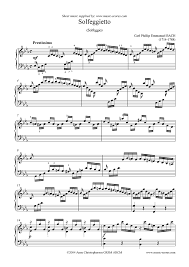
See if you can follow along. The notes with the stems down (even in the treble clef) are normally played with the left hand.
With just the left hand:
Electric Guitar
Bass Clarinet
Clarinet sextet
Harp
Are you any of these? This is the first annoying pianist. Too Humble – Solfeggietto in C minor by C.P.E. Bach



John Cage 4’33”
John Cage on silence

Today’s piece is based on a collection of tales known as the One Thousand and One Nights or Arabian Nights.
The story, which was written many hundreds of years ago, tells of a Persian king who married a young girl every night. Every morning he would send his new wife to have her head chopped off. He had already killed 3000 women in this way.
When Scheherazade heard about this, she wanted to spend the night with him. She spent all night telling him a story. At the end of the night, she stopped the story at an exciting moment, like a modern-day soap opera.
The next night she finished the story and began another one, which she again stopped when it was dawn. The king had to wait another night to hear the rest of the story. Scheherazade kept this up for 1001 nights. By then, the king had fallen in love with Scheherazade and he let her live.
Rimsky-Korsakov’s best-known work is Scheherazade, an orchestral piece that describes in music the stories told by Scheherazade.
The work consists of four movements:
The Sea and Sinbad’s Ship
The Kalandar Prince
The Young Prince and The Young Princess
Festival at Baghdad. The Sea. The Ship Breaks against a Cliff Surmounted by a Bronze Horseman
Today, we’re focusing on The Young Prince and The Young Princess which can be found in Piano Pronto Movement 4

Piano duet
Orchestra
Flute ensemble
Gene Kelly dancing with a cartoon partner
The entire work
Today, we’ll listen to the Symphony No. 5 in C minor, Op. 67, of Ludwig van Beethoven. It was written between 1804–1808. It is one of the best-known compositions in classical music, and one of the most frequently played symphonies. As is typical of symphonies in the classical period, Beethoven’s Fifth Symphony is in four movements.
I’m sure you’ve heard the first 8 notes before…

Since it was written for orchestra, each instrument has its own line:
A piano version, transcribed by Liszt
From Disney’s Fantasia 2000:
Pink learns to play the violin, and interrupts a performance of Beethoven’s Fifth Symphony with the Pink Panther theme played on various instruments.
Beethoven’s Wig:
Arrangements of Beethoven’s Fifth Symphony can be found in Piano Maestro and lots of books including Piano Pronto’s Movement 2, Movement 5 (Victory Theme) and Beethoven: Exploring His Life and Music.
Today’s Listening Assignment is Country Gardens by Percy Grainger.

“Country Gardens” is an English folk tune collected by Cecil Sharp from the playing of William Kimber and arranged for piano in 1918 by Percy Grainger.
The tune and the Grainger arrangement for piano and orchestra is a favorite with school orchestras, and other performances of the work include morris dancing.
A piano version:
Piano duet (four-hands)
Clarinet solo
Orchestra
The Ambrosian Children’s Choir
From the Muppets
And, how a Morris Dance is done:
Find Country Gardens on IMSLP, Piano Maestro (under the method book section) and Piano Pronto: Movement 2

I’m running late today…


“Morning Mood” is part of Edvard Grieg’s Peer Gynt, Op. 23 was written in 1875.
The melody uses the pentatonic (five-note) scale, lending itself to beginning piano books.

Orchestra:
Music box:
Cartoon:
Flash mob(!!)
Morning Mood is available in Piano Maestro, Piano Pronto Prelude (as Morning Theme) and other books.
Pictures at an Exhibition is a suite of ten pieces (plus a recurring, varied Promenade) composed for the piano by Russian composer Modest Mussorgsky in 1874.
The suite is Mussorgsky’s most famous piano composition and has become a showpiece for virtuoso pianists. It has become further known through various orchestrations and arrangements produced by other musicians and composers, with Maurice Ravel’s arrangement being by far the most recorded and performed.
You can download the sheet music at IMSP or I have a copy of the book, as well as simplified sheet music.

The work opens with a brilliant touch – a “promenade” theme (above) that reemerges throughout as a transition amid the changing moods of the various pictures.
The ten pictures Mussorgsky depicts are:
The whole piece for piano. See if you can tell which pictures are which.
Orchestrated, with the full score:
Just the Baba Yaga section:
The Emerson, Lake and Palmer version:

Johann Sebastian Bach’s towering monument of organ music, with its deep sense of foreboding, will forever be associated with Halloween.
Get a free copy of the sheet music at IMSLP or borrow a copy from the O’Connor Music Studio. I have this arranged for organ, piano, duet, 2-piano, simplified…
It’s also available in Piano Maestro, Piano Pronto Encore and Coda
If you want this in a book with other Bach transcriptions, amazon has this: Toccata and Fugue in D minor and the Other Bach Transcriptions for Solo Piano, arranged by Ferruccio Busoni.
Here, Virgil Fox performs it on his Allen Digital Touring Organ.
Diane Bish plays the Massey Memorial Organ at the Chautauqua Institution and talks about this instrument.
Animated organ:
Glass harmonica
Accordion
Cartoon:
 MaryO'Studio