
Tag Archives: Wunderkeys
Daily Listening Assignments ~ June 19

Today’s piece is one of those that piano students often try to learn on their own – or a friend will teach them the first 9 notes. It’s usually played too fast and, often in the wrong octave, or the first couple notes are repeated too many times.
This is one of two pieces that are so often played incorrectly that they have the distinction of being banned from competition in Northern Virginia Piano Teacher competitions.
Stay tuned for the other one!
Für Elise was not published during Beethoven’s lifetime, having been discovered by Ludwig Nohl 40 years after the composer’s death. The identity of “Elise” is unknown.
The very basic melody:

From Wunderkeys – The Elise Session
The actual beginning is a little more involved.
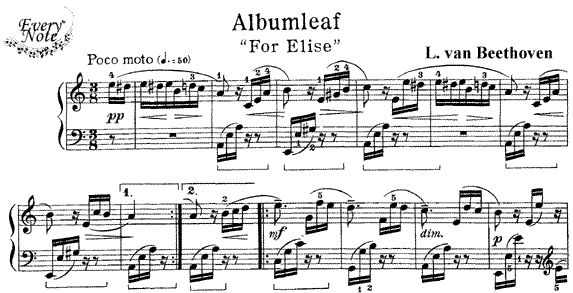
And, there’s more!

If you’d like to learn to play this piece correctly, find the sheet music at IMSLP, Beethoven: Exploring His Life and Music, and countless compilations of classical music available at the O’Connor Music Studio.
Follow along:
By Valentina Lisitsa:
Ragtime!
The Big Piano at FAO Schwartz in NYC:
Glass harp:
The Mystery Behind Für Elise:
Youtube has many, many more versions. Beethoven would probably go nuts!

Daily Listening Assignments ~ June 17
Today’s assignment is a very popular piece by Johann Pachelbel called Canon in D.
A canon is a technique that employs a melody with one or more imitations of the melody played after a given duration (e.g., quarter rest, one measure, etc.). The initial melody is called the leader, while the imitative melody, which is played in a different voice, is called the follower. The follower must imitate the leader, either as an exact replication of its rhythms and intervals or some transformation thereof. Repeating canons in which all voices are musically identical are called rounds—”Row, Row, Row Your Boat” and “Frère Jacques” are popular examples.

The original version:

Can you see why the cellist is bored?
Here’s what his music looks like

And that repeats over and over for the whole piece!
A bit of humor from a past cellist:
Variations on the theme:
Find it in Piano Pronto Finale and Coda

If your student is in Wunderkeys, The Pachelbel Session is a pop take on Pachelbel’s Canon in D. You can find the sheet music for this piece in WunderKeys Intermediate Performance Companion for Pop Studies Book 3.
Daily Listening Assignments ~ June 16
“Ode to Joy” was written in the summer of 1785 by German poet, playwright, and historian Friedrich Schiller and published the following year in Thalia. A slightly revised version appeared in 1808, changing two lines of the first and omitting the last stanza.

“Ode to Joy” is best known for its use by Ludwig van Beethoven in the final (fourth) movement of his Ninth Symphony, completed in 1824. This was Beethoven’s final symphony and lasts over an hour for the whole thing.
The entire final movement:
Beethoven’s text is not based entirely on Schiller’s poem, and introduces a few new sections. His melody (but not Schiller’s words) was adopted as the Anthem of Europe by the Council of Europe in 1972 and subsequently by the European Union.

If your student is in Wunderkeys, this is a classical pop piano solo based on Beethoven’s 9th Symphony. This Level 4 piano solo is from the book The Beethoven Sessions; a collection of 7 classical pop piano solos inspired by the music of Beethoven.
It is often called Joyful, Joyful We Adore Thee (You) in hymnbooks.

Find Ode to Joy in Piano Maestro, Prelude, Beethoven: Exploring His Life and Music and several hym books.
By now, you know I love flashmobs:
And Muppets (note the metronome going wild!):
And Barbershop:
An animated score:
Boomwhackers:
The Piano Guys combined Ode to Joy with Joy to the World for a new Christmas arrangement:
As the European Anthem:
And, finally Joyful, Joyful we Adore Thee by the Mormon Tabernacle Choir.
Do a search on youtube – lots and lots of people have played this famous Beethoven melody.

Daily Listening Assignments ~ June 13
Today’s piece is slow and easy-going. The name “Largo” itself means slow. Antonin Dvorák wrote this as a part of his Symphony No. 9 in E minor, also known as From the New World, Op. 95, B. 178, or just the New World Symphony.
Popularly known as the New World Symphony, it was composed in 1893 while Dvořák was the director of the National Conservatory of Music. It is by far his most popular symphony, and one of the most popular of all symphonies. In older literature and recordings, this symphony was often numbered as Symphony No. 5.
Astronaut Neil Armstrong took a tape recording of the New World Symphony along during the Apollo 11 mission, the first Moon landing, in 1969.
Find Largo in Keyboard Kickoff, Prelude (it’s called River Road), Movement 2 and Piano Maestro

And orchestra
The theme from the Largo was adapted into the spiritual-like song “Goin’ Home”, often mistakenly considered a folk song or traditional spiritual, by Dvořák’s pupil William Arms Fisher, who wrote the lyrics in 1922.
.
Pipe Organ
Recorder
And sung
Whenever I think of slow things, I’m reminded of this clip from the old TV Show, Taxi
If your student is in the Wunderkeys series, “Enchanted” from Elementary 2A s a pop twist on the New World Symphony by Dvořák. In this solo students explore dotted quarter rhythms, two half-notes as a LH accompaniment, and gain further comfort in the G Major pentascales.
So, since it’s summertime…

Daily Listening Assignments ~ June 5, 2025
Happy Birthday is a song that I like to have each of my students learn at various levels appropriate to their level. When a friend or family member has a birthday, it’s great to be able to sit down and play.

It’s only been fairly recently that piano students could have this music in their books.
“Happy Birthday to You”, more commonly known as simply “Happy Birthday”, is a song that is traditionally sung to celebrate the anniversary of a person’s birth. According to the 1998 Guinness World Records, “Happy Birthday to You” is the most recognized song in the English language, followed by “For He’s a Jolly Good Fellow”.
The melody, or part you sing, of “Happy Birthday to You” comes from the song “Good Morning to All”, which has traditionally been attributed to American sisters Patty and Mildred J. Hill in 1893, although the claim that the sisters composed the tune is disputed.
Patty Hill was a kindergarten principal and her sister Mildred was a pianist and composer. The sisters used “Good Morning to All” as a song that young children would find easy to sing. The combination of melody and lyrics in “Happy Birthday to You” first appeared in print in 1912, and probably existed even earlier.
“Happy Birthday” in the style of Bach, Mozart, Beethoven, Mendelssohn, Chopin, Liszt, Dvorak, and Stravinsky. Find the melody!
Lots of legal stuff below which you can skip…
None of the early appearances of the “Happy Birthday to You” lyrics included credits or copyright notices. The Summy Company registered a copyright in 1935, crediting authors Preston Ware Orem and Mrs. R. R. Forman. In 1988, Warner/Chappell Music purchased the company owning the copyright for US$25 million, with the value of “Happy Birthday” estimated at US$5 million. Based on the 1935 copyright registration, Warner claimed that the United States copyright will not expire until 2030, and that unauthorized public performances of the song are illegal unless royalties are paid to Warner. In one specific instance in February 2010, these royalties were said to amount to US$700. By one estimate, the song is the highest-earning single song in history, with estimated earnings since its creation of US$50 million.In the European Union, the copyright for the song expired on January 1, 2017.
The American copyright status of “Happy Birthday to You” began to draw more attention with the passage of the Sonny Bono Copyright Term Extension Act in 1998. When the U.S. Supreme Court upheld the Act in Eldred v. Ashcroft in 2003, Associate Justice Stephen Breyer specifically mentioned “Happy Birthday to You” in his dissenting opinion. American law professor Robert Brauneis, who extensively researched the song, concluded in 2010 that “It is almost certainly no longer under copyright.”
In 2013, based in large part on Brauneis’s research, Good Morning to You Productions, a company producing a documentary about “Good Morning to All”, sued Warner/Chappell for falsely claiming copyright to the song. In September 2015, a federal judge declared that the Warner/Chappell copyright claim was invalid, ruling that the copyright registration applied only to a specific piano arrangement of the song, and not to its lyrics and melody.
In 2016, Warner/Chappell settled for US $14 million, and the court declared that “Happy Birthday to You” was in the public domain.
Legal stuff is finished and people can now sing and play “Happy Birthday to You” whenever and wherever they want.
Students in Wunderkeys may play this version from Remix: Teen Hits from Kids Tunes
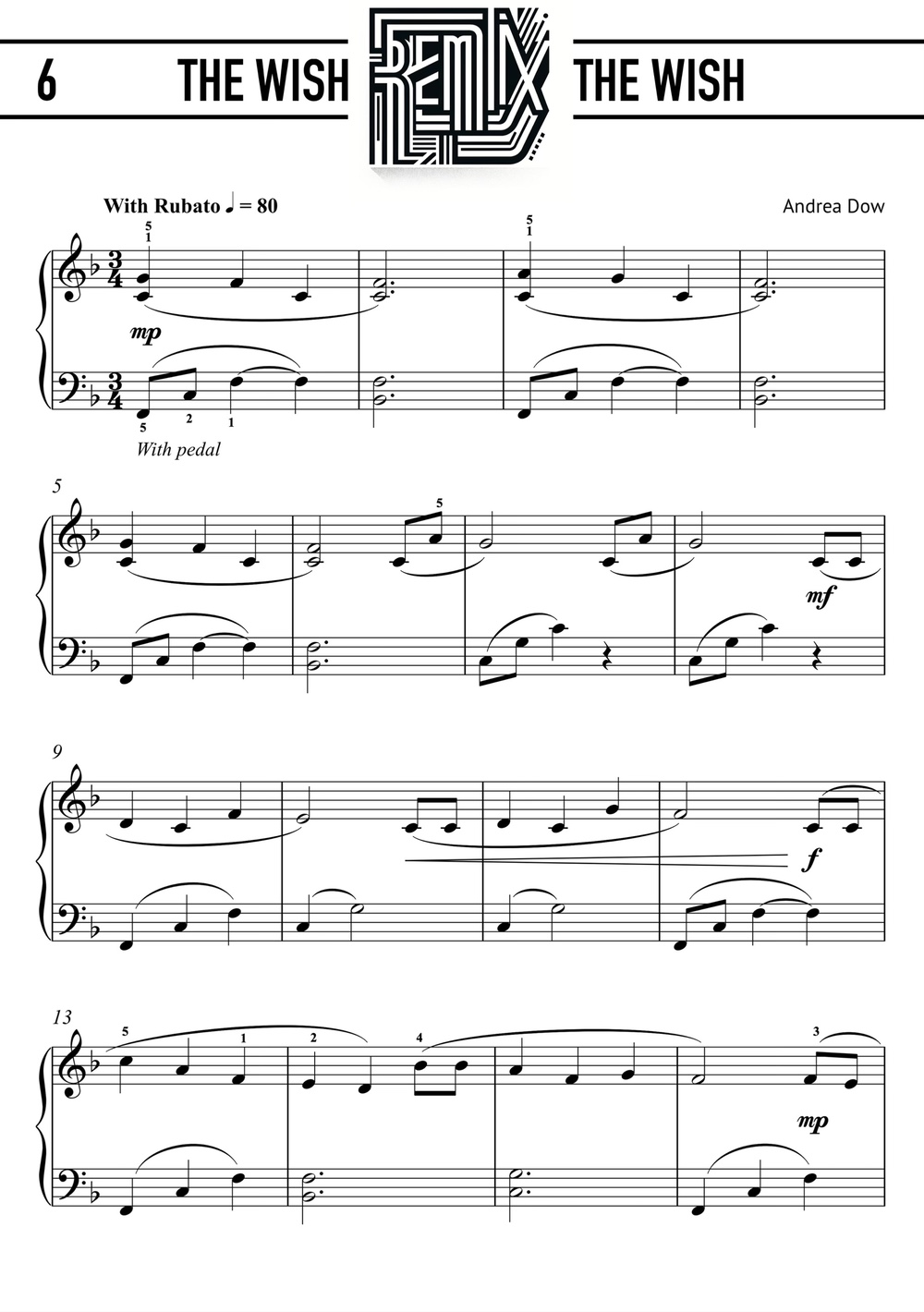
One of my all-time versions of Happy Birthday, in duet form – and I have the music if you want to tackle it.

Daily Listening Assignments ~ June 4, 2025
I’m sure many have you have learned Twinkle, Twinkle Little Star by now. Did you know its’ the same melody as the ABC Song? You know…
Don’t believe it? Sing them both in your head or out loud.
The French melody first appeared in 1761, and has been used for many children’s songs, such as “Twinkle, Twinkle, Little Star”, “Baa, Baa, Black Sheep” and the “Alphabet Song”.
This is one of the first pieces a student learns in piano methods, since it has them reach just a bit outside their accustomed hand position on the word “little”.

I try to remember to let students know that Wolfgang Amadeus Mozart composed a set of twelve variations on the theme “Ah, vous dirai-je, Maman” for the piano and it started as the same basic Twinkle tune.
The sheet music is available at the O’Connor Music Studio if you want to borrow it or download it here about 1/3 of the way down the page under “Scores”.
Students in Wunderkeys may play this version from Remix: Teen Hits from Kids Tunes:
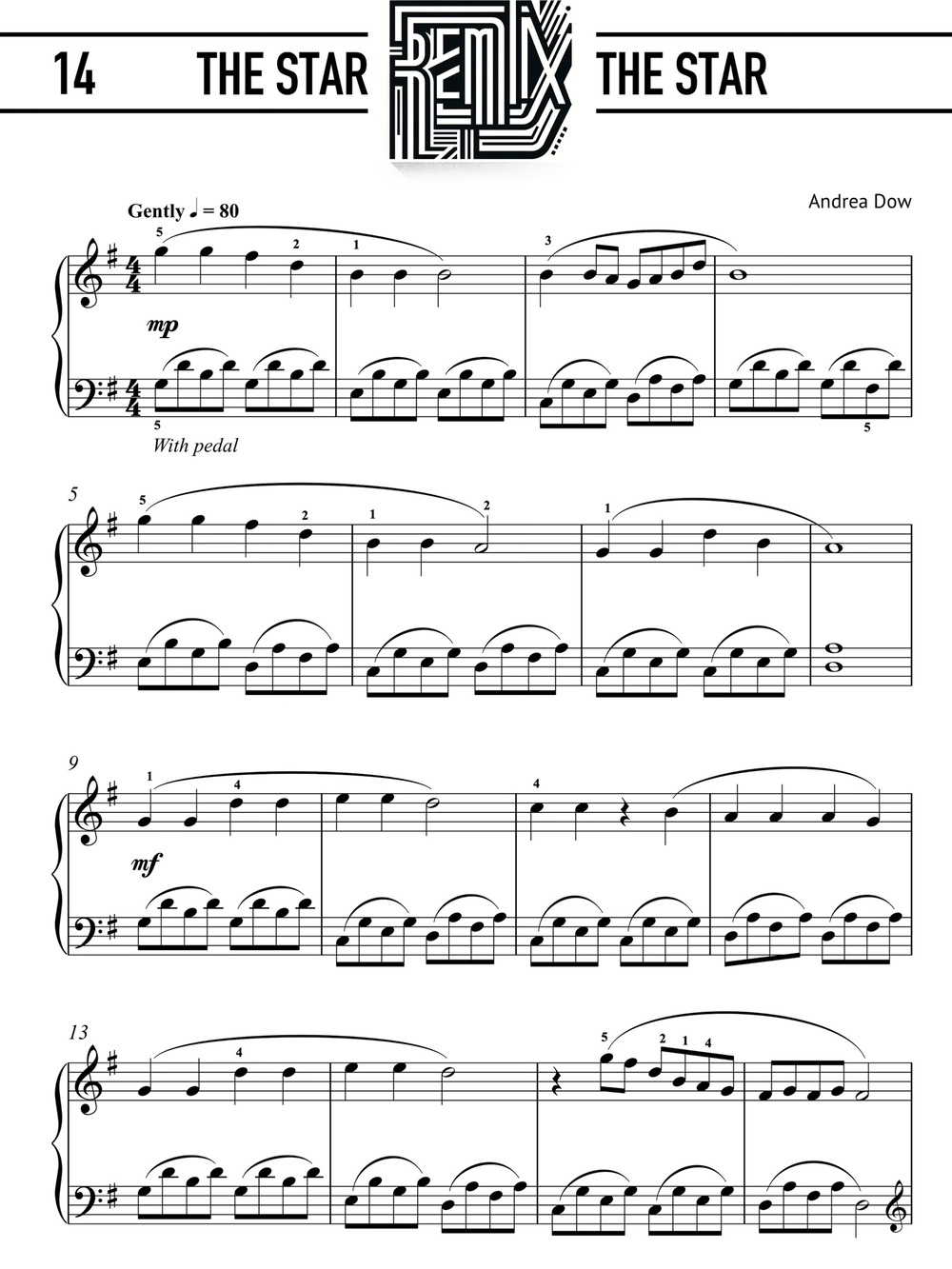
I always enjoy these graphical scores. Watch the colors as the melody gets more and more complex:
Who knew? There’s an accordion version.
Have a great day!

Daily Listening Assignments ~ June 2, 2025
This is the month for graduations of all sorts, college, high school, even preschool. Perhaps you know someone who is graduating this year. Maybe it’s you!
This piece by Sir Edward Elgar is called Pomp and Circumstance and usually heard at graduations. It was featured in Disney’s Fantasia 2000.
Edward Elgar’s father was a musician who tuned pianos, owned a music shop and was employed as a church organist. The young Edward learned to play the organ and violin at a young age and composed his first short piece at the age of 10. His first job was as assistant organist to his father. His main love was composition, although his music was not successful until his Enigma Variations were published in 1899. This work made him famous.
Until Elgar, there had not been a major creative composer in England since Handel’s death in 1759. He became known as England’s greatest composer and was widely recognized in his day. Unfortunately, Elgar’s fame waned at the end of his life – he composed little music during his last fifteen years and withdrew from almost all musical contact. It was not until the 1960’s that his music again became popular.
More information about Elgar
Do you know your chords well? If so, try this version:

Students in Wunderkeys may get this version:
If not, ask at your next lesson for a version at your level.
Daily Listening Assignments ~ June 1, 2025
Today, we start with Spring from the Four Seasons by Vivaldi. Many OCMS students have played this already in one of their Piano Pronto books. It’s also available in Piano Maestro.
If you have it in your piano book, today would be a great day to review it. (HINT – there might be a quick review at your next lesson!)
Vivaldi was born in Venice, Italy, March 4, 1678 and spent most of his life there. His father taught him to play the violin, and the two would often perform together.
He taught at an orphanage for girls and wrote a lot of music for the girls to play. People came from miles around to hear Vivaldi’s talented students perform the beautiful music he had written.
Many people think Vivaldi was the best Italian composer of his time. He wrote concertos, operas, church music and many other compositions. In all, Antonio wrote over 500 concertos.
His most famous set of concertos is The Four Seasons which is a group of four violin concerti. Each of which gives a musical expression to a season of the year. They were written about 1721 and were published in 1725 in Amsterdam.
Here’s a piano version similar to the one in Movement 1 but in a different key.
Students in Wunderkeys may get this version:
And the original with Itzhak Perlman playing and conducting!
Want to play a version of this but aren’t using these books? Just ask!
 MaryO'Studio