George Gershwin lived between September 26, 1898 and July 11, 1937. He is considered to be a twentieth century composer.
If you hate homework but like roller skating, you have something in common with American composer George Gershwin. Born in Brooklyn, New York to Russian immigrant parents, George loved to play street hockey, ‘cat’, and punch ball. He didn’t even have an interest in music until his family got him a piano when he was twelve. Nine years later he had his first hit, “Swanee”, with lyrics written by Irving Caesar. No one else in the Gershwin family was musical, but George was fascinated by music. When he heard a schoolmate play the violin, George struck up a friendship with the boy who introduced him to the world of concert music.
Gershwin’s American in Paris and Rhapsody in Blue (featured in Disney’s newly released Fantasia 2000) proved that jazz was powerful enough to combine will with symphonic music. Gershwin was only 26 years old at the time when he composed Rhapsody in Blue. No matter how you hear it, “Rhapsody in Blue” will remain the signature of one of the most influential of composers, songwriters and pianists in American music history.
His play Porgy and Bess has been produced as both a film and an opera.
Life very often throws some curious coincidences my way. Just as I was preparing a presentation for architecture students at the Goa College of Architecture on ‘Architecture and Music’ and looking at the relationship of the Fibonacci sequence to music, what should appear in my newsfeed but the announcement of the famed piano firm Steinway and Sons unveiling its 600,000th piano, incorporating the iconic Fibonacci spiral in its design.
The veneer of the “Fibonacci” piano features the eponymous spiral made from six individual logs of Macassar Ebony, “creating a fluid design that represents the geometric harmony found in nature.”
In the words of designer Frank Pollaro, who spent over 6000 work-hours over four years in its creation: “Designing Steinway & Sons’ 600,000th piano was an honour and a challenge. To me, knowing that this piano would become part of history meant that it had to be more than just a beautiful design, but also needed to visually convey a deeper message…as I considered the number 600,000, the Fibonacci spiral came to mind. The way in which it continues to grow but stay true to its form is very much like Steinway and Sons over these many years. Combining the universal languages of music and mathematics suddenly made perfect sense.”
Mind you, 600,000 is not a number in the Fibonacci sequence; I checked. 600,000 is between the 29th and 30th numbers in the Fibonacci series, which are 514,229 and 832,040 respectively. But Pollaro was nevertheless highlighting an interesting relationship between music and mathematics.
Named after the Italian mathematician Leonardo Fibonacci (c. 1170- c. 1250) who brought the Indian-Arabic numeral system to Europe, the Fibonacci series appear in nature and in music, and finds application in architecture and in instrument design, much before the Fibonacci Steinway.
The basic ideas of the Fibonacci progression are contained in the writings of Indian scholar Pingala (300-200 BC) in his treatise on Sanskrit prosody.
The Fibonacci numbers have the following integer sequence: 0, 1, 1, 2, 3, 5, 8, 13, 21, 34, 55, 89, 144, 233, 377, 610, 987 and onward. Each added number is the sum of two previous numbers before it.
In nature, the Fibonacci sequence underpins phyllotaxis (arrangement of leaves on a stem), branching in trees, fruit sprouts of a pineapple among many other examples, and even the shape of the human external ear, and the cochlear apparatus of the inner ear.
It can be applied to the western musical scale as well, with the caveat that the starting note one makes the measurement from (or the ‘root’ note) is designated as 1 and not 0. By this token, there are 13 notes in a scale through its octave. There are 8 notes in a diatonic scale (hence the top note is called an ‘oct’ave). The 5th and 3rd notes create the basic foundation of musical chords. All these are Fibonacci numbers.
The very notes in the scale are based on natural harmonics created by ratios of frequencies. Ratios found in the first seven numbers of the Fibonacci series (0, 1, 1, 2, 3, 5, 8) are related to key frequencies of musical notes. Thus if we take an arbitrary frequency of 440 Hz, the root note has a ratio of 1/1, but the octave above it has a frequency of 880 Hz (2/1 of 440); a fifth above has a frequency of 660 Hz (3/2 of 440), and so on for other notes in the scale.
In last Sunday’s article, I had mentioned the ‘golden proportion’ or phi, which underpins the proportions of the Parthenon temple in the Acropolis in Athens, Greece. This ‘golden ratio’ (also called the ‘golden section’, ‘golden mean’ or the ‘divine proportion’) of 1:1618 or 0.618 has influenced composition in painting and photography, prompting the notion of dividing a canvas into thirds vertically and horizontally, and to position a subject of interest ‘about one-third’ of the way across instead of in the centre.
This ‘golden ratio’ can be obtained by dividing a Fibonacci number (in the higher reaches, not the first few) by its immediate predecessor. The quotient approximates phi (φ). Thus 987/610= 1.61803, and its inverse is 0.618.
The climax or high point of many songs and other compositions is often found at the ‘phi’ (φ) point (61.8 per cent) of the work. We have seen this to be true in the first movement of
S. Bach’s G minor sonata for solo violin.
In many compositions in sonata form, the addition of a coda causes the recapitulation (the return of the original idea that started the work) to begin at the 61.8 per cent point.
The legendary violin maker Antonio Stradivari seemed to be aware of the ‘golden section’ and used it in the placement of the f-holes on his violins. The proportions of the violin conform to the ratios of ‘phi’ (φ). The spiral of a violin scroll also obeys the Fibonacci progression.
Isn’t it amazing, how the visual and aural world, indeed nature itself can all be unified by the same mathematical sequence?[NT]
Today, we’ll listen to the Symphony No. 5 in C minor, Op. 67, of Ludwig van Beethoven. It was written between 1804–1808. It is one of the best-known compositions in classical music, and one of the most frequently played symphonies. As is typical of symphonies in the classical period, Beethoven’s Fifth Symphony is in four movements.
I’m sure you’ve heard the first 8 notes before…
Since it was written for orchestra, each instrument has its own line:
A piano version, transcribed by Liszt
From Disney’s Fantasia 2000:
Pink learns to play the violin, and interrupts a performance of Beethoven’s Fifth Symphony with the Pink Panther theme played on various instruments.
Beethoven’s Wig:
Arrangements of Beethoven’s Fifth Symphony can be found in Piano Maestro and lots of books including Piano Pronto’s Movement 2, Movement 5 (Victory Theme) and Beethoven: Exploring His Life and Music.
Humoresques Op. 101 (B. 187), is a piano cycle by the Czech composer Antonín Dvořák, written during the summer of 1894. One writer says “the seventh Humoresque is probably the most famous small piano work ever written after Beethoven’s Für Elise.
Orchestra:
Ragtime:
Jazz with Wynton Marsalis on trumpet
Zez Confrey gave this a makeover and included Way Down Upon the Swanee River:
Find the original Humoresque on IMSLP. The O’Connor Music Studio Lending Library has versions of Humoresque available at several levels and Confey’s Humorestless played in the video above.
Today, we start with Spring from the Four Seasons by Vivaldi. Many OCMS students have played this already in one of their Piano Pronto books. It’s also available in Piano Maestro.
If you have it in your piano book, today would be a great day to review it. (HINT – there might be a quick review at your next lesson!)
Vivaldi was born in Venice, Italy, March 4, 1678 and spent most of his life there. His father taught him to play the violin, and the two would often perform together.
He taught at an orphanage for girls and wrote a lot of music for the girls to play. People came from miles around to hear Vivaldi’s talented students perform the beautiful music he had written.
Many people think Vivaldi was the best Italian composer of his time. He wrote concertos, operas, church music and many other compositions. In all, Antonio wrote over 500 concertos.
His most famous set of concertos is The Four Seasons which is a group of four violin concerti. Each of which gives a musical expression to a season of the year. They were written about 1721 and were published in 1725 in Amsterdam.
Here’s a piano version similar to the one in Movement 1 but in a different key.
Students in Wunderkeys may get this version:
And the original with Itzhak Perlman playing and conducting!
Want to play a version of this but aren’t using these books? Just ask!
. 1850 ~ Vaclav Jan Krtitel Tomasek, organist/pianist/composer, died at the age of 75
. 1859 ~ Reginald De Koven, Composer
. 1895 ~ Mario Castelnuovo-Tedesco, Italian-born American composer
. 1897 ~ Johannes Brahms, German composer and pianist, died. He wrote four symphonies as well as concerti for piano and violin and highly-esteemed chamber works.
. 1924 ~ Doris Day, Singer
. 1942 ~ Wayne Newton, American singer of popular music
. 1944 ~ Tony Orlando, Singer, Tony Orlando and Dawn
. 1948 ~ Garrick Ohlsson, American pianist, winner of Poland’s Frederic Chopin piano competition in 1970. More about this competition.
. 1949 ~ Dean Martin and Jerry Lewis debuted on radio in an NBC program that ran until 1952.
. 1950 ~ Kurt Weil, German composer, died, best known for his “Threepenny Opera” and for his collaboration with actress and singer Lotte Lenya whom he married in 1926.
. 1952 ~ Harry Belafonte recorded his first songs for RCA Victor at Manhattan Center in New York City.
. 1952 ~ Hugo Winterhalter backed up the singer with an 18-piece orchestra. Among the sides recorded were Dogs A-Roving and Chimney Smoke.
. 1955 ~ Fred Astaire appeared on television for the first time on The Toast of the Town, with host, Ed Sullivan. Already an established dancer in films, Astaire was quick to become a TV sensation as well.
. 1965 ~ Bob Dylan appeared on the pop music charts for the first time. Subterranean Homesick Blues entered the Top 40 at number 39. The song stayed on the charts for eight weeks. Dylan would chart a total of 12 singles on the pop charts between 1965 and 1979. He appeared in the films Don’t Look Back, Eat the Document and Pat Garrett and Billy the Kid. He made the film Renaldo and Clara in 1978. Dylan co-starred in the film Hearts of Fire in 1987. He became a member of the Traveling Wilburys and was inducted into the Rock and Roll Hall of Fame in 1988. Dylan won the Grammy’s Lifetime Achievement Award in 1991.
. 1972 ~ Ferde Grofe, US composer (Grand Canyon Suite), died at the age of 80
More about Grofe
. 1986 ~ For the first time in six years, major record companies decided to raise prices – between three and five percent.
. 1986 ~ Peter Pears, British operatic tenor, died. He was a collaborator with composer Benjamin Britten and first interpreter of many of Britten’s works, notably “Peter Grimes.”
. 1990 ~ Sarah Vaughan passed away
. 1999 ~ Lionel Bart, British composer of the musical “Oliver!,” died aged 68.
. 2001 ~ Lester “Big Daddy” Kinsey, a blues singer-guitarist known for his croaky voice, died of prostate cancer. He was 74. Kinsey and his sons, Kenneth, Donald and Ralph, became known as “Big Daddy” Kinsey and His Fabulous Sons. The sons now form the Gary-based Kinsey Report and record for Alligator Records, a Chicago blues label. The Kinsey Report has toured with the likes of the Allman Brothers Band. In the early ’90s, the elder Kinsey experienced one of his career highlights with I Am the Blues, a major-label release on Polygram. The album boasted a host of blues standouts backing up Kinsey, including Buddy Guy, James Cotton, Sugar Blue and Pinetop Perkins.
. 2015 ~ Andrew Porter died. He was a renowned music critic and scholar and translator of opera.
We often use this app in the O’Connor Music Studio. There is a new update coming very soon that looks like it will be even better.
Note Rush boosts your note reading speed and accuracy, building a strong mental model of where each written note is on your instrument.
Note Rush 2nd Edition: What’s New?
Refreshed user interface: Note Rush 2nd Edition boasts a modern, colorful new interface that is visually appealing and user-friendly.
Extended instrument support offering an expanded library of built-in levels designed for various instruments, including piano, guitar, violin, flute, and more.
Enhanced level designer system with support for Treble and Bass clefs as well as Grand Staff (Tenor and Alto coming soon) and up to 6 ledger lines!
Save custom levels within the app for easy access: No more hunting through the camera roll!
Unique landmarks-based hints system! Landmark notes are a great way to get a firm grasp of the staff, and now Note Rush brings this approach into the learning experience. Learn more
New themes including Fruit Smash and Cute Bird, and a new scrolling theme selector, making it quicker to select a theme and get playing.
New Audio Recognition Engine to make gameplay faster and more reliable.
How it Works
Note Rush is like a virtual flash card deck for all ages that listens to you play each note, giving instant feedback and awarding stars based on speed and accuracy.
Race against the clock to improve your performance or hide the timer to gently engage those just starting out with the staff.
Includes built-in levels for piano and a range of other instruments as well as custom level design.
If you want to use it at home, the current cost is only $4.99 (not a subscription, one-time only) but it will be going up soon to 8.99.
Liz Sellers, Pianist/Organist at Pender UMC in Fairfax, VA, and violinist Anthony Shieldsperformed Violin Sonata No. 5 in F major, Op. 24 by Ludwig van Beethoven during Pender’s new Concert Series which began on April 23, 2022.
The Violin Sonata No. 5 in F major, Op. 24, is a four movement work for violin and piano by Ludwig van Beethoven. It was first published in 1801. The work is commonly known as the Spring Sonata (Frühlingssonate), although the name “Spring” was apparently given to it after Beethoven’s death.
Liz and Anthony played the first movement.
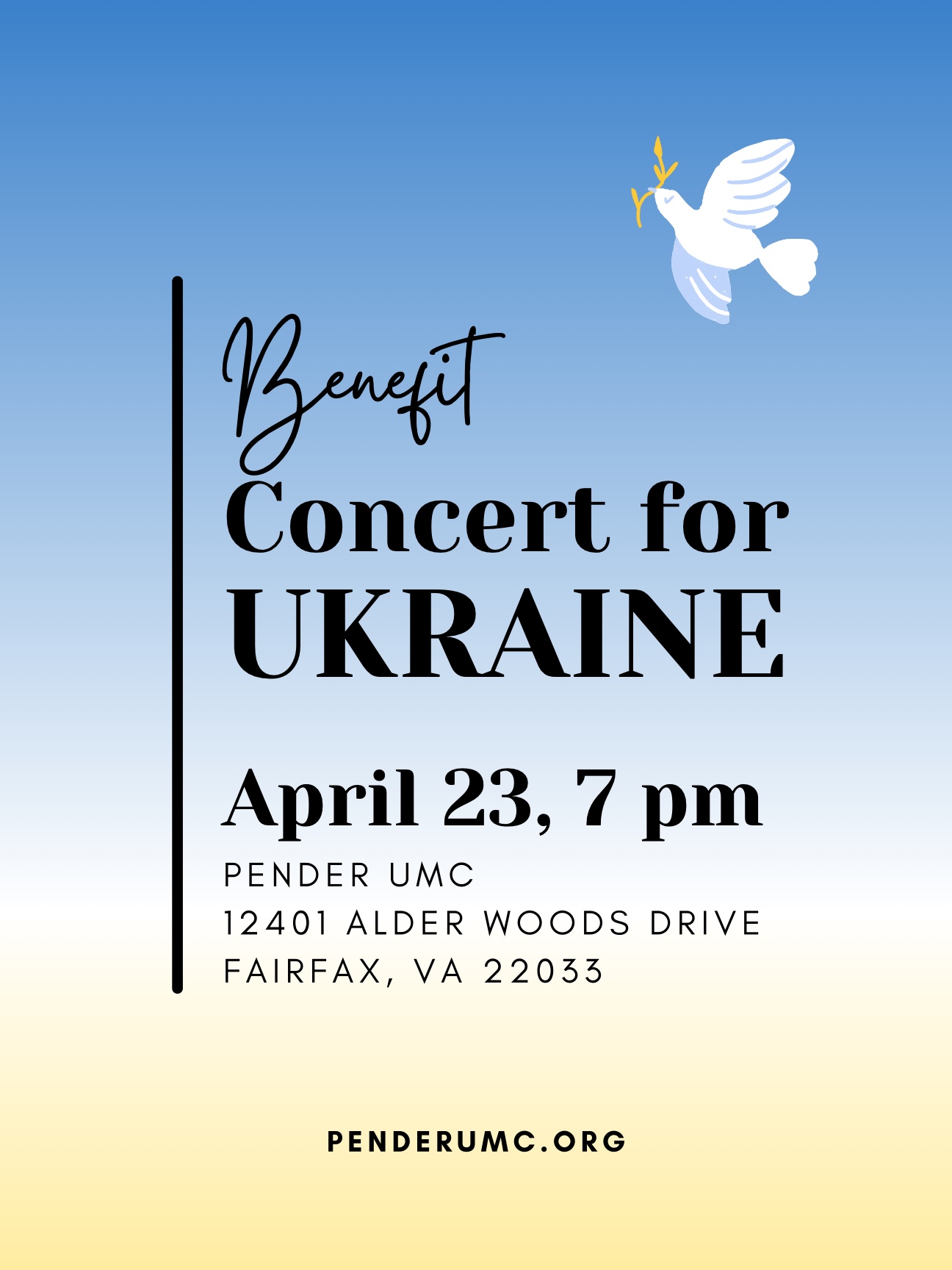
The Pender Concert Supporting Ukraine on April 23 featured Liz Sellers on piano, Brian on harp, and local professional musicians, including woodwind quintet, drums, organ, guitar, flute, penny whistle, singing and violin.
Concert repertoire included: Harp arrangements by Debussy, Piano trio of Jazz/Baroque, Flute Concertino by Chaminade, Woodwind Quintet with music of Duke Ellington, The Widor Toccata Organ Symphony Movement V and an Irish session!
There was no charge for this concert but there was a free will offering taken to support Ukraine through Advance #982450, UMCOR International Disaster Response and Recovery. This fund provides direct assistance to those in Ukraine as well as assistance to Ukrainians fleeing to neighboring countries.
One hundred percent of all Advance contributions go to the designated cause. (The independent charity watchdog, “Charity Watch,” gives UMCOR an “A+” ranking, and includes the UM organization on a highly selective list of charities it recommends when considering how to support the Ukrainian people. Read more)
The United Methodist community in Ukraine, though quite small, is actively engaged in assisting neighbors in need. Global Ministries is in touch with the church’s leadership as well as with church leaders in countries welcoming those who are fleeing from violence in Ukraine.
Click this link and choose UMCOR to send direct aid. In the memo line, put Advance #982450, UMCOR International Disaster Response and Recovery.
Brian Stevenson, Director of Music Ministries at Pender UMC in Fairfax, VA,performed En bateau (Sailing) from The Petite Suite, L 65, by Claude Debussy on the harp during Pender’s new Concert Series which began on April 23, 2022.
Debussy’s music captures perfectly a mood of water-borne serenity and languor, opening with a kind of musical sigh that made the Petite Suite immediately popular with a wide audience.
The Pender Concert Supporting Ukraine on April 23 featured Liz Sellers on piano, Brian on harp, and local professional musicians, including woodwind quintet, drums, organ, guitar, flute, penny whistle, singing and violin.
Concert repertoire included: Harp arrangements by Debussy, Piano trio of Jazz/Baroque, Flute Concertino by Chaminade, Woodwind Quintet with music of Duke Ellington, The Widor Toccata Organ Symphony Movement V and an Irish session!
There was no charge for this concert but there was a free will offering taken to support Ukraine through Advance #982450, UMCOR International Disaster Response and Recovery. This fund provides direct assistance to those in Ukraine as well as assistance to Ukrainians fleeing to neighboring countries.
One hundred percent of all Advance contributions go to the designated cause. (The independent charity watchdog, “Charity Watch,” gives UMCOR an “A+” ranking, and includes the UM organization on a highly selective list of charities it recommends when considering how to support the Ukrainian people. Read more)
The United Methodist community in Ukraine, though quite small, is actively engaged in assisting neighbors in need. Global Ministries is in touch with the church’s leadership as well as with church leaders in countries welcoming those who are fleeing from violence in Ukraine.
Click this link and choose UMCOR to send direct aid. In the memo line, put Advance #982450, UMCOR International Disaster Response and Recovery.
Sylvia Mulherin, organist at St. George’s UMC in Fairfax, VA,performed Toccata Organ Symphony Movement V by Charles-Marie Widor at Pender’s new Concert Series which began on April 23, 2022.
The Pender Concert Supporting Ukraine on April 23 featured Liz Sellers on piano, Brian on harp, and local professional musicians, including woodwind quintet, drums, organ, guitar, flute, penny whistle, singing and violin.
Concert repertoire included: Harp arrangements by Debussy, Piano trio of Jazz/Baroque, Flute Concertino by Chaminade, Woodwind Quintet with music of Duke Ellington, The Widor Toccata Organ Symphony Movement V and an Irish session!
There was no charge for this concert but there was a free will offering taken to support Ukraine through Advance #982450, UMCOR International Disaster Response and Recovery. This fund provides direct assistance to those in Ukraine as well as assistance to Ukrainians fleeing to neighboring countries.
One hundred percent of all Advance contributions go to the designated cause. (The independent charity watchdog, “Charity Watch,” gives UMCOR an “A+” ranking, and includes the UM organization on a highly selective list of charities it recommends when considering how to support the Ukrainian people. Read more)
The United Methodist community in Ukraine, though quite small, is actively engaged in assisting neighbors in need. Global Ministries is in touch with the church’s leadership as well as with church leaders in countries welcoming those who are fleeing from violence in Ukraine.
Click this link and choose UMCOR to send direct aid. In the memo line, put Advance #982450, UMCOR International Disaster Response and Recovery.


 MaryO'Studio