March 29: Today’s Music History

. 1788 ~ Charles Wesley, writer of over 5,500 hymns and, with his brother John, the founder of Methodism, died.

. 1871 ~ The Royal Albert Hall in London opened

. 1878 ~ Albert Von Tilzer, Composer.  He was the composer of “Take Me out to the Ball Game” among other old favorites.
More information about Von Tilzer

. 1879 ~ “Eugene Onegin”, best-known opera by Russian composer Tchaikovsky, was first performed at the Maliy Theatre in Moscow

. 1888 ~ Charles-Valentin Alkan died.  He was a French composer and pianist.

. 1902 ~ Sir William Walton, British composer
More information about Walton

. 1906 ~ E. Power Biggs, English Organist

. 1918 ~ Pearl Mae Bailey, American jazz singer, lead in black cast of Hello Dolly

. 1936 ~ Richard Rodney Bennett, British composer

. 1943 ~ Vangelis, (Evángelos Odysséas Papathanassíou), composer/keyboardist (Chariots of Fire)

. 1947 ~ Bobby Kimball (Toteaux), Singer with Toto

. 1949 ~ Michael Brecker, Jazz musician, reeds with The Brecker Brothers

. 1951 ~ The King and I, the wonderful Rodgers and Hammerstein musical based on Margaret Langdon’s novel, Anna and the King of Siam, opened this night in 1951 on Broadway. The King and I starred Yul Brynner in the role of the King of Siam. The king who, along with his subjects, valued tradition above all else. From this day forward, the role of the King of Siam belonged to Yul Brynner and no other. Brynner appeared in this part in more than 4,000 performances on both stage and screen (the Broadway show was adapted for Hollywood in 1956). Anna, the English governess hired to teach the King’s dozens of children, was portrayed by Gertrude Lawrence. Ms. Lawrence and Mr. Brynner acted, danced and sang their way into our hearts with such memorable tunes as Getting to Know You, Shall We Dance, Hello, Young Lovers, I Whistle a Happy Tune, We Kiss in a Shadow, I Have Dreamed, Something WonderfulA Puzzlement and March of the Siamese Children. The King and I ran for a total of 1,246 outstanding performances at New York’s St. James Theatre.

. 1952 ~ Roy Henderson’s last singing performance was on this date in the role of Christus in Bach’s “St. Matthew Passion” at Southwark Cathedral, the Anglican cathedral on the south bank of the Thames in London.

. 1958 ~ W.C. (William Christopher) Handy, Composer passed away
More information about Handy

. 1963 ~ M.C. Hammer (Stanley Kirk Burrell), Grammy Award-winning singer

. 1973 ~ Hommy, the Puerto Rican version of the rock opera Tommy, opened in New York City. The production was staged at Carnegie Hall.

. 1973 ~ After recording On the Cover of ‘Rolling Stone’, Dr. Hook finally got a group shot on the cover of Jann Wenner’s popular rock magazine. Inside, a Rolling Stone writer confirmed that members of the group (Dr. Hook and the Medicine Show) bought five copies of the magazine for their moms – just like in the song’s lyrics!

. 1980 ~ Annunzio Paolo Mantovani, Anglo-Italian conductor and arranger, died. Created the “Mantovani sound” that made him a highly successful recording artist and concert attraction.

. 1982 ~ Carl Orff, German composer of “Carmina Burana,” died.

. 1982 ~ Ray Bloch passed away

. 1999 ~ Legendary U.S. jazz and blues singer Joe Williams died aged 80.

. 2001 ~ John Lewis, a pianist who masterminded one of the most famous ensembles in jazz, the Modern Jazz Quartet, died at the age of 80. The M.J.Q., as the quartet was known, remained mostly unchanged from the mid-1950’s to the 90’s. It began recording in 1952 with Lewis, vibraphonist Milt Jackson, bassist Percy Heath and drummer Kenny Clarke. When Clarke moved to Paris in 1955, Connie Kay replaced him and the quartet continued until Kay’s death in 1994. Lewis contributed the bulk of the group’s compositions and arrangements, including Django and Two Degrees East, Three Degrees West, and he insisted members wear tuxedos to dignify jazz as an art. He was born in LaGrange, Ill., in 1920, and grew up in Albuquerque, N.M. His entree to the jazz world came during World War II, when he met Kenny Clarke, an established drummer in the nascent bebop movement. At Clarke’s urging, Lewis moved to New York after his discharge and eventually replaced Thelonious Monk as Dizzy Gillespie’s pianist. He also performed or recorded with Charlie Parker, Lester Young and Ella Fitzgerald. In 1952 he formed the M.J.Q. with Clarke, Jackson and Heath. The quartet was a steady seller of records and concert tickets well into the 1970’s. Lewis also taught music at Harvard and the City College of New York, and in the late 1950’s helped found the Lenox School of Jazz in Massachusetts.

. 2009 ~ Maurice Jarre, French composer (Doctor Zhivago-Acadamy Award winner in 1966), died at the age of 84

It’s Palm Sunday!

palm_sunday480

Palm Sunday marks the beginning of Holy Week, the most important week of the church year. At the other end of Holy Week is Easter, the most important day of the church year.

For Christians, this is the big event! And it’s all about the mystery that somehow Jesus Christ makes us one with God.

The days leading up to Easter often have an understandably somber feel to them, particularly as we contemplate Jesus’ arrest, trial, and execution. It’s easy to forget that the week begins with a joyful event: the Triumphal Entry!

Today is Palm Sunday, the first day of Holy Week. On Palm Sunday, we commemorate Jesus’ celebrated entry into Jerusalem just a few days before his arrest, trial, and crucifixion.

The “palm” in Palm Sunday refers to the palm branches waved by the adoring Jerusalem crowds who welcomed Jesus and proclaimed him King. The event is commonly referred to as the Triumphal Entry. Here’s the account from Matthew 21:1-11:

As they approached Jerusalem and came to Bethphage on the Mount of Olives, Jesus sent two disciples, saying to them, “Go to the village ahead of you, and at once you will find a donkey tied there, with her colt by her. Untie them and bring them to me. If anyone says anything to you, say that the Lord needs them, and he will send them right away.”

This took place to fulfill what was spoken through the prophet:

“Say to Daughter Zion,

‘See, your king comes to you,

gentle and riding on a donkey,

and on a colt, the foal of a donkey.’”

The disciples went and did as Jesus had instructed them. They brought the donkey and the colt and placed their cloaks on them for Jesus to sit on. A very large crowd spread their cloaks on the road, while others cut branches from the trees and spread them on the road. The crowds that went ahead of him and those that followed shouted,

“Hosanna to the Son of David!”

“Blessed is he who comes in the name of the Lord!”

“Hosanna in the highest heaven!”

When Jesus entered Jerusalem, the whole city was stirred and asked, “Who is this?”

The crowds answered, “This is Jesus, the prophet from Nazareth in Galilee.”

Read more


Chuck Knows Church — Palm Sunday. Have you ever waved a palm branch in a worship service? If so, do you know why? Chuckle along and learn about Palm Sunday with Chuck


Is Your Tune Piano in Tune?

piano-tuning

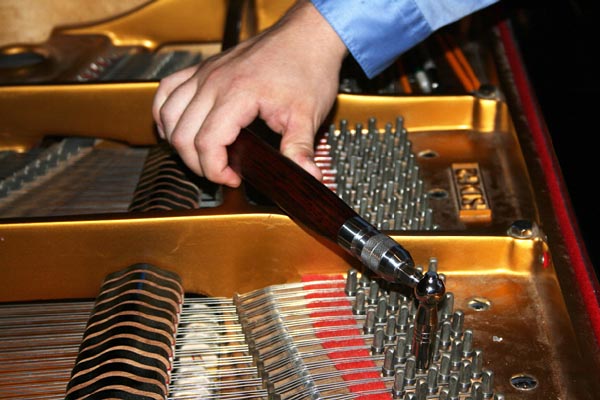
When it comes to tuning, every piano is different, even two pianos of the same style and make are different, and the humidity of the room makes a big difference, he said.

High humidity causes the sound board to swell, stretching the strings and causing the pitch to go sharp, while low humidity has the opposite effect.

In Minnesota, humidity can easily range from 80 percent in the summertime to 10-15 percent in the winter, if the home doesn’t have a humidifier. Wood-heated homes tend to be especially dry, he said.

“Pianos like it between 40 and 50 percent humidity in the house,” he said.

Even places that are supposedly “climate-controlled,” aren’t always. The heat might get turned down substantially evenings and weekends, for example.

A new piano needs a few weeks to settle into its new home before tuning, Fry said.

“If they get a new piano, generally they call us the day before it gets in the house,” he said. “It should sit in the house a couple weeks just to acclimatize it to its new surroundings … brand new pianos stretch for a while. They go out of tune quicker. The wire stretches and they settle into themselves.”

Some people think they have to let a new, or recently moved older piano, sit six months or a year before it gets tuned. That’s not true, Fry said, but it does need a few weeks.

He recommends that pianos be tuned at least once a year (he tunes his own piano once a year, even though he no longer gives lessons) and the busiest time for him is before the holidays — September through December.

“Piano-tuning is something people can put off,” he said. “We noticed a real drop in tuning when gas got over $3 a gallon. I didn’t think it would make that much of a difference, but it did.”

Fry said he is looking for some kind of work to do in the summertime when his other businesses are slow.

He doesn’t give piano or guitar lessons anymore, but does enjoy tuning all types of pianos.

“It takes me a couple of hours. I have time,” Fry said. “I’m going to do the job that I like to do, and do it right.”

Read the entire article at Keeping pianos, life in tune | Detroit Lakes Online.

Palm Sunday Music

Every Palm Sunday, without fail, my father’s church choir in Connecticut sang this.  I still know it nearly by heart.

This hymn for Palm Sunday was originally written in French as “Les rameaux” originally published in 1864 by French art collector, operatic baritone and composer Jean-Baptiste Fauré (1830–1914).

Jean-Baptiste Fauré should not be confused with French composer, organist, pianist and teacher Gabriel Fauré (1845-1924) who composed a world-famous Requiem and other works.

An early English translation “Palm-Branches” was published by Oliver Ditson Co., Boston in “Gems of English Song” 1875. A number of other English translations have been made, and it has proved surprisingly difficult to identify the translators. One version is sometimes credited to Harrison Millard (1830-1895) – but other sources say he was simply an arranger.

I think, as a choir, we didn’t sound quite this good

Other Palm Sunday Music:

We sang this at Pender one year at the 9:00 traditional service, but without quite as much ceremony, and in English.

This looks like fun – “Jerusalem, lift up your gates and sing!”  Hosanna in the Highest to your King!  Note that one person is playing a duet with himself.