Happy Birthday, Jelly Roll!

jelly-grandpa


Jelly Roll Morton, born Ferdinand Joseph La Menthe in 1885, was one of the most influential composers of the jazz era, bridging an important gap between ragtime, blues, and jazz. In a sense, he was the first great jazz composer.

His career began in New Orleans, where he began to experiment with a unique blend of blues, ragtime, Creole, and Spanish music in bordellos as a piano player. Along with being a musician, he also worked as a gambler, pool shark, vaudeville comedian, and was known for his flamboyant personality and diamond front tooth.

Morton became successful when he started making what would be some of the first jazz recordings in 1923 with “the New Orleans Rhythm Kings”. Whether he played on the West Coast, New Orleans, or in Chicago, his recordings were always very popular. He joined the group “the Red Hot Peppers” in 1924 and made several classic albums with the Victor label.

Nothing but success came to him until 1930, when “Hot Jazz” began to die out, and big bands began to take over. Morton died in 1941, claiming that a voodoo spell was the cause of his demise.


   anniversary of Morton’s death

  Read quotes by and about Morton


July 2 ~ Daily Listening Assignment


Today’s piece is Antonin Dvořák’s Humoresque #7.

Humoresques Op. 101 (B. 187), is a piano cycle by the Czech composer Antonín Dvořák, written during the summer of 1894. One writer says “the seventh Humoresque is probably the most famous small piano work ever written after Beethoven’s Für Elise.

Yo Yo Ma (cello) and Itzhak Perlman (violin

https://youtu.be/oBDmAxSFt6A

Orchestra:


Ragtime:


Jazz with Wynton Marsalis on trumpet

Zez Confrey gave this a makeover and included Way Down Upon the Swanee River:

https://youtu.be/uoOgk5T4tPU


Find the original Humoresque on IMSLP.. The O’Connor Music Studio Lending Library has versions of Humoresque available at several levels and Confey’s Humorestless played in the video above.


June 29 ~ Daily Listening Assignment


Korobeiniki is a nineteenth-century Russian folk song that tells the story of a meeting between a peddler and a girl, describing their haggling over goods in a veiled metaphor for courtship.

Outside Russia, “Korobeiniki” is widely known as the Tetris theme.


Orchestral version:


For Boomwhackers:

Vocal:


Ragtime:


Balalaika:


The Red Army Choir:

Korobeiniki/Tetris is available in Piano Maestro on the iPad and I have the sheet music for anyone who is interested.

Enjoy!

June 20 ~ Daily Listening Assignment


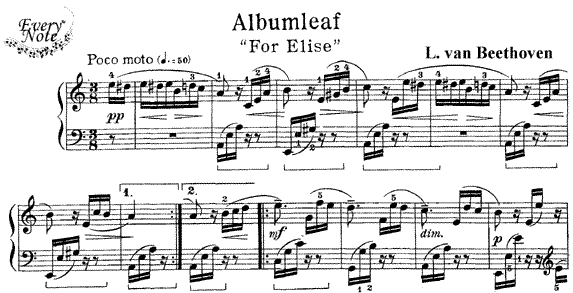
Today’s piece is one of those that piano students often try to learn on their own – or a friend will teach them the first 9 notes.  It’s usually played too fast and, often in the wrong octave, or the first couple notes are repeated too many times.

This is one of two pieces that are so often played incorrectly that they have the distinction of being banned from competition in Northern Virginia Piano Teacher competitions.

Stay tuned for the other one!

Fur Elise was not published during Beethoven’s lifetime, having been discovered by Ludwig Nohl 40 years after the composer’s death. The identity of “Elise” is unknown.

The very basic melody:


The actual beginning is a little more involved.


And, there’s more!


If you’d like to learn to play this piece correctly, find the sheet music at IMSLP, Beethoven: Exploring His Life and Music, and countless compilations of classical music available at the O’Connor Music Studio.

Follow along:

By Valentina Lisitsa:


Ragtime!


A variety of instruments (Piano, Guitar, Cat Piano, Cello, Launchpad, Ukulele)


The Big Piano at FAO Schwartz in NYC:


Glass harp:


Youtube has many, many more versions.  Beethoven would probably go nuts!