From the Washington Post, but we knew this already, right?
Music training not only helps children develop fine motor skills, but aids emotional and behavioral maturation as well, according to a new study, one of the largest to investigate the effects of playing an instrument on brain development.
Using a database produced by the National Institutes of Health Magnetic Resonance (MRI) Study of Normal Brain Development, researchers at the University of Vermont College of Medicine analyzed the brain scans of 232 healthy children ages six to 18 specifically looking at brain development in children who play a musical instrument. (The original study did not indicate specific instruments.)
“What we found was the more a child trained on an instrument,” said James Hudziak, a professor of psychiatry at the University of Vermont and director of the Vermont Center for Children, Youth and Families, “it accelerated cortical organization in attention skill, anxiety management and emotional control.”
For a musical family on the Plains of South Dakota, it was a tragedy that left ashes in the soul – not just that a fire on Nov. 26, 1898, burned down the log house at Oahe Mission north of Pierre, but also that it destroyed the Steinway Grand Piano inside.
It was that same Steinway that had traveled up the Missouri River by steamboat for Nina, the first wife of missionary Thomas L. Riggs, in the early 1870s when the Missouri River country was still Dakota Territory. It supplied just the right tone, full and powerful, to fill that big empty space in the grassland. It helped carry the message of the ancient faith to Dakota and Lakota converts through music.
Very likely it was on the Steinway that Nina taught her first son, Theodore Foster Riggs, what a piano sounded like after he was born in 1874; probably it was a silent reminder of Thomas Riggs’ grief when Nina died in childbirth in August 1878. In spring 1885, when Louisa Irvine Riggs, also with a love for music, moved into the log home at Oahe Mission as the second Mrs. Riggs, the Steinway sat along one wall; and she started to play.
And now, in November 1898, it was burned to cinders…
National Spaghetti Day on January 4 recognizes that long, thin cylindrical pasta of Italian and Sicilian origin.
Who can forget
. 1710 ~ Giovanni Battista Pergolesi, Italian Composer
More information about Pergolesi
. 1720 ~ Johann Friedrich Agricola, German organist and composer
. 1809 ~ Louis Braille, Inventor of the Braille system which enables the blind to read words and music. When he was only 3, Louise Braille, was permanently blinded in an accident with a leatherworking awl in his father’s saddlemaking shop in Coupvray, France. Several years later, he was admitted to a school for the blind, the Institution Nationale des Jeunes Aveugles. Later, as a teacher at the school, he worked at adapting Charles Barbier’s system of writing with points. Ironically, his method centered around using an awl-like stylus to punch marks in paper that could be felt and interpreted by the blind, allowing them to “read” with their fingertips. Braille’s work went unnoticed until after his death, in poverty, in 1852.
. 1874 ~ Josef Suk, Czech violinist and composer
More information about Suk
. 1924 ~ Alfred Grünfeld, Austrian pianist and composer, died
. 1928 ~ NBC radio debuted one of radio’s first variety shows. “The Dodge Victory Hour” starred Will Rogers, Paul Whiteman and his Orchestra and singer Al Jolson. The cost to produce this one show was $67,600.
. 1932 ~ NBC Red presented “The Carnation Contented Hour”. The show continued on network radio for 19 years as a showcase for top singers and musicians.
. 1933 ~ Ray Starling, Arranger for Stan Kenton
. 1935 ~ Bert Ambrose and his orchestra recorded the song that became the group’s theme song. It was titled Hors-d’oeuvres and was cut in London for Decca Records.
. 1935 ~ Bob Hope was first heard on network radio as part of “The Intimate Revue” with Jane Froman, James Melton and the Al Goodman Orchestra.
. 1936 ~ The first pop music chart based on national sales was published by “Billboard” magazine this day. Joe Venuti, jazz violinist, was at the top of the chart with a little ditty called Stop! Look! Listen!.
. 1937 ~ Grace Bumbry, American mezzo-soprano
More information about Bumbry
. 1942 ~ John McLaughlin, Rock guitarist
. 1944 ~ Arthur Conley, Singer
. 1950 ~ RCA Victor announced that it would manufacture long-playing (LP) records. This news came two years after Columbia Records debuted the ‘album’.
. 1954 ~ Elvis Presley strolled into the Memphis Recording Service and put $4 on the counter. He recorded Casual Love and I’ll Never Stand in Your Way, two songs that so impressed record executive Sam Phillips that he had Elvis record his first professional sides for Sun Records the following August.
. 1964 ~Bobby Vinton topped the pop charts with the last #1 single of the pre-Beatles era – “There! I’ve Said Again”
. 1965 ~ The Fender Guitar Company was sold to CBS for $13 million.
. 1979 ~ With a new interest in Beatles music on this day, the Star Club reopened in Hamburg, Germany. None of The Beatles returned to their beginnings to attend the gala opening.
. 2001 ~ Les Brown, whose Band of Renown scored a No. 1 hit with Sentimental Journey during America’s big band era of the 1930s and ’40s, died of lung cancer at the age of 88. A conductor-clarinetist whose smooth arrangements of swing melodies transcended changes in musical tastes, Brown was cited in 1996 by the Guinness Book of Records recognized him as the leader of the longest lasting musical organization in pop music history. He started his professional career in 1936, and his Band of Renown was still performing about 60 dates a year as recently as five months ago, often conducted by son Les Brown Jr. Brown formed his Band of Renown in 1936. In the 1940s heyday of swing, Brown never achieved the greatness of Tommy Dorsey, Glenn Miller or Benny Goodman. But the band scored two hit records – Sentimental Journey, with Doris Day as vocalist, and the instrumental I’ve Got My Love to Keep Me Warm. Sentimental Journey, co-written with Ben Homer and Bud Green, became a theme for soldiers returning home from World War II. “The happiest times in my life were the days when I was traveling with Les and his band,” Day said. “I loved Les very much, I am going to miss his phone calls.” Brown’s career included a close association with Bob Hope. In 1950, he joined Hope for the first of 18 Christmas tours to entertain American troops at military bases around the world. Day also participated. “The world has lost a great musician,” Hope said. “I have lost my music man, my sideman, my straight man and a special friend.” As the first president of the Los Angeles chapter of the Academy of Recording Arts and Sciences, Brown helped make the Grammy Awards a televised event. He convinced Hope, Frank Sinatra and Bing Crosby to participate in the first telecast.
. 2004 ~ Jake Hess, a four-time Grammy winner who sang with some of the premier quartets in gospel music and influenced the career of Elvis Presley, died. He was 76. Hess, whose career spanned more than 60 years, is best known to contemporary audiences as a regular member of Bill Gaither’s Homecoming Friends, on various Christian and country music cable channels, including TBN and TNN. Hess joined The John Daniel Quartet in 1943 and reached stardom with The Statesmen Quartet. He was founder of The Imperials and sang with The Masters V. Each of these groups is enshrined in the Southern Gospel Music Hall of Fame, as is Hess. He is also a member of the Alabama Music Hall of Fame. As a teen, Elvis Presley was a regular at Statesmen concerts. Later, Hess was a backup singer on several of Presley’s Grammy-winning albums. When Presley died in 1977, Hess sang at his funeral, as he had at the funeral of country legend Hank Williams in 1953. Peter Guralnick, author of a two-volume biography of Presley, said the rock star always wanted to emulate the voices of Hess and crooner Roy Hamilton.
. 2018 ~ Ray Thomas, English rock vocalist and flautist (Moody Blues-Legend Of A Mind), died at the age of 76
Born in 1941, Thomas founded The Moody Blues in 1964 with fellow musicians including Mike Pinder and Denny Laine.
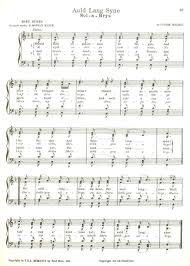
“Auld Lang Syne,” a poignant Scots poem penned by the legendary Robert Burns in 1788, is set to the melody of a timeless folk song. Renowned globally, particularly in English-speaking regions, it is traditionally sung to usher in the New Year at midnight. Additionally, the song finds a place in various other settings, including funerals, graduations, and farewells, symbolizing endings and transitions. The Boy Scout movement internationally has adopted it as a ceremonial conclusion to their gatherings and events.
The title, “Auld Lang Syne,” translates from Scots to English as “old long since,” but more colloquially, it means “long long ago,” “days gone by,” or “times of old.” Hence, the phrase “For auld lang syne” in the chorus loosely means “for the sake of old times.”
This song is a treasured Scottish offering to the world, evoking nostalgia and warmth of days past. It not only reminisces about times gone by but also fosters a sense of unity and togetherness for the future.
“Auld Lang Syne” is a gem from the rich Lowland Scots folk tradition, skillfully refined by one of the world’s premier songwriters, Burns. In his final years, Burns dedicated himself to preserving and enhancing the song tradition, often transforming fragments of old ballads into profound love songs or Scots poems. In “Auld Lang Syne,” he found a piece already gleaming with brilliance, as he expressed in an 1788 letter to Mrs. Dunlop.
An intriguing aspect of “Auld Lang Syne” is that the globally sung melody differs from the one Burns originally set the lyrics to. The original tune, still performed by traditionalists, carries a softer, more reflective quality, as showcased in Mairi Campbell’s rendition in the film “Sex and the City.” Regardless of the tune or its global reach, “Auld Lang Syne” maintains the deep emotional impact of the original Scottish folk song. As Burns himself once reflected, the phrase ‘Auld Lang Syne’ powerfully resonates, capturing the soul-stirring essence of an old song and tune.
Fancy singing along yourself? Here are the verses of the words to Auld Lang Syne:
Should auld acquaintance be forgot,
And never brought to mind?
Should auld acquaintance be forgot,
And auld lang syne.
Chorus:
For auld lang syne, my jo,
For auld lang syne,
We’ll tak a cup o’ kindness yet,
For auld lang syne,
And surely ye’ll be your pint-stowp!
And surely I’ll be mine!
And we’ll tak a cup o’ kindness yet,
For auld lang syne.
Chorus
We twa hae run about the braes
And pu’d the gowans fine;
But we’ve wander’d mony a weary foot
Sin auld lang syne.
Chorus
We twa hae paidl’d i’ the burn,
Frae mornin’ sun till dine;
But seas between us braid hae roar’d
Sin auld lang syne.
Chorus
And there’s a hand, my trusty fiere!
And gie’s a hand o’ thine!
And we’ll tak a right guid willy waught,
For auld lang syne.
Chorus
Should old acquaintance be forgot,
And never brought to mind?
Should old acquaintance be forgot,
And long, long ago.
Chorus
And for long, long ago, my dear
For long, long ago,
We’ll take a cup of kindness yet,
For long, long ago
And surely youll buy your pint-jug!
And surely I’ll buy mine!
And we’ll take a cup of kindness yet,
For long, long ago.
Chorus
We two have run about the hills
And pulled the daisies fine;
But we’ve wandered manys the weary foot
Since long, long ago.
Chorus
We two have paddled in the stream,
From morning sun till dine;
But seas between us broad have roared
Since long, long ago.
Chorus
And there’s a hand, my trusty friend!
And give us a hand of yours!
And we’ll take a deep draught of good-will
For long, long ago.
Chorus
Check out this vintage kinescope, a blast from over half a century ago! For a century now, the iconic descent of a glowing glass ball from One Times Square in New York City on New Year’s Eve has been a beloved American ritual. Year after year, throngs of people gather to ring in the New Year with jubilation.
Starting in 1956, Guy Lombardo and His Royal Canadians became synonymous with the US’s New Year’s Eve celebrations. They combined melodious tunes with the live spectacle of the Midnight ball drop. Guy spearheaded this tradition until his passing in 1977, and his band continued to grace CBS Television with their New Year’s performances for two more years. Meanwhile, Dick Clark’s Rockin’ New Years Eve kicked off in 1972 on ABC and remains a yearly broadcast. Guy’s show would start right after a 15-minute news segment and would run for an hour. While Guy orchestrated the music, news anchor Robert Trout would herald the onset of the New Year.
If you pay attention, you might spot the sharp-tongued TV figure Henry Morgan amidst the crowd. Television back then, fifty years ago, was a far cry from today’s standards, marked by stark lighting and basic technology, like a simple office clock and a World War II-era searchlight sweeping over the gathered crowd.
I hope you’ll enjoy ringing in the New Year – 1958! Recorded: December 31, 1957
Auld Lang Syne played on bagpipes (as it should be)
I could have turned the Alfred Burt Carols into the next 15 parts of this series but I decided that was a bit too easy on me!
I love this story – it’s a wonderful family tradition from the Burt family.
Starting in 1922, Alfred Burt’s father created a Christmas card for family members and parishioners. On these cards were original Christmas carols, with both the words and music by the Reverend Bates Burt. For the family Christmas card in 1942, Bates asked his son to write the music for that year’s carol, “Christmas Cometh Caroling.”
From then on, Alfred would write the music for the family’s Christmas cards, and the “Alfred Burt carols” were born.
Over the next several years, and as the Burts’ circle of friends grew, the Christmas card list grew from 50 to 450 people. But still, the Alfred Burt Carols remained unknown outside the Burts’ growing mailing list.
That changed with the 1952 carol, “Come, Dear Children”. Burt finished writing the music during a rehearsal with the Blue Reys, the vocal group with Alvino Rey’s orchestra. He asked them to sing it so he could make sure the harmonies worked; they liked it so much that they asked Burt if they could sing it at the annual King Sisters Christmas party. It proved to be a hit among the partygoers, and served to introduce Burt’s carols to Hollywood, California.
“This Is Christmas” (also known as “Bright, Bright, the Holly Berries”) (1950)
“Some Children See Him” (1951)
“Come, Dear Children” (1952)
“O, Hearken Ye” (1953)
“Caroling Caroling” (1954)
“We’ll Dress the House” (1954)
“The Star Carol” (1954)
Burt finished the last of his carols, “The Star Carol”, on February 5, 1954. He died less than 24 hours later, at the age of 33.
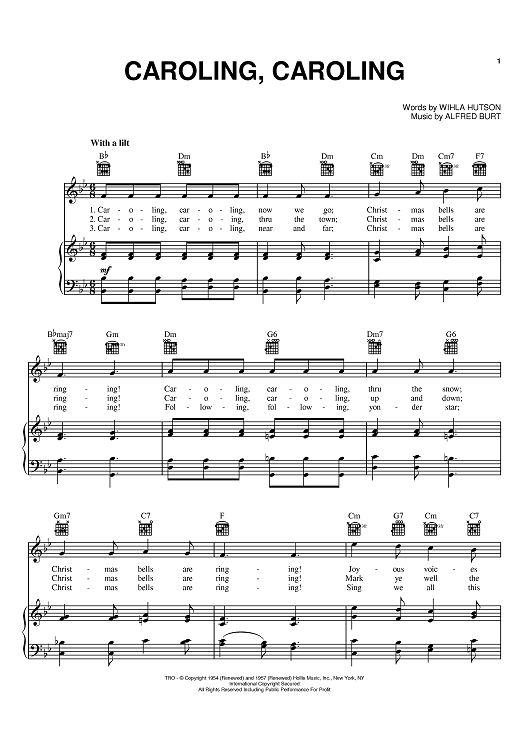
One of the best known of these today is Caroling Caroling (lyrics by the church organist at his father’s church, Wihla Hutson)
The Salt Lake Vocal Artists perform 2 carols; “Caroling, Caroling” and “We’ll Dress the House” by Alfred Burt live in concert on December 17, 2011 in Holy Family Catholic Church, South Ogden, Utah under the direction of Dr. Brady Allred.
Still, Still, Still is an Austrian Christmas carol and lullaby. In German its first line is “Still, still, still, weil’s Kindlein schlafen will!” (Hush, hush, hush, for the little child wants to sleep!)
The melody is a folk tune (authorship unknown) from the State of Salzburg. The tune appeared for the first time in 1865 in a folksong collection of Maria Vinzenz Süß (1802-1868), founder of the Salzburg Museum; it has changed slightly over the years but remains attributed to G. Götsch.
The words, which run to six verses in German, describe the peace of the infant Jesus and his mother as they sleep. There are various English translations. This is one version:
Still, still, still,
One can hear the falling snow.
For all is hushed,
The world is sleeping,
Holy Star its vigil keeping.
Still, still, still,
One can hear the falling snow.
Sleep, sleep, sleep,
‘Tis the eve of our Saviour’s birth.
The night is peaceful all around you,
Close your eyes,
Let sleep surround you.
Sleep, sleep, sleep,
‘Tis the eve of our Saviour’s birth.
Dream, dream, dream,
Of the joyous day to come.
While guardian angels without number,
Watch you as you sweetly slumber.
Dream, dream, dream,
Of the joyous day to come.
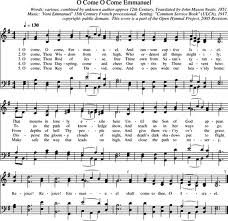
O come, O come, Emmanuel is the mid-19th-century translation by John Mason Neale and Henry Sloane Coffin of the Ecclesiastical Latin text “Veni, veni, Emmanuel”.
The text is based on the Biblical prophecy from Isaiah 7:14 that states that God will give Israel a sign that will be called Emmanuel (Literally: God with us). Matthew 1:23 states fulfillment of this prophecy in the birth of Jesus of Nazareth.
O come, O come, Emmanuel
And ransom captive Israel
That mourns in lonely exile here
Until the Son of God appear
Rejoice! Rejoice! Emmanuel
Shall come to thee, O Israel.
O come, Thou Rod of Jesse, free
Thine own from Satan’s tyranny
From depths of Hell Thy people save
And give them victory o’er the grave
Rejoice! Rejoice! Emmanuel
Shall come to thee, O Israel.
O come, Thou Day-Spring, come and cheer
Our spirits by Thine advent here
Disperse the gloomy clouds of night
And death’s dark shadows put to flight.
Rejoice! Rejoice! Emmanuel
Shall come to thee, O Israel.
O come, Thou Key of David, come,
And open wide our heavenly home;
Make safe the way that leads on high,
And close the path to misery.
Rejoice! Rejoice! Emmanuel
Shall come to thee, O Israel.
O come, O come, Thou Lord of might,
Who to Thy tribes, on Sinai’s height,
In ancient times did’nt give the Law,
In cloud, and majesty and awe.
Rejoice! Rejoice! Emmanuel
Shall come to thee, O Israel.
• 1637 ~ Bernardo Pasquini, Italian composer of operas, oratorios, cantatas and keyboard music.
• 1840 ~ Hermann Goetz, German Composer
• 1842 ~ The Philharmonic Society of New York, the first permanent orchestra in the U.S., held its first concert. Despite uncomfortable seating, the event was a huge success. They performed works of Beethoven.
• 1863 ~ Pietro Mascagni, Italian composer and conductor More information about Mascagni
• 1879 ~ Rudolf Friml, Musician, composer
• 1887 ~ Ernst Toch, Austrian-born American composer
• 1899 ~ Antoni de Kontski, Polish pianist and composer, died at the age of 82
• 1911 ~ Louis Prima, Trumpeter, bandleader with Louis Prima and His New Orleans Gang, Gleeby Rhythm Orchestra; songwriter, singer, married to Keely Smith
• 1931 ~ Bobby Osborne, Musician, mandolin, singer with the duo – Osborne Brothers
• 1942 ~ Harry Chapin, American folk-rock singer and songwriter, Recipient of Special Congressional Gold Medal, Worldwide Humanitarian for the Hungry, Needy and Homeless
• 1948 ~ NBC presented Horace Heidt’s Youth Opportunity Program for the first time. The talent show earned Dick Contino, an accordionist, the $5,000 prize as the program’s first national winner.
• 1949 ~ Tom Waits, Singer, songwriter, playwright, married to Kathleen Brennan
• 1954 ~ Mike Nolan, Singer with Bucks Fizz
• 1957 ~ Pat Boone was at the top of the pop charts for the first of six weeks with April Love. His other number one hits included Ain’t That a Shame, I Almost Lost My Mind, Don’t Forbid Me and Love Letters in the Sand.
• 1980, Leonard Bernstein received the Kennedy Center Honors for lifetime contributions to American culture through the performing arts. His co-recipients were James Cagney, Leontyne Price, Lynn Fontanne, and Agnes de Mille.
At the White House reception for the honorees, President Jimmy Carter said:
“Leonard Bernstein single-handedly, or I might say, with both hands and his entire body, as a matter of fact— [laughter] —has brought great music as a vital part of the personal lives of literally millions of Americans and people throughout the world with his deep commitment, his knowledge of communication, his ability as a teacher, and the inner commitment that makes his words and his attitudes a kind of a burning inspiration to those who have admired his own works and the way he interprets and explains the fine works of others. In motion pictures, on Broadway, in the concert hall, and, I am thankful to say, here in The White House, he’s been a favorite of us and of millions of his fellow Americans.”
• 1984 ~ Michael Jackson was in Chicago to testify that the song, The Girl is Mine, was exclusively his and he didn’t swipe the song, Please Love Me Now. It was a copyright infringement case worth five million dollars. He won.
• 1990 ~ Dee (Delectus) Clark passed away
• 2016 ~ Greg Lake, English rock vocalist and bassist (King Crimson, Emerson, Lake & Palmer), died of cancer at the age of 69
Charles Wesley (1707-1788), the younger brother of John Wesley wrote the words to this Christmas Carol.
Charles was a hymn writer and a poet, also known as one of the people who began the Methodist movement in the Church of England. Hark the Herald Angels Sing appeared in 1739 in a book called Hymns and Sacred Poems.
Wesley envisioned this being sung to the same tune as his hymn, Christ the Lord Is Risen Today, and in some hymnals it is included along with the more popular version.
This hymn was regarded as one of the Great Four Anglican Hymns and published as number 403 in “The Church Hymn Book” (New York and Chicago, USA, 1872).
To celebrate the invention of the printing press, Felix Mendelssohn composed a cantata in 1840 called Festgesang or “Festival Song”. The melody of Mendelssohn’s cantata was then used by William H. Cummings and adapted it to the lyrics of Wesley’s “Hark the Herald Angels Sing”.
Hark the herald angels sing “Glory to the newborn King! Peace on earth and mercy mild God and sinners reconciled” Joyful, all ye nations rise Join the triumph of the skies With the angelic host proclaim: “Christ is born in Bethlehem” Hark! The herald angels sing “Glory to the newborn King!”
And, of course, no one can do it better than The Mormon Tabernacle Choir.
Carol of the Bells was composed by Mykola Dmytrovych Leontovych (1877-1921) in 1916. Originally titled Shchedryk, this Ukrainian folk song is sometimes called Ukrainian Bell Carol. “Shchedryk” which was associated with the coming New Year, originally celebrated in April.
Leontovych used this tune in 1904 along with lyrics by Peter J. Wilhousky to create the version that everyone knows today. It gained popularity during the 1920s and 1930s, and was introduced to an even wider audience when it was used in the movie “Home Alone”.
It was first performed in the Ukraine on the night of January 13, 1916, on the Julian calendar this is considered New Year’s Eve. In the United States the song was first performed on October 5, 1921 at Carnegie Hall.
This video is from the Christmas special of the Mormon Tabernacle Choir, presented at the BYU channel. The orchestra and choir produce a very beautiful sound.
Not the standard version –
The O’Connor Music Studio has several versions of this Christmas Carol available for loan, including this version from the Mannheim Steamroller:






 MaryO'Studio