Christmas Countdown: O Come, O Come Emmanuel

O Come, O Come Emmanuel

O Come, O Come Emmanuel

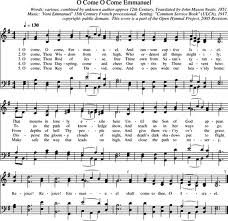
O come, O come, Emmanuel is the mid-19th-century translation by John Mason Neale and Henry Sloane Coffin of the Ecclesiastical Latin text “Veni, veni, Emmanuel”.

The text is based on the Biblical prophecy from Isaiah 7:14 that states that God will give Israel a sign that will be called Emmanuel (Literally: God with us). Matthew 1:23 states fulfillment of this prophecy in the birth of Jesus of Nazareth.

O come, O come, Emmanuel
And ransom captive Israel
That mourns in lonely exile here
Until the Son of God appear
Rejoice! Rejoice! Emmanuel
Shall come to thee, O Israel.

O come, Thou Rod of Jesse, free
Thine own from Satan’s tyranny
From depths of Hell Thy people save
And give them victory o’er the grave
Rejoice! Rejoice! Emmanuel
Shall come to thee, O Israel.

O come, Thou Day-Spring, come and cheer
Our spirits by Thine advent here
Disperse the gloomy clouds of night
And death’s dark shadows put to flight.
Rejoice! Rejoice! Emmanuel
Shall come to thee, O Israel.

O come, Thou Key of David, come,
And open wide our heavenly home;
Make safe the way that leads on high,
And close the path to misery.
Rejoice! Rejoice! Emmanuel
Shall come to thee, O Israel.

O come, O come, Thou Lord of might,
Who to Thy tribes, on Sinai’s height,
In ancient times did’nt give the Law,
In cloud, and majesty and awe.
Rejoice! Rejoice! Emmanuel
Shall come to thee, O Israel.

December 7 ~ On This Day in Music

today


Pearl Harbor Day


Christmas Countdown: Hark the Herald Angels Sing

• 1637 ~ Bernardo Pasquini, Italian composer of operas, oratorios, cantatas and keyboard music.

• 1840 ~ Hermann Goetz, German Composer

• 1842 ~ The Philharmonic Society of New York, the first permanent orchestra in the U.S., held its first concert. Despite uncomfortable seating, the event was a huge success. They performed works of Beethoven.

• 1863 ~ Pietro Mascagni, Italian composer and conductor
More information about Mascagni

• 1879 ~ Rudolf Friml, Musician, composer

• 1887 ~ Ernst Toch, Austrian-born American composer

• 1899 ~ Antoni de Kontski, Polish pianist and composer, died at the age of 82

• 1911 ~ Louis Prima, Trumpeter, bandleader with Louis Prima and His New Orleans Gang, Gleeby Rhythm Orchestra; songwriter, singer, married to Keely Smith

• 1931 ~ Bobby Osborne, Musician, mandolin, singer with the duo – Osborne Brothers

• 1942 ~ Harry Chapin, American folk-rock singer and songwriter, Recipient of Special Congressional Gold Medal, Worldwide Humanitarian for the Hungry, Needy and Homeless

• 1948 ~ NBC presented Horace Heidt’s Youth Opportunity Program for the first time. The talent show earned Dick Contino, an accordionist, the $5,000 prize as the program’s first national winner.

• 1949 ~ Tom Waits, Singer, songwriter, playwright, married to Kathleen Brennan

• 1954 ~ Mike Nolan, Singer with Bucks Fizz

• 1957 ~ Pat Boone was at the top of the pop charts for the first of six weeks with April Love. His other number one hits included Ain’t That a Shame, I Almost Lost My Mind, Don’t Forbid Me and Love Letters in the Sand.

• 1980, Leonard Bernstein received the Kennedy Center Honors for lifetime contributions to American culture through the performing arts. His co-recipients were James Cagney, Leontyne Price, Lynn Fontanne, and Agnes de Mille.

At the White House reception for the honorees, President Jimmy Carter said:

“Leonard Bernstein single-handedly, or I might say, with both hands and his entire body, as a matter of fact— [laughter] —has brought great music as a vital part of the personal lives of literally millions of Americans and people throughout the world with his deep commitment, his knowledge of communication, his ability as a teacher, and the inner commitment that makes his words and his attitudes a kind of a burning inspiration to those who have admired his own works and the way he interprets and explains the fine works of others. In motion pictures, on Broadway, in the concert hall, and, I am thankful to say, here in The White House, he’s been a favorite of us and of millions of his fellow Americans.”

• 1984 ~ Michael Jackson was in Chicago to testify that the song, The Girl is Mine, was exclusively his and he didn’t swipe the song, Please Love Me Now. It was a copyright infringement case worth five million dollars. He won.

• 1990 ~ Dee (Delectus) Clark passed away

• 2016 ~ Greg Lake, English rock vocalist and bassist (King Crimson, Emerson, Lake & Palmer), died of cancer at the age of 69

Christmas Countdown: Hark the Herald Angels Sing

hark

Charles Wesley (1707-1788),  the younger brother of John Wesley wrote the words to this Christmas Carol.

Charles was a hymn writer and a poet, also known as one of the people who began the Methodist movement in the Church of England. Hark the Herald Angels Sing appeared in 1739 in a book called Hymns and Sacred Poems.

Wesley envisioned this being sung to the same tune as his hymn, Christ the Lord Is Risen Today,  and in some hymnals it is included along with the more popular version.

This hymn was regarded as one of the Great Four Anglican Hymns and published as number 403 in “The Church Hymn Book” (New York and Chicago, USA, 1872).

To celebrate the invention of the printing press, Felix Mendelssohn composed a cantata in 1840 called Festgesang or “Festival Song”. The melody of Mendelssohn’s cantata was then used by William H. Cummings and adapted it to the lyrics of Wesley’s “Hark the Herald Angels Sing”.

Hark the herald angels sing
“Glory to the newborn King!
Peace on earth and mercy mild
God and sinners reconciled”
Joyful, all ye nations rise
Join the triumph of the skies
With the angelic host proclaim:
“Christ is born in Bethlehem”
Hark! The herald angels sing
“Glory to the newborn King!”

And, of course, no one can do it better than The Mormon Tabernacle Choir.


Christmas Countdown: Carol of the Bells

Carol of the Bells

Carol of the Bells was composed by Mykola Dmytrovych Leontovych (1877-1921) in 1916. Originally titled Shchedryk, this Ukrainian folk song is sometimes called Ukrainian Bell Carol. “Shchedryk” which was associated with the coming New Year, originally celebrated in April.

Leontovych used this tune in 1904 along with lyrics by Peter J. Wilhousky to create the version that everyone knows today. It gained popularity during the 1920s and 1930s, and was introduced to an even wider audience when it was used in the movie “Home Alone”.

It was first performed in the Ukraine on the night of January 13, 1916, on the Julian calendar this is considered New Year’s Eve. In the United States the song was first performed on October 5, 1921 at Carnegie Hall.

This video is from the Christmas special of the Mormon Tabernacle Choir, presented at the BYU channel. The orchestra and choir produce a very beautiful sound.

Not the standard version –

The O’Connor Music Studio has several versions of this Christmas Carol available for loan, including this version from the Mannheim Steamroller:

Christmas Countdown: Angels We Have Heard On High


Angels We Have Heard On High

Angels we have heard on high
Sweetly singing o’er the plains
And the mountains in reply
Echoing their joyous strains
CHORUS:
Gloria, in excelsis Deo!
Shepherds, why this jubilee?
Why your joyous strains prolong?
What the gladsome tidings be
Which inspire your heavenly song?
Chorus
Come to Bethlehem and see
Him Whose birth the angels sing;
Come, adore on bended knee,
Christ the Lord, the newborn King.
Chorus
See Him in a manger laid
Jesus Lord of heaven and earth;
Mary, Joseph, lend your aid,
With us sing our Savior’s birth.
Chorus

This is a traditional French carol (Les Anges dans nos Campagnes) that was translated into English by Bishop James Chadwick.

This carol commemorates the story of the birth of Jesus Christ found in the Gospel of Luke, in which shepherds outside Bethlehem encounter a multitude of angels singing and praising the newborn child.

This is “Angels We Have Heard on High” with choir and orchestra.

The Piano Guys, Peter Hollens, David Archuleta, and The Mormon Tabernacle Choir get together to sing “Angels We Have Heard On High”

Christmas Countdown: Just In Time For Christmas

From RevKev, Pender UMC’s Former Associate Pastor – “As it was, so it is, Christmas about Jesus. We are all distracted by the glitz and festivities, but let us hear the sound of Angels and the call to worship our Newborn King.

Just in time for Christmas, a gift from God to you: A baby in a manger who would love us through and through..”

Christmas Countdown: I Heard The Bells on Christmas Day

I Heard the Bells on Christmas Day

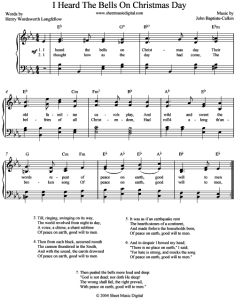
“I Heard the Bells on Christmas Day” is a Christmas carol based on the 1863 poem “Christmas Bells” by American poet Henry Wadsworth Longfellow. The song tells of the narrator’s despair, upon hearing Christmas bells, that “hate is strong and mocks the song of peace on earth, goodwill to men”. The carol concludes with the bells carrying renewed hope for peace among mankind.

This version is done by Casting Crowns.  I chose it because the Pender choir sang this on Christmas Eve with past-Associate Pastor Dan Elmore singing the solo…and I fell in love with this version.

As seen on 2008 TBN Christmas special. “I Heard The Bells On Christmas Day” is available on Casting Crowns’ Christmas album, Peace On Earth.

More traditionally, the Mormon Tabernacle Choir’s version:

I heard the bells on Christmas Day
Their old, familiar carols play,
and wild and sweet
The words repeat
Of peace on earth, good-will to men!

And thought how, as the day had come,
The belfries of all Christendom
Had rolled along
The unbroken song
Of peace on earth, good-will to men!

Till ringing, singing on its way,
The world revolved from night to day,
A voice, a chime,
A chant sublime
Of peace on earth, good-will to men!

Then from each black, accursed mouth
The cannon thundered in the South,
And with the sound
The carols drowned
Of peace on earth, good-will to men!

It was as if an earthquake rent
The hearth-stones of a continent,
And made forlorn
The households born
Of peace on earth, good-will to men!

And in despair I bowed my head;
“There is no peace on earth,” I said;
“For hate is strong,
And mocks the song
Of peace on earth, good-will to men!”

Then pealed the bells more loud and deep:
“God is not dead, nor doth He sleep;
The Wrong shall fail,
The Right prevail,
With peace on earth, good-will to men.”

Christmas Countdown: Joy To The World


Joy_To_The_World-Antioch

Joy To The World

Joy to the World, the Lord is come!

Let earth receive her King.

Isaac Watts wrote the words to “Joy to the World” in 1719, based on Psalm 98 in the Bible. The hymn originally glorified Christ’s triumphant return at the end of the age, rather than a song celebrating His first coming. Only the second half of Watts’ lyrics are still used today.

The music was adapted and arranged to Watts’ lyrics by Lowell Mason in 1839 from an older melody which was then believed to have originated from Handel. The name “Antioch” is generally used for the hymn tune.

As of the late 20th century, “Joy to the World” was the most-published Christmas hymn in North America.


There are versions of Joy to the World available at the O’Connor Music Studio for any level of playing, starting with Pre-Reading, all the way up through Advanced and duets.

Christmas Countdown: Sleigh Ride

Sleigh Ride

I’ve always liked Leroy Anderson’s Sleigh Ride as a secular Christmas song 🙂  It’s not technically a Christmas song since the words never mention Christmas but it’s often played now so it seems like a way to ease into the season.

Anderson had the original idea for the piece during a heatwave in July 1946;  he finished the work in February 1948.  Lyrics, about a person who would like to ride in a sleigh on a winter’s day with another person, were written by Mitchell Parish in 1950.

The orchestral version was first recorded in 1949 by Arthur Fiedler and The Boston Pops Orchestra. The song was a hit record and has become the equivalent of a signature song for the orchestra.

A fun arrangement has been made for piano duet.  I have copies here to lend and it’s available on amazon (of course! What isn’t?)

October 6 ~ On This Day in Music

today

• 1820 ~ Jenny (Johanna) Lind, Swedish coloratura soprano, “The Swedish Nightingale”

• 1882 ~ Karol Szymanowski, Polish composer

• 1917 ~ A new word cropped up in the American lexicon: Jazz. The Literary Digest described jazz as music that caused people to, “shake, jump and writhe in ways to suggest a return to the medieval jumping mania.”

• 1927 ~ Paul Badura-Skoda, Austrian pianist and music editor

• 1927 ~ “Mammy, how I love you, how I love you, my dear old mammy!” It was Al Jolson in blackface, singing in the first full-length talking picture, The Jazz Singer, as it opened in New York City. In reality, The Jazz Singer was not a true talkie. There were only 291 spoken words in the landmark film; however, it was the first to integrate sound and this small amount of dialogue into a story through the Vitaphone disk process; and the first to entertain a large audience. The talking part was mostly singing, and it was Al Jolson who made the flick a success, proving to the critics that an all-talking film could work. (Because he didn’t think the pioneer of talkies would be all the rage, George Jessel actually turned down the starring role; as did Eddie Cantor.) A silent version of the film was released to movie theaters who had not yet popped for the $20,000 or so that it cost to rewire their venue. The audience was thrilled with Jolson’s sound performance as a cantor’s son, Jake Rabinowitz, rejecting the world he came from to become a singer of popular music, changing his name to Jack Robin in the process. Although not jazz as we know it, the songs Jolson sang became part of American music culture: Toot Toot Tootsie (Goodbye), Blue Skies, Waiting for the Robert E. Lee and, of course, My Mammy. For those truly with a need to know, Neil Diamond did not audition for Jolson’s part when finding out that Jessel had turned it down. Diamond performed in a remake of The Jazz Singer in 1980. As Jolson said, “Wait a minute, wait a minute, you ain’t heard nothin’ yet!” Maybe, through the wonders of modern technology, we could hear Jolson and Diamond together, in concert. That would be the Mammy of all jazz singin’.

• 1941 ~ Claude Thornhill and his orchestra recorded Autumn Serenade on Columbia Records.

• 1946 ~ Millie Small (Smith), Singer, known as ‘The Blue Beat Girl’ in her native Jamaica

• 1949 ~ Bobby Farrell, Singer

• 1950 ~ Thomas McClary, Guitarist with The Commodores

• 1951 ~ Kevin Cronin, Singer with REO Speedwagon

• 1960 ~ Steve Lawrence and partner, Eydie Gorme, starred at the new Lotus Club in Washington, DC.

• 1962 ~ Robert Goulet stepped out of the role of Sir Lancelot after singing/acting the part since 1960. The fabulously successful Broadway musical, Camelot, also starred Richard Burton as King Arthur and Julie Andrews as Queen Guenevere.

• 1964 ~ Matthew Sweet, Guitarist, singer, songwriter

• 1969 ~ George Harrison‘s song ‘Something’ was released as the “A” side of a Beatles’ 45, a first for Harrison. Along with Lennon and McCartney’s ‘Come Together’, the single went on reach No.1 on the US chart the following month. Both tracks were lifted from the Abbey Road album.

• 1973 ~ Gene Krupa (1909) passed away. He was an American jazz drummer, bandleader, actor, and composer known for his energetic style and showmanship. His drum solo on “Sing, Sing, Sing” (1937) elevated the role of the drummer as a frequently used solo voice in the band.

• 1974 ~ “Mack & Mabel” opened at Majestic Theater NYC for 66 performances

• 1985 ~ Nelson Riddle, Grammy Award-winning orchestra leader passed away

• 2001 ~ Blues singer Mamie “Galore” Davis died of a stroke. She was 61. Davis was born Sept. 24, 1940, in Erwin, where she started singing the blues. She graduated from O’Bannon High School and joined a local band. She performed with such musicians as Little Johnny Burton, Buddy Hicks, Little Milton and the Ike and Tina Turner Revue. Her first solo recording, Special Agent 34-24-38, was recorded on the St. Lawrence label in 1965. Under her first producer, Monk Higgins, she recorded two more singles for St. Lawrence, including her biggest hit, It Ain’t Necessary, in 1966.

• 2003 ~ Victor Buelow, who made it into the record books as the longest-serving community band director, died os an apparent heart attack. He was 94. Buelow directed the Jefferson American Legion Band for 72 years, from 1931 through the 2002 band season. Guinness World Records declared him the longest-serving director anywhere after he retired. Buelow stayed with the band even in retirement, playing the alto horn this summer

• 2007 ~ Queen’s groundbreaking promo for their 1975 hit Bohemian Rhapsody was named the UK’s best music video in a survey of music fans. Out of 1,051 adults polled by O2, 30% named the six-minute video, (which took only three hours to shoot and cost a mere £3,500 to make), their favorite.

• 2018 ~ Montserrat Caballé, Spanish soprano, died at the age of 85

• 2020 ~ Eddie Van Halen (Edward Lodewijk Van Halen) died at the age of 65. was a Dutch-American musician, songwriter, producer, and inventor.

• 2020 ~ John Lester Nash Jr. was an American singer-songwriter, best known in the United States for his 1972 hit “I Can See Clearly Now”. Primarily a reggae and pop singer, he was one of the first non-Jamaican artists to record reggae music in Kingston.