Redditor NeokratosRed had an idea: depict the hands of great composers and pianists, according to the characteristics of their music. He shared it on the social media site, and also punted for suggestions of more. It has since received over 300,000 images views, and lots of further suggestions from fellow Redditors and piano geeks.
Whisks for Chopin’s elegant pianistic souffles, feather dusters for the gentle impressionism of Debussy, instruments of trade for the composer of the thunderous Hammerklavier sonata.
Piano, and the internet – top marks to the both of you.
The Piano Puzzlers book is available in the O’Connor Music Studio library if you’d like to give any a try. Piano Puzzlers as heard on American Public Media’s “Performance Today.” Includes 32 tunes with songs by Gershwin, Berlin, Arlen, Porter, Rodgers, Fats Waller, Lennon & McCartney, and others disguised in the styles of Bach, Handel, Haydn, Mozart, Beethoven, Brahms, Schubert, Schumann, Chopin, Janacek, Debussy, Ravel, Rachmaninoff, Stravinsky, Prokofiev, Bartok, and Copland.
Includes an introduction by Fred Child, host of “Performance Today” as well as background info by Bruce Adolphe. “Bruce Adolphe has taken a common musician’s party game and elevated it to high art and truly funny musical slapsticks. The Piano Puzzlers are a unique combination of extraordinary insight into the styles of many composers subtle, expert workmanship and great, great fun!”
If you’re a music geek (like me), I have a program for you. Now, let me be clear, to fully qualify as a music geek…you must have a fond appreciation for classical music (no, Poison, Quiet Riot, and Zepplin do not count as classical music). So, if you’re a “music geek” without an appreciation for classical music…well, I hate to burst your bubble…but, you’re not truly a music geek. Instead, you’re a music appreciator, but not a geek. So, if you just listen to indie music and scowl at anything on a label larger than Matador…don’t bother following the link I’ll provide…the fun will be lost on you…And, you probably won’t have a chance.
Every Wednesday night, on my way home from WNL, I turn on my local NPR station to listen to Piano Puzzlers on Performance Today. It’s absolutely incredible. A pianist/composer (Bruce Adolphe) takes a familiar folk or pop tune and sets it inside a classical masterpiece (or in the style of a particular composer). Sometimes it’s easy…sometimes it’s ridiculously difficult. There are days when I say, “got it” on the first pass. Then there are days when I say, “what the heck?” And, more often than not, I’m able to get either the popular/folk tune or the composer.
This is sad to admit, but there are nights when I’ll slow down on the drive home or sit in the car in the driveway to finish an episode. In fact, I get a little worked up if someone stops me after WNL…as I might miss the beginning of Piano Puzzlers (it usually hits around 8:20pm on our local station).
Take a listen to some of the archives and see if you can figure it out! It’s really cool…but probably only appreciated by music geeks (the kind of people that listen to NPR for their musical programs and not just the snipets of cool indie rock between segments on All Things Considered…which is a great show too).
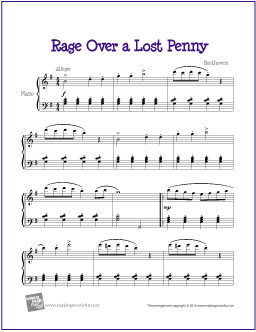
Today’s piece is Beethoven’s Rage Over a Lost Penny found in Piano Pronto Movement 4, Songs I Love to Play 2 and Beethoven: Exploring His Life and Music. The official title is The “Rondo alla ingharese quasi un capriccio” in G major, Op. 129 (Italian for “Rondo in the Hungarian [i.e. gypsy] style, almost a caprice”).
The story goes –
At one point Beethoven was composing this piece, a booming and boisterous piece that exuded energy and vitality.
One night a neighbor heard a loud dispute.
Beethoven was in a rage, accusing a maid of stealing a gold penny. The maid ran out and was never heard from again.
The neighbor then heard furniture crashing, and he could only conclude that the great Maestro was tipping over furniture, madly looking for the lost gold penny.
The story spread through the neighborhood and became part of the legend of Beethoven’s bad moods and curmudgeonly behavior.
Today we will listen to Minuet in G. Several people composed a Minuet (a slow, stately ballroom dance for two in 3/4 time, popular especially in the 18th century) in the key of G including Beethoven, Mozart and Bach.
How are the same? How are they different?
JS Bach’s version
The Bach version also was “acquired” for a popular song in the 1960s
Beethoven
Rowlf from the Muppets plays the Beethoven Minuet
Mozart
So – never say to your teacher that “I already played that” – you never know which version s/he has in mind!
Today we listen to Beethoven’s “Moonlight Sonata”. The real name for this work is The Piano Sonata No. 14 in C♯ minor “Quasi una fantasia”, Op. 27, No. 2. It was completed in 1801 and dedicated in 1802 to his pupil, Countess Giulietta Guicciardi
The piece is one of Beethoven’s most popular compositions for the piano, and it was a popular favorite even in his own day.
It’s in the Piano Pronto Beethoven book as well as many compilations of classical music.
Arranged for piano and orchestra
An animation
The above were all of the first movement only. Here’s the whole sonata played by Valentina Lisitsa:
Today, we’ll listen to the Symphony No. 5 in C minor, Op. 67, of Ludwig van Beethoven. It was written between 1804–1808. It is one of the best-known compositions in classical music, and one of the most frequently played symphonies. As is typical of symphonies in the classical period, Beethoven’s Fifth Symphony is in four movements.
I’m sure you’ve heard the first 8 notes before…
Since it was written for orchestra, each instrument has its own line:
A piano version, transcribed by Liszt
From Disney’s Fantasia 2000:
Pink learns to play the violin, and interrupts a performance of Beethoven’s Fifth Symphony with the Pink Panther theme played on various instruments.
Beethoven’s Wig:
Arrangements of Beethoven’s Fifth Symphony can be found in Piano Maestro and lots of books including Piano Pronto’s Movement 2, Movement 5 (Victory Theme) and Beethoven: Exploring His Life and Music.
• 1915 ~ Laverne Andrews, Pop Singer More information about The Andrews Sisters
• 1915 ~ Dorothy Kirsten, Opera Singer
• 1925 ~ Merv Griffin, Entertainer
• 1925 ~ Bill Haley, American rock-and-roll singer, songwriter and guitarist with Bill Haley and His Comets
• 1932 ~ Della Reese (Delloreese Patricia Early), Pop Singer
• 1937 ~ Vladimir Ashkenazy, Russian-born Icelandic pianist and conductor More information about Ashkenazy Grammy winner
• 1937 ~ Gene Chandler (Eugene Dixon), Singer
• 1937 ~ The big band classic, Sing, Sing, Sing was recorded by Benny Goodman and his band. Sitting in on this famous Victor Records session was Gene Krupa, Ziggy Elman and Harry James.
• 1945 ~ Rik Elswit, Musician, guitarist and singer with Dr. Hook and the Medicine Show
• 1954 ~ Nanci Griffith, Grammy Award-winning singer, songwriter
• 1957 ~ John Lennon and Paul McCartney met for the first time at The Woolton Church Parish Fete where The Quarry Men were appearing. As The Quarry Men were setting up for their evening performance, McCartney eager to impress Lennon picked up a guitar and played ‘Twenty Flight Rock’ (Eddie Cochran) and ‘Be-Bop-A-Lula’ (Gene Vincent). Lennon was impressed, and even more so when McCartney showed Lennon and Eric Griffiths how to tune their guitars, something they’d been paying someone else to do for them.
• 1959 ~ Jon Keeble, Musician, drummer with Spandau Balle
• 1971 ~ Louis Armstrong, Jazz musician, died. His groups, the Hot Five and Hot Seven, from 1925 to 1927, had a revolutionary impact on jazz.
• 1971 ~ Karen and Richard Carpenter hosted the summer series, Make Your Own Kind of Music, on NBC-TV.
• 1973 ~ Otto Klemperer, German conductor particularly known for his interpretations of Beethoven, died.
• 1984 ~ Michael Jackson and his brothers started their Victory Tour in Kansas City, Missouri’s Arrowhead Stadium. The tour turned out to be a victory for the Jacksons when the nationwide concert tour concluded months later.
• 1998 ~ Roy Rogers, U.S. film actor known as “the singing cowboy”, died.
• 2000 ~ Władysław Szpilman, Polish pianist and classical composer, died at the age of 88
• 2020 ~ Country Music legend Charlie Daniels, best known for his monster 1979 hit “The Devil Went Down to Georgia,” died at the age of 83.
• 2020 ~ Ennio Morricone wrote the scores for more than 500 movies and TV series, as well as over 100 works for the concert hall. He died following complications from a fall at the age of 91.
Humoresques Op. 101 (B. 187), is a piano cycle by the Czech composer Antonín Dvořák, written during the summer of 1894. One writer says “the seventh Humoresque is probably the most famous small piano work ever written after Beethoven’s Für Elise.
Orchestra:
Ragtime:
Jazz with Wynton Marsalis on trumpet
Zez Confrey gave this a makeover and included Way Down Upon the Swanee River:
Find the original Humoresque on IMSLP. The O’Connor Music Studio Lending Library has versions of Humoresque available at several levels and Confey’s Humorestless played in the video above.
Today we listen to the third movement Mozart’s Piano Sonata No.11 III (Turkish March) with just a bit of the first movement near the end.
The Turkish influence on western music came through the Turkish military band music (Mehter), which was at the time was the only military band in Europe. It was once popular among western composers like Mozart to write Turkish-style (alla Turca) works, Turkish music being known at that time as Turkish band music. That’s why the Turkish-influenced music works by Mozart, Beethoven or Strauss are in march rhythm as they are called march.
A rondo is a piece of music where the musical material stated at the beginning of the piece keeps returning. This opening music can be called either the theme or the refrain; they are the same thing. The form can be A, B, A or A, B, C, A – anything as long as the “A” theme returns
The Turkish March movement:
On guitar:
Harmonica, anyone?
Vocal:
Find the Turkish march movement of this sonata in these Piano Pronto books: Encore, Mozart: Exploring His Life and Music,
The first movement can be found in Keyboard Kickoff, Movement 2
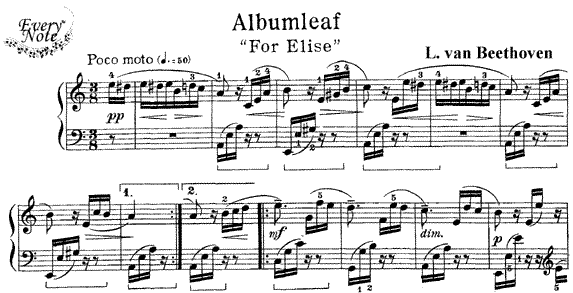
Today’s piece is one of those that piano students often try to learn on their own – or a friend will teach them the first 9 notes. It’s usually played too fast and, often in the wrong octave, or the first couple notes are repeated too many times.
This is one of two pieces that are so often played incorrectly that they have the distinction of being banned from competition in Northern Virginia Piano Teacher competitions.
Stay tuned for the other one!
Für Elise was not published during Beethoven’s lifetime, having been discovered by Ludwig Nohl 40 years after the composer’s death. The identity of “Elise” is unknown.
The very basic melody:
From Wunderkeys – The Elise Session
The actual beginning is a little more involved.
And, there’s more!
If you’d like to learn to play this piece correctly, find the sheet music at IMSLP, Beethoven: Exploring His Life and Music, and countless compilations of classical music available at the O’Connor Music Studio.
Follow along:
By Valentina Lisitsa:
Ragtime!
The Big Piano at FAO Schwartz in NYC:
Glass harp:
The Mystery Behind Für Elise:
Youtube has many, many more versions. Beethoven would probably go nuts!








 MaryO'Studio