Happy Birthday, Franz Liszt

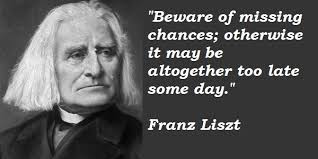
liszt-quote


Franz Liszt was born in Raiding, near Ödenburg, October 22, 1811 and died in Bayreuth, July 31, 1886. He was a Hungarian composer and pianist who was a major influence during the romantic period. Liszt was an outstanding pianist at seven, composed at eight and made concert appearances at nine. In addition to being a piano virtuoso, he was also a critic, conductor, city music director, literary writer and transcriber of the works of other composers. He transcribed Beethoven’s Symphonies for the piano.

Franz Liszt began his career as the outstanding concert pianist of the century, who, along with the prodigious violinist Niccoló Paganini (1782-1840), created the cult of the modern instrumental virtuoso. To show off his phenomenal and unprecedented technique, Liszt composed a great deal of music designed specifically for this purpose, resulting in a vast amount of piano literature laden with dazzling, and other technical marvels. In this vein, Liszt composed a series of virtuosic rhapsodies on Hungarian gypsy melodies, the best-known being the all too familiar Hungarian Rhapsody no. 2. Liszt developed the rhapsody as a form of serious music. This kind of music is worlds apart from the generally more introspective, poetic music of pianist-composer Frédéric Chopin.

Liszt was wildly handsome and hugely talented. He was extremely popular in Paris during the 1830’s. It is said that women actually fainted at his piano recitals. He was the first to position the piano so that its lid reflected the sound and the audience could see his profile as he performed.

Liszt was the first to write a tone poem, which is an extended, single-movement work for orchestra, inspired by paintings, plays, poems or other literary or visual works, and attempting to convey the ideas expressed in those media through music. Such a work is Les Préludes, based on a poem in which life is expressed as a series of struggles, passions, and mysteries, all serving as a mere prelude to . . .what? The Romantic genre of the symphonic poem, as well as its cousin the concert overture, became very attractive to many later composers, including Saint-Saëns, TchaikovskyDvorák, Sibelius, and Richard Strauss.


     Liszt’s birthday

     anniversary of Liszt’s death

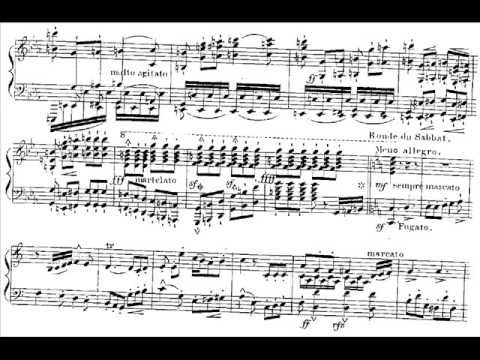
    Listen to Liszt’s transcription of Meyerbeer’s Hellish Waltz from Robert du Diable, which probably caused more public commotion than any other piano piece in history.


     Read quotes by and about Liszt

     Liszt was the first recitalist

     In Praise of Pianos and the Artists Who Play Them

     History of the Piano

     Franz Liszt


William and Mary piano class offers fellowship for vets

piano-dream


Rebecca Davy paced through her class Saturday, giving instructions to each student sitting at their keyboards.

This was no computer exercise though. “Keep your fingers super glued to those notes. Where’s E? Where’s G? Where’s C?,” she said. “You need to know where your fingers are mentally on the keyboard.”

In Ewell Hall on the College of William and Mary’s campus, Davy has been giving piano lessons to military veterans through a collaboration with the Armed Services Arts Partnership.

The program partners colleges and veterans to help them build communities and fellowships centered around the arts. The program, which is free for veterans whose applications are accepted, provides instruction in courses like writing, stand-up comedy, guitar and piano.

Armed Services Arts Partnership was founded by Sam Pressler, who attended W&M.

Pressler founded the group seeking to use comedy as a way to allow veterans to express themselves after he lost a relative to suicide and learned later about the high rate of suicide among military veterans.

“A single class soon blossomed into communities around writing, music, and comedy, and with such proof of concept and demand, he formed a nonprofit to scale the model to other communities located in areas with high military populations,” said Megan Brew, director of operations for Armed Services Arts Partnership, which is based in Arlington.

“I’ve done so many things. I work with veterans as a transition counselor, and a lot of our soldiers are leaving the service with mental health issues,” said Willie Burston, who attends the piano group. Burston himself is a retired Army veteran.

“Something like this will keep them focused on positive things,” he said. Burston said he also joined the group for a simpler reason. He enjoys singing in church and has aspirations to one day play some of the instrumental music. His favorite songs are hymns such as “Amazing Grace.”

“I came from a family of ministers and pastors and musicians, but I can’t play.”

On Saturday, he sat patiently as Davy taught him the beginning of “The Can-Can” by Jacques Offenbach.

“I heard about this from the VA hospital. My doctor said this would be good for you,” said Anita Jones Chow Yuk, a retired Navy Commander. She had aspirations to learn a musical instrument earlier in life but never received the encouragement she needed.

“I think it’s a great opportunity to help them find a teacher,” Davy said. “I wasn’t about to let the class not happen,” she said.

From http://www.vagazette.com/news/va-vg-jcc-vet-piano-lesson-20151013,0,1449853.story

Simply Piano Teaches You Piano, Listens And Corrects Your Mistakes

Simply-Piano


iOS: Learning to play the piano can be difficult, and even moreso if you don’t have someone there to help you fix your errors and learn good tempo. Simply Piano can do both of those things, and all it takes is your iPhone or iPad. Best of all, it’s free.

Like many “piano-learning” apps, Simply Piano teaches you various pieces of music by essentially displaying sheet music in front of you to play, guiding you to the right keys on your piano or keyboard, and showing you the right order in which to press them and when — that’s all great, and not terribly unique, even if it works well. Where the app shines however is its listening feature. Simply put the phone down near the keyboard, and Simply Piano will “listen” to you play.

As you play, the app identifies what you’re playing and gives you feedback on how to improve. Maybe you need to pick up the tempo, or maybe you missed a few notes here or there — whatever it is, the app can give you a few tips, and encourages you to try again, all while it listens and tries to help.

Simply Piano is free, and available now. It comes bundled with a ton of songs to learn (including classical and pop songs you’ll probably recognise), and is geared to all skill levels — and keyboard types, so you don’t need a fancy piano just to use the app, any keyboard will do. Hit the link below to try it out.

Simply Piano (Free) [iTunes App Store via JoyTunes]

From http://www.lifehacker.com.au/2015/10/simply-piano-teaches-you-piano-listens-and-corrects-your-mistakes/


Keyboard Conversations® with Jeffrey Siegel: Chopin and Grieg – A Musical Friendship

steinway-new

Get tickets now!

  • October 25, 2015 at 7:00 pm

George Mason Concert Hall

In his second concert of the season, Jeffrey Siegel presents music of two of the most popular composers of the Romantic era in a performance of engaging melodies and nationalistic pride! Edvard Grieg was known as “the Chopin of the North” and put Norway on the classical music map in the same way Chopin celebrated his Polish heritage and homeland.

This delightful program features Chopin’s exhilirating [sic] Polonaises, Op. 22 and a group of his soulful Mazurkas, as well as Grieg’s zesty Norwegian Dances, and his heartbreaking, narrative Ballade. Part artist, part educator, and part entertainer, Jeffrey Siegel has enchanted Center audiences for nearly a quarter century with his brilliant artistry, massive pianotechnique, and a remarkable gift for making the audience a part of the classical music experience. “Siegel lit the stage…piano playing to delight the ears.” (San Diego Evening Tribune)

In addition to the remaining two Keyboard Conversations performances at the Center for the Arts, Mr. Siegel will also be performing at the Hylton Performing Arts Center in Manassas on March 6, 2016. Take a look.

$40, $34, $24. 2 Free Student Tickets Available with Mason ID on October 13, 2015

Get Tickets

October 4 ~ Today in Music

today

• 1812 ~ Fanny Perisiani, Italian coloratura soprano

• 1881 ~ The player piano was invented by Edward Leveaux of Sussex, England, who received a patent for it this day. There were many player piano inventions going on throughout the world during this time. Leveaux happened to be the lucky chap who received the patent England was handing out.

• 1929 ~ Leroy Van Dyke, Singer

• 1939 ~ A barber from Canonsburg (near Pittsburgh), PA, who had quite a singing voice, recorded That Old Gang of Mine with the Ted Weems Orchestra. That singer was the feature of the Weems band for many years before going solo as a radio, TV and stage star. You know him as ‘The Incomparable Mr. C.’, Perry Como. His string of hits for RCA Victor spans four decades. He was an NBC mainstay for years and years.

• 1943 ~ Is You is or is You Ain’t My Baby? was the musical question by Louis Jordan and His Tympany Five on this day on Decca Records.

• 1947 ~ James Fielder, Bass with these groups: Buffalo Springfield, Mothers of Invention and Blood, Sweat & Tears

• 1948 ~ Gordon MacRae hosted the premiere of a radio classic. The Railroad Hour debuted on ABC radio. The theme song was I’ve Been Working on the Railroad and the show was sponsored by….America’s Railroads.

• 1949 ~ John Aler, American tenor

• 1959 – Chris Lowe, Keyboards with Pet Shop Boys

• 1966 ~ It was, indeed, a Sunny Day for singer Bobby Hebb, who received a shiny gold record award for his song.

• 1967 ~ Woody (Woodrow Wilson) Guthrie passed away

• 1970 ~ Janis Joplin died from a drug overdose. She was 27. Joplin, known for her passionate, bluesy, vocal style, was the lead singer of Big Brother and the Holding Company. She became a superstar with hits like, Down on Me, Pearl (her nickname) and Every Little Piece of My Heart; but Me and Bobby McGee was her only certified top 40 hit. The Bette Midler movie, The Rose, was based on Joplin’s life.

• 1999 ~ Art Farmer passed away

• 2000 ~ International diplomat and Newport Music Festival director David Meredith Evans died at the age of 64.

• 2001 ~ Irmgard Farden Aluli, considered the most prolific female Hawaiian composer since Queen Liliuokalani, died after suffering complications from colon cancer surgery. She was 89. Aluli, affectionately nicknamed “Aunty”, became the first living member to be inducted into the Hawaiian Music Hall of Fame in 1998. In August, the Prince Kuhio Hawaiian Civic Club honored her as a cultural living treasure. She wrote more than 200 songs, including Boy from Laupahoehoe and E maliu Mai. Aluli began performing publicly after graduating from St. Andrew’s Priory in 1929. She was a member of the Annie Kerr Trio in the 1930s. In the late 1960s, Aluli, her daughters and a niece formed the group Puamana.

• 2001 ~ Jazz guitarist John Collins, who played with Nat King Cole for over a decade, died at the age of 83. Collins was born in Montgomery, Ala., and grew up in Chicago. His mother, Georgia Gorham, was a pianist and bandleader. Collins briefly played clarinet before switching to guitar and moving to New York, where he played with prominent jazzmen such as pianist Art Tatum. Collins accompanied singer Billie Holiday and saxophonist Lester Young in the 1940s and played in bands led by Benny Carter and Fletcher Henderson. He served in the Army during World War II, and played in Army bands. Esquire magazine gave Collins its New Star award as best guitarist of 1947, his lone jazz poll honor. Collins’ 14-year association with Cole began in 1951, when he replaced guitarist Oscar Moore. Collins played with Cole until the latter’s death in 1965. Collins went on to tour Europe with his own group. He played occasionally around Southern California in the 1990s but worked mainly as a private teacher.

A grand piano for a good cause

Piano 6


From Singapore: Classical music radio station Symphony 92.4FM is putting up a piano designed by Steinway & Sons for auction, and proceeds will go to the President’s Challenge 2015.

The President’s Challenge supports close to 100 charity organisations such as Boys’ Town, Cerebal Palsy Alliance Singapore, Lions Home for The Elders, and Guide Dogs Association of the Blind.

The Boston GP-163PE Grand Piano is valued at S$44,800, with a minimum bid of S$10,000. The silent auction will end on Sep 30 at 11.59pm.

Corporations are welcome to particpate, and the successful bidder can also choose to donate the piano to a beneficiary.

Visit www.toggle.sg/symphony924auction for more details and to take part.

Piano Explorer ~ October 2015

piano-explorer


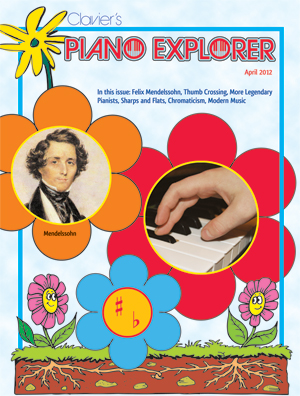
Each month, young students will receive a copy of Piano Explorer magazine.  It is available to adults, on request.

Included are

Composer biographies
• Music history
• Instruments
• Theory, practice tips, composing ideas
• Beginner’s Corner
• Music Corner (featuring student compositions)

Colorful pictures, timelines, and maps capture students’ attention. At the end of each magazine is a quiz to test students’ comprehension of the material. Games, puzzles, riddles, and student contributions round out the magazine and keep things fun.

Additional Features: Check out our website for additional material. The student page includes links to music mentioned in the issue, additional quizzes, and other interesting information.

The October issue includes information about

  • Franz Schubert
  • Practice tips
  • Dynamics
  • Voice
  • E Major
  • Antonio Salieri

Please note that students will have assignments from each issue.

You Think Playing the Piano is Hard?

Try to find an American Fotoplayer!

fotoplayer

The American Fotoplayer is a type of photoplayer developed by the American Fotoplayer Company between the years of 1912 and 1925. The Fotoplayer is a type of player piano specifically developed to provide music and sound effects for silent movies.

The appeal of the Fotoplayer to theatre owners was the fact that it took no musical skill to operate. The Fotoplayer would play the piano and pipe organ mechanically using an electric motor, an air pump, and piano rolls while the user of the Fotoplayer would follow the onscreen action while pulling cords, pushing buttons, and pressing pedals to produce relatable sounds to what was occurring onscreen. These actions could create sounds such as a steamboat whistle, a bird chirp, wind, thunder, a telephone bell, as well as many others. On Fotoplayers specifically, most effects were created using leather cords with wooden handles on the ends which the effects were directly connected to. For example, the steamboat whistle sound effect was created using a household bellows with a whistle at the end. Pulling the cord compressed the bellows, delivering a gust of air into the whistle. Creating a drum roll on the other hand was a bit more complicated. A clockwork device was needed to time the strikes of the drum which required constant winding.

Adapted from https://en.wikipedia.org/wiki/The_American_Fotoplayer


Another App from JoyTunes

Simply-Piano


Simply Piano helps you learn piano step by step, no previous knowledge required. It works with any piano or keyboard. Simply Piano is meant to teach people with little to no previous experience how to play songs and read music.

Run the app as you play and it provides real-time feedback as you progress through lessons. Just place your iPhone (or iPad) on your piano (or use your MIDI keyboard) and play, your iPhone will immediately recognize what you are playing!

The app slowly progresses from learning a few notes at a time to simple (and later, more complex) songs.

The app doesn’t let you skip ahead between lessons to maximize their effect. But not everyone has to start at square one. If you have some prior experience, you can indicate that the first time you use the app and it adjusts accordingly.


Free: iOS (I had to search for “Joytunes”)

IMAGE: JOYTUNES