Daily Listening Assignment ~ June 2


This is the month for graduations of all sorts, college, high school, even preschool.  Perhaps you know someone who is graduating this year.  Maybe it’s you!

This piece by Sir Edward Elgar is called Pomp and Circumstance and usually heard at graduations.  It was featured in Disney’s Fantasia 2000.

Edward Elgar’s father was a musician who tuned pianos, owned a music shop and was employed as a church organist. The young Edward learned to play the organ and violin at a young age and composed his first short piece at the age of 10. His first job was as assistant organist to his father. His main love was composition, although his music was not successful until his Enigma Variations were published in 1899. This work made him famous.

Until Elgar, there had not been a major creative composer in England since Handel’s death in 1759. He became known as England’s greatest composer and was widely recognized in his day. Unfortunately, Elgar’s fame waned at the end of his life – he composed little music during his last fifteen years and withdrew from almost all musical contact. It was not until the 1960’s that his music again became popular.

More information about Elgar

Do you know your chords well?  If so, try this version:

If not, ask at your next lesson for a version at your level.


Daily Listening Assignment ~ June 1


Today, we start with Spring from the Four Seasons by Vivaldi.  Many OCMS students have played this already in one of their Piano Pronto books.  It’s also available in Piano Maestro.

If you have it in your piano book, today would be a great day to review it. (HINT – there might be a quick review at your next lesson!)

Vivaldi was born in Venice, Italy, March 4, 1678 and spent most of his life there. His father taught him to play the violin, and the two would often perform together.

He taught at an orphanage for girls and wrote a lot of music for the girls to play. People came from miles around to hear Vivaldi’s talented students perform the beautiful music he had written.

Many people think Vivaldi was the best Italian composer of his time. He wrote concertos, operas, church music and many other compositions. In all, Antonio wrote over 500 concertos.

His most famous set of concertos is The Four Seasons which is a group of four violin concerti.  Each of which gives a musical expression to a season of the year. They were written about 1721 and were published in 1725 in Amsterdam.

Here’s a piano version similar to the one in Movement 1 but in a different key.


And the original with Itzhak Perlman playing and conducting!

Want to play a version of this but aren’t using these books? Just ask!

Scales and Arpeggios

scales

PDF Article on Scales and Arpeggios

In music, a scale is any set of musical notes ordered by fundamental frequency or pitch.

An arpeggio (it. /arˈpeddʒo/) is a musical technique where notes in a chord are played or sung in sequence, one after the other, rather than being played together like a chord. This word comes from the Italian word “arpeggiare”, which means “to play on a harp”. An alternative translation of this term is “broken chord”.

Make any scale or chord here

In the O’Connor Music Studio, we have started using some newer books with beginning students:  Piano Adventures Scale and Chord Book, Book 1 (5 finger) and 2 (Full scales).

Don’t Give Up Because You Miss a Note!

FaeriesAireandDeathWaltz1

I have a copy of this music (Faerie’s Aire and Death Waltz) if anyone is interested in playing it!

The music above has been played:

The drive you need to accomplish whatever you’re attempting—big or small—needs fuel. Instead of letting slip-ups set you back, psychologist and author John Norcross recommends you make them the fuel:

If you are learning to play the piano, you don’t give up because you miss a note. It’s not whether you slip, it’s how you respond to the slip.

Cut yourself some slack and remember that things take time and hard work. Listen to the sound of your “missed note” and let that push you forward. You missed that note yesterday, but that doesn’t mean you’ll miss it today.

via “If You’re Learning Piano, You Don’t Give Up Because You Miss a Note”.

Reston Sings: Handel’s Messiah!

messiah


Enrich your holiday season by singing the glorious Christmas portion of Handel’s Messiah with guest soloists, Crossley Danielle Hawn, soprano; Barbara Hollinshead, mezzo; C. J. David, tenor and Richard Giarusso, bass. Dr. Allan Laino, conducting; David B. Lang, organist.

Tuesday, December 6, 2016 at 7:30 pm

St. John Neumann Catholic Church

$15* General Admission (Singers and Audience)
Free for Children 12 and Under
$5 Music Rental (or bring your own – I have some copies to lend, if you ask at your next lesson)
Tickets available online or at the door 30 minutes prior to program.

*Bring a new or gently used coat or other new winterwear (hat, gloves, scarves, heavy socks, etc.) to donate to Cornerstones’ Coat Closet, and receive a $5 discount on admission.

Want to Learn a Christmas Duet?

sleigh-ride

I have loved this version of Sleigh Ride since I first saw it on YouTube:

When I found out it was available in sheet music, I rushed to amazon to buy several copies for myself, my son, my friend, basically, everyone I thought could play it.

Lots of fun to play and to hear.

Amazon says:

Leroy Anderson’s “Sleigh Ride” is a holiday favorite, and this setting for advanced piano duet gives it a fresh twist. It begins with Anderson’s jingling melody and some musical “banter” between the Primo and Secondo players, and then it launches into a series of variations which take the listener on a journey through a variety of styles—from gently swirling, impressionistic arpeggios to a triumphant coda with brilliant, virtuosic passagework. Audiences will enjoy a number of other musical surprises along the way.

If you want to borrow it, let me know early because someone at the studio may already be playing it!

maryOpianoplayer

Getting Ready for Halloween: Toccata and Fugue in d minor by J.S Bach

toccata-d-minor


Johann Sebastian Bach’s towering monument of organ music, with its deep sense of foreboding, will forever be associated with Halloween.

Get a free copy of the sheet music at IMSLP or borrow a copy from the O’Connor Music Studio.  I have this arranged for organ, piano, duet, 2-piano, simplified…

If you want this in a book with other Bach transcriptions, amazon has this: Toccata and Fugue in D Minor and the Other Bach Transcriptions for Solo Piano, arranged by Ferruccio Busoni.

Here, Virgil Fox performs it on his Allen Digital Touring Organ.


Diane Bish plays the Massey Memorial Organ at the Chautauqua Institution and talks about this instrument.


Play along with pianist Cyprien Katsaris if you wish!


And, the most fun…

Getting Ready for Halloween: In the Hall of the Mountain King by Edvard Grieg

hall-mountain


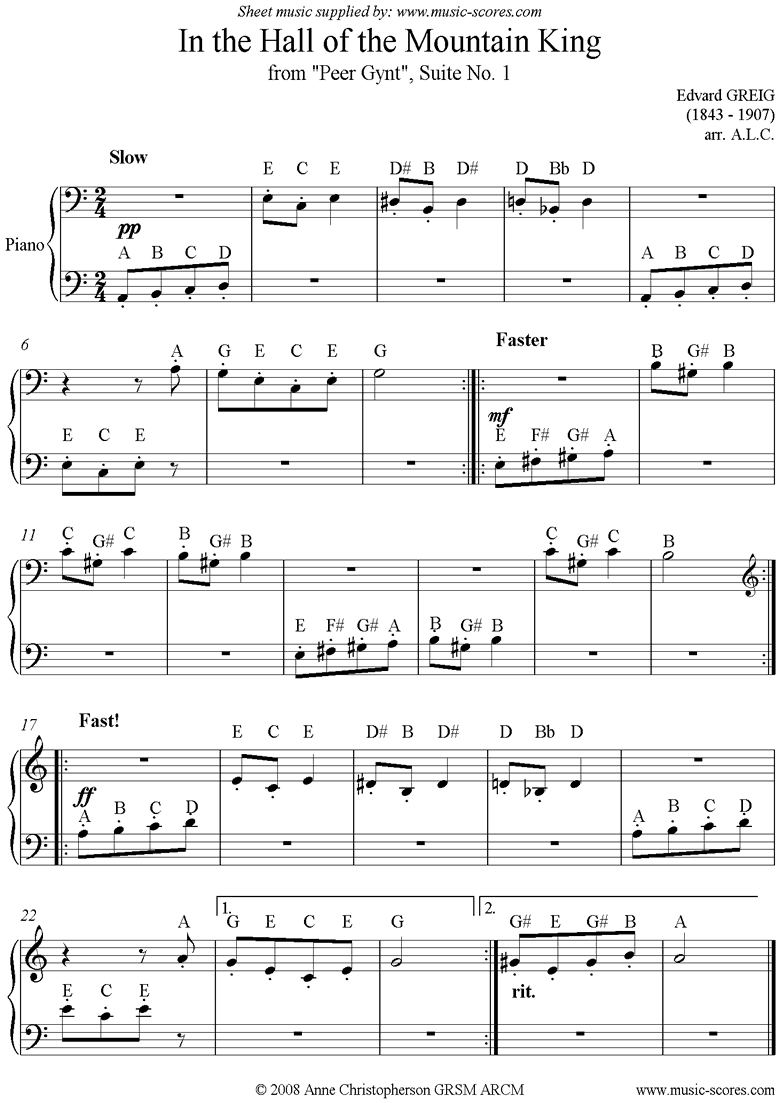
“In the Hall of the Mountain King” is a piece of orchestral music composed for the sixth scene of act 2 in Henrik Ibsen’s 1867 play Peer Gynt. It was originally part of Opus 23 but was later extracted as the final piece of Peer Gynt, Suite No. 1, Op. 46. Its easily recognizable theme has helped it attain iconic status in popular culture, where it has been arranged by many artists, including for the piano.

Borrow a copy of the sheet music from the O’Connor Music Studio.  I have this arranged for piano, duet, 2-piano, simplified…


8 part vocal orchestra (plus a tiny pair of cymbals)


Pianist Paul Barton


Solo piano sheet music – Video Score


Orchestral version

Getting Ready for Halloween: Night on Bald Mountain by Modest Mussorgsky

bald-mountain

Night on Bald Mountain refers to a series of compositions by Modest Mussorgsky (1839–1881). Inspired by Russian literary works and legend, Mussorgsky composed a “musical picture”, St. John’s Eve on Bald Mountain on the theme of a witches’ sabbath occurring on St. John’s Eve, which he completed on that very night, June 23, in 1867.

Get a free copy of the sheet music at IMSLP or buy it on amazon.com.

From Disney’s Fantasia


Piano version transcribed for solo piano by Konstantin Chernov (1865-1937).


The Ludwig Symphony Orchestra, conducted by Maestro Thomas Ludwig