Humoresques Op. 101 (B. 187), is a piano cycle by the Czech composer Antonín Dvořák, written during the summer of 1894. One writer says “the seventh Humoresque is probably the most famous small piano work ever written after Beethoven’s Für Elise.
Yo Yo Ma (cello) and Itzhak Perlman (violin
Orchestra:
Ragtime:
Jazz with Wynton Marsalis on trumpet
Zez Confrey gave this a makeover and included Way Down Upon the Swanee River:
Find the original Humoresque on IMSLP.. The O’Connor Music Studio Lending Library has versions of Humoresque available at several levels and Confey’s Humorestless played in the video above.
Korobeiniki is a nineteenth-century Russian folk song that tells the story of a meeting between a peddler and a girl, describing their haggling over goods in a veiled metaphor for courtship.
Outside Russia, “Korobeiniki” is widely known as the Tetris theme.
Orchestral version:
For Boomwhackers:
Vocal:
Ragtime:
Balalaika:
The Red Army Choir:
Korobeiniki/Tetris is available in Piano Maestro on the iPad and I have the sheet music for anyone who is interested.
Pictures at an Exhibition is a suite of ten pieces (plus a recurring, varied Promenade) composed for the piano by Russian composer Modest Mussorgsky in 1874.
The suite is Mussorgsky’s most famous piano composition and has become a showpiece for virtuoso pianists. It has become further known through various orchestrations and arrangements produced by other musicians and composers, with Maurice Ravel’s arrangement being by far the most recorded and performed.
You can download the sheet music at IMSP or I have a copy of the book, as well as simplified sheet music.
The work opens with a brilliant touch – a “promenade” theme (above) that reemerges throughout as a transition amid the changing moods of the various pictures.
The ten pictures Mussorgsky depicts are:
a gnome-shaped nutcracker;
a troubadour plaintively singing outside an ancient castle;
children vigorously playing and quarreling in a park;
a lumbering wooden Polish ox-cart;
a ballet of peeping chicks as they hatch from their shells;
an argument between two Warsaw Jews, one haughty and vain, the other poor and garrulous;
shrill women and vendors in a crowded marketplace;
the eerie, echoing gloom of catacombs beneath Paris;
the hut of a grotesque bone-chomping witch of Russian folklore named Baba Yaga;
and a design for an entrance gate to Kiev.
The whole piece for piano. See if you can tell which pictures are which.
Today’s is a cheat post, partly because I ran out of time.
I’ve watched this video several times in the past few days. It’s a great overview of the Beatles music. And, yes, I have books of their music arranged for piano, if you want to play anything.
Today we listen to the third movement Mozart’s Piano Sonata No.11 III (Turkish March) with just a bit of the first movement near the end.
The Turkish influence on western music came through the Turkish military band music (Mehter), which was at the time was the only military band in Europe. It was once popular among western composers like Mozart to write Turkish-style (alla Turca) works, Turkish music being known at that time as Turkish band music. That’s why the Turkish-influenced music works by Mozart, Beethoven or Strauss are in march rhythm as they are called march.
A rondo is a piece of music where the musical material stated at the beginning of the piece keeps returning. This opening music can be called either the theme or the refrain; they are the same thing. The form can be A, B, A or A, B, C, A – anything as long as the “A” theme returns
The Turkish March movement:
On guitar:
Harmonica, anyone?
Vocal:
Find the Turkish march movement of this sonata in these Piano Pronto books: Encore, Mozart: Exploring His Life and Music,
The first movement can be found in Keyboard Kickoff, Movement 2
Eine Kleine Nachtmusik (Serenade No. 13 for strings in G major), K. 525, is a 1787 composition for a chamber ensemble by Wolfgang Amadeus Mozart. The German title means “a little serenade”, though it is often rendered more literally but less accurately as “a little night music.” The work is written for an ensemble of two violins, viola, and cello with optional double bass but is often performed by string orchestras and there are many arrangements for other instruments as we will see below.
Part of a full orchestral score:
Follow the score…
Easy piano sheet music might look like this:
The first movement of Mozart’s Eine Kleine Nachtmusik, with a graphical score.
One of my favorites, Barbershop-Style. Eine Kleine Not Musik by the Gas Houe Gang tells the story of The Magic Flute (from June 19) to the music of Eine Kleine Nachtmusik.
A piano transcription
For four recorders, all played by the same person
From the Muppets: The Great Gonzo performing Eine Kleine Nachtmusik on bagpipe while sitting on a ten-foot pole!
When my son and I played Eine Kleine Nachtmusik by Mozart arranged for 2 pianos November 30, 2014 we were the last people to play in the old Steinway Hall. Unfortunately, we didn’t have a good video camera 😦
Find this arranged for piano in Piano Pronto: Movement 2, Movement 3, Encore, Coda and Mozart: Exploring His Life and Music,
Today’s listening assignment is Can-can from “Orpheus in the Underworld” by Jacques Offenbach. This piece is very often in early method books because of the descending C Major scale. Can you find it?
The can-can (or cancan as in the original French) is a high-energy, physically demanding dance that became a popular music hall dance in the 1840s, continuing in popularity in French cabaret to this day. Originally danced by both sexes, it is now traditionally associated with a chorus line of female dancers. The main features of the dance are the vigorous manipulation of skirts and petticoats, along with high kicks, splits, and cartwheels.
Many composers have written music for the cancan. Today’s selection is the most famous of these.
A ‘follow-along” video. This key has 6 flats, so the scale will be in what key?
Flute ensemble:
The original, for full orchestra
An animation
A dog barking the can-can?
Find this in many student books including Piano Pronto: Movement 1
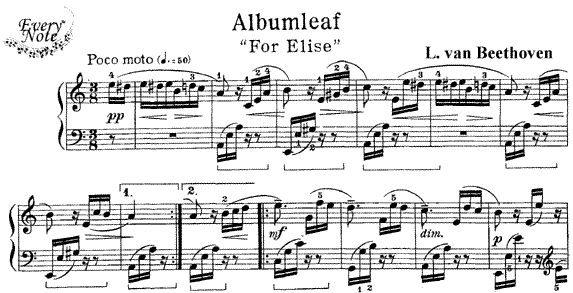
Today’s piece is one of those that piano students often try to learn on their own – or a friend will teach them the first 9 notes. It’s usually played too fast and, often in the wrong octave, or the first couple notes are repeated too many times.
This is one of two pieces that are so often played incorrectly that they have the distinction of being banned from competition in Northern Virginia Piano Teacher competitions.
Stay tuned for the other one!
Fur Elise was not published during Beethoven’s lifetime, having been discovered by Ludwig Nohl 40 years after the composer’s death. The identity of “Elise” is unknown.
The very basic melody:
The actual beginning is a little more involved.
And, there’s more!
If you’d like to learn to play this piece correctly, find the sheet music at IMSLP, Beethoven: Exploring His Life and Music, and countless compilations of classical music available at the O’Connor Music Studio.
Follow along:
By Valentina Lisitsa:
Ragtime!
A variety of instruments (Piano, Guitar, Cat Piano, Cello, Launchpad, Ukulele)
The Big Piano at FAO Schwartz in NYC:
Glass harp:
Youtube has many, many more versions. Beethoven would probably go nuts!
‘The Magic Flute’ (German name: Die Zauberflöte) is Wolfgang Amadeus Mozart’s final opera, and it contains one of the most well-known arias in music. But what is ‘The Magic Flute’ all about?
An animated version:
Played as a piano/organ duo:
Arranged by Ferruccio Busoni for 2 pianos:
Why Mozart’s Magic Flute is a masterpiece – an introduction (The Royal Opera)
The accordion version:
Find this in Piano Pronto: Movement 3, Encore, Mozart: Exploring His Life and Music




 MaryO'Studio