Today, we’ll be listening to the end of the William Tell Overture by Gioachino Rossini. This piece, originally the overture to an opera, has been arranged for piano and is in several method books, including Piano Pronto Movements 1 and 2. It’s also in Bastien Book 4 and Piano Maestro.
The original story
Maybe your grandparents watched the original Lone Ranger
Or you saw the newer Lone Ranger with Johnny Depp
Here’s the entire William Tell Overture played by an orchestra
Piano Solo
Franz Liszt made a really hard version for piano solo. See if you can follow along!
Piano Duet (1 piano, 4 hands)
Piano Duet arranged by Louis Moreau Gottschalk
Piano Duo (2 pianos, 8 hands)
Piano Quartet (4 pianos, 16 hands)
For pipe organ
For synthesizer
And then things get nuts with cartoons. Lots of cartoons used this music. Here are Mickey Mouse and friends
And Spike Jones
Handbells…
Poor Rossini – I think he’d have a fit if he knew how is music was being used.
I’m sure many have you have learned Twinkle, Twinkle Little Star by now. Did you know its’ the same melody as the ABC Song? You know…
Don’t believe it? Sing them both in your head or out loud.
The French melody first appeared in 1761, and has been used for many children’s songs, such as “Twinkle, Twinkle, Little Star”, “Baa, Baa, Black Sheep” and the “Alphabet Song”.
This is one of the first pieces a student learns in piano methods, since it has them reach just a bit outside their accustomed hand position on the word “little”.
I try to remember to let students know that Wolfgang Amadeus Mozart composed a set of twelve variations on the theme “Ah, vous dirai-je, Maman” for the piano and it started as the same basic Twinkle tune.
The sheet music is available at the O’Connor Music Studio if you want to borrow it or download it here about 1/3 of the way down the page under “Scores”.
I always enjoy these graphical scores. Watch the colors as the melody gets more and more complex:
Today we’re going to listen and learn about the opera Carmen.
I chose this for today since it’s the anniversary of French composer Georges Bizet‘s death.
Georges Bizet was born in Paris, France. Both his parents were musicians, and they actually wanted their son to become a composer when he grew up! Bizet loved music, but he also loved to read books. His parents wound up hiding his books so that he would spend more time on his music.
When Georges was 10 years old, his father enrolled him in the Paris Conservatory. While he was there, he wrote his only symphony, but it wasn’t performed until many years after he died. Bizet graduated from the Conservatory with awards in both composition and piano.
Bizet also composed operas. His most famous opera is Carmen. When Carmen first opened in Paris, the reviews were terrible. Many critics said there were no good tunes in it, so audiences stayed away.
In the middle of the night during the first round of Carmen performances, Bizet died. He was only 36. Four months later, Carmen opened in Vienna, Austria, and was a smash hit. It is now one of the most popular operas ever written. Bizet never knew that audiences would come to consider it his masterpiece.
Vladimir Horowitz made Carmen his own by turning it into a fantasy (or the more musical spelling – fantasie).
The fantasia (Italian; also English: fantasy, fancy, fantazy, phantasy, German: Fantasie, Phantasie, French: fantaisie) is a musical composition with its roots in the art of improvisation. Because of this, like the impromptu, it seldom approximates the textbook rules of any strict musical form.
When you play wrong notes for an audience, just tell the audience it’s a “Fantasie”, not the original work!
As you can see, Carmen is a popular work. Here it is for two pianos, played by Anderson and Roe.
The Canadian Brass tell the story of Carmen in their own humorous words.
This is the month for graduations of all sorts, college, high school, even preschool. Perhaps you know someone who is graduating this year. Maybe it’s you!
This piece by Sir Edward Elgar is called Pomp and Circumstance and usually heard at graduations. It was featured in Disney’s Fantasia 2000.
Edward Elgar’s father was a musician who tuned pianos, owned a music shop and was employed as a church organist. The young Edward learned to play the organ and violin at a young age and composed his first short piece at the age of 10. His first job was as assistant organist to his father. His main love was composition, although his music was not successful until his Enigma Variations were published in 1899. This work made him famous.
Until Elgar, there had not been a major creative composer in England since Handel’s death in 1759. He became known as England’s greatest composer and was widely recognized in his day. Unfortunately, Elgar’s fame waned at the end of his life – he composed little music during his last fifteen years and withdrew from almost all musical contact. It was not until the 1960’s that his music again became popular.
Today, we start with Spring from the Four Seasons by Vivaldi. Many OCMS students have played this already in one of their Piano Pronto books. It’s also available in Piano Maestro.
If you have it in your piano book, today would be a great day to review it. (HINT – there might be a quick review at your next lesson!)
Vivaldi was born in Venice, Italy, March 4, 1678 and spent most of his life there. His father taught him to play the violin, and the two would often perform together.
He taught at an orphanage for girls and wrote a lot of music for the girls to play. People came from miles around to hear Vivaldi’s talented students perform the beautiful music he had written.
Many people think Vivaldi was the best Italian composer of his time. He wrote concertos, operas, church music and many other compositions. In all, Antonio wrote over 500 concertos.
His most famous set of concertos is The Four Seasons which is a group of four violin concerti. Each of which gives a musical expression to a season of the year. They were written about 1721 and were published in 1725 in Amsterdam.
Here’s a piano version similar to the one in Movement 1 but in a different key.
And the original with Itzhak Perlman playing and conducting!
Want to play a version of this but aren’t using these books? Just ask!
As all my students know, I teach theory with all piano and organ lessons. Sometimes, it’s from a theory book that matches a lesson book, sometimes on the fly on an “as needed” basis.
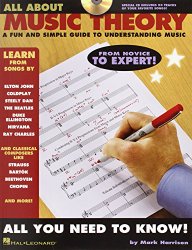
This book looks like it would be interesting to use as a review or to look ahead and see what’s coming. I have just ordered a copy for the studio if you want to check it out at the next lesson.
If you wish there was a fun and engaging way to help you understand the fundamentals of music, then this is it. Whether it’s learning to read music, understanding chords and scales, musical forms, or improvising and composing, this enjoyable guide will help you to finally start understanding the structure and design of music.
This fun-filled, easy-to-use guide includes:
* Music notation
* Scales and modes
* Melody harmonization and counterpoint
* Chord progressions
* Song form and structure
Listen and learn with the CD that has 90 tracks, including over 50 popular songs such as:
* Beauty and the Beast
* Candle in the Wind
* Imagine
* In the Air Tonight
* Killing Me Softly with His Song
* Let It Be
* Message in a Bottle
* Misty
* Satin Doll
* Take the ‘A’ Train
* Unchained Melody
* What’d I Say
* and more!
Since the first release of this classic Schirmer edition over 100 years ago, almost anyone who has taken piano lessons for more than two years has played from The Virtuoso Pianist.
Most anyone who has ever played piano has a love-hate relationship with the “Hanon”.
The Virtuoso Pianist (Le Pianiste virtuose) by Charles-Louis Hanon, is a compilation of sixty exercises meant to train the pianist in speed, precision, agility, and strength of all of the fingers and flexibility in the wrists.
First published in Boulogne, in 1873, The Virtuoso Pianist is Hanon’s most well-known work, and is still widely used by piano instructors and pupils although some teachers are getting away from the mechanical playing these can produce.
Personally, I’ve sometimes played these on “auto-pilot” since all one really needs is to get the first pattern going, then move up a step, up a step…
Notes by C. L. Hanon: Preparatory exercises for the Acquirement of Agility, Independence, Strength and Perfect Evenness in the Fingers. For studying the 20 exercises, begin with the metronome set at 60, gradually increasing the speed up to 108.
The exercises are intended to address common problems which could hamper the performance abilities of a student. These include “crossing of the thumb”, strengthening of the fourth and fifth fingers, and quadruple- and triple-trills.
The exercises are meant to be individually mastered and then played consecutively in the sections they are placed in.
Apart from increasing technical abilities of the student, when played in groups at higher speeds, the exercises will also help to increase endurance. The exercises are divided in three parts:
Exercises 1 – 20: Labeled “preparatory exercises”, these are also the most famous exercises, and are used to develop finger strength and independence. Each exercise contains a sequence of 8 semiquavers, beginning on C, which is then repeated starting on D, and so on across two octaves. The exercise is then repeated in reverse down two octaves to the starting C. The exercises are intended to be practiced in groups of three, except for the first two which are practiced together.
Exercises 21 – 43: Labeled “further exercises for the development of a virtuoso technique.” This more difficult section is meant to be played after the pianist has fully mastered Part 1. Part 2 includes scales and arpeggios.
Exercises 44 – 60: Labeled “virtuoso exercises for mastering the greatest technical difficulties.” Since this section is considerably more difficult, Hanon recommends the mastery of both previous parts before proceeding to this one. This part includes repeated notes,, and more.
After all three parts are mastered, Hanon recommends all exercises be played through daily to retain technique.
The O’Connor Music Studio has several editions of this work.
I have a copy of this music (Faerie’s Aire and Death Waltz) if anyone is interested in playing it!
The music above has been played:
The drive you need to accomplish whatever you’re attempting—big or small—needs fuel. Instead of letting slip-ups set you back, psychologist and author John Norcross recommends you make them the fuel:
“If you are learning to play the piano, you don’t give up because you miss a note. It’s not whether you slip, it’s how you respond to the slip.“
Cut yourself some slack and remember that things take time and hard work. Listen to the sound of your “missed note” and let that push you forward. You missed that note yesterday, but that doesn’t mean you’ll miss it today.
“O Come, All Ye Faithful” (originally written in Latin as Adeste Fideles) is a Christmas carol which has been attributed to various authors, including John Francis Wade (1711–1786), John Reading (1645–1692) and King John IV of Portugal (1604–1656), with the earliest manuscript of the hymn bearing his name, located in the library of the Ducal Palace of Vila Viçosa.
The original four verses of the hymn were extended to a total of eight, and these have been translated into many languages. The English translation of “O Come, All Ye Faithful” by the English Catholic priest Frederick Oakeley, written in 1841, is widespread in most English speaking countries.
There are now several versions in the O’Connor Music Store if you are interested in learning this Christmas carol.
Gesù Bambino by Pietro Yon has always had a place in my childhood memories since my church choir sang it every Christmas. Other than that, it didn’t seem to be too well known but this song has been turning up in piano books lately. There are now several versions in the O’Connor Music Studio if you are interested in learning this beautiful older Christmas carol.
Gesù bambino was written in 1917. The melody was used by Frederick H. Martens in his English language carol “When Blossoms Flowered ‘mid the Snows”. The melody and lyrics of the chorus are derived from “Adeste Fideles” (O Come All Ye Faithful).
A piano version
Piano and Organ
Sung by David Archuleta and the Mormon Tabernacle Choir






 MaryO'Studio