I have several copies of this book for the music studio so parents can check it out to see if it would be useful for them to buy for home use. If any of the studio parents have this book already, please let me know what you think.
Some of my adult students have this and have found it helpful in doing theory assignments.
Help Your Kids with Music is a step-by-step visual guide to music theory and is the perfect primer to help students gain a solid foundation in music, no matter their age, skill level, or instrument.
Help Your Kids with Music clearly explains key concepts in five step-by-step chapters:
The Basics explains the types of instruments, notation for keyboard and stringed instruments, the “musical alphabet,” and counting a beat.
Rhythm covers the length of notes and rests, as well as basic rhythms and meters, phrasing, syncopation, tempo, and using a metronome.
Tone and Melody includes everything a student needs to know about tones and how they work together to build a melody.
Chords and Harmony shows how intervals work together and includes examples for horn and woodwind instruments.
Form and Interpretation helps students understand how musical form can aid appreciation and interpretation for classical, jazz, blues, and other musical styles.
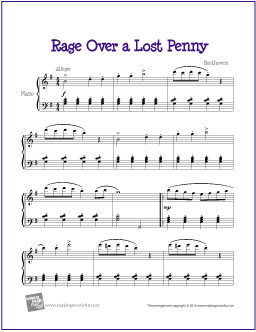
Today’s piece is Beethoven’s Rage Over a Lost Penny found in Piano Pronto Movement 4, Songs I Love to Play 2 and Beethoven: Exploring His Life and Music. The official title is The “Rondo alla ingharese quasi un capriccio” in G major, Op. 129 (Italian for “Rondo in the Hungarian [i.e. gypsy] style, almost a caprice”).
The story goes –
At one point Beethoven was composing this piece, a booming and boisterous piece that exuded energy and vitality.
One night a neighbor heard a loud dispute.
Beethoven was in a rage, accusing a maid of stealing a gold penny. The maid ran out and was never heard from again.
The neighbor then heard furniture crashing, and he could only conclude that the great Maestro was tipping over furniture, madly looking for the lost gold penny.
The story spread through the neighborhood and became part of the legend of Beethoven’s bad moods and curmudgeonly behavior.
The following ornament table is a transcription of the one appearing in the Clavier-Büchlein vor Wilhelm Friedemann Bach, written by Johann Sebastian Bach for the keyboard instruction of his eldest son.
A scan of the original manuscript appears at Dave’s J.S. Bach Page.
The German title translates as “Explanation of various signs, showing how to play certain ornaments correctly.”{1} Bach gives the sign for each ornament on the upper of the paired staves, while the lower shows its execution directly beneath.
(This blog has) simply modernized the clefs in my transcription, since Bach’s manuscript uses soprano clefs, as several composers continued to do throughout the 18th century in place of the treble clef now used in all keyboard music.
After the transcription graphic showing the table, there appear clickable buttons which are keyed to AU sound files; you can click on any of the ornaments and hear a sound file play its execution.
Stephen Powers first thought of his grand piano as an impressive piece of furniture.
But he enjoyed listening to music so much when friends played at parties at his home in North Wilmington that he began taking lessons.
“I enjoy having a couple of songs under my belt,” says Powers, a 52-year-old banker. “I play Happy Birthday. I play Getting to Know You for my mom.”
Powers is part of a boomlet of adults who are studying piano. Many took lessons briefly as children and regret giving it up. Some simply enjoy music. Others gravitated toward the keyboard because studies suggest piano improves mental acuity while reducing the odds of dementia.
A Swedish study published in 2014 in the International Journal of Alzheimer’s Disease found that when a twin played a musical instrument later in life, he or she was 64 percent less likely to develop dementia than the twin who did not play.
A study published in Frontiers in Psychology in 2013 evaluated the impact of piano lessons on cognitive function, mood and quality of life in adults age 60 to 84.
The group that studied piano showed significant improvement in tests that measure executive function, controlling inhibitions and divided attention, as well as enhanced visual scanning and motor ability. Piano students also reported a better quality of life.
Some grownups simply relish a challenge.
In the United Kingdom, Alan Rusbridger, editor of the Guardian, took to the keyboard at age 56. He chronicled the year he spent learning Chopin’s demanding No. Ballade 1 in G Minor in the book Play It Again: An Amateur Against the Impossible.
Richard Swarmer, 57, of Lewes, played the trumpet from grade school through college. He has sung in several choirs. This year, he began piano lessons.
Learning the piano isn’t easy even for someone with a musical background. Still, Swarmer appreciates that the creative thought process is different from the focus required by his job for a medical benefits company.
“I have thoroughly enjoyed taking piano lessons as an adult,” he says. “It provides a welcome respite from the demands of my job.”
Ethel Thirtel of North Wilmington is 71 and a student at the Music School of Delaware. She is also taking French lessons to help keep her intellect sharp.
“Both pursuits involve active studying and practice to master new skills,” she says.
To meet rising demand, the Music School of Delaware offers adults-only evening group classes to accommodate working people, says Matthew Smith, student and alumni relations officer. The school also provides instruction for adults 50 and older through the Osher Lifelong Learning Institute at University of Delaware.
“In addition to professionals, we are getting a lot more inquiries from older adults who are retired and have time on their hands,” he says.
Geri Smith, a Julliard-trained singer, musician and composer, has taught piano to children in public schools as well as private arts centers. Her adult students include a 59-year-old writer who took up piano after the death of her husband, a gifted musician.
“Teaching children is a different experience than teaching adults,” says Smith, of Unionville. “Kids pretty much do what you ask them to do but adults ask lots of questions. They want to know why things have to be done a certain way.”
An important part of learning piano is creating new pathways in the brain. A Harvard Medical School study examined the impact of practicing the piano on synapses, the connections between neurons that encode memories and learning.
Volunteers practiced two hours a day for five days, playing a five-finger exercise to the beat of a metronome. To learn how that impacted the neurons scientists used transcranial-magnetic-stimulation (TMS), in which a wire coil sends magnetic impulses to the brain.
They discovered that after a week of practice, the stretch of motor cortex devoted to the finger exercises had expanded like crabgrass.
“Playing the piano creates new synapses,” Smith says. “Think of it as creating a conduit so your right hand can talk to your left hand.”
Meldene Gruber of Rehoboth Beach, who has taught piano for more than 40 years, has seen a surge in adult students in the past two years. Now, half her students are adults.
“A number of my adults say they think playing the piano will help with mental acuity,” she says. “Playing the piano forces you to use both sides of the brain, which is great for neuron firing.”
Most adults have specific goals in mind, such as learning to play Christmas carols or a few favorite pieces.
“You don’t get adults who are focused on becoming concert pianists,” Gruber says. “They come for the joy of playing, not because their mothers made them.”
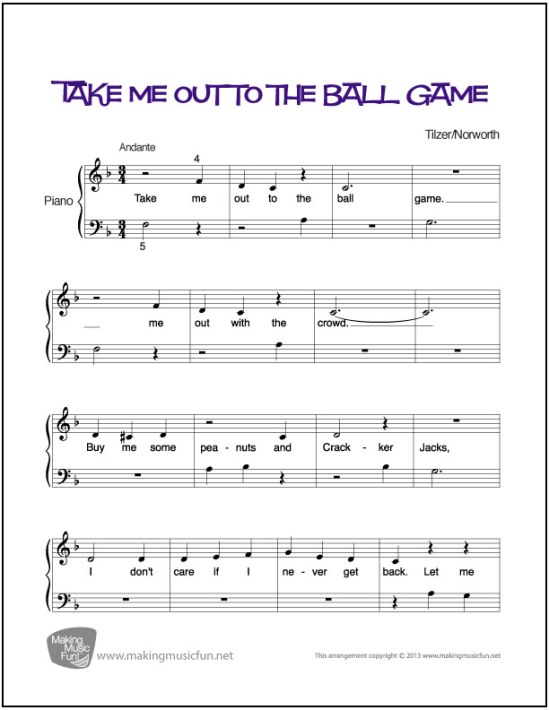
Today’s piece is a fine baseball standard “Take Me Out to the Ballgame” by Jack Norworth and Albert Von Tilzer. The song’s chorus is traditionally sung during the middle of the seventh inning of a baseball game. Fans are generally encouraged to sing along, and at some ballparks, the words “home team” are replaced with the team name.
Find it in Piano Pronto Songs I love to Play 2 and Alfred Premier 2B among others.
Below are the lyrics to the chorus of the 1908 version, which is out of copyright.
Chorus
Take me out to the ball game,
Take me out with the crowd;
Buy me some peanuts and Cracker Jack,
I don’t care if I never get back.
Let me root, root, root for the home team,
If they don’t win, it’s a shame.
For it’s one, two, three strikes, you’re out,
At the old ball game.
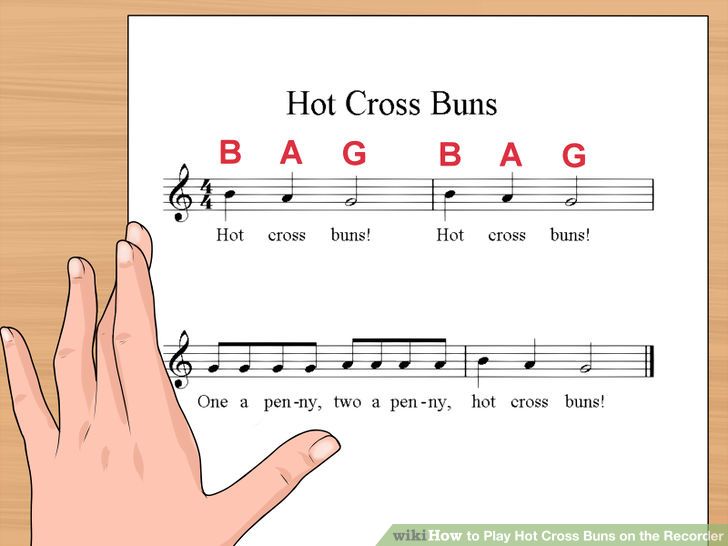
Today we listen to Hot Cross Buns. “Hot Cross Buns” is an English language nursery rhyme, Easter song, and street cry referring to the spiced English bun known as a hot cross bun, which is associated with the end of Lent and is eaten on Good Friday in various countries.
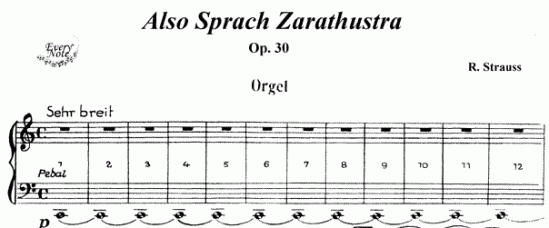
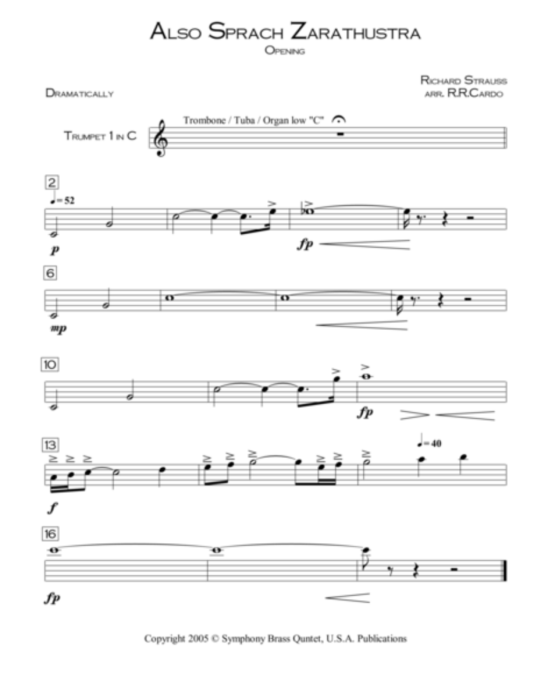
Today’s piece is Also Sprach Zarathustra by Richard Strauss. It was made popular in the 1968 Stanley Kubrick science-fiction movie 2001: A Space Odyssey.
The organ part in this snippet looks pretty easy.
Just the main theme for piano
One-quarter speed
A piano reduction of the whole orchestral score
Tee orchestra playing the entire word
Just the opening of 2001: A Space Odyssey
The Blue Danube Waltz composed by Johann Strauss (no relation) was also used in this movie.
Today we will listen to Minuet in G. Several people composed a Minuet (a slow, stately ballroom dance for two in 3/4 time, popular especially in the 18th century) in the key of G including Beethoven, Mozart and Bach.
How are the same? How are they different?
JS Bach’s version
The Bach version also was “acquired” for a popular song in the 1960s
Beethoven
Rowlf from the Muppets plays the Beethoven Minuet
Mozart
So – never say to your teacher that “I already played that” – you never know which version s/he has in mind!
Today we listen to Beethoven’s “Moonlight Sonata”. The real name for this work is The Piano Sonata No. 14 in C♯ minor “Quasi una fantasia”, Op. 27, No. 2. It was completed in 1801 and dedicated in 1802 to his pupil, Countess Giulietta Guicciardi
The piece is one of Beethoven’s most popular compositions for the piano, and it was a popular favorite even in his own day.
It’s in the Piano Pronto Beethoven book as well as many compilations of classical music.
Arranged for piano and orchestra
An animation
The above were all of the first movement only. Here’s the whole sonata played by Valentina Lisitsa:





 MaryO'Studio