Babbitt
Milton Babbitt was both a musical genius and a math whiz kid. He could identify classical music recordings and add up grocery bills when he was only 2 years old. When he was 5, he made his violin debut and composed his first concerto. Babbitt is now an electrical music pioneer and the founder of the Electronic Music Center.
Bach, Carl Phillip Emanuel
Carl Phillip Emanuel Bach was the second surviving son of Johann Sebastian Bach’s. He was born in Weimar, Germany. He lived from 1714 until 1788 and was the leading composer of the pre-Classical period.
He studied at the Thomasschule, Leipzig, where his father was cantor, and at Frankfurt University. In 1740 he became cembalist to the future Frederick II, and later became Kapellmeister at Hamburg in 1767. He was famous for his playing of the organ and clavier, for which his best pieces were composed. He published The True Art of Clavier Playing in 1753, the first methodical treatment of the subject, introduced the sonata form, and wrote numerous concertos, keyboard sonatas, church music, and chamber music. C.P.E. Bach wrote an influential “Essay on Keyboard Instruments”.
He is sometimes known as the “Berlin Bach” or the “Hamburg Bach”.
Bach, Johann Christian
Johann Christian Bach, the youngest son (the 11th!) of Johann Sebastian and Anna Magdalena Bach, lived from 1735 until 1782. He was born in Leipzig, Germany. He was taught music by his father and by one of his brothers Carl Phillip Emanuel.
After becoming a Catholic, he was appointed organist at Milan in 1760, and for a time composed only ecclesiastical music, including two Masses, a requiem, and a “Te Deum’, but later he began to compose opera.
In 1762 he went to London to spend the rest of his life and so became known as the “English Bach” or the “London Bach”. He was appointed composer to the London Italian opera in 1762, and became musician to Queen Charlotte. His influence can be seen in the early orchestral works of Mozart.
Bach, Johann Christoph Friedrich
Johann Christoph Friedrich Bach lived from 1732 until 1795. He was the ninth son of J S Bach, also a composer and was born in Leipzig, Germany. He studied there at the Thomasschule and at Leipzig University, and became in 1750 Kapellmeister at Bückeburg. He was an industrious but undistinguished church composer. Johann Christoph Friedrich Bach is known as the “Bückeburg Bach”
Bach, Johann Sebastian
Since 1580 there have been close to 100 musical Bachs in seven generations of distinguished musicians and composers.
Johann Sebastian Bach, the most famous of these, lived between 1685 and 1750. He is considered to be a baroque composer.
Bach was born in Eisenach, Germany in 1685. He was orphaned by the age of 10, and brought up by his elder brother, Johann Christoph Bach (1671 to 1721), organist at Ohrdruf, who taught him the organ and clavier.
Bach sought and got important posts through the years. He attended school in L?neburg, before becoming organist at Arnstadt. He found his duties as choirmaster irksome, and angered the authorities by his innovative chorale accompaniments. In 1707 he married a cousin, Maria Barbara Bach (1684 to 1720), and left to become organist at M?hlhausen.
By 1708 he has secured himself a position as court organist and chamber musician to the reigning Duke at Weimar, with plenty of opportunity to compose music for the organ and in 1711 became Kapellmeister to Prince Leopold of Anhalt-Köthen, where he wrote mainly instrumental music, including the “Brandenburg’ Concertos (1721) and The Well-tempered Clavier (1722).
In 1721, about a year and a half after the death of his beloved wife, Bach married again. His new bride, the 20-year old Anna Magdalena Wilcken (1701 to 1760), sang but could not play keyboard instruments, so Bach wrote The Anna Magdalena Notebook with pieces whe could learn. These pieces were charming minuets, marches and polonaises. They had 13 children, of whom six survived.
In 1723 he was appointed cantor of the Thomasschule in Leipzig, where his works included perhaps about 300 church cantatas, the St Matthew Passion (1727), and the Mass in B Minor. He later became “Kapellmeister” for the court of Prince Leopold. At age 38 he became “Cantor” of the St. Thomas School in Leipzig and stayed there until his death, almost totally blind, in 1750.
One of his main achievements was his remarkable development of polyphony. Known to his contemporaries mainly as an organist, his genius as a composer was not fully recognized until the following century. Today he is considered one of the greatest Baroque masters along with Handel, but the people of Bach’s time considered his compositions too elaborate. It was not until 100 years later that the world recognized Bach as one of its greatest composers. The very thought of a majestic old church and the music of Johann Sebastian Bach leaps gloriously to mind. Bach was one of the finest organists and ablest contrapuntists of his time and the noblest writer of fugues who ever lived. Little of his music was published during his lifetime and it was not until 1829 when Mendelssohn performed the St. Matthew Passion that the general public realized his genius and the music of Bach was “reborn”.
His home was filled with music and children: he had 20 children and five early pianos called claviers and many stringed instruments. Bach gave lessons to everyone in the family and wrote many keyboard pieces for family members. All four of Bach’s sons became successful musicians.
The period in which he lived came to be known as the baroque period not just in music, but in art and architecture, as well.
Bach’s Toccata and Fugue in d minor was featured in the Walt Disney movie Fantasia and the new Fantasia 2000.
Bach’s most famous works are the Brandenburg Concerti,the Well-Tempered Clavier (a collection of 48 preludes and fugues. A fugue is a composition in which different instruments repeat the same melodies with slight variations), The Art of Fugue, Mass in b minor, St. John Passion,and the St. Matthew Passion.
J.S. Bach also composed organ music; chamber music; orchestral concertos; and nearly 300 religious choral works called cantatas.
His timeless religious orchestral compositions are of unique purity.
Perhaps the finest exemplar of the baroque era, Bach composed major, complex works in every genre of music except opera. Both his sacred and secular compositions are among the finest ever penned and brilliantly synthesize the various national styles practiced by Bach’s contemporaries. Here are his essential recordings: Goldberg Variations; The 6 Cello Suites; Mass in B minor; The Art of Fugue, Musical Offering; Brandenburg Concertos 1-6, all of which were chosen as Best 100 Classical Pieces of the Millenium.
Barber
Samuel Barber lived from 1910 until 1981. He is most famous for his Adagio for Strings, used in the movie “Platoon”
Bartók
Béla Bartók lived from 1881 until 1945 and was one of the leading Hungarian and European composers of his time. He was also proficient as a pianist.
He collected folk-music in Hungary as did his friend, Zoltán Kodály. His compositions include Mikrokosmos, Concerto for Orchestra, Music for Strings, Percussion and Celeste, Solo Sonata for Violin, and Concerto No. 2 for Violin and Orchestra.
Basie
Count (William) Basie lived from 1904 until 1984. He was a jazz musician who was born in Red Bank, New Jersey, USA. He received his first piano lessons at age six from his mother and worked as an accompanist to silent films while still in high school. He studied organ informally with Fats Waller, whom he replaced in a New York vaudeville act called Katie Crippin and Her Kids. Between 1924 and 1927, he toured on the Keith Circuit with the Gonzelle White vaudeville show until it got stranded in Kansas City, then a bustling center of jazz and blues activity. He played piano at a silent movie theater there, then spent a year (1928 to 1929) with Walter Page’s Blue Devils. When this band broke up, he began a five~year association with Benny Moten’s orchestra, whose sidemen included blues singer Jimmy Rushing, trumpeter Hot Lips Page, and Lester Young, the highly innovative tenor saxophonist. Upon Moten’s death in 1935, these musicians formed the nucleus of Basie’s first band. Under his leadership they broadcast from the Reno Club in Kansas City, where a radio announcer dubbed him “Count”. Through these broadcasts, he attracted the attention of the well~connected talent scout John Hammond, who set up his first tour. The band played a residency at the Grand Terrace in Chicago, then opened at the Roseland in New York in December 1936. Basie began a prolific series of recordings the following year, and in 1938 he played a long residency at the Savoy Ballroom in Harlem, where his reputation as leader of one of the premier swing bands was firmly established. He led his band on a continual series of US tours throughout the 1940s, but in 1950 economic conditions compelled him to disband and front a sextet for two years. He formed a new 16~piece band in 1952 and began a long association with producer Norman Granz of Verve Records; this outfit established a new and enduring prototype for big bands and radio and television studio orchestras.
In 1954, the band undertook the first of its many European tours. During the 1960s, the Basie orchestra accompanied various singers, including Frank Sinatra, Sarah Vaughan, Tony Bennett, and Sammy Davis Jr, on recordings and concert tours. He made numerous appearances with all~star groups in the 1970s, but maintained a regular touring schedule with his band until his death. His autobiography, Good Morning Blues, written with Albert Murray, was published posthumously in 1985.
Bax
Arnold Bax, who lived from 1883 until 1853, was English by birth. He occupied an important place in English music in his own time and was knighted in 1937. At its best his music has a compelling charm and power.
Bax wrote scores for the films Oliver Twist, the war-time Malta GC and Journey into History. Orchestral Music In addition to his seven symphonies Bax wrote a series of evocative tone poems of Celtic implication, including The Garden of Fand, November Woods and Tintagel. There are concertos for cello, for viola and for violin and Symphonic Variations for piano and orchestra in addition to a Concertante for piano left hand and orchestra, written for Harriet Cohen, with whom he had a long relationship.
Bax wrote string quartets and quintets, an interesting Viola Sonata, three Violin Sonatas and works for larger instrumental groups, including a Nonet for wind and string instruments and an Octet for horn, piano and string sextet.
Bax’s choral works include settings of traditional carols, while his solo songs allow him to explore more Celtic ground in a variety of settings, ranging from A Celtic Song Cycle to settings of poems by James Joyce, J.M. Synge, and by the English writers A.E. Housman and his brother, the writer Clifford Bax.
Bax wrote seven piano sonatas, some unpublished, and a number of pieces for piano solo or duo, many with evocative titles.
Beach
Amy Marcy Cheney Beach (Mrs. H.H.A. Beach) was born on September 5, 1867 in Henniker, NH and died on December 27, 1944 in New York, NY. She was an American composer and pianist and the first significant female composer in America and one of the leading composers of the “New England School”.
By all measures, young Amy Marcy Cheney was a true prodigy. At one year she knew forty songs, always singing them at the same pitch. By age two she could improvise a countermelody to any melody her mother sang, and at age four, she could not only read four-part hymns at sight, but wrote her first pieces in her head and then sat down and played them on the piano. She began piano study at age six with her mother, and then studied with the finest pianists in Boston. She made her debut at sixteen, and in 1885 played with the Boston Symphony Orchestra.
From this point on, her career was influenced greatly by society’s views of women. It was suggested that her desire to study composition would best be served by independent study, in part in the belief that women composed based on feeling rather than intellect. When she married the physician and amateur musician Henry Harris Aubrey Beach in 1885, he asked that she limit her concertizing to a few performances a year. Because of this, she focused on composition. After his death in 1910, she resumed her concert career in Europe and in this country.
These all had an effect on her musical development, and the results can be seen as both positive and negative. Her natural abilities made self-study a viable avenue (she learned orchestration, for example, by translating the famous treatise by Hector Berlioz). At the same time, this probably accounts for the fact that much of her music borrows stylistic elements from contemporary composers. Her husband’s desire that she not make a career as a performer may have curtailed that aspect of her professional life, but it allowed her the rare luxury (rare for both men and women) of full-time compositional activity.
The body of work that Beach produced stands out for its size as well as its quality. She also stands out as the first woman to master larger forms. Her Symphony in E (the “Gaelic”) demonstrates this, and is one of the first works by an American to answer Antonin Dvor?k’s challenge to use national themes in their compositions. Beach believed that since a large percentage of Boston’s citizens were of Irish extraction, this would be the most representative source to draw upon. Many of her works have remained popular in this century, and her music is receiving a fairer re-evaluation as a result of the general interest in the music of women and the special circumstances of its creation.
Works:
Orchestral music, including Gaelic Symphony (1896) and Piano Concerto (1899)
1 opera, Cabildo (1932)
Chamber music, including a violin sonata (1896), piano quintet (1907), string quartet (1929), and piano trio (1938)
Choral music, including the Mass in E-flat (1890), Festival Jubilate (1891),
and many sacred works (anthems and hymns); secular choral works, including “The Song of Welcome” (1898) and “The Chambered Nautilus” (1907)
More than 120 songs for voice and piano, including Five Songs to Words by Robert Burns (1899) and Three Browning Songs (1900); concert aria “Eilende Wolken” (“Racing Clouds”) for voice and orchestra (1892)
Keyboard music, including character pieces (The Hermit Thrush at Morn and The Hermit Thrush at Eve, 1921); Suite for Two Pianos on Old Irish Melodies (1924); sets of variations
Numerous articles on composition and pedagogical topics
Beethoven
Ludwig van Beethoven lived between 1770 and 1824. He bridged the gap between the Classical period and the Romantic period Beethoven was born in Bonn, Germany, but lived most of his life in Vienna, Austria.
He studied in Vienna under Mozart and Haydn.
Beethoven was born and brought up in Bonn and first studied harpsichord and violin under the direction of his father, who had dreams of fame and fortune for his young prodigy. Alas, Beethoven was a talent “in waiting” – waiting for the right teacher and the right opportunity. This happened in 1783 with the appointment of Christian Gottlob Neefe to the music staff of the ruling prince, where both Beethoven’s father and grandfather were employed.
In nine years, Beethoven was ready to pursue his studies in Vienna, with Joseph Haydn. He never returned to Bonn. Beethoven had many influential patrons in Vienna and it was clear he was on the verge of becoming a major force in music. In Vienna he first made his reputation as a pianist and teacher, and he became famous quickly.
Four years later, about 1800, after arriving in Vienna, Beethoven started to become deaf. By 1820, when he was almost totally deaf, Beethoven composed his greatest works. These include the last five piano sonatas, the Missa solemnis, and the last five string quartets. He experienced the greatest of despair but accepted his fate with a sense of profound greatness: he would show the world! From this point on, he focused all his energy on his compositions. The first work was his Third Symphony, known as the “Eroica,” a work of infinite levels of expression. Some of Beethoven’s most popular works include the Violin Concerto in D Major, Mass in D Major (“Missa Solemnis”), The Nine Symphonies, including the “Eroica”, “Pastorale” and “Choral”), Egmont Overture, Fidelio, Piano Sonata in C-Sharp Minor (“Moonlight”), Sonata in F Minor “Appassionata”), Piano Concerto No. 5 in E Flat (“Emperor”). Major chamber works include 16 string quartets, 16 piano trios, 10 violin sonatas, and 35 piano sonatas. And what beginning piano student will ever forget “Fër Elise” or many sets of variations, including a set on a theme by Paisiello?
Beethoven waged a constant war with the world he lived in – with his landlords, his debtors, his students, his friends and, of course, his deafness. By the time he wrote his celebrated Fifth Symphony in 1805, he could hear virtually nothing. This symphony has become a musical symbol of victory all over the world.
Beethoven’s Pastoral Symphony was featured in the Walt Disney movie Fantasia and his Symphony number 5 in the newly released Fantasia 2000.
Beethoven surpassed himself with his Ninth Symphony, finally finished in 1823. He based his main theme of the choral movement on Friedrich von Schiller’s “Ode to Joy”. This theme also became an hymn with the words “Joyful, Joyful, We Adore Thee. When this symphony was performed in 1824, Beethoven was already deaf and was unaware of the audience applause until he turned around from the conductor’s podium to see the audience.
Beethoven composed 32 piano sonatas, 16 string quartets, 10 overtures, 10 sonatas for violin and piano, 9 symphonies, 5 piano concerti, 5 sonatas for cello and piano, 2 masses, 1 violin concerto, 1 opera and several miscellaneous works.
Beethoven developed a completely original style of music, reflecting his sufferings and joys. His work forms a peak in the development of tonal music and is one of the crucial evolutionary developments in the history of music. Before his time, composers wrote works for religious services, and to entertain people. But people listened to Beethoven’s music for its own sake. As a result, he made music more independent of social, or relgious purposes.
The story is often repeated that when Beethoven died, his last defiant act was to shake his fist at a raging thunderstorm outside. Many have seen this as symbolic of his triumph over deafness, which was a major turning point in his life.
Beiderbecke
“Bix” Beiderbecke. From the Smithsonian magazine article: Bix: The story of a young man and his horn:
Bix Beiderbecke taught himself to play the cornet when he was in his teens and died in 1931 at the age of 28. During his brief career, says author Fred Turner, he became one of the true sensations of the Jazz Age, unforgettable to anyone who ever heard him. So unforgettable, in fact, that the Bix Beiderbecke Memorial Jazz Festival held each July draws some 15,000 jazz aficionados to Davenport, Iowa, where the jazz legend was born. And the well-known composer Lalo Schifrin recently premiered a symphonic jazz work, “Rhapsody for Bix,” based on songs written or popularized by the cornetist. Bix was also the inspiration for a popular novel of the late ’30s, Young Man With a Horn, and the 1950 movie by the same title starring Kirk Douglas. He has been the subject of a steady stream of critical assessments, a full-scale biography, a 1990 feature film and a 1994 film documentary.
But what made this young musician so memorable? The qualities that strike the modern listener, says Turner, are the ones that awed his contemporaries: the round, shimmering tone; the deliberateness of the attack that still manages to flow. “The best of his solos,” said critic Chip Deffaa, “seem absolutely perfect: one cannot conceive of them being improved upon.” Guitarist Eddie Condon said Bix’s horn sounded like a girl saying yes.
Another part of Bix’s appeal, says Turner, derives from the way he lived. Here was a handsome young man who never grew old, whose frenetic pace matched that of the new music he helped create. When fans took him partying, they found he liked the things they liked, especially Prohibition alcohol, which he could consume in enormous quantities. With the aid of booze, said Eddie Condon, “he drove away all other things like food, sleep, women, ambition, vanity, desire. He played the piano and the cornet, that was all.”
But in the end, says Turner, despite his brief fame, despite the ghastly death, there remains the beautiful sound he made and left behind.
Berg
Alban Berg Lived from 1885 until 1935. He was the Viennese pupil of Arnold Schoenberg who brought to maturity the atonal style of twentieth-century music.
Berio
Luciano Berio was born in Oneglia, Italy in 1925. He is a composer and teacher of music who studied at the Music Academy in Milan, and founded an electronic studio. He moved to the USA in 1962, taught composition at the Juilliard School, New York City, and returned to Italy in 1972. In 1950 he married the US soprano Cathy Berberian (1925 to 1983), for whom he wrote several works. He is particularly interested in the combining of live and pre-recorded sound, and the use of tapes and electronic music, as in his compositions Mutazioni (Mutations) in 1955, and Omaggio a James Joyce (Homage to James Joyce) in 1958. His Sequenza series for solo instruments (1958 onwards) are striking virtuoso pieces. Other works include Passaggio (1963), Laborintus II (1965), and Opera (1969 to 1970).
Berlin
Irving Berlin lived from 1888 until 1989. He was born Israel Baline in Tyumen, Russia. Little Israel came to the United States with his family at the age of four. His father passed away several years later, so Israel took to the streets of New York, singing on street corners and in saloons, and as a singing waiter, all to earn money to help support his family. It was the beginning of a wonderful career in song, stage and movies. A printer’s error on the music sheet for his composition, Marie from Sunny Italy, accidentally changed his name. The change became permanent.
Mr. American Music, better known to us as Irving Berlin, wrote more songs than we care to count including Alexander’s Ragtime Band, Always, Doin’ What Comes Naturally, Puttin’ on the Ritz, Blue Skies, Oh! How I Hate to Get Up in the Morning and Play a Simple Melody. This man, who could neither read nor write music, also composed a song titled, Smile and Show Your Dimple. You probably never heard of that one; but seventeen years later, when produced, it became a hit as Easter Parade.
Kate Smith was the voice he chose to sing God Bless America, which he wrote in 1917. It became her signature and a major contender to replace The Star-Spangled Banner as the U.S. national anthem.
Berlin wrote the scores for many Broadway shows (Annie Get Your Gun) and films (Top Hat). Winning an Oscar for his composition, White Christmas, Irving Berlin had the unique experience of opening the envelope that contained his name. He was the presenter at this segment of the Academy Awards for 1942 and upon opening the envelope, said, “This goes to a nice guy; I’ve known him all my life. The winner is … me.”
Berlioz
Hector Berlioz (1803 until 1869), along with Felix Mendelssohn was one of the first conductors of a large orchestra. Berlioz was generally regarded as the most important French Romantic composer. He was also known as a critic and conductor. People either really loved him, or really hated him. His music could be so powerful and original, or trite and vulgar. His music is emotional and full of the drama of the Romantic life, but it also contained the Classicism of Gluck.
Louis Hector Berlioz’s father, a property owner and a doctor, wanted him to study medicine, but it was clear that the boy was destined for music. He had an aptitude for music, composing little bits as a child. But, with his father set against a career as a musician, young Hector had to piece together a musical education. He never even learned how to play the piano, the building block for almost every composer. But Berlioz gave a positive spin to his deficiency, saying that it allowed him to create music anywhere, piano or not. This freedom gave Berlioz a voice unlike any other.
But Hector’s father still insisted that the boy study medicine, so at 16, Berlioz began his medical studies. In 1821, he went to the Medical School in Paris, but the city of Paris was the wrong place for a frustrated musician stuck in medical school. Berlioz attended the opera and heard Gluck’s work, Iphigenie en Tauride. He fell in love with the music, and soon became obsessed with it. He went to the library at the Paris Conservatoire, studying all of Gluck’s opera scores. A year later, he was writing his first opera, and in 1823, he wrote an oratorio. He still managed to receive his Bachelor of Science in 1824, but this would be as far as he would go in his medical career.
He enrolled in the Paris Conservatoire, and lived the life of the starving artist. To earn extra money, he worked at the theatre, where he met Harriet Smithson. She was an Irish lass, an actress, and the 26-year-old Berlioz fell in love with her, but she rejected him. For the next three months, he poured all of his heartbreak into his Symphonie Fantastique, subtitled An Episode in the Life of an Artist. The symphony became his first success. Eventually, though, true love would conquer all and Berlioz and his beloved Harriet would marry, and then separate.
But, Berlioz wasn’t satisfied with success as a composer of orchestral works. He wanted to conquer the stage. Paris at the time of Berlioz was a difficult place for anyone who did not compose operas. Regular concert orchestras were such a rarity that an audience didn’t exist, and composers wanting to give concerts usually ended up losing money. The old patronage system that supported the likes of Mozart and Haydn was drying up, and making a living as a composer was almost impossible, unless you composed operas. But another reason for Berlioz’s enthusiasm for the stage was his own dramatic personality. One listen to his Requiem, and you get the feeling that his aim was more theatrical than religious. His Symphonie Fantastique also contains operatic elements. After writing his first opera in 1823, Berlioz tried again in 1826, and again in 1838 with Benvenuto Cellini. It failed after only 4 performances. His next opera, The Damnation of Faust (1846), premiered in Paris, did not do any better. According to Berlioz, it had only two performances, and both were before a half-empty house.
Frustrated, Berlioz left Paris and went travelling to Russia, Berlin, and London. The British and the Germans loved his music, and Berlioz regularly visited them for the next 15 years. His once beloved Paris was changing, embracing the new music of Liszt and Wagner. Liszt tried to help Berlioz’s cause, reviving Berlioz’s opera Benvenuto Cellini in 1852 and later that year having a Berlioz Week featuring performances of Berlioz works. Berlioz reciprocated by dedicating the published version of his Damnation of Faust to Liszt in 1854.
Bernstein
January 11, 1981 Leonard Bernstein began conducting the BR – Bayerischer Rundfunk Symphony Orchestra in Richard Wagner’s “Tristan und Isolde” in Munich’s Hercules Hall. Performed one act at a time, in January, April, and November of 1981, respectively, Bernstein’s “Tristan und Isolde” was telecast live and later released as an audio recording by Philips–to some controversy.
Karl Böhm remarked, with regards to Bernstein’s exaggeratedly slow tempi, “For the first time, someone dares to perform this music as Wagner wrote it.” Böhm’s own recording of the Prelude was four minutes faster.
Upon completion of the project, Bernstein declared, “My life is complete… I don’t care what happens after this. It is the finest thing I’ve ever done.”
Bizet
Georges Bizet, 1838 to 1875, was a French composer who wrote piano music, orchestral works and eight operas. Best known for his opera Carmen. He was asked to compose music for Daudet’s play L’Arlésienne when he was only 33. This play needed 27 musical pieces, which Bizet amazingly produced, even though he had little time and his health was poor. He died 3 years later.
Black
Arnold Black was a composer and violinist who started a beloved classical music program in the rural Berkshires. He died in 2000 at the age of 77, two days after the Mohawk Trails Concert series opened its 31st year.
Black moved to the Berkshires in 1970 to escape his hectic life in New York. Born in Philadelphia, he attended the Juilliard School of Music and wrote music for theater, film, television and concert halls.
Black engaged world-renowned artists for the concert series, which could satisfy the most discriminating classical music fan.
Black was composer-in-residence at The Circle in the Square in New York City in the 1950s. He wrote the score for the production of James Joyce’s “Ulysses in Nighttown,” starring Zero Mostel.
He also wrote music for the National Shakespeare Company and for films including “River Song,” “Black Harvest,” “Memorial Day,” “Empire of Reason,” and “Peace for Our Time,” which he co-composed with Eric Clapton.
In 1995, his opera “The Phantom Tollbooth,” based on the children’s classic, premiered with Opera Delaware.
Blake
Herbert “Eubie” Blake, 1883 to 1983, was an American jazz pianist, vaudevillian, songwriter and composer of 1,000 songs. Some of them are: Charleston, Chocolate Dandies, Blackbirds of 1930, Memories of You, Shuffle Along of 1932, Atrocities of 1932, Swing It, Tan Manhattan, Brownskin Models and Hit the Stride. He teamed up with Noble Sissle to write: It’s All Your Fault, Shufflin’ Along, Love Will Find a Way, I’m Just Wild About Harry.
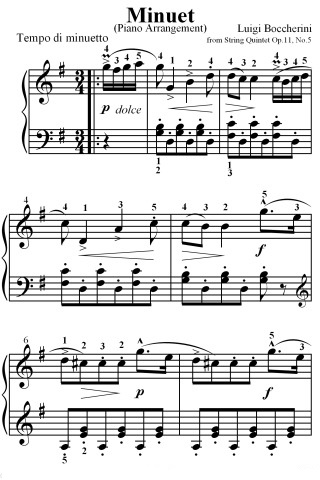
Boccherini
Bocelli
Andrea Bocelli was born in 1958 in rural Tuscany. Music has been a lifelong passion and it was noted at an early age how enthralled Andrea was by opera. Through a growing collection of 78s, Bocelli spent his childhood attempting to emulate his heroes, great Italian tenors including Gigli and particularly Franco Corelli. As a child Andrea learned whole operas, dreaming of performing the great heroic and tragic roles on famous opera stages.
Bocelli’s musical talents were nurtured, with classical tuition for instruments including flute and piano. However, despite a clearly beautiful natural vocal talent, formal study of the voice was not to come until later in life. While harbouring deep operatic ambitions, Bocelli’s family were sceptical that music was a realistic or secure career for any young man. Respecting his parent’s wishes, Bocelli studied law at the University of Pisa. After graduation Andrea practiced law in Pisa, but having achieved future security, turned his attention to formal training for his mature voice and the ambitions of his youth.
Andrea first studied under the maestro Luciano Bettarini of Prato, known for working with some of Italy’s finest voices. Bocelli discovered that Franco Corelli was to give master classes. Performing for his childhood idol was a daunting prospect and acceptance as a pupil of Corelli vindicated Bocelli, strengthening the confidence to pursue his goals. Bocelli put his legal career on hold to devote his life to music.
“I don’t think that one really decides to be a singer. It’s decided for you, by the reaction of those around you. Perhaps one shouldn’t sway ‘listen to me, I want to sing for you’, but if people say ‘please sing for us’, well….”
Andrea Bocelli is a true phenomenon. The manner in which the voice of one man captured the hearts of music lovers across five continents, is truly unprecedented. In just five years since the Italian public were introduced to the voice of Andrea Bocelli, through his remarkable triumph at the Sanremo Festival, this amazing talent has become the biggest selling classical performer to emerge in several decades. His two classical discs, “Viaggio Italiano” and “Aria”, have achieved international success. Just one illustration of the huge scale of Bocelli’s international popularity occurred in the US in 1999, when four of his albums featured simultaneously on the official Billboard album chart. Such a feat had been achieved only twice in recent memory, in the early 1990s by Garth Brooks and before this in the mid 1980s by U2.
Following the success of his first three albums in Italy, the contemporary album “Romanza” became Andrea Bocelli’s international debut release. In just twelve months, “Romanza” transformed Bocelli into one of the globe’s most popular recording artists. Conquering Europe, “Romanza” was released throughout 1997 in North and South America, Asia, Africa and Australia & New Zealand. “Romanza” has sold over 15 million copies to date, introducing millions of the world’s music lovers to the passionate voice of Andrea Bocelli. Andrea Bocelli has since acquainted them with his passion for opera.
Boëllmann
Léon Boëllmann lived from 1862 until 1897. His name is known to all organists because of his brilliant Toccata for the instrument, the final movement of a Suite gothique. Born in Alsace in 1862, he served as organist at the church of St. Vincent-de-Paul in Paris from 1881 until his early death in 1897.
In addition to the Toccata from the Suite gothique, Op. 25, the Douze pièces (Twelve Pieces), Op. 16, and Heures mystiques, Opp. 29 & 30, are well enough known.
Borge
Victor Borge was born in 1909 in Copenhagen, Denmark. He was an entertainer and pianist – a deliciously funny performer. He studied at the Royal Danish Academy of Music, Copenhagen, and in Vienna and Berlin. He made his debut as a pianist in 1926, and as a revue actor in 1933. From 1940 until his death in 2000 he worked in the USA for radio, television, and theatre, and has performed with leading symphony orchestras on worldwide tours since 1956. He was best known for his comedy sketches combining music and narrative. He used his classical training to skew serious music and performers.
From his obituary:
Pianist Victor Borge, died in his sleep Dec 23, 2000 at his Greenwich, Connecticut home, was known as the unmelancholy Dane of international show business. He would have turned 92 on Jan. 3, 2001.
“The cause of death was heart failure,” his daughter, Sanna Feirstein, told Reuters.
“He had just returned from a wonderfully successful trip to Copenhagen … and it was really heartwarming to see the love he experienced in his home country,” she said.
Borge was one of five performers selected for the Kennedy Center Honors in 1999.
“He went to sleep, and they went to wake him up this morning, and he was gone,” said his agent, Bernard Gurtman.
“He had so much on the table, and to the day he died he was creative, and practicing piano several hours a day,” Gurtman told Reuters. “He was just a great inspiration.”
Funeral services will be private, his daughter said.
Borge made a career of falling off piano stools, missing the keys with his hands and getting tangled up in the sheet music.
One of his inspirations was a pianist who played the first notes of the Grieg A Minor Concerto and then fell on the keys dead.
He said that the only time he got nervous on stage was when he had to play seriously and adds that if it had not been for Adolf Hitler he probably would never have pursued a career as a concert-hall comedian.
Until he was forced to flee Denmark in 1940 he was a stage and screen idol in his native country.
Lampooned Hitler
But as a Jew who had lampooned Hitler, Borge — his real name was Boerge Rosenbaum — was in danger and fled first to Sweden and then to the United States, where he arrived penniless and unknown and by a fluke got booked on the Bing Crosby radio show. He was an instant success.
He became an American citizen in 1948, but thought of himself as Danish. It was obvious from the numerous affectionate tributes and standing ovations at his 80th birthday concert in Copenhagen in 1989 that Danes felt the same way.
In the concert at Copenhagen’s Tivoli gardens, Borge played variations on the theme of “Happy Birthday to You” in the styles of Mozart, Brahms, Wagner and Beethoven — all executed with such wit that the orchestra was convulsed with laughter that a woman performing a piccolo solo was unable to draw breath to play.
“Playing music and making jokes are as natural to me as breathing,” Borge told Reuters in an interview after that concert.
“That’s why I’ve never thought of retiring because I do it all the time whether on the stage or off. I found that in a precarious situation, a smile is the shortest distance between people. When one needs to reach out for sympathy or a link with people, what better way is there?
“If I have to play something straight, without deviation in any respect, I still get very nervous. It’s the fact that you want to do your best, but you are not at your best because you are nervous and knowing that makes you even more nervous.”
His varied career included acting, composing for films and plays and writing but he was best known for his comic sketches based on musical quirks and oddities.
Unpredictable Routine
His routines were unpredictable, often improvised on stage as his quick wit responded to an unplanned event — a noise, a latecomer in the audience — or fixed on an unlikely prop — a fly, a shaky piano stool.
Borge was born in Denmark on January 3, 1909, son of a violinist in the Danish Royal Orchestra.
His parents encouraged him to become a concert pianist, arranging his first public recital when he was 10. In 1927 he made his official debut at the Tivoli Gardens.
Borge’s mischievous sense of humor was manifest from an early age. Asked as a child to play for his parent’s friends he would announce “a piece by the 85-year-old Mozart” and improvise something himself.
When his mother was dying in Denmark during the occupation, Borge visited her, disguised as a sailor.
“Churchill and I were the only ones who saw what was happening,” he said in later years. “He saved Europe and I saved myself.”
From 1953 to 1956, he appeared in New York in his own production “Comedy in Music,” a prelude to world tours that often took him to his native Scandinavia.
On radio and television, Borge developed the comedy techniques of the bungling pianist that won him worldwide fame.
Many of his skits were based on real-life events. One of his classics evolved from seeing a pianist playing a Tchaikovsky concerto fall off his seat.
Borge’s dog joined the show after it wandered on stage while he was at the keyboard — an entrance nobody would believe had been unplanned.
One incident could not be repeated. A large fly flew on to Borge’s nose while he was playing. “How did you get that fly to come on at the right time?” people asked. “Well, we train them,” Borge explained.
Borge’s book, “My Favorite Intervals”, published in 1974, detailed little-known facts of the private lives of composers describing Wagner’s pink underwear and the time Borodin left home in full military regalia but forgot his trousers.
In 1975, Borge was honored in recognition of the 35th anniversary of his arrival in the United States and his work as unofficial goodwill ambassador from Denmark to the United States. He celebrated his 75th birthday in 1984 with a series of concerts at Carnegie Hall and in Copenhagen.
Borge received a host of honors from all four Scandinavian countries for his contributions to music, humor and worthy causes.
Borge, who had lived in Greenwich since 1964, is survived by five children, nine grandchildren, and one great grandchild. His wife of many years, Sanna, died.
Borodin
One of the most beautiful string quartets ever written was Borodin’s Second String Quartet in D Major, composted in the 1880’s. Two of the melodies in the 1953 production of Kismet were based on themes from this quartet.
Boulanger, Lili
Lili Boulanger lived from 1893 until 1918. Encouraged by her elder sister Nadia, the French composer Lili Boulanger was the first woman to win the Prix de Rome and was prolific, during her short life, writing music very much in the prevailing style of the period.
Lili Boulanger’s compositions for orchestra include Pie Jesu, Sicilienne and Marche gaie for small orchestra and a fuller Poeme symphonique.
Boulanger, Nadia
Nadia Boulanger (1887 – 1979) is better known as a teacher and conductor than as a composer. In the first capacity she was responsible for the musical training of a generation of distinguished composers from Europe and America. Her work as an interpreter influenced many, not least by the part she played in the revival of interest in Monteverdi.
Nadia Boulanger’s few compositions include Les heures claires, settings of poems by Verhaeren completed in 1912, after which she wrote little, although in 1908 she had won the second Prix de Rome.
Boulez
Pierre Boulez was born in 1925 in Montbrison, France. He is a conductor and composer. He studied at the Paris Conservatoire from 1943 until 195), and became musical director of Barrault’s Théâtre Marigny (1948), where he established his reputation as an interpreter of contemporary music. During the 1970s he devoted himself mainly to his work as conductor of the BBC Symphony Orchestra (1971 to 1975) and of the New York Philharmonic (1971 to 1977), and in 1977 he became director of the Institut de Recherche et de Co-ordination Acoustique Musique at the Pompidou Centre in Paris. His early work as a composer rebelled against what he saw as the conservatism of such composers as Stravinsky and Schoenberg.
Boulez died January 5, 2016.
Brahms
Johannes Brahms lived between 1833 and 1897. He is considered to be the foremost romantic composer of instrumental music in the late 19th century. As well as being a fine composer, he was also a pianist. Brahms’ father discouraged his talent for music but Robert Schumann gave him help in reaching his goal of becoming a musician and the two remained close friends until Schumann’s death.
Brahms wrote four symphonies, two piano concerti, chamber music, piano works, and over 200 songs. Some of his most famous works are Requiem, Symphony #1 in C Minor and his Symphony #4 in E Minor.
Braxton
Anthony Braxton is an American composer and woodwind improviser, one of the most prolific artists in free jazz.