Daily Listening Assignment ~ June 9


This is a more advanced piece but I really like it.  Some students may have heard this since it’s an alarm tone on my phone. My dog, Mimi, recognizes this music as her signal to go out for a walk!


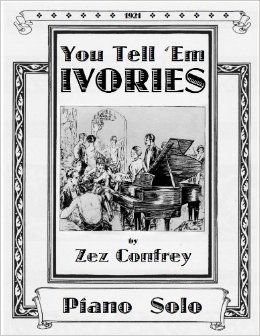
confrey-you

I just love Zez Confrey’s music.  It’s not overplayed like some of Scott Joplin’s works but it’s just as much fun.

This is a piece I have often played in recitals and just for fun.

https://youtu.be/u20Qmv7HdAI

If any of my students are interested in tackling this piece, just let me know and we’ll start learning!

In 1921 Confrey wrote his novelty piano solo “Kitten on the Keys”, inspired by hearing his grandmother’s cat walk on the keyboard of her piano. It became a hit, and he went on to compose many other pieces in the genre.

Considered to be one of the fastest and most challenging of all “novelty” piano solos, “Dizzy Fingers” was composed in 1923. and was Confrey’s other biggest seller.

He left behind more than a hundred piano works, songs and miniature operas, and numerous piano rolls, music publications and sound recordings.

Not surprisingly, this piece is not available on Piano Maestro!

One of the books in my studio is Zez Confrey at the Piano: Piano Solos.

confrey-book“This collection represents a cross-section of Confrey’s works and encompasses the broad range of his styles. Besides his famous 1920s novelty works (including Kitten on the Keys), there are many wonderful, lesser-known gems of remarkable quality included here from later in his career. Appearing for the first time in print are transcriptions of one of his disc recordings (Poor Buttermilk) and two of his player piano roll arrangements (My Pet and Humorestless). Many of Confrey’s later works have long been out of print and are included here for the first time in decades.”

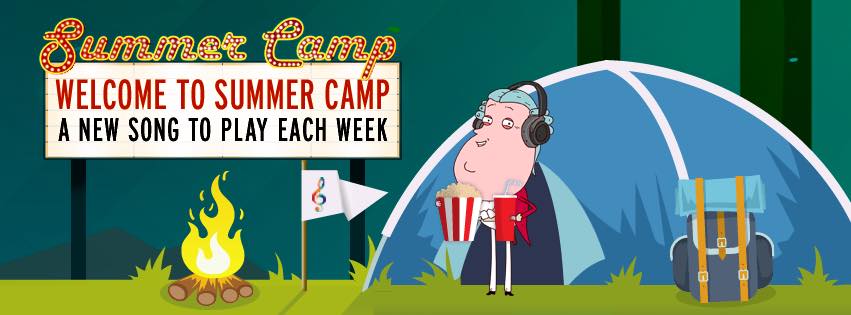
Summer Camp, Week 1


summer-camp2


We’re excited to announce that Summer Camp is finally in session for 4 weeks starting TODAY! Tune in each week to see which song will be released for your students to learn and play. Each song will feature live singer recordings that the JoyTunes musicians have worked hard to prepare!

The first Summer Camp song will be all-time classic “We Are The Champions” by Queen

Summer Camp is the perfect way to keep your student’s piano practice up during this summer to keep the skills you’ve worked so hard to gain so that come fall your students return to lessons prepared!

Each week a $10 Amazon Gift Card will be rewarded to a top player to recognize your student’s awesome playing (winner will be chosen at random and announced here the following week)!

Songs can be found in the Summer Camp category of the Library.

How to Behave at a Recital

recital

Student recitals can be lots of fun and create valuable experiences for pianists. Unfortunately, they can also be a source of anxiety or stress if students aren’t ready and/or guidelines aren’t followed.

There are guidelines and rules of behavior all performers and audience members should follow during recitals, concerts or other performances.

Audience members must remember the reason for their visit to the recital hall – to listen quietly, actively and appreciatively to the music being offered by the performers.

For the performer:

1.  Dress appropriately. Performers being nicely dressed (or following the recital theme) shows respect for the audience, the teacher and themselves!

Girls in knee-length or longer skirts/dresses or slacks.  No spaghetti straps, no platform shoes, flip-flops, bedroom slippers or athletic footwear.

Do not wear dangling, jingling jewelry – especially bracelets.  You may need to remove rings if they twist around easily.

Boys in dress pants and buttoned dress shirts with ties preferred, or suits.

IMPORTANT: Remember to practice several times in your outfit, shoes included.  You don’t want to get to the recital and find that you can’t use the pedal properly because of your shoes.

2. Clean hands!  Dirty, sticky, or oily fingers can hurt your performance and bother the next pianist. If you complete a long piece and notice some keys are slippery with sweat (a very common issue), notify your instructor so they can clean the keyboard before the next performer.

2. When it is your turn, stand quickly and walk up to the stage. Do not run!

Bow before you perform to acknowledge the applause. Audiences used to know that it was appropriate to clap for the musician who was entering the stage to perform. This now isn’t always the case (I will start clapping if it doesn’t happen automatically). Students should bow to their applauding audience before they sit down at the bench (not acknowledging applause is generally considered to be rude).

2.  Enter the bench from the side furthest from your audience. This was a biggie for my former piano teacher and I’m reminded of it every time I see a student slink in from the “front side”… or climb over the top. I used to think this was awfully stuffy – but when you see a student do it, it just looks right.

3.  Hands in your lap before you begin. I use this with my students to give them a moment to hear the first few measures in their mind before they begin.  Once fingers are on the keys it means you’re  ready to play. If the bench needs adjusting it should be done first… and then  hands should be placed in your lap before beginning to play.

Play the scale of the piece in your head and think over tempo, markings, etc. Then  arch your hands onto the piano and position  feet on the pedals or flat on the floor–NEVER under the stool. Proceed to play!

3. Should you make a mistake while performing, you should try to continue playing without starting over or repeating. This makes sufficient practice before the recital very Very VERY important!

If playing more than one piece, you should acknowledge applause in between with a nod or smile.

4.  Hands in lap after you finish. So many piano students are already lifting themselves off the bench as they play the final note (perhaps really eager to return to their seat in the audience!?) Learning to place your hands in your lap after finishing gives the audience a moment to truly relish what they just heard.

5.  Rise and stand at the edge of the piano (with left hand on the wood). Bow from the hips,  don’t curtsey. Bowing nicely takes practice!  In handbells, we bow towards the table and say silently “I love handbells”.  The same can be said in piano recitals – “I LOVE Piano”.

6.  Walk calmly off the stage or away from the piano.  No running… no matter how badly you want to get back to your seat!

For the audience:

Recitals are a special occasion and so it is customary to dress nicely.

• Please arrive a little early in order to find a comfortable place to sit.

• Make sure all your invited guests understand the importance of arriving on time. If they arrive late, it makes it difficult for those performing.

• Please invite as many friends and family members as you’d like. Our recital hall has lots of room, and can accomodate likely as many as you’d like to invite. And if not, then a standing room only crowd would be a fantastic crowd to have, and a wonderful problem to deal with!

• Turn off all cell phones and any electrical devices that may produce sound.

• Once the recital begins, please listen and be quiet. Crying babies should be taken out. They are not happy, and neither is the audience or the performer!

• If you arrive late, please wait to enter between pieces when you hear applause. Do not enter the recital hall or switch seats while someone is performing.

• The soloist will bow and your response is to applaud politely!

• No whistling, yelling, or other loud methods of congratulation. While boisterous congratulations are meant to show support for the performer, it may actually cause unintended problems instead. The best way to show appreciation for the performance is with thunderous applause, and an occasional “bravo” at the end of an especially great performance.

• Compositions that have movements or suites are, in general, performed without applause in the middle.

• Respect the performers. Unnecessary noise from whispering, talking, candy wrappers, etc. during a program is not acceptable. Reading, studying, and writing letters during a program are also inappropriate.

• Please stay until the performance or event is completely over. Attending a recital so that other families will serve as audience to your student, and then leaving before the other performers have finished is rude, inconsiderate and unacceptable. If you have other obligations or matters to attend to before the recital is over, please do not attend.

• Flash photography is not appropriate during a performance. The flash can disrupt the performer’s concentration.

• Enjoy! Your presence is the greatest affirmation!

For Everyone:

No Perfume!  Your perfume or cologne will linger around the piano after you leave the stage (especially under hot lights), and it might give the next pianist some sinus or eye irritation; or, at the very least, create a distraction that can prevent them from getting “in the zone.”

Parts of this article adapted from It’s The Little Things That Count… Piano Etiquette and Your Piano Students | Teach Piano Today

Bi-weekly Lessons – Why they won’t work – The Piano Studio

7 reasons why bi-weekly lessons do not work…


Now and then, our studio gets asked if we offer bi-weekly lessons. I mean, doesn’t it make sense that if you take lessons every other week, you have half the number of trips into the studio, you have double the amount of time to practice, and you can save some money, right?

WRONG.

Aside from the fact that it is a scheduling nightmare for the teacher and studio, I want to outline a few reasons why (in most cases) bi-weekly lessons do not work.

Source: Bi-weekly Lessons – Why they won’t work – The Piano Studio

Finding The Right Teacher

NOT Mrs. O'Connor!

NOT Mrs. O’Connor!

See if a prospective teacher allows a trial lesson to test how the personalities mesh. And be sure to ask lots of questions. What’s the teacher’s background as a musician and as an instructor? What kinds of teaching materials and music does she use? How much practice time is expected for students, and does that vary by the student’s age? Does the teacher have access to student ensembles? What kinds of performance opportunities will he provide? Will the teacher allow the student to record the lesson? This can be a terrific practice aid, especially when it comes to remembering how something is supposed to sound. Does she teach any music theory or composition? What are the expectations for students and for their parents?

A good teacher can be a friendly, encouraging and inspiring presence — even when a student hits rough patches. He will point out the student’s weaknesses without being harsh or dismissive, suggest innovative ways to overcome challenges, and create engaging ways to tackle even rote activities like playing scales or honing fine motor skills. The instructor’s age and experience might or might not be a deciding factor; for example, I’m consistently impressed by the range of tricks my own child’s very youthful private teacher has up her sleeve to turn what could easily be drudgery into fun. Not to mention the huge helpings of good humor and patience she brings to her tiny charges!

Read more at Finding The Right Teacher For Your Music-Loving Kid : Deceptive Cadence : NPR.

Practicing the Piano – The Myth of the Instant Fix

practice-eat


When they make a mistake they hack away at it until it finally yields, and simply move on. What they have actually practised is getting it wrong three or four times in a row and right on the fifth attempt. What, then, are the chances of getting it right the first time in the context of the flow of the piece?

via Practising the Piano – The Myth of the Instant Fix.

Piano Lessons Not Just For Kids

~~~

By Diana Greenburg 

When Paula Fay started taking piano lessons for the first time in her late fifties, it fulfilled a lifelong dream.

“I always wanted to learn how to play as a child, but my parents couldn’t afford it,” she said.

Today, four years later, Paula can play some of her favorite tunes. And she’s loving every minute of it.

Some adults may groan at childhood memories of lesson after lesson, practice after practice and a lot of teacher nagging, but many wish those days were back.

And more and more, these adults are turning wishful thinking into reality. According to the National Piano Foundation, adults ages 25-55 are the fastest-growing segment of people learning piano.

When Ruth Ann Laye started teaching an adult piano class at Mandarin’s Keyboard Connection, there was only one weekday class. Now, she’s up to seven classes. And of her own private practice of 28, 11 are adults.

One of her students is Belinda May from St. Augustine, who is in her 60s and in her second year of piano lessons.

Though her brothers played piano, she was more athletically inclined than musical. Then after years of “picking” at the pianos in her house, she recently resolved to start taking lessons. A beginner when she started, “now I’m playing Christmas carols,” she said.

“It tells me that you’re never too old to learn something new.”

Maureen Rhodes, a piano teacher on the Southside, would likely agree. She has more adults in her practice than she did 20 years ago.

“I think baby boomers are looking for ways to stay active,” she said. “Sometimes, kids come to me for lessons and then when they grow up and leave, their mother starts to take lessons,” says Rhodes. “Other adults have a specific goal in mind, like they want to play in church or accompany their grandson.”

Sandra Stewart, outgoing president of the Jacksonville Music Teachers Association and adjunct professor teaching a non-degree adult piano course at Florida State College, believes technology is a big part of the reason for the greater interest in piano among adults.

“Keyboards are more affordable, and that’s made all the difference,” she says.

But the piano is not always a succession of high notes for the adult student. Says Stewart: “Adults can have problems with finger dexterity. If they never played before, this can be frustrating. People who use computer a lot have an advantage. But if they don’t have this experience, they have to get over that hurdle.”

And some adults expect to transform into Mozart overnight.

“They may be symphony patrons or just love classical music and want to play instantly and do it like the pros,” Rhodes says. “But they have to develop the skills first, and it takes a lot of patience.”

But for adults committed to learning, it can be very satisfying for student and teacher alike.

“Adults are there for their own pleasure,” said Marc Hebda, president of the Florida State Music Teachers Association. “They have wonderful enthusiasm; it’s fun to see them get excited. It’s also interesting that with the economic downturn, they are not cutting back on lessons or buying instruments. Piano is a constant source of entertainment and personal development.”

The key to any student learning well, whether that student is an adult or child, is finding the right teacher. Hebda stresses the importance of taking lessons from a teacher with a music degree.

“Some people who took piano figure it’s easy to teach. But credentials are very important. You wouldn’t go to a doctor without certification or a lawyer who didn’t pass the bar. All our teachers have a music degree or demonstrate teaching ability.”

Hebda also notes that rapport between teacher and student is important.

“The student should interview the teacher, because not all students and teachers are a good match.”

For those who want to fast-track the learning process, there are alternatives. “The Piano Guy,” Scott Houston, has been teaching piano using a non-traditional method through his shows on public station WJCT.

“It seemed like there was a single path to the world of piano: this long process of taking lessons,” he said. “But people want to play the tunes they know.”

So Houston came up with a simple way for adults to learn quickly, based on the concept behind “lead sheets,” which are used by professional musicians. Houston’s technique is to teach adults a single line of notes on the treble clef with their right hand and chords with their left.

“My goal is not to teach adults to be the greatest players but to be able to play the tunes they want to play,” Houston says.

His approach has clearly struck a chord, as his book has sold 300,000 copies and he has taught many adults through his workshops in Indiana and master class “piano camp” from his beach home in Fort Myers.

There’s also a new trend gaining traction called “recreational music making” — RMM — which like Houston’s approach focuses on a simplified method to teaching music. The goal is not for a student to become accomplished at the piano and perform, but rather to just have fun making music. It is often taught to adults in group settings, such as music stores, churches and senior centers.

“Research has found that RMM is very helpful for seniors, promotes hand/eye coordination and keeps the brain working,” said Erin Bennett, assistant professor of piano and pedagogy at the University of North Florida. “Its asset is the ability to reach more people; it’s more inclusive and easier for the non-experienced.”

Whether learning piano through traditional or nontraditional means, its many benefits include boosting self-confidence.

“When I first started, I didn’t think I could do it,” Fay said. “And my friends and family were in disbelief that I was taking lessons. Then they wanted to hear a concert. In another year, I might just do it.”

She gets some measure of satisfaction in surprising those around her.

“Society puts restrictions on us as we get older that we stop learning,” she says. “But we are wiser, more patience and accept our limitations.”

Read more at Jacksonville.com: http://jacksonville.com/entertainment/music/2011-10-27/story/piano-lessons-not-just-kids#ixzz1l14hSFaV