Angels we have heard on high
Sweetly singing o’er the plains
And the mountains in reply
Echoing their joyous strains
CHORUS:
Gloria, in excelsis Deo!
Gloria, in excelsis Deo!
Shepherds, why this jubilee?
Why your joyous strains prolong?
What the gladsome tidings be
Which inspire your heavenly song?
Chorus
Come to Bethlehem and see
Him Whose birth the angels sing;
Come, adore on bended knee,
Christ the Lord, the newborn King.
Chorus
See Him in a manger laid
Jesus Lord of heaven and earth;
Mary, Joseph, lend your aid,
With us sing our Savior’s birth.
Chorus
This is a traditional French carol (Les Anges dans nos Campagnes) that was translated into English by Bishop James Chadwick.
This carol commemorates the story of the birth of Jesus Christ found in the Gospel of Luke, in which shepherds outside Bethlehem encounter a multitude of angels singing and praising the newborn child.
This is “Angels We Have Heard on High” with choir and orchestra.
The Piano Guys, Peter Hollens, David Archuleta, and The Mormon Tabernacle Choir get together to sing “Angels We Have Heard On High”
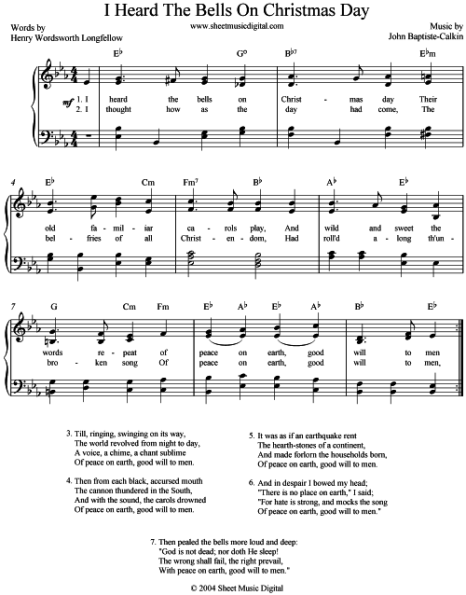
“I Heard the Bells on Christmas Day” is a Christmas carol based on the 1863 poem “Christmas Bells” by American poet Henry Wadsworth Longfellow. The song tells of the narrator’s despair, upon hearing Christmas bells, that “hate is strong and mocks the song of peace on earth, goodwill to men”. The carol concludes with the bells carrying renewed hope for peace among mankind.
This version is done by Casting Crowns. I chose it because the Pender choir sang this on Christmas Eve with past-Associate Pastor Dan Elmore singing the solo…and I fell in love with this version.
As seen on 2008 TBN Christmas special. “I Heard The Bells On Christmas Day” is available on Casting Crowns’ Christmas album, Peace On Earth.
More traditionally, the Mormon Tabernacle Choir’s version:
I heard the bells on Christmas Day
Their old, familiar carols play,
and wild and sweet
The words repeat
Of peace on earth, good-will to men!
And thought how, as the day had come,
The belfries of all Christendom
Had rolled along
The unbroken song
Of peace on earth, good-will to men!
Till ringing, singing on its way,
The world revolved from night to day,
A voice, a chime,
A chant sublime
Of peace on earth, good-will to men!
Then from each black, accursed mouth
The cannon thundered in the South,
And with the sound
The carols drowned
Of peace on earth, good-will to men!
It was as if an earthquake rent
The hearth-stones of a continent,
And made forlorn
The households born
Of peace on earth, good-will to men!
And in despair I bowed my head;
“There is no peace on earth,” I said;
“For hate is strong,
And mocks the song
Of peace on earth, good-will to men!”
Then pealed the bells more loud and deep:
“God is not dead, nor doth He sleep;
The Wrong shall fail,
The Right prevail,
With peace on earth, good-will to men.”
I’ve always liked Leroy Anderson’s Sleigh Ride as a secular Christmas song 🙂 It’s not technically a Christmas song since the words never mention Christmas but it’s often played now so it seems like a way to ease into the season.
Anderson had the original idea for the piece during a heatwave in July 1946; he finished the work in February 1948. Lyrics, about a person who would like to ride in a sleigh on a winter’s day with another person, were written by Mitchell Parish in 1950.
The orchestral version was first recorded in 1949 by Arthur Fiedler and The Boston Pops Orchestra. The song was a hit record and has become the equivalent of a signature song for the orchestra.
A fun arrangement has been made for piano duet. I have copies here to lend and it’s available on amazon (of course! What isn’t?)
Johann Sebastian Bach’s towering monument of organ music, with its deep sense of foreboding, will forever be associated with Halloween.
The piece is recognizable to most and has been featured in many films, including: Dr. Jekyll and Mr. Hyde (1931), The Black Cat (1934), Disney’s Fantasia (1940), Sunset Boulevard (1950), 20,000 Leagues Under the Sea (1954), The Phantom of the Opera (1962), and The Great Race (1965).
This is arranged for very easy piano in PIano Maestro. Get a free copy of the sheet music at IMSLP or borrow a copy from the O’Connor Music Studio. I have this arranged for organ, piano, duet, 2-piano, simplified…
Here, Virgil Fox performs it on his Allen Digital Touring Organ.
Diane Bish plays the Massey Memorial Organ at the Chautauqua Institution and talks about this instrument.
Mormon Tabernacle Organist, Richard Elliott, performs an eerie rendition of Johann Sebastian Bach’s “Toccata in D Minor” with the Salt Lake Tabernacle pipe organ, the Tabernacle Organ has 11,623 pipes. “Toccata” is often played in the full extent as “Toccata and Fugue in D Minor.” This piece is one of the most famous works in organ repertoire.
Fantasia (1940)
As a bar graph
Just because…one of my new favorites, a mashup of a different Bach d minor work and the Phantom of the Opera. I bought it at MusicNotes last year, in case anyone wants to give it a try!
This is another piece I just like to listen to, partly because of the bagpipes. I do have sheet music, but it’s not quite the same!
This melody was composed by German musicians Ulrich Roever and Michael Korb[1] in 1982 for a Highland games held in Germany. It has been proposed as the Scottish national anthem to replace unofficial anthems Scotland the Brave and/or Flower of Scotland.
“Ode to Joy” was written in the summer of 1785 by German poet, playwright, and historian Friedrich Schiller and published the following year in Thalia. A slightly revised version appeared in 1808, changing two lines of the first and omitting the last stanza.
“Ode to Joy” is best known for its use by Ludwig van Beethoven in the final (fourth) movement of his Ninth Symphony, completed in 1824. This was Beethoven’s final symphony and lasts over an hour for the whole thing.
The entire final movement:
Beethoven’s text is not based entirely on Schiller’s poem, and introduces a few new sections. His melody (but not Schiller’s words) was adopted as the Anthem of Europe by the Council of Europe in 1972 and subsequently by the European Union.
If your student is in Wunderkeys, this is a classical pop piano solo based on Beethoven’s 9th Symphony. This Level 4 piano solo is from the book The Beethoven Sessions; a collection of 7 classical pop piano solos inspired by the music of Beethoven.
It is often called Joyful, Joyful We Adore Thee (You) in hymnbooks.
Find Ode to Joy in Piano Maestro, Prelude, Beethoven: Exploring His Life and Music and several hym books.
By now, you know I love flashmobs:
And Muppets (note the metronome going wild!):
And Barbershop:
An animated score:
Boomwhackers:
The Piano Guys combined Ode to Joy with Joy to the World for a new Christmas arrangement:
As the European Anthem:
And, finally Joyful, Joyful we Adore Thee by the Mormon Tabernacle Choir.
Do a search on youtube – lots and lots of people have played this famous Beethoven melody.
This is another piece I just like to listen to, partly because of the bagpipes. I do have sheet music, but it’s not quite the same!
This melody was composed by German musicians Ulrich Roever and Michael Korb[1] in 1982 for a Highland games held in Germany. It has been proposed as the Scottish national anthem to replace unofficial anthems Scotland the Brave and/or Flower of Scotland.
“Ode to Joy” was written in the summer of 1785 by German poet, playwright, and historian Friedrich Schiller and published the following year in Thalia. A slightly revised version appeared in 1808, changing two lines of the first and omitting the last stanza.
“Ode to Joy” is best known for its use by Ludwig van Beethoven in the final (fourth) movement of his Ninth Symphony, completed in 1824. This was Beethoven’s final symphony and lasts over an hour for the whole thing.
The entire final movement:
Beethoven’s text is not based entirely on Schiller’s poem, and introduces a few new sections. His melody (but not Schiller’s words) was adopted as the Anthem of Europe by the Council of Europe in 1972 and subsequently by the European Union.
It is often called Joyful, Joyful We Adore Thee (You) in hymnbooks.
Find Ode to Joy in Piano Maestro, Prelude, Beethoven: Exploring His Life and Music and several hym books.
By now, you know I love flashmobs:
And Muppets (note the metronome going wild!):
And Barbershop:
An animated score:
Boomwhackers:
The Piano Guys combined Ode to Joy with Joy to the World for a new Christmas arrangement:
As the European Anthem:
And, finally Joyful, Joyful we Adore Thee by the Mormon Tabernacle Choir.
Do a search on youtube – lots and lots of people have played this famous Beethoven melody.
Can it be that not much happened in the world of music today? I’ll be editing this post as I find items!
In the meantime, please enjoy this video:
.1875 ~ The Georges Bizet opera Carmen premiered in Paris.
.1931 ~ The “Star Spangled Banner” was adopted as the American national anthem. The song was originally known as “Defense of Fort McHenry.”
.1931 ~ The first jazz album to sell a million copies was recorded. It was “Minnie The Moocher” by Cab Calloway.
.1940 ~ Artie Shaw and his orchestra recorded “Frenesi”.
.1945 ~ Bing Crosby recorded “Temptation” with John Scott Trotter’s Orchestra. He had recorded it before on October 22, 1933, with Lennie Hayton’s orchestra.
.1957 ~ Samuel Cardinal Stritch banned rock ‘n’ roll from Chicago archdiocese Roman Catholic schools.
. 1830 ~ Hans Bronsart Von Schellendorf, classical musician, pianist and composer who studied under Franz Liszt
. 1889 ~ John Mills, Guitarist, singer, bass with The Mills Brothers. He was father of the four Mills brothers and took youngest son John, Jr.’s place after his death in 1935
. 1912 ~ Rudolf Firkušný, Czech composer, classical pianist
. 1914 ~ Matt Dennis, Pianist, singer, recorded vocals for Paul Whiteman
. 1916 ~ The Baltimore Symphony Orchestra presented its first concert. The symphony was the first by a municipal orchestra to be supported by taxes.
. 1941 ~ Sergio Mendes, Brazilian jazz pianist and composer
. 1935 ~ Gene Vincent (Craddock), Singer, actor
. 1938 ~ Larry Clinton and his orchestra recorded Martha on Victor Records. Bea Wain was heard warbling the vocals on the tune.
. 1938 ~ Bobby”Boris” Pickett, American singer-songwriter (Monster Mash), born in Somerville, Massachusetts (d. April 25, 2007)
. 1939 ~ Gerry Goffin, Lyricist with Carole King and with Michael Masser
. 1940 ~ NBC radio presented “The Chamber Music Society of Lower Basin Street” for the first time. The famous Blue network series included several distinguished alumni — among them, Dinah Shore and Zero Mostel. The chairman, or host, of “The Chamber Music Society of Lower Basin Street” was Milton Cross. He would say things like, “A Bostonian looks like he’s smelling something. A New Yorker looks like he’s found it.” The show combined satire, blues and jazz and was built around what were called the three Bs of music: Barrelhouse, Boogie Woogie and Blues.
. 1968 ~ The new 20,000 seat Madison Square Garden officially opened in New York. It was the fourth arena to be named Madison Square Garden. The showplace for entertainment and sports opened with a gala show hosted by Bob Hope and Bing Crosby.
. 1973 ~ Ethan Iverson, US pianist, composer, and critic, born in Menomonie, Wisconsin
. 1982 ~ Eleanor Powell, American actress and tap dancer (Born to Dance), died of cancer at the age of 69
. 1985 ~ Ulysses Simpson Kay, composer, died at the age of 68
. 2001 ~ Dame Sonia Arova, a Bulgarian-born ballerina who danced with Rudolf Nureyev, at his request, in his American debut, died of pancreatic cancer at the age of 74. Arova was knighted by King Olaf V of Norway, only the second woman to receive that distinction. During her years as founding artistic director of the State of Alabama Ballet, Dame Sonia Arova changed the face of dance in Birmingham. Through a stage career that lasted three decades and a teaching career that occupied three more, she lived and breathed ballet. Born in Sofia, Bulgaria, Arova began dancing at age 6. By 8, she was studying ballet intensively in Paris. When war broke out in 1940, she escaped the Nazis’ advance with her English piano teacher in a harrowing flight during which their train was machine-gunned by German troops. Arriving in England, Arova was enrolled in an arts school and later joined the International Ballet. In 1965, Arova became artistic director of the Norwegian National Ballet, moved to California in 1971 to co-direct the San Diego Ballet and in 1975 accepted a teaching position at the Alabama School of Fine Arts. Maintaining her position at ASFA, she took over the newly formed State of Alabama Ballet in 1981 as artistic director, with her husband, Thor Sutowski, as artistic associate and choreographer. In 1996, the couple returned to San Diego, and she spent her last years with the San Diego Ballet.
. 2003 ~ Moses G. Hogan, 45, a pianist and choral conductor known for his contemporary arrangements of spirituals, died of a brain tumor in New Orleans. He was editor of the Oxford Book of Spirituals, published in 2001 by Oxford University Press. The book has become the U.S. music division’s top seller. Mr. Hogan also toured with his own singing groups, the Moses Hogan Chorale and Moses Hogan Singers. His arrangements, more than 70 of which have been published by the Hal Leonard publishing company, were performed by the Mormon Tabernacle Choir, soprano Barbara Hendricks and countertenor Derek Lee Ragin.
. 2003 ~ William L. “Weemo” Wubbena Jr., 72, a retired Army colonel who sang in Washington area barbershop quartets, died of cancer. Col. Wubbena was born in Marquette, Mich., and raised in Washington. He was a member of the Montgomery County chapter of the Society for the Preservation and Encouragement of Barber Shop Quartet Singing in America.
. 2018 ~ Vic Damone [Vito Farinola], American singer (On the Street Where You Live), entertainer, actor and TV presenter (Vic Damone Show), died at the age of 89








 MaryO'Studio