Today we listen to the third movement Mozart’s Piano Sonata No.11 III (Turkish March) with just a bit of the first movement near the end.
The Turkish influence on western music came through the Turkish military band music (Mehter), which was at the time was the only military band in Europe. It was once popular among western composers like Mozart to write Turkish-style (alla Turca) works, Turkish music being known at that time as Turkish band music. That’s why the Turkish-influenced music works by Mozart, Beethoven or Strauss are in march rhythm as they are called march.
A rondo is a piece of music where the musical material stated at the beginning of the piece keeps returning. This opening music can be called either the theme or the refrain; they are the same thing. The form can be A, B, A or A, B, C, A – anything as long as the “A” theme returns
The Turkish March movement:
On guitar:
Harmonica, anyone?
Vocal:
Find the Turkish march movement of this sonata in these Piano Pronto books: Encore, Mozart: Exploring His Life and Music,
The first movement can be found in Keyboard Kickoff, Movement 2
Today’s piece is slow and easy going. The name “Largo” itself means slow. Antonin Dvorák wrote this as a part of his Symphony No. 9 in E minor,also known as From the New World, Op. 95, B. 178 or just the New World Symphony.
Popularly known as the New World Symphony, it was composed in 1893 while Dvořák was the director of the National Conservatory of Music. It is by far his most popular symphony, and one of the most popular of all symphonies. In older literature and recordings, this symphony was often numbered as Symphony No. 5.
Astronaut Neil Armstrong took a tape recording of the New World Symphony along during the Apollo 11 mission, the first Moon landing, in 1969.
For Piano
And orchestra
The theme from the Largo was adapted into the spiritual-like song “Goin’ Home”, often mistakenly considered a folk song or traditional spiritual, by Dvořák’s pupil William Arms Fisher, who wrote the lyrics in 1922.
Find Largo in Keyboard Kickoff, Prelude (it’s called River Road, Movement 2 and Piano Maestro.
Whenever I think of slow things, I’m reminded of this clip from the old TV Show, Taxi
It’s wedding season! Today and tomorrow, we’ll be looking at, and listening to, the music most associated with weddings.
The “Bridal Chorus” from the 1850 opera Lohengrin by German composer Richard Wagner is a march played for the bride’s entrance at many formal weddings throughout the Western world.
The piece was made popular when it was used as the processional at the wedding of Victoria the Princess Royal to Prince Frederick William of Prussia in 1858.
This piece is available in Keyboard Kickoff, Movement 2 and Piano Maestro.
The original from the opera
A piano version (this book is available for loan, if interested)
Today, we start with Spring from the Four Seasons by Vivaldi. Many OCMS students have played this already in one of their Piano Pronto books. It’s also available in Piano Maestro.
If you have it in your piano book, today would be a great day to review it. (HINT – there might be a quick review at your next lesson!)
Vivaldi was born in Venice, Italy, March 4, 1678 and spent most of his life there. His father taught him to play the violin, and the two would often perform together.
He taught at an orphanage for girls and wrote a lot of music for the girls to play. People came from miles around to hear Vivaldi’s talented students perform the beautiful music he had written.
Many people think Vivaldi was the best Italian composer of his time. He wrote concertos, operas, church music and many other compositions. In all, Antonio wrote over 500 concertos.
His most famous set of concertos is The Four Seasons which is a group of four violin concerti. Each of which gives a musical expression to a season of the year. They were written about 1721 and were published in 1725 in Amsterdam.
Here’s a piano version similar to the one in Movement 1 but in a different key.
And the original with Itzhak Perlman playing and conducting!
Want to play a version of this but aren’t using these books? Just ask!
Today’s piece is slow and easy going. The name “Largo” itself means slow. Antonin Dvorák wrote this as a part of his Symphony No. 9 in E minor, also known as From the New World, Op. 95, B. 178 or just the New World Symphony.
For Piano
And orchestra
The theme from the Largo was adapted into the spiritual-like song “Goin’ Home”, often mistakenly considered a folk song or traditional spiritual, by Dvořák’s pupil William Arms Fisher, who wrote the lyrics in 1922.
Find Largo in Keyboard Kickoff, Prelude (it’s called River Road, Movement 2 and Piano Maestro.
Whenever I think of slow things, I’m reminded of this clip from the old TV Show, Taxi
It’s wedding season! Today and tomorrow, we’ll be looking at, and listening to, the music most associated with weddings.
The “Bridal Chorus” from the 1850 opera Lohengrin by German composer Richard Wagner is a march played for the bride’s entrance at many formal weddings throughout the Western world.
The piece was made popular when it was used as the processional at the wedding of Victoria the Princess Royal to Prince Frederick William of Prussia in 1858.
This piece is available in Keyboard Kickoff, Movement 2 and Piano Maestro.
The original from the opera
A piano version (this book is available for loan, if interested)
Today, we start with Spring from the Four Seasons by Vivaldi. Many OCMS students have played this already in one of their Piano Pronto books. It’s also available in Piano Maestro.
If you have it in your piano book, today would be a great day to review it. (HINT – there might be a quick review at your next lesson!)
Vivaldi was born in Venice, Italy, March 4, 1678 and spent most of his life there. His father taught him to play the violin, and the two would often perform together.
He taught at an orphanage for girls and wrote a lot of music for the girls to play. People came from miles around to hear Vivaldi’s talented students perform the beautiful music he had written.
Many people think Vivaldi was the best Italian composer of his time. He wrote concertos, operas, church music and many other compositions. In all, Antonio wrote over 500 concertos.
His most famous set of concertos is The Four Seasons which is a group of four violin concerti. Each of which gives a musical expression to a season of the year. They were written about 1721 and were published in 1725 in Amsterdam.
Here’s a piano version similar to the one in Movement 1 but in a different key.
And the original with Itzhak Perlman playing and conducting!
Want to play a version of this but aren’t using these books? Just ask!
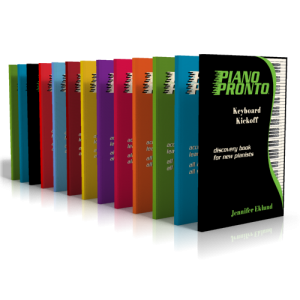
Some of you have noticed that I am switching your students (or yourself!) over to Piano Pronto and may have wondered why.
It was one of the first “method book series” to be integrated into Piano Maestro, so some of the songs have already been worked on using this iPad app.
I am in a Facebook group with the author/composer and many other participants have said that once their students have started in Piano Pronto, the students “forget” the other books at home or in the music bag.
So, a simple experiment was started here and the same thing happened. Only the Piano Pronto book (Keyboard Kickoff) came out of the bag.
Then, another student got hooked, and another…
Even the young boys seem to love the duets, which are excellent at helping with counting and listening to other musicians.
A minor point but one that makes life easier for the teacher. All books are $10.00 (plus shipping) Other method books have varying prices in hard to find locations, some hidden in codes on the back.
Piano Pronto books can be ordered online at https://www.pianopronto.com/ and they are available at our local Music and Arts store in Oakton. If something is needed fast, digital copies are available to print (or add to the iPad)
If you would like to look through any of the books, just ask!
From the composer, Jennifer Eklund, on Facebook:
Let me give you my fast 5 “things that makes us different from everyone else”:
#1 – On the staff reading day one (I take what I call a “total immersion” approach to note-reading/learning – watch the webinar for the full scoop)
#2 – Aurally pleasing music from very early on. I challenge you to find better and/or more consistently solid arranging in another method series. I don’t wait 2 years to introduce 8th notes. The tunes used in the series are strong and familiar and therefore we can get to more of the fundamentals earlier in the lesson process. Students practice with confidence at home because they recognize the melodies and therefore progress faster.
#3 – All-in-one integrated books (i.e. there aren’t 4 separate books per level the most you ever need is the method and maybe one supplement book)
#4 – The material is age and gender neutral. Clean layout with no illustrations to distract.
#5 – We start teaching how to *effectively* practice from the get-go with our “Pronto Prep” sections that pull out the difficult portions of pieces *before* a student learns the piece.
Other less important stuff:
#6 – The supplements are rooted in my “pop/jazz” background so while the method books are very “classically-based” the supplements are full of pop-style stuff that really creates well-rounded students
#7 – I challenge you to find more varied/interesting teacher duet parts.
#8 – I’m actively writing/creating new items constantly. I really listen to my customers and am writing to suit the needs of the market. If you need something and I don’t have it odds are I’ll probably end up filling your request.
#9 – I stay out of your way as a teacher. The material is extremely flexible. I wanted to give you a solid curriculum that is paced thoughtfully and you can augment the series with all the tools available in your toolbox. You will not feel restricted in any way by the material.
#10 – You can SEE and HEAR everything before you buy. There is NO guesswork involved with shopping with Piano Pronto.


 MaryO'Studio