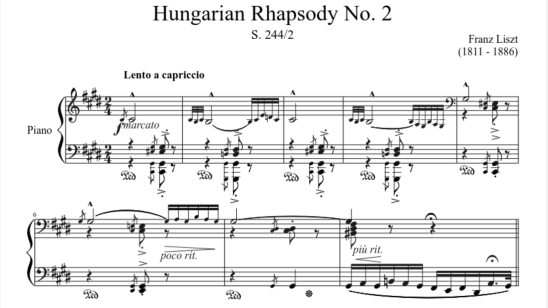
Today’s piece is a favorite in cartoons as you’ll see below. Hungarian Rhapsody number 2 by Franz Liszt is the second in a set of 19 Hungarian Rhapsodies and is by far the most famous of the set. They are all based on Hungarian folk tunes, or what Liszt assumed were Hungarian folk tunes. Even though Liszt’s nationality was Hungarian, he wasn’t familiar with the language.
So he ended up making some assumptions. Some of these Hungarian Rhapsodies were not actually gypsy folk tunes at all, but tunes composed by middle-and-upper-class folk, which the gypsies integrated into their own music.
These Rhapsodies are very difficult for pianists since Liszt was a virtuoso musician and liked to compose pieces only he could play.
• 1818 ~ Henry Charles Litolff, French pianist, composer and music publisher
• 1921 ~ Karel Husa, Czech-born American composer and conductor
• 1921 ~ Warren Covington, Bandleader, trombone, played with Horace Heidt and His Musical Knights
• 1925 ~ Felice Bryant, Songwriter with husband Boudleaux
• 1931 ~ Bix Beiderbecke, U.S. Jazz musician and composer, died. The first white musician to make an impact on jazz, he died from pneumonia aged 28.
• 1936 ~ Rahsaan Roland Kirk, American jazz musician
• 1937 ~ Bunny Berigan and his orchestra recorded I Can’t Get Started for Victor Records. The song became Berigan’s longtime theme song.
• 1939 ~ Ron Holden, Singer
• 1942 ~ B.J. (Billy Joe) Thomas, Singer
• 1943 ~ Lana Cantrell, Entertainer and singer
• 1952 ~ Andy Fraser, Musician: bass with Free
• 1958 ~ Bruce Dickenson, Singer with Iron Maiden
• 1970 ~ Christine McVie joined Fleetwood Mac as the group’s first female member. McVie was married to bass player John McVie. She quit touring with the group in 1991.
• 1971 ~ Homer (Henry D. Haynes) passed away
• 1975 ~ The Rolling Stones received a gold album for Made in the Shade.
• 1987 ~ Back to the Beach opened at theatres around the country. The film reunited Frankie Avalon and Annette Funicello, who played middle-aged parents with rebellious kids — kids like Frankie and Annette had played in their Bikini Beach movies in the 1960s.
• 2001 ~ Larry Adler, acknowledged as the king of the harmonica, died at the age of 87 at a London hospital after a long illness. Adler, born in Baltimore in February 1914, was a musical prodigy whose career covered seven decades during which he worked with a veritable who’s who of the 20th century’s entertainment industry.
From George Gershwin to Elton John, the classically trained Adler had worked with and inspired generations of musicians, touring as late as 1994 and even planning an update of his 1985 biography “It Ain’t Necessarily So.”
“He was without doubt one of the greatest musicians of the 20th century,” said musical agent Jonathan Shalit.
“Larry was a man who believed the show must always go on, even to the point of playing from his wheelchair,” he added.
Adler learned to play the piano and mouth organ by ear from listening to records and could not actually read music until 1941.
He won the Maryland Harmonica Championship in 1927 after being expelled from a music conservatory and promptly ran away to New York and got a job playing in film theaters between features.
In 1936 he played harmonica on George Gershwin’s Rhapsody in Blue, prompting the composer to exclaim that it sounded as though he had written the haunting melody especially for Adler.
During World War Two Adler toured extensively in Africa and the Middle East, entertaining troops, and insisting on a non-segregation policy between whites and blacks at concerts.
He also entertained in the South Pacific with artists including comedian Jack Benny, and worked consistently for the war effort and the Allied forces.
In 1945 he went to Berlin where he played The Battle Hymn of the Republic on harmonica on the balcony of Adolf Hitler’s ruined chancellery after Germany capitulated.
He left the U.S. for Britain in the early 1950s after being blacklisted during the McCarthy communist witch hunt.
Adler’s most familiar composition is the music for the film comedy “Genevieve,” but he composed the music for other films.
In 1967 and 1973, gave his services to Israel in aid of those affected by the Six Day and Yom Kippur wars.
After Adler guested on Sting’s 1993 album “Ten Summoner’s Tales,” the rock singer returned the compliment and appeared on Adler’s 80th birthday celebration, The Glory Of Gershwin.
They were joined by other stars from the rock world such as Meat Loaf, Kate Bush, Peter Gabriel and Sinead O’Connor.
A tennis fanatic, Adler once played in a doubles match with Charlie Chaplin, Greta Garbo and Salvador Dali.
• 2001 ~ Billy Byrd, who once played lead guitar for Ernest Tubb’s Texas Troubadours, died at the age of 81.
William Lewis Byrd was born in Nashville, and taught himself guitar by copying the records of Charlie Christian and Django Reinhardt.
In the 1940s, Byrd backed the Oak Ridge Quartet (predecessor of the Oak Ridge Boys), Little Jimmy Dickens, George Morgan and others.
In 1949, Byrd succeeded Tommy “Butterball” Paige as lead guitarist in Ernest Tubb’s Texas Troubadours.
On many of Tubb’s hit records, Tubb would introduce Byrd’s tight melodic solos by exclaiming, “Aw, Billy Byrd now,” or “Play it pretty, Billy Byrd.” Byrd played on scores of Tubb hits, including Jealous Loving Heart,Two Glasses Joe and Answer the Phone.
Byrd also drove Tubb’s bus during his first tenure with the Texas Troubadours, which lasted a decade. He returned twice to the band, from 1969-70 and 1973-74.
Byrd released three solo instrumental albums, and during a brief stint in California backed Tab Hunter and Tex Ritter. In 1950, Byrd and guitarist Hank Garland designed the popular Byrdland guitar for Gibson Guitars.
• 2017 ~ David Henry Maslanka, American composer, died at the age of 73
I have several copies of this book for the music studio so parents can check it out to see if it would be useful for them to buy for home use. If any of the studio parents have this book already, please let me know what you think.
Some of my adult students have this and have found it helpful in doing theory assignments.
Help Your Kids with Music is a step-by-step visual guide to music theory and is the perfect primer to help students gain a solid foundation in music, no matter their age, skill level, or instrument.
Help Your Kids with Music clearly explains key concepts in five step-by-step chapters:
The Basics explains the types of instruments, notation for keyboard and stringed instruments, the “musical alphabet,” and counting a beat.
Rhythm covers the length of notes and rests, as well as basic rhythms and meters, phrasing, syncopation, tempo, and using a metronome.
Tone and Melody includes everything a student needs to know about tones and how they work together to build a melody.
Chords and Harmony shows how intervals work together and includes examples for horn and woodwind instruments.
Form and Interpretation helps students understand how musical form can aid appreciation and interpretation for classical, jazz, blues, and other musical styles.
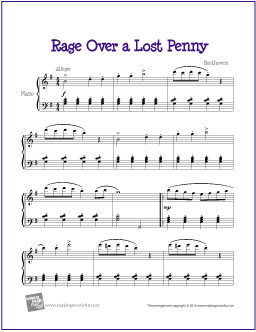
Today’s piece is Beethoven’s Rage Over a Lost Penny found in Piano Pronto Movement 4, Songs I Love to Play 2 and Beethoven: Exploring His Life and Music. The official title is The “Rondo alla ingharese quasi un capriccio” in G major, Op. 129 (Italian for “Rondo in the Hungarian [i.e. gypsy] style, almost a caprice”).
The story goes –
At one point Beethoven was composing this piece, a booming and boisterous piece that exuded energy and vitality.
One night a neighbor heard a loud dispute.
Beethoven was in a rage, accusing a maid of stealing a gold penny. The maid ran out and was never heard from again.
The neighbor then heard furniture crashing, and he could only conclude that the great Maestro was tipping over furniture, madly looking for the lost gold penny.
The story spread through the neighborhood and became part of the legend of Beethoven’s bad moods and curmudgeonly behavior.
• 1834 ~ Hermann Mendel, German music lexicographer
• 1909 ~ Karl Ulrich Schnabel, German pianist and composer
• 1912 ~ Marina Koshetz, who followed her famous Russian diva mother Nina to the opera and concert stage and into the movies, was born. Koshetz was born in Moscow, trained in France and came to the United States as a teenager. She made her debut substituting for her mother Nina Koshetz on radio’s “Kraft Music Hall.” Using her father’s surname, she began appearing in films in the early 1930s as Marina Schubert. Among her early films were “Little Women,” “All the King’s Horses” and “British Agent.”
Marina concentrated more on her voice in the 1940s. Adopting the professional name Marina Koshetz, she went on to sing with the New York Metropolitan Opera and the Boston Symphony Orchestra. Koshetz made her Los Angeles recital debut at the old Philharmonic Auditorium in 1947.
• 1921 ~ Buddy (William) Collette, Musician. reeds, piano and composer
• 1939 ~ After becoming a success with Ben Bernie on network radio, Dinah Shore started her own show on the NBC Blue radio network. Dinah sang every Sunday evening. Dinah also had a successful TV career spanning over two decades.
• 1940 ~ Columbia Records cut the prices of its 12-inch classical records. The records were priced to sell at $1. Within two weeks, RCA Victor did the same and ended a record-buying slump brought on by disinterested consumers.
• 1958 ~ Randy DeBarge, Musician, bass, vocals with DeBarge
• 1973 ~ Stevie Wonder came close to losing his life, following a freak auto accident. Wonder, one of Motown’s most popular recording artists, was in a coma for 10 days. Miraculously, he recovered and was back in the recording studio in less than eight weeks.
• 1981 ~ Stevie Nicks’ first solo album, Bella Donna, was released. The lead singer for Fleetwood Mac scored a top-three hit with Stop Draggin’ My Heart Around from the album. Tom Petty and The Heartbreakers were featured on the track. Nicks went on to record a total of 11 hits for the pop-rock charts through 1988.
• 2012 ~ Marvin Hamlisch, American composer and conductor, died at the age of 68
• 2016 ~ Pete Fountain, the famed New Orleans jazz clarinetist whose 60-year career was marked by performances for presidents and a pope, making him an international ambassador for the music and culture of his hometown, died at the age of 86.
The following ornament table is a transcription of the one appearing in the Clavier-Büchlein vor Wilhelm Friedemann Bach, written by Johann Sebastian Bach for the keyboard instruction of his eldest son.
A scan of the original manuscript appears at Dave’s J.S. Bach Page.
The German title translates as “Explanation of various signs, showing how to play certain ornaments correctly.”{1} Bach gives the sign for each ornament on the upper of the paired staves, while the lower shows its execution directly beneath.
(This blog has) simply modernized the clefs in my transcription, since Bach’s manuscript uses soprano clefs, as several composers continued to do throughout the 18th century in place of the treble clef now used in all keyboard music.
After the transcription graphic showing the table, there appear clickable buttons which are keyed to AU sound files; you can click on any of the ornaments and hear a sound file play its execution.
Today’s piece is from a TV show my son used to love to watch: Inspector Gadget. The show followed the adventures of a powerful but dimwitted cyborg police inspector named Gadget as he investigates the criminal schemes of Dr. Claw and his organization, MAD, as they fruitlessly attempt to stop him. However, neither side was aware that it is Gadget’s niece, Penny, and her dog, Brain, who are truly responsible for thwarting MAD.
Now, for just the theme
One of my favorite piano duet (I have the sheet music!)
• 1397? ~ Guillaume Du Fay, French composer. Considered the leading composer of the early Renaissance.
More information about Du Fay
• 1694 ~ Leonardo Leo, Italian composer and organist
• 1811 ~ Ambrose Thomas, French composer, primarily of operas
• 1890 ~ Erich Kleiber, Austrian conductor
• 1891 ~ Henry Charles Litolff, French pianist/composer, died at the age of 73
• 1924 ~ The comic strip Little Orphan Annie debuted in the New York Daily News. Annie and her little dog, Sandy, were creations of cartoonist Harold Gray. His work would come to life in the Broadway and film adaptations of Annie a half-century later, with great success.
• 1926 ~ Jeri Southern (Genevieve Hering), Singer
• 1940 ~ Damita Jo (DuBlanc), Singer
• 1942 ~ Rick Huxley, Bass with Dave Clark Five
• 1943 ~ Sammi Smith, Singer
• 1947 ~ Rick Derringer (Zehringer), Singer, songwriter with The McCoys, record producer
• 1953 ~ Samantha Sang, Singer
• 1957 ~ Dick Clark’s American Bandstand caught the attention of network executives at ABC-TV in New York, who decided to put the show on its afternoon schedule. Many artists, acts and groups of the rock ’n’ roll era debuted on American Bandstand – Simon and Garfunkel, Frankie Avalon, Fabian, Bobby Rydell, Chubby Checker – catapulting Clark into the spotlight as one of TV’s most prolific producers and hosts.
• 1958 ~ Joseph Holbrooke, English pianist, conductor and composer (3 Blind Mice), died at the age of 80
• 1975 ~ Singer Stevie Wonder signed the recording industry’s largest contract: $13 million over a seven-year period. Wonder stayed with his original label, Tamla/Motown, while other major Motown artists, including Diana Ross, Gladys Knight and The Four Tops had left the label over creative differences and financial accounting disputes.
Many homeowners don’t realize that there are movers available to them who specialize in the transportation and storage of pianos. A piano is a delicate instrument and not something you want to take risks with. By trusting this major job to a piano mover, you can rest easy knowing that one of the most valuable items in your home is being transported with the care it deserves.
But It Weighs 1500 Pounds. How Delicate Can It Be?
This is exactly where many homeowners go wrong. Sure, that piano in your living room is heavy enough to throw out the backs of four or five of your best buddies as you wrestle it out the door and up into the truck, but don’t let that fool you. Despite its bulky appearance, it is also a precision musical instrument with over 1000 moving parts and 200 finely-tuned strings, any number of which can be damaged and require repair if your piano isn’t handled properly in a move.
Your Piano Mover Understands Pianos
These intricate inner workings of a piano are exactly why hiring an expert in piano moving is so important. These professionals understand pianos and moving them, from the safest way to lift and twist a standard upright piano to get it out the door, to how to properly disassemble a grand piano and transport it without causing any damage. And even more importantly, a piano mover understands that when your piano is delivered to your new home, you expect to be able to sit down and play it right away. It’s why many piano movers keep tuners and repairmen on staff, and why the rest will have a trusted list of professionals available on request if you need it.
And, we’re back with Clair de Lune by Claude Debussy. Clair de Lune is French for “light of the moon”, or “moonlight”. Debussy liked to create tonal “impressions” rather than conventional melodies. Clair de Lune” is a famous example of this as it creates the feeling of rippling water.




 Be sure your student reads and listens to







 MaryO'Studio