On August 22 ~ in Music History

today

OCMS   1862 ~ Claude Debussy, French composer. Along with Maurice Ravel, he was one of the most prominent figures associated with Impressionist music, though he himself disliked the term when applied to his compositions.
More information about Debussy

• 1906 ~ The Victor Talking Machine Company of Camden, New Jersey began to manufacture the Victrola (record player). The hand-cranked unit, with horn cabinet, sold for $200. Records sold separately.

• 1917 ~ John Lee Hooker, American blues guitarist and singer, born in Clarksdale, Miss. He began his career in Detroit in 1948 with the release of Boogie Chillun, the biggest of his several hit records and a staple of both the blues and rock repertoires. He toured continually, and among “deep blues” artists, enjoyed an unusually successful career, appearing in concerts and on recordings with many of the leading figures in rock. He was inducted into the Rock ‘n’ Roll Hall of Fame in 1991.

OCMS  1928 ~ Karlheinz Stockhausen, German composer
More information about Stockhausen
Read quotes by and about Stockhausen

• 1926 ~ Bob Flanigan, Singer with The Four Freshmen

• 1932 ~ The British Broadcasting Corporation (BBC) began its first experimental TV broadcast in England.

• 1938 ~ Fred Astaire and Ginger Rogers appeared, dancing, on the cover of LIFE magazine, published on this day.

• 1938 ~ Count Basie recorded the classic swing tune, Jumpin’ at the Woodside, for Decca Records.

• 1942 ~ Joe Chambers, Musician: guitar, singer with The Chambers Brothers

• 1950 ~ Sam Neely, Singer

• 1960 ~ Debbi Peterson, Drummer, singer with Bangles

• 1961 ~ Roland Orzabal, Singer, guitarist

• 2002 ~ Frederick Selch, an advertising executive and magazine publisher who collected hundreds of antique musical instruments, died at the age of 72.
Selch began collecting almost 50 years ago and owned more than 300 musical instruments by 1977.
In that year, he founded the Federal Music Society, an organization dedicated to performing music from the Colonial-Federal period. The group’s 26 players used instruments in Selch’s collection to perform in more than 70 concerts.
Selch was also the owner, editor and publisher of Ovation, a monthly magazine about classical music, from 1983 to 1989. He produced the Broadway musical “Play Me a  Country Song” in 1982, and in the past 10 years was involved in a series of American  Music Festivals at Illinois Wesleyan University.
Selch, who received a master’s degree in radio-television production from Syracuse University, worked at the J. Walter Thompson advertising agency from 1955 to 1974.
He is to be awarded a posthumous doctorate from the American Studies program at New York University.

• 2002 ~ Richard Lippold, a sculptor whose abstract works are featured at New York’s Avery Fisher Hall and at Harvard University, died. He was 87. Lippold created giant metal abstractions, many of which are suspended by wires so they appear to be hovering or moving through space.
His piece World Tree, a 27-foot structure of straight and circular metal tubes that resembles a radio antenna, stands on the Harvard University campus.
He is also known for Ad Astra, a double spire that rises 115 feet in front of the National Air and Space Museum in Washington, and Orpheous and Apollo, a constellation of bronze bars connected by wires in the lobby of Avery Fisher Hall in Lincoln Center.
Lippold studied industrial design, piano and dance at the Art Institute of Chicago and the University of Chicago. He worked as a freelance industrial designer for several years before teaching art at the University of Michigan.
He later taught at Goddard College in Plainfield, Vt., and Hunter College in New York.

• 2018 ~ Ed King, former guitarist for Lynyrd Skynyrd who co-wrote ‘Sweet Home Alabama,’ died at the age of 68

Piano Lessons For Very Young Children

RT_Front-cover

Student books in 5 different categories are available now in both digital and hardcopy.  There is now “To the Lake”, “Outdoor Adventure”, “To the Farm”, “Country Carnival” and two levels of “Rockstar Rally”.

  • Ideal for students ages 4 and up.
  • On the staff from the start
  • Music is a mix of familiar tunes and original pieces
  • Multi-key approach
  • 18 songs that can be learned by note or rote
  • Clean easy-to-follow pages (great for special needs students!)


Two levels of Roadtrip! are currently available in Piano Maestro.

Register for Roadtrip!  Students (ages 4-5) are scheduled for half-hour lessons with their parents present.

August 22, 2019 ~ Daily Listening Assignment


The Polovtsian Dances form an exotic scene at the end of act 2 of Alexander Borodin’s opera Prince Igor.

The work remained unfinished when the composer died in 1887, although he had worked on it for more than a decade. A performing version was prepared by Nikolai Rimsky-Korsakov and Alexander Glazunov in 1890. One of the more famous dances is found in Piano Pronto Movement 4 and Alfred Premier Piano Course Book 3,.

Can you find it in here?


Follow the score!

A different dance


The dance that’s usually in method books

On August 21 ~ This Day in Music History


• 1904 ~ (William Allen) Count Basie, Bandleader, pianist
More information about Count Basie

• 1928 ~ Art Farmer, Trumpeter, flugelhorn, worked with Horace Henderson, Johnny Otis, Lionel Hampton Band; recorded be-bop classic Farmer’s Market; developed musical instrument called ‘flumpet’

OCMS   1933 ~ Dame Janet Baker, British mezzo-soprano Read quotes by and about Baker
More information about Baker

• 1938 ~ Kenny (Kenneth Donald) Rogers, Grammy and CMA Award-winning singer; groups: The Kirby Stone Four, The New Christy Minstrels, The First Edition

• 1938 ~ A classic recording was made this day when Fats Waller performed Ain’t Misbehavin.

• 1939 ~ Harold Reid, Singer with The Statler Brothers

• 1944 ~ Jackie DeShannon (Sharon Myers), Singer, songwriter

• 1947 ~ Carl Giammarese, Guitarist with The Buckinghams

• 1952 ~ Joe Strummer (John Mellors), Guitarist and singer

• 1957 ~ Kim Sledge, Singer with Sister Sledge

• 1976 ~ RCA Victor Records announced that sales of Elvis Presley records had passed the 400 million mark.

• 1980 ~ Linda Ronstadt debuted on Broadway in the production of Gilbert and Sullivan’s, The Pirates of Penzance.

• 2005 ~ Robert Moog, American engineer (Moog synthesizer, Moog Music), died of a brain tumor at 71

August 21, 2019 ~ Daily Listening Assignment

This is another piece I just like to listen to, partly because of the bagpipes.  I do have sheet music, but it’s not quite the same!

This melody was composed by German musicians Ulrich Roever and Michael Korb[1] in 1982 for a Highland games held in Germany. It has been proposed as the Scottish national anthem to replace unofficial anthems Scotland the Brave and/or Flower of Scotland.


I heard it first here, at the Edinburgh Tattoo

One of my favorite versions

And, from the Mormon Tabernacle Choir


From the Red Hot Chili Pipers


On August 20 ~ This Day in Music History

today

• 1561 ~ Jacopo Peri, Italian composer
More information about Peri

• 1882 ~ Tchaikovsky’s “1812 Overture” first performed in Moscow.

• 1885 ~ The Mikado, by Gilbert and Sullivan, opened at the Fifth Avenue Theatre in New York City.

• 1905 ~ Weldon Leo ‘Jack’ Teagarden, Jazz musician, trombonist and singer whose relaxed, melodic instrumental style was highly influential
More information about Teagarden

• 1923 ~ Jim (James Travis) Reeves, American country singer and actor

• 1926 ~ Frank Rosolino, Musician: trombone, played with Stan Kenton, Harold Land, Bob Cooper, Clarke-Boland Big Band

• 1927 ~ Joya Sherrill, Singer

• 1931 ~ Frank Capp, Musician, drummer with the big jazz band, Capp-Pierce Juggernaut

• 1935 ~ Justin Tubb, Singer, Ernest Tubb’s son

• 1939 ~ Orrin Tucker’s orchestra recorded Oh, Johnny, Oh, Johnny, Oh!, on Columbia Records.

• 1942 ~ Issac Hayes, Grammy and Academy Award-winning American rhythm-and-blues singer, songwriter and arranger

• 1947 ~ Jim Pankow, Trombonist, songwriter with Chicago

• 1948 ~ Robert Plant, British rock singer with Honeydrippers and composer

• 1951 ~ Phyl Lynott, Musician: bass, singer with Thin Lizzy

• 1952 ~ Doug Fieger, Musician, guitar, singer with The Knack

• 1952 ~ Rudy Gatlin, Singer with The Gatlin Brothers

• 1969 ~ Andy Williams received a gold record for the album Happy Heart on Columbia   Records.

• 1977 ~ Best of My Love, by the Emotions, topped the pop charts. It had a number one run of four weeks.

• 2001 ~ Frank C. “Papa” Mangione, father of jazz musicians Chuck and Gap Mangione, died at age 91.
Mangione worked at Eastman Kodak Co., ran a grocery store for about two decades and returned to the photography company until his retirement in 1975. For the next 15 years, he sold music and merchandise on worldwide tours with his more famous son, Chuck, a flugelhorn ace.
A son of Italian immigrants, Mangione’s childhood was chronicled by his brother, Jerry, in a best-selling 1942 memoir called “Mount Allegro: A Memoir of Italian American Life.”
Three of Chuck Mangione’s songs, 60 Miles Young, 70 Miles Young and Papa Mangione, were dedicated to his father.

• 2013 ~ Marian McPartland, British jazz pianist (Marian McPartland’s Piano Jazz), died at the age of 95

• 2016 ~ Irving Fields, American composer and pianist (Miami Beach Rhumba), died at the age of 101


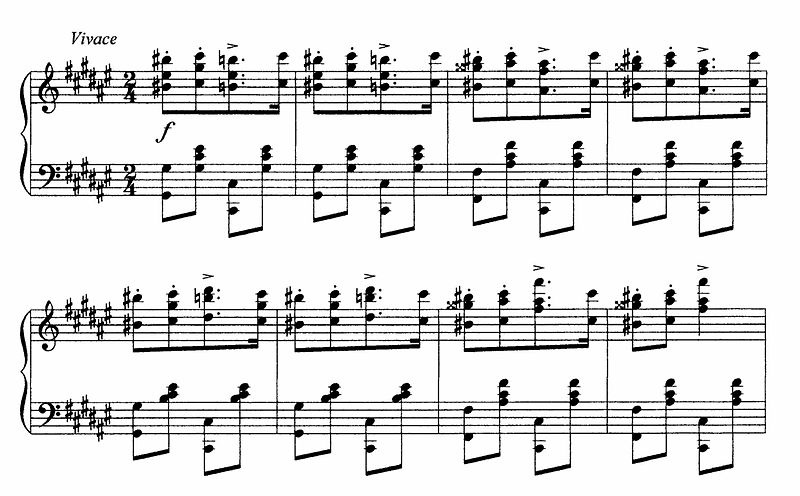
Franz Liszt: Hungarian Rhapsody no. 2 in c-sharp minor

liszt

Hungarian Rhapsody No. 2, S.244/2, is the second in a set of 19 Hungarian Rhapsodies by composer Franz Liszt, and is by far the most famous of the set. Few other piano solos have achieved such widespread popularity, offering the pianist the opportunity to reveal exceptional skill as a virtuoso, while providing the listener with an immediate and irresistible musical appeal.

In both the original piano solo form and in the orchestrated version this composition has enjoyed widespread use in animated cartoons. Its themes have also served as the basis of several popular songs.

It is probable that you have heard this piece of music somewhere at one time or another because it is perhaps the most prominent piece of classical (romantic, actually) music featured in animated cartoons across the years.

Now, let the anvils fall and dynamite explode!

And, in real life, Valentina Lisitsa plays Liszt’s Hungarian Rhapsody No. 2

This piece is available in Piano Pronto Movement 5 and several anthologies of classical music.

On August 19 ~ in Music History

today

• 1881 ~ Georges Enesco, Rumanian composer, violinist and conductor

• 1918 ~ Sgt. Irving Berlin’s musical about army life in World War I opened at the Century Theatre in New York City. Yip Yip Yaphank included songs, such as Mandy and Oh, How I Hate to Get Up in the Morning.

• 1939 ~ Ginger (Peter) Baker, Trumpeter, drummer with Cream

• 1939 ~ The Dick Jurgens Orchestra recorded Day Dreams Come True at Night on Okeh Records. Eddy Howard was the vocalist on the piece. It became Jurgens’ theme song.

• 1940 ~ Johnny Nash, American pop-reggae singer, songwriter and guitarist

• 1943 ~ Billy J. Kramer (William Ashton), Singer with The Dakotas

• 1945 ~ Ian Gillan, Singer with Deep Purple

• 1947 ~ Gerard Schwarz, American trumpeter and conductor

• 1951 ~ John Deacon, Bass with Queen, score of Flash Gordon

• 1964 ~ The Beatles began their first North American concert tour. They would visit 26 cities.

• 1972 ~ NBC-TV presented The Midnight Special for the first time. John Denver was the host for the first show. Wolfman Jack was the show’s announcer. The Midnight Special proved to be a ratings success.

• 1991 ~ Richard Maltby passed away. He was an American musician, conductor, arranger and bandleader.

• 2001 ~ Singer Betty Everett, whose recording of The Shoop Shoop Song (It’s In His Kiss) made Billboard’s Top 10 in 1964, died Sunday. She was 61.

Everett is remembered primarily for one huge hit song in the 1960s, but she also recorded many other songs and was recognized as one of the top soul singers of her time.

Starting at age 9, Everett played the piano and sang in church. She continued to sing in gospel choirs before moving to Chicago in 1957, where she recorded a string of hits on local record labels such as C.J. Cobra and OneDerful that included I’ll Be There and I’ve Got a Claim On You.

Everett signed a contract in the early 1960s with VeeJay, a record label that was then issuing recordings by The Beatles.
Everett recorded The Shoop Shoop Song in the spring of 1964, and it soared to Billboard’s Top 10.

The song was later recorded by Cher in the soundtrack for the 1990 movie Mermaids and more recently by Vonda Shepard of the Fox television show Ally McBeal.

• 2017 ~ Bea Wain, American singer and radio host (Deep Purple, Heart and Soul), died at the age of 100


2019 Fall Piano Lesson Registration


Thank you for your interest in the O’Connor Music Studio!

Available times are on Mondays, Wednesdays and Fridays during the day and after school for all ages and levels.  There may be other times available if requested.

After you register, you will get a confirmation email with the information you need to access the Student Portal. After logging in you may choose from the available lesson times or request something different.

If you are a transfer student, please bring your most recent method book(s) and notebook to the interview.

Prospective students must have a piano, organ or electric keyboard to use for daily practice. 

Roadtrip! students (ages 4-5) are scheduled for half-hour lessons with their parents present.

Beginning children (ages 6 to 9) are scheduled for half-hour lessons.

Youth (ages 10 and up) may be scheduled for half-hour lessons or forty-five minute lessons.

Adults are highly encouraged to take hour-long lessons but are always welcome to schedule half-hour lessons at first.

I look forward to meeting you!


Ornaments Aren’t Just For Christmas

The following ornament table is a transcription of the one appearing in the Clavier-Büchlein vor Wilhelm Friedemann Bach, written by Johann Sebastian Bach for the keyboard instruction of his eldest son.

A scan of the original manuscript appears at Dave’s J.S. Bach Page.

The German title translates as “Explanation of various signs, showing how to play certain ornaments correctly.”{1} Bach gives the sign for each ornament on the upper of the paired staves, while the lower shows its execution directly beneath.

(This blog has) simply modernized the clefs in my transcription, since Bach’s manuscript uses soprano clefs, as several composers continued to do throughout the 18th century in place of the treble clef now used in all keyboard music.

After the transcription graphic showing the table, there appear clickable buttons which are keyed to AU sound files; you can click on any of the ornaments and hear a sound file play its execution.

ornaments

Read the original blog post with the ornament table and listening files at J.S. Bach’s Ornament Table.