Help Your Kids with Music


I am ordering this book for the music studio so parents can check it out to see if it would be useful for them to buy for home use.  If any of the studio parents have this book already, please let me know what you think.

Thanks!

From Amazon:

Help Your Kids with Music is a step-by-step visual guide to music theory and is the perfect primer to help students gain a solid foundation in music, no matter their age, skill level, or instrument.

Help Your Kids with Music clearly explains key concepts in five step-by-step chapters:

  • The Basics explains the types of instruments, notation for keyboard and stringed instruments, the “musical alphabet,” and counting a beat.
  • Rhythm covers the length of notes and rests, as well as basic rhythms and meters, phrasing, syncopation, tempo, and using a metronome.
  • Tone and Melody includes everything a student needs to know about tones and how they work together to build a melody.
  • Chords and Harmony shows how intervals work together and includes examples for horn and woodwind instruments.
  • Form and Interpretation helps students understand how musical form can aid appreciation and interpretation for classical, jazz, blues, and other musical styles.

Sample pages:


Scales and Arpeggios

scales

PDF Article on Scales and Arpeggios

In music, a scale is any set of musical notes ordered by fundamental frequency or pitch.

An arpeggio (it. /arˈpeddʒo/) is a musical technique where notes in a chord are played or sung in sequence, one after the other, rather than being played together like a chord. This word comes from the Italian word “arpeggiare”, which means “to play on a harp”. An alternative translation of this term is “broken chord”.

Make any scale or chord here

In the O’Connor Music Studio, we have started using some newer books with beginning students:  Piano Adventures Scale and Chord Book, Book 1 (5 finger) and 2 (Full scales).

A Major Punny


c-eflat


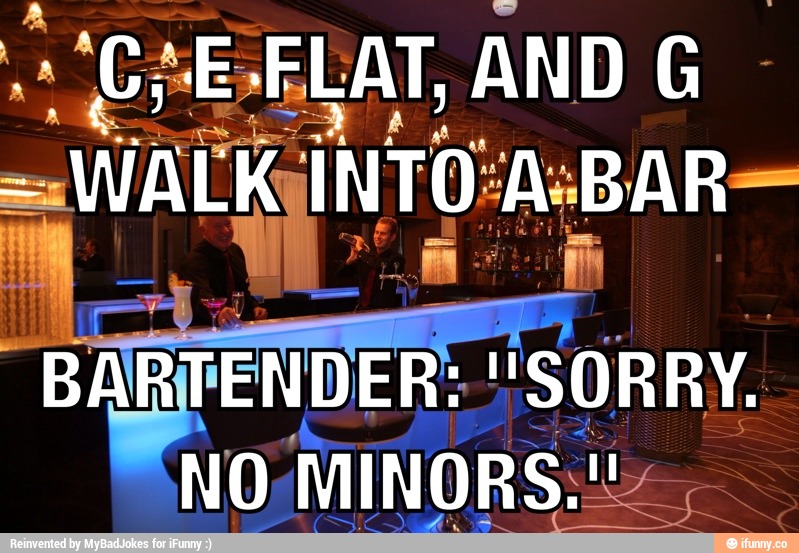
Some of these might make you think… C, E-flat, and G go into a bar. The bartender says, “Sorry, but we don’t serve minors.” So E-flat leaves, and C and G have an open fifth between them.

After a few drinks, the fifth is diminished, and G is out flat. F comes in and tries to augment the situation, but is not sharp enough. D comes in and heads for the bathroom, saying, “Excuse me; I’ll just be a second.”

Then A comes in, but the bartender is not convinced that this relative of C is not a minor. Then the bartender notices B-flat hiding at the end of the bar and says, “Get out! You’re the seventh minor I’ve found in this bar tonight.”

E-flat comes back the next night in a three-piece suit with nicely shined shoes. The bartender says, “You’re looking sharp tonight. Come on in, this could be a major development.” Sure enough, E-flat soon takes off his suit and everything else, and is au natural.

Eventually C sobers up and realizes in horror that he’s under a rest. C is brought to trial, found guilty of contributing to the diminution of a minor, and is sentenced to 10 years of D.S. without Coda at an upscale correctional facility.

On appeal, however, C is found innocent of any wrong doing, even accidental, and that all accusations to the contrary are bassless.

Reading the Notes on the Bass Clef

bass-clef-notes


An educational parody of Meghan Trainor’s music “All About That Bass” that teaches the notes of the bass clef.


Learn the notes of “The Cool Bass Clef” by watching this cool animated video. Music by Karl Hitzemann. Animation by Bill Belongia. The song originally appeared in Music K-8 magazine, Vol. 22, No. 3.


Why is Theory Important for Piano Students?

Music_Theory


Students at the O’Connor Music Studio know that music theory is always a part of lessons.  I strongly believe that theory is needed so that students understand what they are playing and why.

To me, theory work is just as important as playing.  A firm knowledge of musical structure makes playing everything easier.

Music knowledge learned through piano lessons transfers easily to other  musical activities.  Students in Fairfax County Public Schools, students learn to play recorder.  Students are sometimes surprised to learn that they already know all the notes – from their piano lessons!

When you sing in a choir, harmonize with Sweet Adelines, play an instrument in your school or community band/orchestra, join your church’s handbell choir (note:  Pender UMC has an excellent Handbell program), teach yourself guitar – theory will help in every instance. By learning to read, write, and understand this musical language, many more musical opportunities will be made available the rest of your life.

Most piano methods come with a theory book that matches page by page what concepts are being learned in the lesson books.  I actually recommend that students do the theory first when they get home, while the concepts are still fresh in their minds.

If the student is not in a piano method, I’m starting to use the Theory Time series.  Book One covers music alphabet, introduction to keyboard and staff, stem rule, steps & skips on a keyboard and staff, repeated notes, dynamics, treble clef lines & spaces, bass clef lines & spaces, quarter note & rest, half note & rest, whole note & rest, dotted half note, bar lines, double bar line, measures, time signatures, rhythm drill, vocabulary, ear training and a review test. Free ear training videos for each ear training exercise are hosted on the Theory Time YouTube channel. The Grade One workbook is appropriate for beginning 1st, 2nd or 3rd grade students. This workbook includes 51 pages, 13 lessons and 8 Fun Sheets.

For adults and more advanced students, I have a copy of All About Music Theory: A Fun and Simple Guide to Understanding Music which can be used as a review or a “try before buy”.

Stop procrastinating and go do your theory!

Exercises: Scales and Arpeggios

scales

PDF Article on Scales and Arpeggios

In music, a scale is any set of musical notes ordered by fundamental frequency or pitch.

An arpeggio (it. /arˈpeddʒo/) is a musical technique where notes in a chord are played or sung in sequence, one after the other, rather than being played together like a chord. This word comes from the Italian word “arpeggiare”, which means “to play on a harp”. An alternative translation of this term is “broken chord”.

Make any scale or chord here


Some Music Humor :)

any-key


So a C, an E-flat and a G walk into a bar. The bartender says, “sorry, but we don’t serve minors.” So E-flat leaves, and C and G have an open fifth between them. After a few drinks, the fifth is diminished and G is out flat. F comes in and tries to augment the situation, but is not sharp enough.

A D comes in and heads for the bathroom saying, “Excuse me. I’ll just be a second.” Then A comes in, but the bartender is not convinced that this relative of C is not a minor. Then the bartender notices B-flat hiding at the end of the bar and says, “Get out! You’re the seventh minor I’ve found in this bar tonight.”

E-Flat comes back the next night in a three-piece suit with nicely shined shoes. The bartender says, “you’re looking sharp tonight. Come on in, this could be a major development.” Sure enough, E-flat soon takes off his suit and everything else, and is au natural. Eventually, C, who had passed out under the bar the night before, begins to sober up and realizes in horror that he’s under a rest.

So, C goes to trial, is convicted of contributing to the diminution of a minor and sentenced to 10 years of DS without Coda at an up scale correctional facility. The conviction is overturned on appeal, however, and C is found innocent of any wrongdoing, even accidental, and that all accusations to the contrary are bassless.

The bartender decides, however, that since he’s only had tenor so patrons, the soprano out in the bathroom and everything has become alto much treble, he needs a rest and closes the bar.


‘Intervals Roasting’ – The Most Educational Christmas Carol Ever

music-theory-song

Music theory has never sounded so catchy with this witty remake of the holiday classic The Christmas Song (with apologies to Mel Torme) Try not to laugh at the ending.

Though it is a bit humorous, this version titled ‘Intervals Roasting’, with lyrics by David Rakowski, attempts to encapsulate the fundamentals of music theory in just over two minutes.

It does a good job of explaining the intervals and harmonic structure of the song and also gives you an idea of how to use music theory to analyse or compose music.

The O’Connor Music Studio has a copy if anyone wants to learn this 🙂

Free Today! Music Theory in One Lesson: Discover How Easy Music Theory Can Be!

music-theory-1-lesson


Music Theory in One Lesson was developed to make music theory more approachable than ever before. This book is packed and carefully formatted with rich, easy to understand diagrams. The use of space and visual learning really sets this book apart from the rest. The ability to read music is not required at any point in this book, so anyone can learn! The book is short and sweet, giving you the tools necessary to explore music in any direction you please.

Audio Examples are provided on the Music Theory in One Lesson website.

“As a music major, I’ve had to complete four semesters of college music theory. I can honestly say that in those four semesters I did not learn, much less understand, a fraction of what I did reading Music Theory in One Lesson. Each topic is expertly condensed and explained in a refreshing and enlightening way. This text takes all the pain so typically associated with learning music theory and replaces it with one exciting ‘Eureka!’ after another. I highly recommend it.”

— Therese Carmack