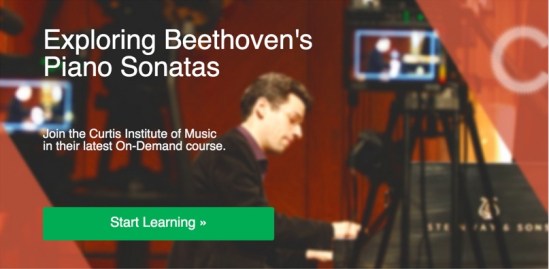
The wait is over… Exploring Beethoven’s Piano Sonatas is once again open! You can instantly Start Learning in this On-Demand course if you missed our last offering in the Spring of 2014 (or if you’re ready for another round).
We’ll explore Beethoven’s sonatas from the point of view of performer Jonathan Biss. You’ll learn from approximately 5 hours of videos and quizzes in this self-paced course.
Jonathan is busy recording new lectures on new sonatas that will be added to the course this Spring. Even if you took the course last time, you may want to re-watch the first series to refresh your knowledge. Then you’ll be ready to dive in as he covers NEW sonatas in detail.
In honor of the Chinese New Year, which begins Thursday, February 19th, JoyTunes is releasing a new category of songs to celebrate! The tunes included in this category are traditional Chinese songs that are fun to learn and play.
In addition, we are excited to be participating in the App Store Chinese New Year promotion! AppStore.com/CNY
About the Chinese New Year
Also known as the Spring Festival and celebrated for 15 days, the Chinese New Year occurs separately from the western celebrated New Year date as the Chinese follow a different calendar. Many of the celebrations come from ancient Chinese traditions which were set forth to honor deities and family ancestors. Although the biggest celebrations occur in China and other countries with a significant Chinese population, many major cities around the world hold festivals with some of the largest being in San Francisco, New York and London.
Celebrating the New Year
As the New Year approaches, families take great care to clean their houses as it is a way to “sweep” away any bad luck and misfortune. When the celebrations begin, families open the doors and windows of the home in order to let in good luck and fortune. You will also see red paper-cuts and lanterns hanging in doors and windows.
According to an ancient legend, a mythical beast called Nian would come to a Chinese village on New Year’s Day and eat animals, crops, and sometimes even children. One day a god visited a villager and told him to put red paper and firecrackers in from of each home as Nian was afraid of both. This began the tradition of placing red lanterns and other paper objects in the windows of homes. Nian was frightened away and never returned to harm the village.
The Year of the Goat
2015 is the year of the goat and your Chinese zodiac sign if you were born in 1919, 1931, 1943, 1955, 1967, 1979, 1991, 2003 or 2015. So, what should you know if you are a goat sign? Your lucky numbers are 2, 7 and any number containing a 2 or 7. The 7th and 30th are your lucky days of each month and your lucky colors are brown, red and purple. Many good things will happen for those born under the goat sign!
Lionel Kelly, 78, may have come late to the piano – he took it up at the age of 73 – but it’s changed his life. “I first heard Mahler performed in London in the mid-50s, when he became very popular over here,” he says. “I’m currently working on a piano transcription of the Adagietta from his Symphony No. 5. It’s a beautiful piece of music, slow and passionate, and was used in Luchino Visconti’s 1971 film of Thomas Mann’s novella, Death in Venice. To be able to play Mahler now, all these years later, is a real treat.”
Kelly, formerly director of American Studies at Reading University, practises up to four hours a day. He has lessons in Reading with Janet Sherbourne, whom he describes as “an excellent, if strict, teacher”, and is not taking grades. “Janet reckons I’m somewhere between grade four and five level, but I’m just doing it for pleasure, because I want to learn and play,” he says.
Bach, Beethoven and Mozart are among other composers tackled by Kelly…
When you listen to music, multiple areas of your brain become engaged and active. But when you actually play an instrument, that activity becomes more like a full-body brain workout.
What’s going on? Anita Collins explains the fireworks that go off in musicians’ brains when they play, and examines some of the long-term positive effects of this mental workout.
Practice slowly in the beginning (metronome on 60 or less). If you played it easily, and precisely with the metronome, move the tempo up one notch. Continue to practice in this way until you reach your goal speed.
Practice with various dynamics. Practice soft, loud and everything in between.
As you practice, vary the touch. Play staccato, play legato, and play two-note slurs.
Practice in different rhythms.
Try to practice Hanon Exercises in other keys, starting with the white keys (C, D, E, F, G, A, and B) and then going to the black keys (D-flat, E-flat, G-flat,A-flat, and B-flat).
And as Charles-Louis Hanon recommends it, practice his exercises by lifting the fingers high and with precision, playing each note very distinctly.
Most anyone who has ever played piano has a love-hate relationship with the “Hanon” book.
The Virtuoso Pianist (Le Pianiste virtuose) by Charles-Louis Hanon, is a compilation of sixty exercises meant to train the pianist in speed, precision, agility, and strength of all of the fingers and flexibility in the wrists.
First published in Boulogne, in 1873, The Virtuoso Pianist is Hanon’s most well-known work, and is still widely used by piano instructors and pupils although some teachers are getting away from the mechanical playing these can produce.
Personally, I’ve sometimes played these on “auto-pilot” since all one really needs is to get the first pattern going, then move up a step, up a step…
Notes by C. L. Hanon: Preparatory exercises for the Acquirement of Agility, Independence, Strength and Perfect Evenness in the Fingers. For studying the 20 exercises, begin with the metronome set at 60, gradually increasing the speed up to 108.
The piano was once the heart of the home. In 1909, people bought more than 350,000 of the instruments.
“Back in the early 1900s, there were very little forms of entertainment,” says Stephen Scharbrough, a second-generation piano tuner and technician. “It was a time that was pre-radio, so if you wanted entertainment, music, or something to interact with at your house, place of business, or a restaurant or bar, you had to hire a musician or pianist.”
The piano eventually caught on, and individuals learned how to play the piano on their own to entertain themselves. But today, “things have obviously changed a bit since then,” Scarborough says.
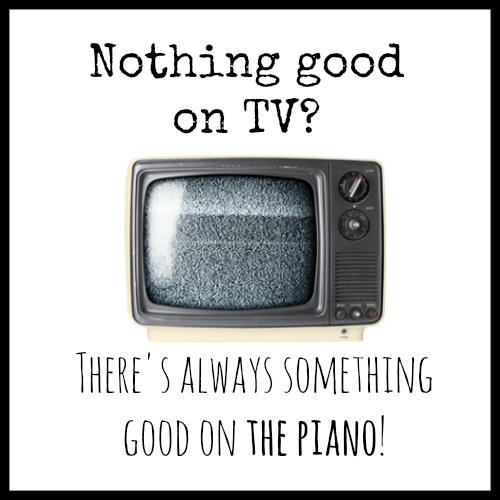
The television has adopted the piano’s former role in the modern era, and children are easily entertained with tablets instead of having to practice musical scales. Annual piano sales have dropped to between 30,000 and 40,000.
Instead of serving as the family entertainment center, Scharbrough says pianos are now owned by specific sets of people. “It’s the family that places priority on self-discipline and has a respect for arts and music,” he says.