Coming Soon for Younger Students!

RT_Front-cover

This new method book is at the publishers right now.  I’ve already downloaded the Teacher’s Guide and I’m liking what I see.

From the Piano Pronto website

Roadtrip! is a primer level method book for very early beginners ages 4 and up. Students master basic music fundamentals while creating a musical memory book that becomes a keepsake item to commemorate their maiden voyage into piano lessons.

18 songs: Non-position based; black key pieces; R.H. & L.H. only pieces; on-staff reading only
Also features: improvisation activities; ear training; composition; teacher duets

What this means for the O’Connor Music Studio – younger beginners will be able to get a great start to their musical lives.  Previously, I’ve only accepted students starting at age 6.

Starting with the new school year, interested parents can enroll their students from the age of 4.

Register for lessons here: http://ocms.mymusicstaff.com/Register-for-Lessons


Free Children’s Music Program

music-camp2015-header


At Pender’s Music Camp, rising second through sixth graders sing in choir, play Orff instruments, ring handbells, experiment with rhythm in a percussion class, learn to read music, and make crafts.

Friday afternoon traditionally concludes with musical performances which our campers perform for friends and family!

The Music Camp Final Program will be Friday, July 10 at 3:00 pm.

Directions to Pender

12401 Alder Woods Drive
Fairfax, VA 22033
Tel: 703.278.8023

Summer Camp is Back. New Pop Song Released Each Week!

PM-SummerCamp

Summer is upon us which means BBQ cook outs, poolside hangouts and lots of ice cream! It also means less time by the piano, which means getting back into the groove of playing can be difficult come September.

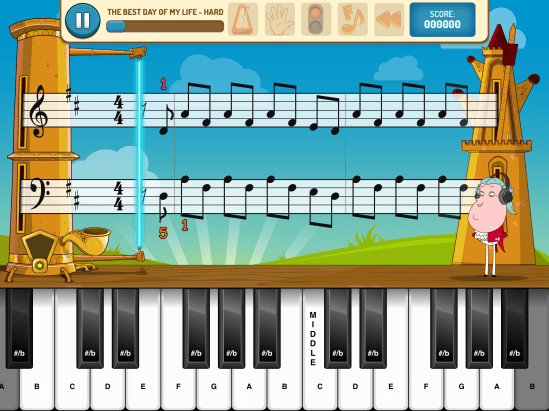
We at JoyTunes want to keep you playing all summer long! To do so we are bringing back Summer Camp in Piano Maestro!

Each week, starting July 1st, we will release a new fun song for you to learn and play. Songs from artists such as

Colbie Caillat

Michael Buble

Florida Georgia Line and more!

Summer Camp songs can be found in the “summer camp” category in the Library.

Prizes will be rewarded to top players, we want to recognize your awesome playing!

Summer Camp is the perfect way to keep your piano practice up during this summer, as to not miss a beat.

The first song of Summer Camp will be Andy Grammer “Honey, I’m good”. Check out the (very cute!) video for the song to get a taste of what to look forward to!

via Summer Camp is Back. New Pop Song Released Each Week! | JoyTunes.

Shocking News for Piano Students: Note Reading Not the Best Way to Learn Piano?

So many piano students would love to be able to just sit down at the piano and play without having to read sheet music. At least, that’s according to pianist/composer Edward Weiss.

Weiss, owner and webmaster of Quiescence Music’s online piano lessons believes anyone can play the piano. And he does it all without note reading.

Weiss explains…

“Most piano students assume they must learn how to read music before they attempt anything creative. Nothing could be further from the truth. In fact, I encourage students to speak the language of music first through chords before learning how to read it.”

This ‘backwards’ approach isn’t really backwards at all according to this teacher. When asked why he teaches piano this way, Weiss says:

“We learn our native language first by speaking it. This is a normal and natural thing. Why not music? Note reading should be the last thing taught. As students become more and more comfortable with ‘speaking the language’ of music, the need to play what other’s have written and produced decreases.”

via Shocking News for Piano Students: Note Reading Not the Best Way to Learn Piano? | PRLog.

Technology is key to piano

Piano-Maestro-End-Game


Piano teacher Leila Viss isn’t only about Bach, Beethoveen and Chopin. For her, it’s also about easing her students into using the iPad application “Piano Maestro.”

Viss, a piano performance and pedagogy graduate of University of Denver, first set up a studio in her home after she graduated in 1990. Ever since, she’s blossomed into a teacher who incorporates a different kind of approach in her lessons.

It all began with her mentor, Elaine Emeigh, who’s a piano teacher in Littleton.

“I wanted to continue her legacy, so I started having labs during my private lessons,” Viss said.

The Centennial resident’s students are now urged to stay for an extra 30 minutes after each lesson to spend time doing something on the computer — whether it be reviewing concepts, studying piano history or reinforcing lessons, she said.

“When I graduated, the Internet was just coming around. Now I have my own website, blog, and my whole idea of how I communicate has completely changed. It was a hassle over the years using technology; you were booting up the computer, putting in a CD-ROM, and then when the iPad came along, it made everything so much easier,” Viss said.

Her book, “The iPad Piano Studios, Keys to Unlocking the Power of Apps,” came out in 2013 and reflects her appetite for using apps to practice note names, inspire creativity and compose with her students. Viss considers herself to be a writer and also contributes to the Clavier Companion, a nationally known premiere piano magazine.

The owners of private applications company, JoyTunes, contacted Viss after reading her blog a year ago.

With more than 4 million users, the company’s apps are a hit, Viss said.

“Joytunes is changing the face of music education by transforming the way people learn music, enabling anyone to play a musical instrument,” JoyTunes head of brand Nadia Hitman said. “By combining music methodologies with the latest in gaming features and instant feedback, the learning process is significantly shortened for millions of children, adults and teachers already using the apps.”

Hitman said all of their applications recently became free for teachers and their students, and many of the apps are still available for purchase to anyone.

“Speaking on their (JoyTunes’) behalf, and mobile technology — Piano Maestro is unbelievably amazing,” Viss said. “You set it up on the piano (doesn’t have to be digital) and choose from like 2,000 songs in the library. You press play and the student follows along with the piano. After that, you get evaluated and receive immediate feedback. You can get up to three gold stars.

via Technology is key to piano | Centennialcitizen.net.

It’s Not Too Late!

music-camp-2015


Pender’s annual summer Music Camp will be held on July 6-10 from 12:30pm-3:30pm. Our theme this year is “The Amazing Grace Race.” Children in rising 2nd through rising 6th grade are invited to participate. Rising 7-12th graders who are interested in volunteering can also sign up online through the Pender UMC website.

The cost is $25 per child, $50 per family (siblings only).

If you have any questions about Music Camp, please contact Theresa Carpenter or Nicole Parrish.

Pianos in harmony with palace halls – ARTS

pianos-Istanbul

The pianos in Istanbul’s Dolmabahçe Palace, which hosted some 1 million people last year, draw great interest from local and foreign visitors for their magnificence and harmony with their surroundings.

National Palace guide Osman Nihat Bişgin said Dolmabahçe Palace was a Tanzimat (reform-era) palace, adding, “All features of the reform era are clearly seen in Dolmabahçe Palace. This process, which we call the Europeanization and westernization process, made western music enter Dolmabahçe Palace.”

He said the palace had a total of 12 pianos, and all of them had ornamentations suitable to the style and harmony of the palace.

Bişgin said the palace opened in 1856 and the pianos were brought there nearly at the same time. “The wives of sultans were taking piano education in the palace, particularly in the final years of the Ottomans. There are many pianos and none of them were inactive; all of them were being played,” he said.

He said most of the piano brands in the palace were Hertz, Pleyel, Gaveau and Erard, and that the number of grand pianos was less.

Speaking of a striking green piano in Zülvecheyn Hall on the upper floor of the palace, Bişgin said it was a classical Pleyel-brand palace piano.

“Since the magnificence and glory was dominant in the palace, the pianos draw our attention visually. Their sound is not very famous, but they are very important and famous visually,” he said.

Bişgin said Zülvecheyn Hall had gilded ornamentation on its white and beige ceiling, adding, “We see enormous harmony between the piano and the ceiling.”

He said the furniture in Dolmabahçe Palace was in its original place, and added, “We can say that the pianos belong to these halls. The pianos in the Zülvecheyn and Süfera halls were designed to add visual richness to halls like them. They are not generally played.”

Crystal piano and chair in the Glass Kiosk

As for the rare crystal piano in the Glass Kiosk, Bişgin said the following: “The Glass Kiosk is a big venue hidden behind the walls of the palace. Mustafa Kemal Atatürk greeted the public in this place. It is like a winter garden surrounded with glass. In harmony with this kiosk, there is a crystal piano. It is a Paris-made Gaveau piano. Its chair is crystal, too.”

Another piano in the palace is a plain black German-made Steinway. Bişgin said its sound was very strong and it was very valuable.

“It was produced as a Hamburg Steinway in 1912. Then the factory moved to the U.S. Accordingly, there were only five Steinway pianos made in Germany. This is one of them. Its estimated price is 200,000 euros. It also has the emblem of the sultan Abdulmecid,” Bişgin added.

Speaking of the piano, which was used during the acceptance of ambassadors in the Süfera Hall, Bişgin said, “Süfera is the plural of the word sefir [ambassador]. This hall was created to address foreigners. The furniture is gold-plated; the ceiling is the same. There is a boulle-work piano here to show the beauty of metal and gold. This piano is wonderful for decoration.”

More pictures at Pianos in harmony with palace halls – ARTS.

Music helps children learn maths – Telegraph

music-math


For tapping out a beat may help children learn difficult fraction concepts, according to new findings due to be published in the journal Educational Studies in Mathematics.

An innovative curriculum uses rhythm to teach fractions at a California school where students in a music-based programme scored significantly higher on math tests than their peers who received regular instruction.”Academic Music” is a hands-on curriculum that uses music notation, clapping, drumming and chanting to introduce third-grade students to fractions.The programme, co-designed by San Francisco State University researchers, addresses one of the most difficult – and important – topics in the elementary mathematics curriculum.”If students don’t understand fractions early on, they often struggle with algebra and mathematical reasoning later in their schooling,” said Susan Courey, assistant professor of special education at San Francisco State University.

via Music helps children learn maths – Telegraph.

Master Chopin By Practicing Just 20 Minutes A Day

Here are 8 bits of wisdom from Play It Again that remind us that it is possible to make time for what matters most in the face of life’s demands and stresses.

Own Your Stress

Rusbridger is completely clear-eyed about just how stressful his job is, and by confronting — rather than denying — the reality of his stress, he’s able to seek out ways to reduce it. Being editor of the Guardian is “one of those jobs which expands infinitely to fill the time and then spill beyond it,” he writes. “An editor, particularly within a modern global media company, is never truly off duty.”

A typical day in the life of a newspaper editor, he writes, means “a hum of low-level stress much of the time, with periodic eruptions of great tension.”

Find Your Metaphor

When Rusbridger felt frustration and self-doubt — which was nearly all the time — he found it helpful to think of people who took on great challenges in different fields. This helped put his own project in perspective, and also let him feel solidarity with others who had taken on great challenges. He compares learning Chopin to climbing the Matterhorn, the forbidding mountain in the Alps.

He writes: “Jerry R. Hobbs, an American computational linguistics expert and amateur climber, described the mountain as ‘just about the hardest climb and ordinary person can do’, which, apropos the G minor Ballade, sounds familiar.”

You’re Not Alone

Rusbridger supplements his piano practice with lots of reading. One book in particular, Arnold Bennett’s 1910 How to Live on 24 Hours a Day, reminds him that the sense of having not enough time to do all we want to do is universal, and not exactly new.

As Bennett writes: “We never shall have any more time. We have, and we have always had, all the time there is.”

There’s Power In A Morning Routine

Rusbridger learns quickly that his daily 20 minutes have to happen in the morning, before the unpredictable demands of work kick in. Here is how he describes his routine:

“I get up half an hour earlier. I fit in ten minutes of yoga listening to the Todayprogramme – not exactly meditative. Then breakfast and the papers with more Today programme all at the same time. Then I slip upstairs to the sitting room to play before driving into work.”

Pursuing Your Passion Is An Investment

Even though his morning piano practice is a solitary activity, he undertakes it knowing that it will have social benefits. After all, when he was a child, his mother told him that playing the piano would help him make friends. She’s right, and he finds her message echoed in the pages of Charles Cooke’s book Playing the Piano for Pleasure: “The better you play, the more your circle of friends will expand. You can count on this as confidently as you can count on the sun rising. Music is a powerful magnet which never fails to attract new, congenial, long-term friends.”

Mortality Is A Good Motivator

When Rusbridger’s former girlfriend gets in touch to tell him that her breast cancer has returned, he finds himself reflecting on mortality, and thinking of other friends more or less his age who are undergoing treatment for various serious diseases. Each brush with illness or mortality strengthens his determination to lean the Ballade. “In terms of getting on with life’s ambitions,” he writes, “I’m hit by more than a tinge of carpe diem.”

“Amateur” Is Not An Insult

Rusbridger has no illusions or intentions about becoming a professional pianist. He’s a dedicated amateur from the start, and his conversations and meetings with other music lovers — both professional and amateur — is a reminder that “amateur” isn’t a value judgment (i.e. worse than a professional), but a worthy end in itself. In fact, it’s probably a good deal more enjoyable and less stressful than being a pro.

In conversation with Rusbridger, the New York Times music critic Michael Kimmelman talks about the perks of being an amateur. “You have another life, it’s a full and interesting life, but you decide to add this life as well because music gives you something that you can’t get from this other life. It isn’t about having a career and making a living from it, it’s about something that only music-making will give you.”


It’s Never Too Late

As he improves and comes closer to learning the entire Ballade, no one is as surprised as Rusbridger himself. “It’s a funny thing to discover about yourself in your mid-50s — that you spent the previous forty years not doing something on the assumption that you couldn’t do it, when all along you could.”

He is astonished to learn, after memorizing complex passages of the Ballade, just how powerful his own memory is. “Back in the summer of 2010 I had no idea of just how capable a 56-year-old brain was of learning new tricks,” he writes. “So it’s heartening to know that, quite well into middle age, the brain is plastic enough to blast open hitherto unused neural pathways and adapt to new and complicated tasks. So, no, it’s not too late.”

From http://www.huffingtonpost.com/2013/10/14/how-alan-rusbridger-edito_n_4080735.html