
Fairfax County has closed school today so…no lessons today due to the snowy weather.
Keep practicing!
Those using Piano Maestro may find a new assignment for today 🙂


Fairfax County has closed school today so…no lessons today due to the snowy weather.
Keep practicing!
Those using Piano Maestro may find a new assignment for today 🙂
These are some examples of pedal marks in piano music:
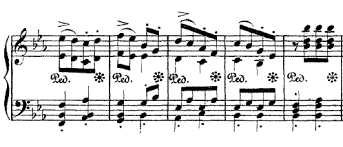
An older style of pedalling. The symbols can be between or below the staves.

This type of pedalling is more commonly used today.

Another type of pedalling
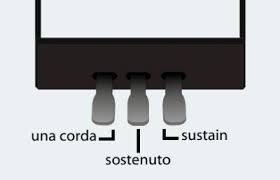
Pedals on a grand piano:

There are two standard foot pedals on the piano: on the left side is the una corda pedal and on the right side is the sustain (damper) pedal.
The middle sostenuto pedal is only standard on the American grand piano, and is very rarely used.
With pedals, the pianist can add resonance and color to the music and thereby bring out its inherent emotion. At the same time, over-pedaling or improper pedaling can drown the listener and the performer in a miasma of overlapping sounds.
Anton Rubinstein, renowned pianist of the late nineteenth century, said that the rightmost pedal is the very soul of the instrument. His book, The Art of Piano Pedaling: Two Classic Guides, is still in print.
This pedal has various names. It is sometimes called the damper pedal (because it lifts all the dampers inside the piano), or the forte pedal (because the result of lifting all the dampers is a fuller sound), or the tre corde pedal (because it allows the three strings of each key to vibrate), or the sustaining pedal (because when you depress it the note will continue to sound even if you take your fingers off the keys).
Here are some guidelines pedaling. As with everything in art, they can be ignored under certain circumstances.
There are several manipulations possible with the damper pedal, each affecting the sound slightly differently.
For the cleanest sound, the syncopated (or legato) pedal will give you the most control. This is an action where the foot is put down immediately after the note is played. This may take some getting used to, but you can practice it by playing a C scale.
The sound is clean. Continue up the scale the same way.
As an experiment, try putting the pedal down as you play a note, and notice the difference in the sound. Since the damper pedal lifts all the dampers, when you strike the D, not only are the three strings of that note free to vibrate but so do all the other strings vibrate sympathetically. You have a sound that is full of overtones.
There are times when you will want that effect and so will keep your foot down until the accumulated sound needs to breathe.
You can practice the syncopated pedal away from the piano by sitting on the bench or a chair and lifting your right knee at exactly the same time as your right hand goes down to tap the rising knee. This is the same action at the keyboard. The foot goes up when the hand goes down and then returns to the pedal.
There are half and quarter pedals too, which are used when you don’t want full vibrato. Rather than depressing the pedal all the way down, you lower your foot halfway so that the dampers are lifted only slightly off the strings, without allowing them to vibrate fully.
The quarter pedal gives even just a hint of pedal. It will take a while to feel these various distances on your piano. Also, you will find that each piano has its own pedal feel, which you must get used to before attempting to perform on that instrument.
Then there are times, usually in scale passages, where touches of pedal can be very appealing and then the foot goes up and down rapidly and shallowly, and that is called the “flutter” pedal.
The different types of damper pedaling techniques are for you, the pianist, to decide. But what determines which choice you will make?
Two things will control that: your very important ear, and your understanding of the music—the composer and the era in which the music was composed.
Your pedaling approach following the composer’s style depends on your knowledge of what instruments were available during the composer’s lifetime and how the pedal or lack of pedals would have made the music sound. This way, your interpretation will have authenticity.
Right pedal
Right foot
Damper pedal, forte pedal, loud pedal
The sustain pedal allows all of the notes on the piano to resonate after the keys have been lifted, for as long as the pedal is depressed. It creates a legato effect, forcing all of the notes to echo and overlap.
The sustain pedal was originally operated by hand, and an assistant was required to operate it until the knee lever was created. The creators of the sustain foot pedal are unknown, but it is believed to have been invented around the mid-1700s.
Use of the sustain was uncommon until the Romantic Period, but is now the most commonly used piano pedal.
The sustain pedal lifts the dampers off of the strings, allowing them to vibrate until the pedal is released.
In piano notation, use of the sustain pedal begins with Ped., and ends with a large asterisk.
Variable pedal marks, seen as __/\_/\__, are placed under notes, and define the precise pattern in which the sustain pedal is depressed and released.
Left pedal
Left foot
Soft pedal, “piano” pedal
The una corda pedal is used to enhance the timbre of softly played notes, and exaggerate a low volume. The soft pedal should be used with notes that are already played softly, and will not produce the desired effect on louder notes.
The una corda was the first mechanism to modify the piano’s sound, and was originally operated by hand. It was invented in 1722 by Bartolomeo Cristofori, and quickly became a standard addition to the piano.
Most treble keys are attached to two or three strings. The una corda shifts the strings so that the hammers only strike one or two of them, creating a softened sound.
Some bass keys are only attached to one string. In this case, the pedal creates a shift so that the hammer strikes on a lesser-used portion of the string.
In piano notation, use of the soft pedal begins with the words una corda (meaning “one string”), and is released by the words tre corde (meaning “three strings”).
Usually the middle pedal, but is often omitted.
Right foot
Tone-sustaining pedal
The sostenuto pedal allows certain notes to be sustained while other notes on the keyboard are unaffected. It is used by hitting the desired notes, then depressing the pedal. The selected notes will resonate until the pedal is released. This way, sustained notes can be heard alongside notes played with a staccato effect.
The sostenuto pedal was the last addition to the modern piano. Boisselot & Sons first showcased it in 1844, but the pedal didn’t gain popularity until Steinway patented it in 1874. Today, it’s primarily found on American grand pianos, but is not considered a standard addition since it is very rarely used.
When the sostenuto pedal is depressed, it keeps the dampers off the selected strings, allowing them to resonate while the rest of the keys’ dampers remain down.
In piano music, use of the sostenuto pedal begins with Sost. Ped., and ends with a large asterisk. Notes meant to be sustained are sometimes marked by hollow, diamond-shaped notes, but there are no strict rules for this pedal since it is hardly ever used.

There’s always time to practice 🙂
NO excuses at your next lesson!

The holiday season is in full swing. The decorations are up, the presents bought (or in the process of being bought) but there’s no reason why our apps can’t get the same love this holiday.
So, without further ado, I’d like to jump into the updates we’ve made to Piano Maestro for you this holiday season!
You’ll be able to impress your friends and family with a bunch of FREE holiday songs to play! We also added some new ones to the mix for our veteran Piano Maestro players.
You’ll find 50 free (yes, free!!) songs in this category from Christmas to Hanukkah and even New Year’s too! We just added Mariah Carey’s “All I want for Christmas is You” (because who doesn’t LOVE that Christmas classic).
Also available is the Christmas staple, “Jingle Bell Rock”.
The only thing missing is the ability for our app to make a strong cup of eggnog! We’ll try and work on that for next Christmas
The free holiday songs can be accessed from two places. As mentioned above, you can get there directly from the “Free Holiday Songs” button on the main menu as well as going to Library -> Songs -> and then choosing the “Free Holiday Songs” category.
Make sure to download the latest update of Piano Maestro.
Learning on your own? Don’t forget to download our free iPhone app, Simply Piano, and learn to play “Jingle Bells” in just 30 minutes!
Adapted from http://www.joytunes.com/blog/featured/piano-maestro-new-holiday-appdates-performance-fixes
Remember that these apps are available at no charge as long as you’re a student at the O’Connor Music Studio

Music theory has never sounded so catchy with this witty remake of the holiday classic The Christmas Song (with apologies to Mel Torme) Try not to laugh at the ending.
Though it is a bit humorous, this version titled ‘Intervals Roasting’, with lyrics by David Rakowski, attempts to encapsulate the fundamentals of music theory in just over two minutes.
It does a good job of explaining the intervals and harmonic structure of the song and also gives you an idea of how to use music theory to analyse or compose music.
The O’Connor Music Studio has a copy if anyone wants to learn this 🙂
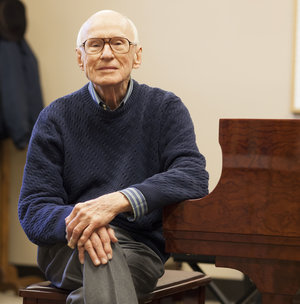
I have always respected Dr. Hinson’s work and his music. So much so that I went to Connecticut to take a class on Piano Pedagogy with him several years ago. I have also attended several local piano teacher workshops with him. At one of them, he claimed to remember me from that Connecticut class. Whether true or not, I treasure that comment and the signature on a piano book he gave me.
We have several of his books at the O’Connor Music Studio and many are available for loan. If you are interested in buying any for yourself, amazon.com has a great selection. In addition to those books he has authored, he has edited the works of many composers. Amazon lists 270 works edited and annotated by Dr. Hinson.
From his page on alfred.com:
One of America’s most respected authorities on piano literature, Dr. Maurice Hinson received the Lifetime Achievement Award from the Music Teachers National Association at its Washington, D.C. convention in the spring of 1994, the Outstanding Alumni Award from the University of Florida in 1990, and the Outstanding Alumni Award from the University of Michigan in the fall of 1995. Hailed as a specialist in American piano music, some of his articles appear in the New Grove Dictionary of American Music in the United States.
Dr. Hinson received his Bachelor of Arts degree from the University of Florida and his Master of Music and Doctor of Musical Arts degrees from the University of Michigan. He also studied at The Juilliard School and the Conservatoire National in Nancy, France.
While a Senior Professor of Piano in the School of Church Music at the Southern Baptist Theological Seminary in Louisville, Kentucky, Dr. Hinson’s curriculum included teaching piano, piano literature, and piano chamber music. He performed, lectured, and gave masterclasses worldwide. His books and editions have become classic standards in the studios of serious piano teachers and students the world over.
From his obituary at legacy.com:
Hinson, Dr. G. Maurice, age 84 died November 11, 2015 in the company of his family. Dr. Hinson was Professor and Senior Professor of Piano at the Southern Baptist Theological Seminary from 1957 to 2015, and a member of Broadway Baptist Church. He was also organist-choirmaster of churches in Florida, Michigan and Kentucky from 1943 to 1980. Dr. Hinson received his BA degree from the University of Florida and his MM and DMA degrees from the University of Michigan, and also studied at The Julliard School and the University of Nancy, France (Conservatoire National).
He was the first president of the Greater Louisville Music Teachers Association, and president of the Kentucky Music Teachers Association as well as the Southern Division of the MTNA. He also taught “The Dorsey Class,” a group of selected piano teachers from 1963 to 2015.
Dr. Hinson is the author of 14 books mostly published by Indiana University Press, plus over 100 articles for music publications. He was a senior editor for The Alfred Publishing Company of California. He edited more than 300 editions of classical piano music and recorded five DVDs of piano music.
As Professor of Piano at the Southern Baptist Theological Seminary for 58 years, he taught and nurtured many pianists who now hold distinguished positions in churches and universities throughout the world.
Dr. Hinson received many awards in piano pedagogy and performance. He was awarded the Liszt Commemorative Medal by the Hungarian Government and the Medal of Excellence by the American Liszt Society for his research on the music of Franz Liszt. He was hailed as a specialist in American Piano music and some of his most recent articles appeared in the NEW GROVE DICTIONARY OF AMERICAN MUSIC. He gave recitals, lectures, and master classes in five continents and 50 states.
Hinson was the founding editor of the JOURNAL OF THE AMERICAN LISZT SOCIETY, past editor of THE AMERICAN MUSIC TEACHER, and contributing editor of THE PIANO QUARTERLY and PIANO AND KEYBOARD.
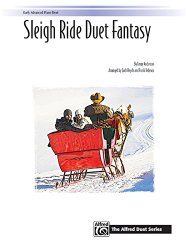
I have loved this version of Sleigh Ride since I first saw it on YouTube:
When I found out it was available in sheet music, I rushed to amazon to buy several copies for myself, my son, my friend, basically everyone I thought could play it.
Lots of fun to play and to hear.
Leroy Anderson’s “Sleigh Ride” is a holiday favorite, and this setting for advanced piano duet gives it a fresh twist. It begins with Anderson’s jingling melody and some musical “banter” between the Primo and Secondo players, and then it launches into a series of variations which take the listener on a journey through a variety of styles—from gently swirling, impressionistic arpeggios to a triumphant coda with brilliant, virtuosic passagework. Audiences will enjoy a number of other musical surprises along the way.
If you want to borrow it, let me know early because someone at the studio may already be playing it!


Who: Kids Ages 3 (must be potty-trained)- 6th Grade
What:“Under Wraps: The Gift We Never Expected”
Where: Pender UMC Christmas VBS
Why: Celebrate Christmas and the Gift of Jesus Christ
When: Saturday, Dec. 5th @ 10 am – 2 pm
Cost: $10 per Kid or $20 total per Family
Join us for Christmas VBS on December 5, 2015 while your parents enjoy the gift of time to prepare for Christmas. We will enjoy music, crafts, lunch, recreation, a story and more!
RSVP: Register online on our website by clicking on this link, beginning November 1st & ending November 30th.

Rebecca Davy paced through her class Saturday, giving instructions to each student sitting at their keyboards.
This was no computer exercise though. “Keep your fingers super glued to those notes. Where’s E? Where’s G? Where’s C?,” she said. “You need to know where your fingers are mentally on the keyboard.”
In Ewell Hall on the College of William and Mary’s campus, Davy has been giving piano lessons to military veterans through a collaboration with the Armed Services Arts Partnership.
The program partners colleges and veterans to help them build communities and fellowships centered around the arts. The program, which is free for veterans whose applications are accepted, provides instruction in courses like writing, stand-up comedy, guitar and piano.
Armed Services Arts Partnership was founded by Sam Pressler, who attended W&M.
Pressler founded the group seeking to use comedy as a way to allow veterans to express themselves after he lost a relative to suicide and learned later about the high rate of suicide among military veterans.
“A single class soon blossomed into communities around writing, music, and comedy, and with such proof of concept and demand, he formed a nonprofit to scale the model to other communities located in areas with high military populations,” said Megan Brew, director of operations for Armed Services Arts Partnership, which is based in Arlington.
“I’ve done so many things. I work with veterans as a transition counselor, and a lot of our soldiers are leaving the service with mental health issues,” said Willie Burston, who attends the piano group. Burston himself is a retired Army veteran.
“Something like this will keep them focused on positive things,” he said. Burston said he also joined the group for a simpler reason. He enjoys singing in church and has aspirations to one day play some of the instrumental music. His favorite songs are hymns such as “Amazing Grace.”
“I came from a family of ministers and pastors and musicians, but I can’t play.”
On Saturday, he sat patiently as Davy taught him the beginning of “The Can-Can” by Jacques Offenbach.
“I heard about this from the VA hospital. My doctor said this would be good for you,” said Anita Jones Chow Yuk, a retired Navy Commander. She had aspirations to learn a musical instrument earlier in life but never received the encouragement she needed.
“I think it’s a great opportunity to help them find a teacher,” Davy said. “I wasn’t about to let the class not happen,” she said.
From http://www.vagazette.com/news/va-vg-jcc-vet-piano-lesson-20151013,0,1449853.story

In town this weekend? I know I will be so the OCMS will be OPEN for piano lessons.
If you’re traveling, I hope you have a wonderful time off and see you next Monday.
Keep practicing!


