From the Washington Post, but we knew this already, right?
Music training not only helps children develop fine motor skills, but aids emotional and behavioral maturation as well, according to a new study, one of the largest to investigate the effects of playing an instrument on brain development.
Using a database produced by the National Institutes of Health Magnetic Resonance (MRI) Study of Normal Brain Development, researchers at the University of Vermont College of Medicine analyzed the brain scans of 232 healthy children ages six to 18 specifically looking at brain development in children who play a musical instrument. (The original study did not indicate specific instruments.)
“What we found was the more a child trained on an instrument,” said James Hudziak, a professor of psychiatry at the University of Vermont and director of the Vermont Center for Children, Youth and Families, “it accelerated cortical organization in attention skill, anxiety management and emotional control.”
Show your support for revitalizing music education!
Join the 1st worldwide virtual recital celebrating Mozart’s birthday on January 27th.
“Putting Mozart on the Map” marks the 1st event in a new global campaign to inspire and engage music students by coupling classical music with today’s technology, and honoring Mozart in a way that’s never been done before.
Every musician – concert pianist or 2nd-grader – playing a score on the Wolfie app on January 27th will automatically appear on an interactive world map at, www.wolfiepiano.com. Invite your friends, teachers, and music students!
What’s Wolfie?
Wolfie is the premier music education platform for teachers and students worldwide. The Wolfie for piano app is powered by a magic cursor that listens as you play, keeping track of your tempo, time, errors and more, and turns the pages at exactly the right moment. With its catalog of thousands of songs, Wolfie allows teachers and students to easily share annotations, record and review performances, and hear scores at different paces – with no need for carrying around sheet music.
The second semester of Fun With Music will meet every Monday from 10-11:30 am in the Gathering Place of Pender United Methodist Church at 12401 Alder Woods Drive Fairfax, VA 22033.
This program is for moms and dads with their children ages 0 to 5. A fee of $30 covers the cost of food and supplies for the semester.
Each week there is 30 minutes of singing, a snack and toys are brought out for the children to play. The parents are served a breakfast and have the opportunity to fellowship with each other.
Music theory has never sounded so catchy with this witty remake of the holiday classic The Christmas Song (with apologies to Mel Torme) Try not to laugh at the ending.
Though it is a bit humorous, this version titled ‘Intervals Roasting’, with lyrics by David Rakowski, attempts to encapsulate the fundamentals of music theory in just over two minutes.
It does a good job of explaining the intervals and harmonic structure of the song and also gives you an idea of how to use music theory to analyze or compose music.
The O’Connor Music Studio has a copy if anyone wants to learn this 🙂
I have purchased a set of Christmas Shades of Sound Listening & Coloring Book for the studio.
Please let me know if you do not want your student to participate in Christmas activities and I will assign alternate activities.
Each week, I will print out some of the pages for your student and put them in his/her notebook. After listening to the music on YouTube, the student may color the pages.
After they are colored, please return them to the notebook so that there will be a complete book when finished.
If you are an adult and want to listen and color, too, just let me know and I’ll print you a set.
Get your piano students listening to great classical music!
The Shades of Sound Listening and Coloring Books are a great way to encourage students to listen to great piano and orchestral repertoire. Students of all ages will love coloring the fun pictures while listening to and learning from the music of the great composers.
This Shades of Sound Christmas edition includes 20 pieces of piano and orchestral literature for the Christmas season, from the Baroque to the Modern period. Includes background and historical information on the pieces and the composers, and a beautiful coloring page for each piece.
The Christmas Shades of Sound book includes 20 different pieces, including:
In Dulci Jubilo from the Christmas Tree Suite by Liszt
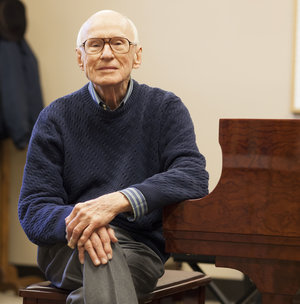
I have always respected Dr. Hinson’s work and his music. So much so that I went to Connecticut to take a class on Piano Pedagogy with him several years ago. I have also attended several local piano teacher workshops with him. At one of them, he claimed to remember me from that Connecticut class. Whether true or not, I treasure that comment and the signature on a piano book he gave me.
We have several of his books at the O’Connor Music Studio and many are available for loan. If you are interested in buying any for yourself, amazon.com has a great selection. In addition to those books he has authored, he has edited the works of many composers. Amazon lists 270 works edited and annotated by Dr. Hinson.
One of America’s most respected authorities on piano literature, Dr. Maurice Hinson received the Lifetime Achievement Award from the Music Teachers National Association at its Washington, D.C. convention in the spring of 1994, the Outstanding Alumni Award from the University of Florida in 1990, and the Outstanding Alumni Award from the University of Michigan in the fall of 1995. Hailed as a specialist in American piano music, some of his articles appear in the New Grove Dictionary of American Music in the United States.
Dr. Hinson received his Bachelor of Arts degree from the University of Florida and his Master of Music and Doctor of Musical Arts degrees from the University of Michigan. He also studied at The Juilliard School and the Conservatoire National in Nancy, France.
While a Senior Professor of Piano in the School of Church Music at the Southern Baptist Theological Seminary in Louisville, Kentucky, Dr. Hinson’s curriculum included teaching piano, piano literature, and piano chamber music. He performed, lectured, and gave masterclasses worldwide. His books and editions have become classic standards in the studios of serious piano teachers and students the world over.
Hinson, Dr. G. Maurice, age 84 died November 11, 2015 in the company of his family. Dr. Hinson was Professor and Senior Professor of Piano at the Southern Baptist Theological Seminary from 1957 to 2015, and a member of Broadway Baptist Church. He was also organist-choirmaster of churches in Florida, Michigan and Kentucky from 1943 to 1980. Dr. Hinson received his BA degree from the University of Florida and his MM and DMA degrees from the University of Michigan, and also studied at The Julliard School and the University of Nancy, France (Conservatoire National).
He was the first president of the Greater Louisville Music Teachers Association, and president of the Kentucky Music Teachers Association as well as the Southern Division of the MTNA. He also taught “The Dorsey Class,” a group of selected piano teachers from 1963 to 2015.
Dr. Hinson is the author of 14 books mostly published by Indiana University Press, plus over 100 articles for music publications. He was a senior editor for The Alfred Publishing Company of California. He edited more than 300 editions of classical piano music and recorded five DVDs of piano music.
As Professor of Piano at the Southern Baptist Theological Seminary for 58 years, he taught and nurtured many pianists who now hold distinguished positions in churches and universities throughout the world.
Dr. Hinson received many awards in piano pedagogy and performance. He was awarded the Liszt Commemorative Medal by the Hungarian Government and the Medal of Excellence by the American Liszt Society for his research on the music of Franz Liszt. He was hailed as a specialist in American Piano music and some of his most recent articles appeared in the NEW GROVE DICTIONARY OF AMERICAN MUSIC. He gave recitals, lectures, and master classes in five continents and 50 states.
Hinson was the founding editor of the JOURNAL OF THE AMERICAN LISZT SOCIETY, past editor of THE AMERICAN MUSIC TEACHER, and contributing editor of THE PIANO QUARTERLY and PIANO AND KEYBOARD.
The Funeral March of a Marionette (Marche funèbre d’une marionnette) is a short piece by Charles Gounod. It was written in 1872 for solo piano and orchestrated in 1879. It is perhaps best known as the theme music for the television program Alfred Hitchcock Presents, which originally aired from 1955 to 1965.
In 1871-72, while residing in London, Gounod started to write a suite for piano called “Suite Burlesque”. After completing one movement, the Funeral March of a Marionette, he abandoned the suite and had the single movement published by Goddard & Co. In 1879 he orchestrated the piece. The instrumentation is: piccolo, flute, 2 oboes, 2 clarinets in A, 2 bassoons, 2 horns in D, 2 trumpets in A, 3 trombones, ophicleide, timpani, bass drum, triangle, strings. The work is in the key of D minor, with a central section in D major. Various arrangements by other hands exist.
There is a program underlying the Funeral March of a Marionette: The Marionette has died in a duel. The funeral procession commences (D minor). A central section (D Major) depicts the mourners taking refreshments, before returning to the funeral march (D minor).
The score contains the following inscriptions in appropriate places:
La Marionnette est cassée!!! (The Marionette is broken!!!)
Murmure de regrets de la troupe (Murmurs of regret from the troupe)
Le Cortège (The Procession)
Ici plusieurs des principaux personnages de la troupe s’arrêtent pour sa rafrâichir (Here many of the principal personages stop for refreshments)
Retour a la maison (Return to the house). (Wikipedia)
Download this music in several versions from IMSLP. Click on Arrangements and Transcriptions. There are also some arrangements for piano at the O’Connor Music Studio, including an advanced level. This is arranged for three levels starting with very easy piano in Piano Maestro.
On Alfred Hitchcock:
From Faber Piano Adventures Performance Book Level 3B No.7 (Also available in the OCMS Library):
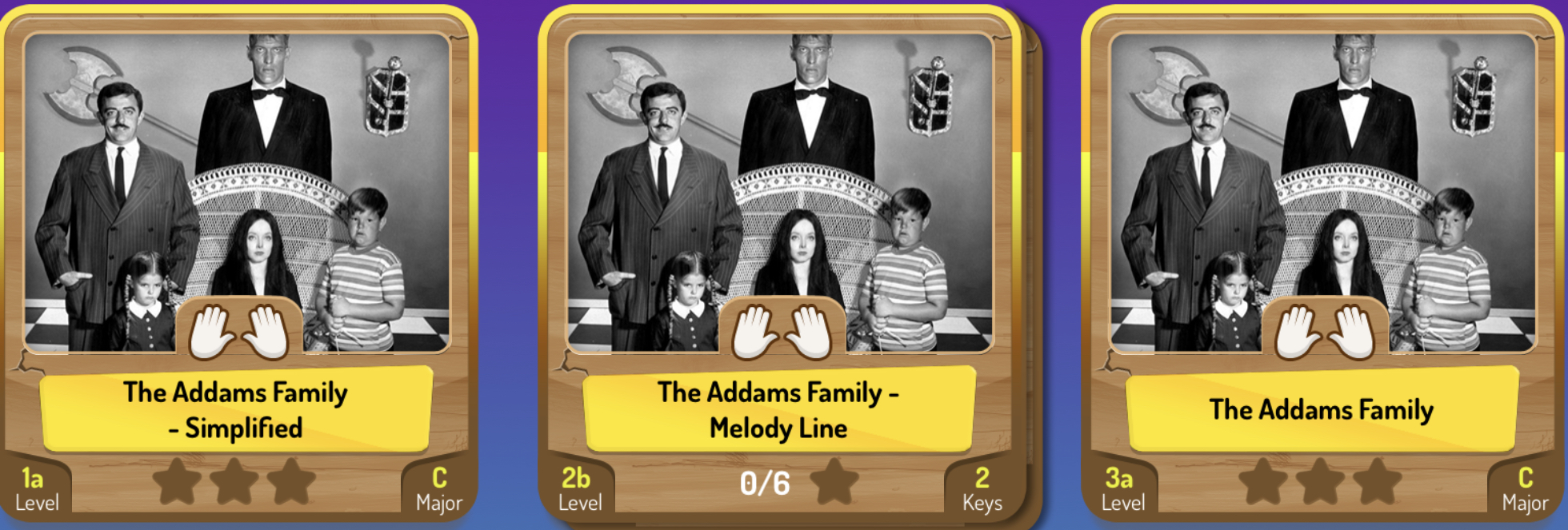
Students always find this piece fun with its finger snaps. There are three versions in Piano Maestro and it’s in several piano books including Halloween Songbook (Easy Piano). There was a a new Addams Family animated movie out in 2019, so your students are going to be snapping all over the place when this Halloween rolls around.







 MaryO'Studio
