Vivaldi, one of the greatest baroque composers, has a very interesting story. He ran an orphanage in the 18th century in Italy that became famous all over the western world for its musically talented children. A lot of his pieces were written for specific children in his school. Vivaldi learned the violin from his father, and was trained as a priest. He was nicknamed “the red priest” for his red hair and was apparently somewhat sure of himself, having claimed once he can compose a concerto faster than it can be copied.
Vivaldi wrote over 500 pieces, most of which are lost today. He is considered one of the greatest musical landmarks in history, having inspired many composers that followed him, including J.S.Bach and others.
These days, there is much pressure for parents to begin their children in activities from an early age. We know that children tend to pick up new skills easily and we want for them to have an opportunity to become experts at these new skills. We also see curiosity, desire and eagerness to learn in our children and want to capitalize on that.
Music lessons are no exception. We often get calls asking the question, “When is the best time to enroll my child in piano lessons?” The answer to that is a tricky one, and varies for each child. The right age for one may not be the right age for another. Here are a few questions to ask yourself if you are considering enrolling your child in music lessons:
1. Does my child have an attention span to sit still for chunks of time and listen to instruction?
Many teachers today are very creative in using off-bench activities during lessons and have a plethora of activities to make lessons fun and engaging. However, the fact remains that your child will need to sit at the piano for some periods of time during the lesson. It is important that your child have the attention span to do this.
It will be fun watching your child improve their piano skills all while having fun using Piano Maestro in lessons each week!
As your child’s teacher (or YOUR teacher!), I’m looking forward to seeing the progress they will make when they start using it at home each day. This guide will help you understand how this app will benefit your child and how to get it set up on your own iPad.
Overview What is Piano Maestro?
Piano Maestro is the ultimate piano practice tool that will have students quickly playing their favorite classical, pop, rock, TV and video game songs and themes. It is available in the App Store and works on the iPad.
What skills does it improve?
• Note reading
• Sight reading
• Rhythm
• Inner pulse
• Confidence
What makes it so fun?
• Upbeat background tracks
• Stunning graphics
• Instant rewards and feedback
• Satisfaction of playing REAL music
It works with an acoustic piano?
Yes! Your child practices on your real acoustic or digital piano. Piano Maestro listens from the iPad’s built-in microphone. No wires needed.
I’m already paying for lessons. What value does this add?
Sometimes I wish I could be there with your child to encourage them to keep practicing daily. I’m sure it’s not always easy, as unforeseen challenges will arise.
Since our time each week is just too short, this app will give me eyes on the ground and it will keep them practicing longer and improving more quickly.
How will it be used in lessons?
I will spend a few minutes of each lesson helping your child master a couple of new songs all while having fun! I will also teach them how to use the practice options at home.
At the end of the lesson, we will choose Home Challenge assignments within the app that will show up in your account at home. I’ll get updates when progress is made.
Getting Started
Wow, this sounds awesome. Now, how do I get started?
1) Download Piano Maestro on your iPad from the AppStore
2) Create a JoyTunes account with a parent’s email, under which, you can have multiple profiles for each member of the family.
3) Create a profile for each family member (that means you too Mom and Dad!) inside the Parent/Teacher zone (top right-hand corner of the main screen)
4) Connect to your teacher, me! After creating a profile in the “profiles” tab of the parent/teacher zone, select the student’s profile and click “connect to teacher.” Once I approve the connection to your child, they will receive full access to all content for FREE! I will then also begin receiving weekly progress reports.
5) Start Playing – I will now start assigning you homework, meanwhile, get started on Journey Mode.
When you connect to the O’Connor Music Studio, Piano Maestro is free for as long as you study here.
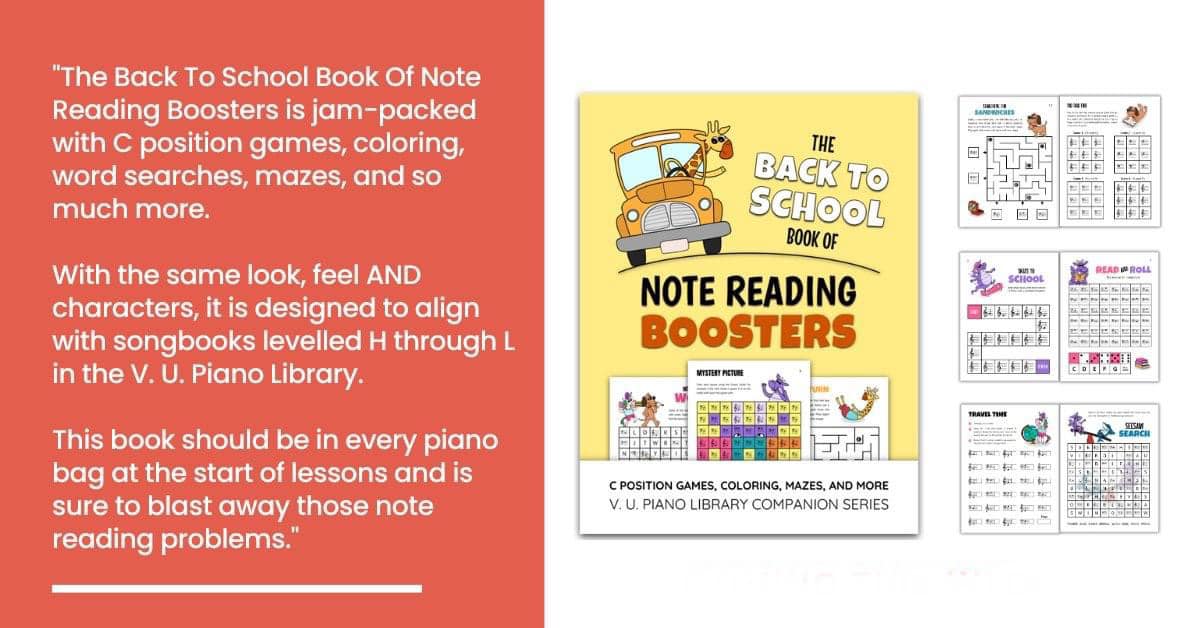
Some students will be getting this new book the first lesson this fall. With The Back To School Book Of Note Reading Boosters, you and your students have a jam-packed resource that can be used at home for extra practice or during lessons for off-the-bench activities.
Inside your students will discover back-to-school-themed mazes, color-it mystery pictures, word searches, pattern play, dot-to-dot journeys, tic tac toe, and board games; all designed to reinforce note reading in C position.
In addition, the book includes a build-your-own note printing solo, a mix and match sight reading solo, and a make-a-motive composing solo.
This year, show students just how fun note reading can be with The Back To School Book Of Note Reading Boosters.
Let’s face it. Most kids don’t want to practice the piano. And if they do find the time to practice, it’s usually because their parent kept nagging them. How frustrating!
Piano teachers are frustrated too. It’s nearly impossible to teach students new concepts when they don’t understand the old ones–all because of a lack of practice.
If you’re a parent in this situation, I have just the solution you’re looking for.
In this upbeat book, I share all the tips I’ve discovered in my 14 years of teaching piano. You’ll learn fun, practical ways to get your kids to the keyboard.
But this easy-to-read guide goes one step further. I’ll show you simple ways to encourage better quality practice. Even if you’ve never had a music lesson in your life!
I wrote this book for kids of all ages. There are creative ideas for elementary students and also a section for teens.
There’s even a section for what to do if your child wants to stop taking piano lessons. That’s right, there is hope and my book will show you exactly how to get them interested in piano again.
Don’t be the kind of parent who sits on the sidelines waiting until their child wants to practice. Piano lessons are too expensive for you to let another “no-practice” day go by.
This book is your answer to get your child to the keyboard, have good quality practice and develop a life-long love of music.
1. When choosing a location for your piano, select a space that is lived-in, welcoming, and well-lit. Keep it close to “the action” but not in the action. Your children will gravitate to the piano more often if it is in a central place in your home. Avoid bedrooms, basements and other “put away” places. Feeling shut-off from the family while practicing will inevitably lead to a reluctance to spend time on the piano.
While choosing an appropriate space, also consider the noise factor; not only from the piano, but also from your family’s day-to-day activities. Your children want to be close by, but not competing with noise from TV’s, dishwashers and washing machines.
2. Make the space warm and welcoming. Your children will be encouraged to spend upwards of 30 minutes every day in this space. Is it a happy place to be for this amount of time? Small adjustments to lighting and heating can make a world of difference. Seek out places with natural light and ensure it is a cheerful and welcoming space that will encourage your child to visit the piano often for their own enjoyment.
3. Ensure your children have all required materials at hand. Help your children put together a small basket or bin of everything they may need for home practice. Pens, pencils, highlighters, and post-it notes will give your children a sense of organization that will then spill over into their practice habits. Your children will also need adequate lighting to see their music, and a comfortable bench at the correct height to practice comfortably and correctly.
4. Make the “Practice Nest” a communal space. Children of any age appreciate company while they practice. Having a chair, couch, beanbag chair or pillows nearby where family members will be inclined to sit, listen and enjoy the music immediately sets the tone for happy time on the piano. Encourage siblings to stop by and listen quietly, and allow yourself even just 10 minutes to sit and listen with undivided attention each time your children practice. A setup that is conducive to including the family in home practice will encourage everyone involved to make piano practice an activity the entire family can be a part of.
5. Set the stage for organization. Ensure your children’s practice space is uncluttered and organized. Clear out old sheet music and books from the piano bench, use a magazine organizer to hold current and favorite materials, and minimize knickknacks and other distractions from the top of the piano. If you can, avoid having the piano room do “double-duty” for laundry, toys and other clutter. Having the books your children need at their fingertips reliably ensures that no time is spent searching for lost or crumpled music. Get into the habit of placing the piano books in their appropriate space immediately after each piano lesson so they are ready and waiting.
Plus one more! Adding small surprises to your children’s practice nest (fresh flowers, a hand-written note of encouragement, a small treat, a new sticker pad, a special pen etc.) helps to show that you value the time they are spending on the piano and that you appreciate their efforts and dedication. Preserving the “specialness” of their practice space encourages positive feelings towards their home music time.
When my students are first working with the Grand Staff, they are often confused about the placement of the various clefs.
In piano music, we generally use only the G-clef (Treble clef – not “trouble clef” as some think!) and the F-clef (Bass clef) I try to show students how the curvy part of the G-clef wraps around the G above middle C and the F-clef looks sort of like an F marking the F below middle C. I draw out G and F on the staff to show how these could have looked.
Originally, instead of a special clef symbol, the reference line of the staff was simply labeled with the name of the note it was intended to bear: F and C and, more rarely, G. These were the most often-used ‘clefs’ in Gregorian chant notation. Gregorian chant developed mainly in western and central Europe during the 9th and 10th centuries, with later additions and redactions.
Over time the shapes of these letters became stylized, leading to their current versions.
Student books in 6 different categories are available now in both digital and hardcopy. There is now “To the Lake”, “Outdoor Adventure”, “To the Farm”, “Country Carnival” and two levels of “Rockstar Rally”.
Ideal for students ages 4 and up.
On the staff from the start
Music is a mix of familiar tunes and original pieces
Multi-key approach
18 songs that can be learned by note or rote
Clean easy-to-follow pages (great for special needs students!)
Two levels of Roadtrip! are currently available in Piano Maestro.
Register for Roadtrip! Students (ages 4-5) are scheduled for half-hour lessons with their parents present.