
|

|
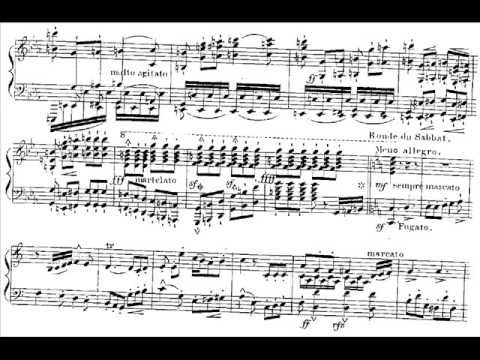
The final movement is the best known part of the symphony, thanks to its use in the Julia Roberts movie, Sleeping With The Enemy. It features a four-part structure, which Berlioz described in his own program notes from 1845 as follows:
“He sees himself at a witches’ Sabbath, in the midst of a hideous gathering of shades, sorcerers and monsters of every kind who have come together for his funeral. Strange sounds, groans, outbursts of laughter; distant shouts which seem to be answered by more shouts. The beloved melody appears once more, but has now lost its noble and shy character; it is now no more than a vulgar dance tune, trivial and grotesque: it is she who is coming to the Sabbath… Roar of delight at her arrival… She joins the diabolical orgy… The funeral knell tolls, burlesque parody of the Dies irae, the dance of the witches. The dance of the witches combined with the Dies irae.”
The Dies irae melody is one of the most-quoted in musical literature, appearing in the works of many diverse composers.
The traditional Gregorian melody has also been used as a theme or musical quotation in a number of classical compositions, notable among them:
Free sheet music from IMSLP for the basic Dies irae
Free sheet music from IMSLP for the basic Symphonie fantastique (look under Arrangements and Transcriptions)
The basic Gregorian Chant
An animated version of the Dreams of a Witches’ Sabbath from Symphonie fantastique. Can you hear the Dies irae in this? It starts around 3:18.
Leonard Bernstein conducts the “Orchestre National de France” in Berlioz’s Symphonie Fantastique
5th Movement

From October 5, 2010
There will be $1.6 million worth of piano on stage at the City Recital Hall on Friday night. With their legs and lids removed for transport, eight Steinway grand pianos will be trucked to the venue.
There they will be reassembled on stage and tuned, ready for eight of Australia’s finest classical pianists.
In The Steinway Spectacular 16 hands and 80 fingers will play some of classical music’s greatest hits.
Conducted by Guy Noble, the pianists will work as an ensemble to perform works by composers such as Ravel, Saint-Saens and George Gershwin. ”It’s a very large affair,” says Noble. ”Logistically, it’s a nightmare.” The piano technician Ara Vartoukian will spend hours tuning the instruments.
For past concerts in Melbourne the process sometimes took all night. ”The pianos all, in essence, sound the same, so they have to be absolutely in tune with each other.”
Even after the most careful tuning, things can go awry.
The pianists – Anthony Halliday, Roger Heagney, Clemens Leske, Tamara Smolyar, Mikhail Solovei, Evgeny Ukhanov, Gerard Willems and Alexey Yemtsov – usually perform as soloists. Every now and again, Noble says, one of them ”goes rogue”.
”One will suddenly break out and play their own thing,” he says. ”I have to herd them back into the pride, glaring at them with eyes of death. It’s one of the hardest things I’ve ever had to conduct. It’s like herding cats.”
There is no repertoire for an ensemble of pianists, so Noble has created new arrangements.
His favourite is a rendition of the children’s staple Chopsticks. ”That just goes wild,” he says.
The segment titled So You Think You Can Play Scales is also a crowd pleaser. ”It’s like Piano Idol. People get voted off if they go off the rails.”
Other pieces will feature the organist Calvin Bowman and the soprano Shu-Cheen Yu. Bowman, who usually plays above the stage in a loft, will join the other performers on stage on an electronic organ.
”It’s a relief for him to be down on stage because he suffers terribly from vertigo,” Noble says. ”He’s been terrified in organ lofts all over Australia.”
More boisterous extravaganza than a recital for purists, the performance will appeal to an eclectic crowd.
”We get classical music lovers, as well as people who are just curious. It’s pure fun and enjoyment.”
The Steinway Spectacular is at the City Recital Hall on Friday.
From http://www.smh.com.au/entertainment/music/a-piano-spectacular-for-80-fingers-20101004-164ac.html
Try to find an American Fotoplayer!

The American Fotoplayer is a type of photoplayer developed by the American Fotoplayer Company between the years of 1912 and 1925. The Fotoplayer is a type of player piano specifically developed to provide music and sound effects for silent movies.
…
The appeal of the Fotoplayer to theatre owners was the fact that it took no musical skill to operate. The Fotoplayer would play the piano and pipe organ mechanically using an electric motor, an air pump, and piano rolls while the user of the Fotoplayer would follow the onscreen action while pulling cords, pushing buttons, and pressing pedals to produce relatable sounds to what was occurring onscreen. These actions could create sounds such as a steamboat whistle, a bird chirp, wind, thunder, a telephone bell, as well as many others. On Fotoplayers specifically, most effects were created using leather cords with wooden handles on the ends which the effects were directly connected to. For example, the steamboat whistle sound effect was created using a household bellows with a whistle at the end. Pulling the cord compressed the bellows, delivering a gust of air into the whistle. Creating a drum roll on the other hand was a bit more complicated. A clockwork device was needed to time the strikes of the drum which required constant winding.
Adapted from https://en.wikipedia.org/wiki/The_American_Fotoplayer

Pianist and composer Sonya Belousova celebrated 30 years of Super Mario Bros. with an epic piano medley on the world’s coolest piano.
YouTube channel Player Piano had Belousova play the tribute to the late Nintendo president Satoru Iwata on a piano styled after a classic Nintendo Entertainment System. While the medley is good, it’s the amazingly detailed piano that stands out.
The bench looks like a Nintendo controller, while the piano itself is modeled after the console. It comes complete with power and reset buttons as well as connection cords. The flip top door can cover the keys, which Belousova appropriately takes the time to blow on at the end!
From http://www.dailydot.com/geek/nintendo-super-mario-bros-player-piano/
Steinway Place, Queens, New York, 11105. steinway.com or 718-721-2600.
It all begins with bare wood, rough and fragrant.
Skilled craftsmen then use muscle, fine motor skills and magic to transform simple planks into magnificent instruments. In the bridge-notching process, the “bellymen” use tools they’ve constructed themselves, the better to execute this highly skilled operation.
Alaskan Sitka Spruce becomes a soundboard, with ribs of Sugar Pine.
Eighty-eight keys, 88 hammers, more than 230 strings — all are carefully created, installed and tested in every piano.
All in all, it takes about 11 months to make a Steinway grand piano.
Steinway & Sons has been located in the same spot in the Astoria section of Queens since the early 1870s. Founded in 1853 in a loft on Varick Street in Manhattan, the company’s reputation grew quickly, and the company needed space to expand their operations.
Factory tours are offered from September through the end of June. (Factory tours are not available in July and August.) Tours are scheduled from 9:30 a.m. to noon on Tuesdays, for a maximum of 15 people.
Needless to say, tours fill up quickly and must be booked in advance. Steinway currently has no openings for the rest of 2017 and is not yet taking reservations for 2018. Plan way ahead, and check for updates by emailing tours@steinway.com or by calling 718-721-2600.
Adapted from http://www.app.com/story/entertainment/events/2017/08/18/factory-tours-made-usa/530543001/
Mary and Michael playing in the original Steinway Hall

In Piano Maestro – the Pokemon Theme!
You can find it in the TV & Game Theme’s category in 3 different versions (Easy, Melody Line and 2 Hands version)
Enjoy!

Picture a seven-foot grand piano in a studio. The lid’s missing, so you can see all the strings. Researchers suspend a rod embedded with 32 microphones over the piano’s body.
“We played this middle C at a very soft level, a medium level, and a very loud level,” says Agnieszka Roginska, a professor in NYU’s music technology program. She says using a pianist to play middle C over and over wouldn’t be scientific. So they’re using a disklavier, a fancy player piano triggered by electronics. “So we could hit the same note, with the same velocity, thousands of times,” she says.
They’d record the piano in one spot. Then move the microphones eight inches. Record the note. Move the mics again. Record the note. Over and over and over, until they reach the back of the piano. At the end, they get “what is basically a very dense acoustical scan of the radiation pattern of the grand piano,” Roginska says.
Read the entire article here: http://www.pri.org/stories/2014-08-10/science-tries-understand-what-gives-piano-its-voice

Today’s Listening Assignment is Country Gardens by Percy Grainger.

“Country Gardens” is an English folk tune collected by Cecil Sharp from the playing of William Kimber and arranged for piano in 1918 by Percy Grainger.
The tune and the Grainger arrangement for piano and orchestra is a favorite with school orchestras, and other performances of the work include morris dancing.
A piano version:
Piano duet (four-hands)
Clarinet solo
Orchestra
From the Muppets
And, how a Morris Dance is done:
Find Country Gardens on IMSLP, Piano Maestro (under the method book section) and Piano Pronto: Movement 2

Each year on May 22 we observe National Buy a Musical Instrument Day. The day is all about playing music. If you are a musician, it might be time for a new instrument. Maybe you can learn to play a second or third one. If you have never played an instrument before, National Buy A Musical Instrument Day might be the motivation you need to start.
Naturally, here at the O’Connor Music Studio, a piano, keyboard with weighted keys (and 88 of them!) or organ is recommended but this day is for all types of instruments and is for people of all ages. Grandpa can play his ukulele while the grandkids play the drums, trombone, and flute. Together they can all make terrific music!
Adapted from http://www.nationaldaycalendar.com/national-buy-a-musical-instrument-day-may-22/

 MaryO'Studio