Pianist and composer Sonya Belousova celebrated 30 years of Super Mario Bros. with an epic piano medley on the world’s coolest piano.
YouTube channel Player Piano had Belousova play the tribute to the late Nintendo president Satoru Iwata on a piano styled after a classic Nintendo Entertainment System. While the medley is good, it’s the amazingly detailed piano that stands out.
The bench looks like a Nintendo controller, while the piano itself is modeled after the console. It comes complete with power and reset buttons as well as connection cords. The flip top door can cover the keys, which Belousova appropriately takes the time to blow on at the end!
The American Fotoplayer is a type of photoplayer developed by the American Fotoplayer Company between the years of 1912 and 1925. The Fotoplayer is a type of player piano specifically developed to provide music and sound effects for silent movies.
…
The appeal of the Fotoplayer to theatre owners was the fact that it took no musical skill to operate. The Fotoplayer would play the piano and pipe organ mechanically using an electric motor, an air pump, and piano rolls while the user of the Fotoplayer would follow the onscreen action while pulling cords, pushing buttons, and pressing pedals to produce relatable sounds to what was occurring onscreen. These actions could create sounds such as a steamboat whistle, a bird chirp, wind, thunder, a telephone bell, as well as many others. On Fotoplayers specifically, most effects were created using leather cords with wooden handles on the ends which the effects were directly connected to. For example, the steamboat whistle sound effect was created using a household bellows with a whistle at the end. Pulling the cord compressed the bellows, delivering a gust of air into the whistle. Creating a drum roll on the other hand was a bit more complicated. A clockwork device was needed to time the strikes of the drum which required constant winding.
What’s so neat about the Wing and Sons Piano? Check out the five (yes, 5!) pedals. Most pianos have 3, or sometimes 2 pedals.
Established in 1868, the Wing & Son Piano Company quickly became a masterclass in innovative marketing! Originally launched as Doan, Wing & Cushing, the company manufactured the usual square grand and upright pianos like many of its competitors. But in 1873, when Frank L. Wing took the reins and incorporated the business as Wing & Son Piano Company, things started to change – and fast!
Frank L. Wing believed that a piano should be more than just an instrument; it should bring the richness of an entire orchestra into the home. To fulfill this vision, Wing & Son introduced an exciting innovation: the 5-pedal mechanism. Unlike standard pianos, these pedals could imitate the sounds of various string instruments, including the mandolin, guitar, zither, harp, and banjo. This feature gave their pianos an edge, allowing players to explore new musical depths. The pedals, labeled Mandolin, Orchestra, Expression, Soft, and Forte, made these instruments a hit with musicians who wanted more than just a standard piano sound.
But it wasn’t just the piano’s features that made Wing & Son stand out—it was Frank Wing’s marketing genius. Rather than relying on expensive showrooms or high-pressure sales tactics, Wing & Son took a unique approach. They published beautifully illustrated catalogs titled “The Book of Complete Information About Pianos.” These catalogs were designed to educate the average person on how pianos were made, demystifying the manufacturing process. Once the reader felt like a piano expert, the catalogs skillfully highlighted why Wing & Son pianos were superior. This soft-sell strategy worked wonders!
By selling directly from these lavish catalogs, Wing & Son eliminated the need for showrooms, keeping their prices competitive. They also offered free trials and flexible financing, making their pianos accessible to a broader audience—especially in rural areas, where the nearest piano showroom was often miles away.
Unfortunately, like many businesses, Wing & Son couldn’t withstand the economic downturn of the Great Depression, and by 1931, the company seemed to have faded away. But for decades, Wing & Son was at the forefront of both piano innovation and clever marketing, proving that a little creativity can go a long way in making a business sing.
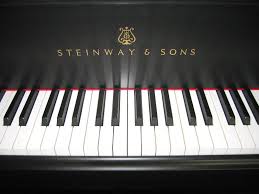
Steinway Place, Queens, New York, 11105. steinway.com or 718-721-2600.
It all begins with bare wood, rough and fragrant.
Skilled craftsmen then use muscle, fine motor skills and magic to transform simple planks into magnificent instruments. In the bridge-notching process, the “bellymen” use tools they’ve constructed themselves, the better to execute this highly skilled operation.
Alaskan Sitka Spruce becomes a soundboard, with ribs of Sugar Pine.
Eighty-eight keys, 88 hammers, more than 230 strings — all are carefully created, installed and tested in every piano.
All in all, it takes about 11 months to make a Steinway grand piano.
Steinway & Sons has been located in the same spot in the Astoria section of Queens since the early 1870s. Founded in 1853 in a loft on Varick Street in Manhattan, the company’s reputation grew quickly, and the company needed space to expand their operations.
Factory tours are offered from September through the end of June. (Factory tours are not available in July and August.) Tours are scheduled from 9:30 a.m. to noon on Tuesdays, for a maximum of 15 people.
Needless to say, tours fill up quickly and must be booked in advance. Steinway currently has no openings for the rest of 2017 and is not yet taking reservations for 2018. Plan way ahead, and check for updates by emailing tours@steinway.com or by calling 718-721-2600.
Picture a seven-foot grand piano in a studio. The lid’s missing, so you can see all the strings. Researchers suspend a rod embedded with 32 microphones over the piano’s body.
“We played this middle C at a very soft level, a medium level, and a very loud level,” says Agnieszka Roginska, a professor in NYU’s music technology program. She says using a pianist to play middle C over and over wouldn’t be scientific. So they’re using a disklavier, a fancy player piano triggered by electronics. “So we could hit the same note, with the same velocity, thousands of times,” she says.
They’d record the piano in one spot. Then move the microphones eight inches. Record the note. Move the mics again. Record the note. Over and over and over, until they reach the back of the piano. At the end, they get “what is basically a very dense acoustical scan of the radiation pattern of the grand piano,” Roginska says.
Life very often throws some curious coincidences my way. Just as I was preparing a presentation for architecture students at the Goa College of Architecture on ‘Architecture and Music’ and looking at the relationship of the Fibonacci sequence to music, what should appear in my newsfeed but the announcement of the famed piano firm Steinway and Sons unveiling its 600,000th piano, incorporating the iconic Fibonacci spiral in its design.
The veneer of the “Fibonacci” piano features the eponymous spiral made from six individual logs of Macassar Ebony, “creating a fluid design that represents the geometric harmony found in nature.”
In the words of designer Frank Pollaro, who spent over 6000 work-hours over four years in its creation: “Designing Steinway & Sons’ 600,000th piano was an honour and a challenge. To me, knowing that this piano would become part of history meant that it had to be more than just a beautiful design, but also needed to visually convey a deeper message…as I considered the number 600,000, the Fibonacci spiral came to mind. The way in which it continues to grow but stay true to its form is very much like Steinway and Sons over these many years. Combining the universal languages of music and mathematics suddenly made perfect sense.”
Mind you, 600,000 is not a number in the Fibonacci sequence; I checked. 600,000 is between the 29th and 30th numbers in the Fibonacci series, which are 514,229 and 832,040 respectively. But Pollaro was nevertheless highlighting an interesting relationship between music and mathematics.
Named after the Italian mathematician Leonardo Fibonacci (c. 1170- c. 1250) who brought the Indian-Arabic numeral system to Europe, the Fibonacci series appear in nature and in music, and finds application in architecture and in instrument design, much before the Fibonacci Steinway.
The basic ideas of the Fibonacci progression are contained in the writings of Indian scholar Pingala (300-200 BC) in his treatise on Sanskrit prosody.
The Fibonacci numbers have the following integer sequence: 0, 1, 1, 2, 3, 5, 8, 13, 21, 34, 55, 89, 144, 233, 377, 610, 987 and onward. Each added number is the sum of two previous numbers before it.
In nature, the Fibonacci sequence underpins phyllotaxis (arrangement of leaves on a stem), branching in trees, fruit sprouts of a pineapple among many other examples, and even the shape of the human external ear, and the cochlear apparatus of the inner ear.
It can be applied to the western musical scale as well, with the caveat that the starting note one makes the measurement from (or the ‘root’ note) is designated as 1 and not 0. By this token, there are 13 notes in a scale through its octave. There are 8 notes in a diatonic scale (hence the top note is called an ‘oct’ave). The 5th and 3rd notes create the basic foundation of musical chords. All these are Fibonacci numbers.
The very notes in the scale are based on natural harmonics created by ratios of frequencies. Ratios found in the first seven numbers of the Fibonacci series (0, 1, 1, 2, 3, 5, 8) are related to key frequencies of musical notes. Thus if we take an arbitrary frequency of 440 Hz, the root note has a ratio of 1/1, but the octave above it has a frequency of 880 Hz (2/1 of 440); a fifth above has a frequency of 660 Hz (3/2 of 440), and so on for other notes in the scale.
In last Sunday’s article, I had mentioned the ‘golden proportion’ or phi, which underpins the proportions of the Parthenon temple in the Acropolis in Athens, Greece. This ‘golden ratio’ (also called the ‘golden section’, ‘golden mean’ or the ‘divine proportion’) of 1:1618 or 0.618 has influenced composition in painting and photography, prompting the notion of dividing a canvas into thirds vertically and horizontally, and to position a subject of interest ‘about one-third’ of the way across instead of in the centre.
This ‘golden ratio’ can be obtained by dividing a Fibonacci number (in the higher reaches, not the first few) by its immediate predecessor. The quotient approximates phi (φ). Thus 987/610= 1.61803, and its inverse is 0.618.
The climax or high point of many songs and other compositions is often found at the ‘phi’ (φ) point (61.8 per cent) of the work. We have seen this to be true in the first movement of
S. Bach’s G minor sonata for solo violin.
In many compositions in sonata form, the addition of a coda causes the recapitulation (the return of the original idea that started the work) to begin at the 61.8 per cent point.
The legendary violin maker Antonio Stradivari seemed to be aware of the ‘golden section’ and used it in the placement of the f-holes on his violins. The proportions of the violin conform to the ratios of ‘phi’ (φ). The spiral of a violin scroll also obeys the Fibonacci progression.
Isn’t it amazing, how the visual and aural world, indeed nature itself can all be unified by the same mathematical sequence?[NT]
The Piano Puzzlers book is available in the O’Connor Music Studio library if you’d like to give any a try. Piano Puzzlers as heard on American Public Media’s “Performance Today.” Includes 32 tunes with songs by Gershwin, Berlin, Arlen, Porter, Rodgers, Fats Waller, Lennon & McCartney, and others disguised in the styles of Bach, Handel, Haydn, Mozart, Beethoven, Brahms, Schubert, Schumann, Chopin, Janacek, Debussy, Ravel, Rachmaninoff, Stravinsky, Prokofiev, Bartok, and Copland.
Includes an introduction by Fred Child, host of “Performance Today” as well as background info by Bruce Adolphe. “Bruce Adolphe has taken a common musician’s party game and elevated it to high art and truly funny musical slapsticks. The Piano Puzzlers are a unique combination of extraordinary insight into the styles of many composers subtle, expert workmanship and great, great fun!”
If you’re a music geek (like me), I have a program for you. Now, let me be clear, to fully qualify as a music geek…you must have a fond appreciation for classical music (no, Poison, Quiet Riot, and Zepplin do not count as classical music). So, if you’re a “music geek” without an appreciation for classical music…well, I hate to burst your bubble…but, you’re not truly a music geek. Instead, you’re a music appreciator, but not a geek. So, if you just listen to indie music and scowl at anything on a label larger than Matador…don’t bother following the link I’ll provide…the fun will be lost on you…And, you probably won’t have a chance.
Every Wednesday night, on my way home from WNL, I turn on my local NPR station to listen to Piano Puzzlers on Performance Today. It’s absolutely incredible. A pianist/composer (Bruce Adolphe) takes a familiar folk or pop tune and sets it inside a classical masterpiece (or in the style of a particular composer). Sometimes it’s easy…sometimes it’s ridiculously difficult. There are days when I say, “got it” on the first pass. Then there are days when I say, “what the heck?” And, more often than not, I’m able to get either the popular/folk tune or the composer.
This is sad to admit, but there are nights when I’ll slow down on the drive home or sit in the car in the driveway to finish an episode. In fact, I get a little worked up if someone stops me after WNL…as I might miss the beginning of Piano Puzzlers (it usually hits around 8:20pm on our local station).
Take a listen to some of the archives and see if you can figure it out! It’s really cool…but probably only appreciated by music geeks (the kind of people that listen to NPR for their musical programs and not just the snipets of cool indie rock between segments on All Things Considered…which is a great show too).
Many homeowners don’t realize that there are movers available to them who specialize in the transportation and storage of pianos. A piano is a delicate instrument and not something you want to take risks with. By trusting this major job to a piano mover, you can rest easy knowing that one of the most valuable items in your home is being transported with the care it deserves.
But It Weighs 1500 Pounds. How Delicate Can It Be?
This is exactly where many homeowners go wrong. Sure, that piano in your living room is heavy enough to throw out the backs of four or five of your best buddies as you wrestle it out the door and up into the truck, but don’t let that fool you. Despite its bulky appearance, it is also a precision musical instrument with over 1000 moving parts and 200 finely-tuned strings, any number of which can be damaged and require repair if your piano isn’t handled properly in a move.
Your Piano Mover Understands Pianos
These intricate inner workings of a piano are exactly why hiring an expert in piano moving is so important. These professionals understand pianos and moving them, from the safest way to lift and twist a standard upright piano to get it out the door, to how to properly disassemble a grand piano and transport it without causing any damage. And even more importantly, a piano mover understands that when your piano is delivered to your new home, you expect to be able to sit down and play it right away. It’s why many piano movers keep tuners and repairmen on staff, and why the rest will have a trusted list of professionals available on request if you need it.
Today’s Listening Assignment is Country Gardens by Percy Grainger.
“Country Gardens” is an English folk tune collected by Cecil Sharp from the playing of William Kimber and arranged for piano in 1918 by Percy Grainger.
The tune and the Grainger arrangement for piano and orchestra is a favorite with school orchestras, and other performances of the work include morris dancing.
A piano version:
Piano duet (four-hands)
Clarinet solo
Orchestra
The Ambrosian Children’s Choir
From the Muppets
And, how a Morris Dance is done:
Find Country Gardens on IMSLP, Piano Maestro (under the method book section) and Piano Pronto: Movement 2
Each year on May 22 we observe National Buy a Musical Instrument Day. The day is all about playing music. If you are a musician, it might be time for a new instrument. Maybe you can learn to play a second or third one. If you have never played an instrument before, National Buy A Musical Instrument Day might be the motivation you need to start.
Naturally, here at the O’Connor Music Studio, a piano, keyboard with weighted keys (and 88 of them!) or organ is recommended but this day is for all types of instruments and is for people of all ages. Grandpa can play his ukulele while the grandkids play the drums, trombone, and flute. Together they can all make terrific music!




 MaryO'Studio