I have loved this version of Sleigh Ride since I first saw it on YouTube:
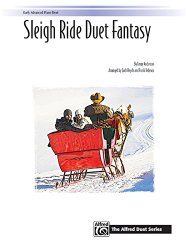
When I found out it was available in sheet music, I rushed to amazon to buy several copies for myself, my son, my friend, basically, everyone I thought could play it.
Leroy Anderson’s “Sleigh Ride” is a holiday favorite, and this setting for advanced piano duet gives it a fresh twist. It begins with Anderson’s jingling melody and some musical “banter” between the Primo and Secondo players, and then it launches into a series of variations which take the listener on a journey through a variety of styles—from gently swirling, impressionistic arpeggios to a triumphant coda with brilliant, virtuosic passagework. Audiences will enjoy a number of other musical surprises along the way.
If you want to borrow it, let me know early because someone at the studio may already be playing it!
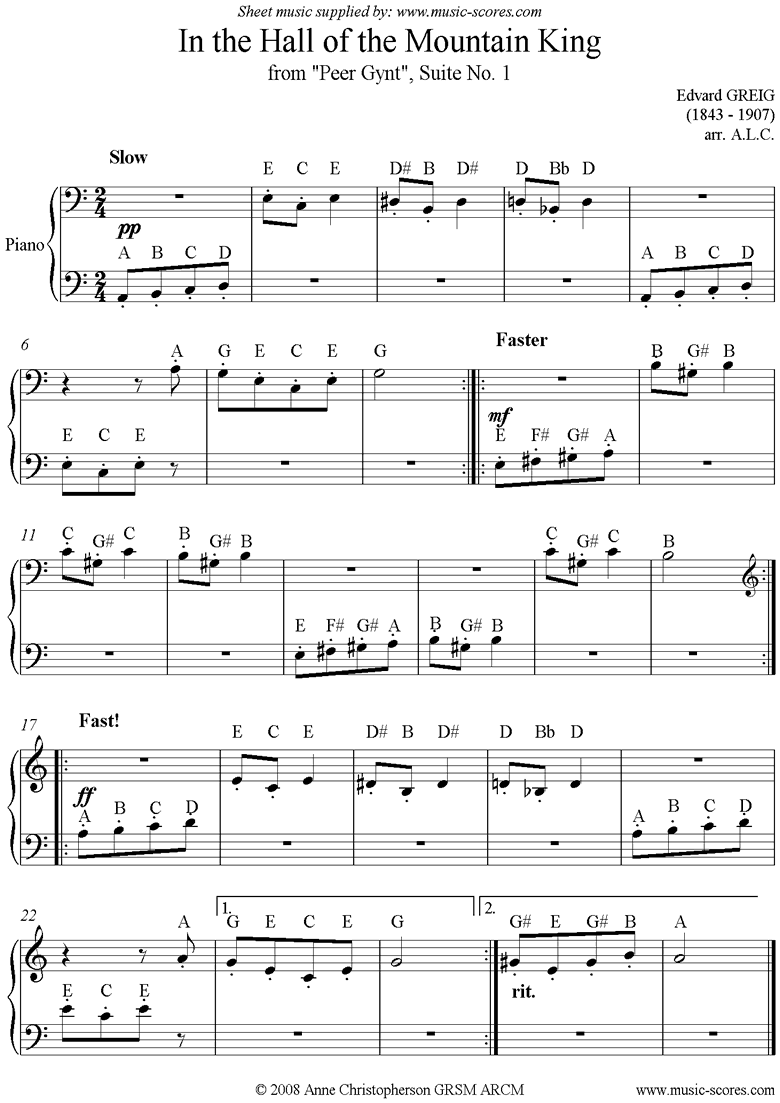
“In the Hall of the Mountain King” is a piece of orchestral music composed for the sixth scene of act 2 in Henrik Ibsen’s 1867 play Peer Gynt. It was originally part of Opus 23 but was later extracted as the final piece of Peer Gynt, Suite No. 1, Op. 46. Its easily recognizable theme has helped it attain iconic status in popular culture, where it has been arranged by many artists, including for the piano.
Borrow a copy of the sheet music from the O’Connor Music Studio. I have this arranged for piano, duet, 2-piano, simplified…
8 part vocal orchestra (plus a tiny pair of cymbals)
Night on Bald Mountain refers to a series of compositions by Modest Mussorgsky (1839–1881). Inspired by Russian literary works and legend, Mussorgsky composed a “musical picture”, St. John’s Eve on Bald Mountain on the theme of a witches’ sabbath occurring on St. John’s Eve, which he completed on that very night, June 23, in 1867.
Get a free copy of the sheet music at IMSLP or buy it on amazon.com.
From Disney’s Fantasia
Piano version transcribed for solo piano by Konstantin Chernov (1865-1937).
The Ludwig Symphony Orchestra, conducted by Maestro Thomas Ludwig
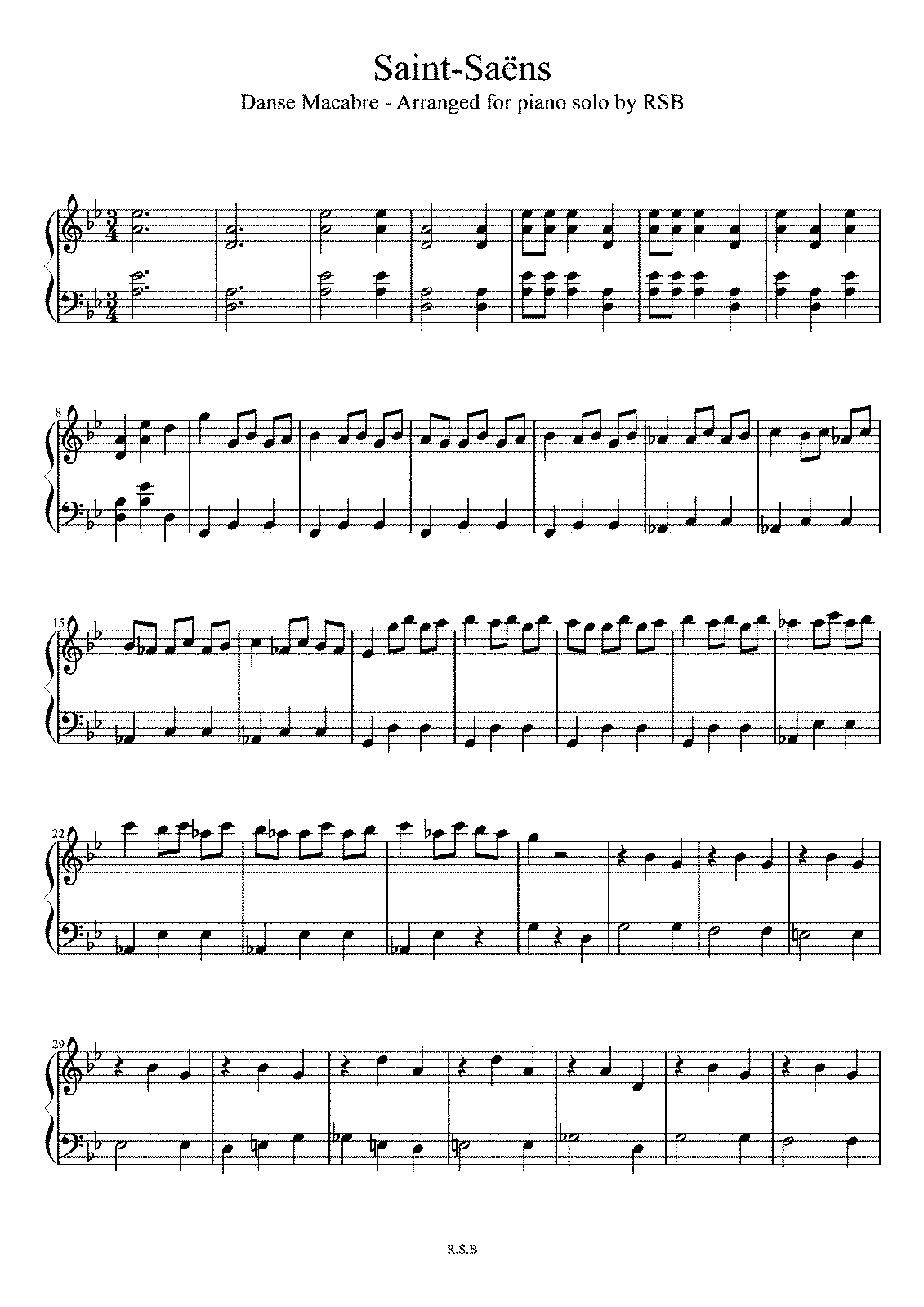
Danse macabre, Op. 40, is a tone poem for orchestra, written in 1874 by French composer Camille Saint-Saëns. It started out in 1872 as an art song for voice and piano with a French text by the poet Henri Cazalis, which is based on an old French superstition. In 1874, the composer expanded and reworked the piece into a tone poem, replacing the vocal line with a solo violin.
Get a free copy of the sheet music at IMSLP (Look for Arrangements and Transcriptions) or borrow a copy from the O’Connor Music Studio. I have this arranged for organ, piano, duet, simplified…
Amazon has a great Dover edition for solo piano. This splendid compilation features a variety of the composer’s best piano works, all reproduced from authoritative sources. Taking its title from the popular orchestral work “Danse Macabre” (presented here in the brilliant arrangement by Liszt), this collection also includes “Allegro appassionato,” “Album” (consisting of six pieces), “Rhapsodie d’Auvergne,” “Theme and Variations,” plus six etudes, three waltzes, and six etudes for left hand alone.
The Funeral March of a Marionette (Marche funèbre d’une marionnette) is a short piece by Charles Gounod. It was written in 1872 for solo piano and orchestrated in 1879. It is perhaps best known as the theme music for the television program Alfred Hitchcock Presents, which originally aired from 1955 to 1965.
In 1871-72, while residing in London, Gounod started to write a suite for piano called “Suite Burlesque”. After completing one movement, the Funeral March of a Marionette, he abandoned the suite and had the single movement published by Goddard & Co. In 1879 he orchestrated the piece. The instrumentation is: piccolo, flute, 2 oboes, 2 clarinets in A, 2 bassoons, 2 horns in D, 2 trumpets in A, 3 trombones, ophicleide, timpani, bass drum, triangle, strings. The work is in the key of D minor, with a central section in D major. Various arrangements by other hands exist.
There is a program underlying the Funeral March of a Marionette: The Marionette has died in a duel. The funeral procession commences (D minor). A central section (D major) depicts the mourners taking refreshments, before returning to the funeral march (D minor).
The score contains the following inscriptions in appropriate places:
La Marionnette est cassée!!! (The Marionette is broken!!!)
Murmure de regrets de la troupe (Murmurs of regret from the troupe)
Le Cortège (The Procession)
Ici plusieurs des principaux personnages de la troupe s’arrêtent pour sa rafrâichir (Here many of the principal personages stop for refreshments)
Retour a la maison (Return to the house). (Wikipedia)
Download this music in several versions from IMSLP. Click on Arrangements and Transcriptions. There are also some arrangements for piano at the O’Connor Music Studio.
On Alfred Hitchcock:
From Faber Piano Adventures Performance Book Level 3B No.7 (Also available in the OCMS Library):
Stephen Powers first thought of his grand piano as an impressive piece of furniture.
But he enjoyed listening to music so much when friends played at parties at his home in North Wilmington that he began taking lessons.
“I enjoy having a couple of songs under my belt,” says Powers, a 52-year-old banker. “I play Happy Birthday. I play Getting to Know You for my mom.”
Powers is part of a boomlet of adults who are studying piano. Many took lessons briefly as children and regret giving it up. Some simply enjoy music. Others gravitated toward the keyboard because studies suggest piano improves mental acuity while reducing the odds of dementia.
A Swedish study published in 2014 in the International Journal of Alzheimer’s Disease found that when a twin played a musical instrument later in life, he or she was 64 percent less likely to develop dementia than the twin who did not play.
A study published in Frontiers in Psychology in 2013 evaluated the impact of piano lessons on cognitive function, mood and quality of life in adults age 60 to 84.
The group that studied piano showed significant improvement in tests that measure executive function, controlling inhibitions and divided attention, as well as enhanced visual scanning and motor ability. Piano students also reported a better quality of life.
Some grownups simply relish a challenge.
In the United Kingdom, Alan Rusbridger, editor of the Guardian, took to the keyboard at age 56. He chronicled the year he spent learning Chopin’s demanding No. Ballade 1 in G Minor in the book Play It Again: An Amateur Against the Impossible.
Richard Swarmer, 57, of Lewes, played the trumpet from grade school through college. He has sung in several choirs. This year, he began piano lessons.
Learning the piano isn’t easy even for someone with a musical background. Still, Swarmer appreciates that the creative thought process is different from the focus required by his job for a medical benefits company.
“I have thoroughly enjoyed taking piano lessons as an adult,” he says. “It provides a welcome respite from the demands of my job.”
Ethel Thirtel of North Wilmington is 71 and a student at the Music School of Delaware. She is also taking French lessons to help keep her intellect sharp.
“Both pursuits involve active studying and practice to master new skills,” she says.
To meet rising demand, the Music School of Delaware offers adults-only evening group classes to accommodate working people, says Matthew Smith, student and alumni relations officer. The school also provides instruction for adults 50 and older through the Osher Lifelong Learning Institute at University of Delaware.
“In addition to professionals, we are getting a lot more inquiries from older adults who are retired and have time on their hands,” he says.
Geri Smith, a Julliard-trained singer, musician and composer, has taught piano to children in public schools as well as private arts centers. Her adult students include a 59-year-old writer who took up piano after the death of her husband, a gifted musician.
“Teaching children is a different experience than teaching adults,” says Smith, of Unionville. “Kids pretty much do what you ask them to do but adults ask lots of questions. They want to know why things have to be done a certain way.”
An important part of learning piano is creating new pathways in the brain. A Harvard Medical School study examined the impact of practicing the piano on synapses, the connections between neurons that encode memories and learning.
Volunteers practiced two hours a day for five days, playing a five-finger exercise to the beat of a metronome. To learn how that impacted the neurons scientists used transcranial-magnetic-stimulation (TMS), in which a wire coil sends magnetic impulses to the brain.
They discovered that after a week of practice, the stretch of motor cortex devoted to the finger exercises had expanded like crabgrass.
“Playing the piano creates new synapses,” Smith says. “Think of it as creating a conduit so your right hand can talk to your left hand.”
Meldene Gruber of Rehoboth Beach, who has taught piano for more than 40 years, has seen a surge in adult students in the past two years. Now, half her students are adults.
“A number of my adults say they think playing the piano will help with mental acuity,” she says. “Playing the piano forces you to use both sides of the brain, which is great for neuron firing.”
Most adults have specific goals in mind, such as learning to play Christmas carols or a few favorite pieces.
“You don’t get adults who are focused on becoming concert pianists,” Gruber says. “They come for the joy of playing, not because their mothers made them.”
Since the first release of this classic Schirmer edition over 100 years ago, almost anyone who has taken piano lessons for more than two years has played from The Virtuoso Pianist.
Most anyone who has ever played piano has a love-hate relationship with the “Hanon”.
The Virtuoso Pianist (Le Pianiste virtuose) by Charles-Louis Hanon, is a compilation of sixty exercises meant to train the pianist in speed, precision, agility, and strength of all of the fingers and flexibility in the wrists.
First published in Boulogne, in 1873, The Virtuoso Pianist is Hanon’s most well-known work, and is still widely used by piano instructors and pupils although some teachers are getting away from the mechanical playing these can produce.
Personally, I’ve sometimes played these on “auto-pilot” since all one really needs is to get the first pattern going, then move up a step, up a step…
Notes by C. L. Hanon: Preparatory exercises for the Acquirement of Agility, Independence, Strength and Perfect Evenness in the Fingers. For studying the 20 exercises, begin with the metronome set at 60, gradually increasing the speed up to 108.
The exercises are intended to address common problems which could hamper the performance abilities of a student. These include “crossing of the thumb”, strengthening of the fourth and fifth fingers, and quadruple- and triple-trills.
The exercises are meant to be individually mastered and then played consecutively in the sections they are placed in.
Apart from increasing technical abilities of the student, when played in groups at higher speeds, the exercises will also help to increase endurance. The exercises are divided in three parts:
Exercises 1 – 20: Labeled “preparatory exercises”, these are also the most famous exercises, and are used to develop finger strength and independence. Each exercise contains a sequence of 8 semiquavers, beginning on C, which is then repeated starting on D, and so on across two octaves. The exercise is then repeated in reverse down two octaves to the starting C. The exercises are intended to be practiced in groups of three, except for the first two which are practiced together.
Exercises 21 – 43: Labeled “further exercises for the development of a virtuoso technique.” This more difficult section is meant to be played after the pianist has fully mastered Part 1. Part 2 includes scales and arpeggios.
Exercises 44 – 60: Labeled “virtuoso exercises for mastering the greatest technical difficulties.” Since this section is considerably more difficult, Hanon recommends the mastery of both previous parts before proceeding to this one. This part includes repeated notes,, and more.
After all three parts are mastered, Hanon recommends all exercises be played through daily to retain technique.
The O’Connor Music Studio has several editions of this work.
Music theory has never sounded so catchy with this witty remake of the holiday classic The Christmas Song (with apologies to Mel Torme) Try not to laugh at the ending.
Though it is a bit humorous, this version titled ‘Intervals Roasting’, with lyrics by David Rakowski, attempts to encapsulate the fundamentals of music theory in just over two minutes.
It does a good job of explaining the intervals and harmonic structure of the song and also gives you an idea of how to use music theory to analyse or compose music.
The O’Connor Music Studio has a copy if anyone wants to learn this 🙂





 MaryO'Studio