As all my students know, I teach theory with all piano and organ lessons. Sometimes, it’s from a theory book that matches a lesson book, sometimes on the fly on an “as needed” basis.
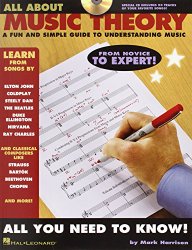
This book looks like it would be interesting to use as a review or to look ahead and see what’s coming. I have just ordered a copy for the studio if you want to check it out at the next lesson.
If you wish there was a fun and engaging way to help you understand the fundamentals of music, then this is it. Whether it’s learning to read music, understanding chords and scales, musical forms, or improvising and composing, this enjoyable guide will help you to finally start understanding the structure and design of music.
This fun-filled, easy-to-use guide includes:
* Music notation
* Scales and modes
* Melody harmonization and counterpoint
* Chord progressions
* Song form and structure
Listen and learn with the CD that has 90 tracks, including over 50 popular songs such as:
* Beauty and the Beast
* Candle in the Wind
* Imagine
* In the Air Tonight
* Killing Me Softly with His Song
* Let It Be
* Message in a Bottle
* Misty
* Satin Doll
* Take the ‘A’ Train
* Unchained Melody
* What’d I Say
* and more!
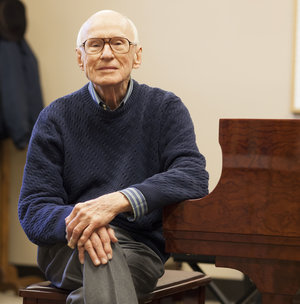
I have always respected Dr. Hinson’s work and his music. So much so that I went to Connecticut to take a class on Piano Pedagogy with him several years ago. I have also attended several local piano teacher workshops with him. At one of them, he claimed to remember me from that Connecticut class. Whether true or not, I treasure that comment and the signature on a piano book he gave me.
We have several of his books at the O’Connor Music Studio and many are available for loan. If you are interested in buying any for yourself, amazon.com has a great selection. In addition to those books he has authored, he has edited the works of many composers. Amazon lists 270 works edited and annotated by Dr. Hinson.
One of America’s most respected authorities on piano literature, Dr. Maurice Hinson received the Lifetime Achievement Award from the Music Teachers National Association at its Washington, D.C. convention in the spring of 1994, the Outstanding Alumni Award from the University of Florida in 1990, and the Outstanding Alumni Award from the University of Michigan in the fall of 1995. Hailed as a specialist in American piano music, some of his articles appear in the New Grove Dictionary of American Music in the United States.
Dr. Hinson received his Bachelor of Arts degree from the University of Florida and his Master of Music and Doctor of Musical Arts degrees from the University of Michigan. He also studied at The Juilliard School and the Conservatoire National in Nancy, France.
While a Senior Professor of Piano in the School of Church Music at the Southern Baptist Theological Seminary in Louisville, Kentucky, Dr. Hinson’s curriculum included teaching piano, piano literature, and piano chamber music. He performed, lectured, and gave masterclasses worldwide. His books and editions have become classic standards in the studios of serious piano teachers and students the world over.
Hinson, Dr. G. Maurice, age 84 died November 11, 2015 in the company of his family. Dr. Hinson was Professor and Senior Professor of Piano at the Southern Baptist Theological Seminary from 1957 to 2015, and a member of Broadway Baptist Church. He was also organist-choirmaster of churches in Florida, Michigan and Kentucky from 1943 to 1980. Dr. Hinson received his BA degree from the University of Florida and his MM and DMA degrees from the University of Michigan, and also studied at The Julliard School and the University of Nancy, France (Conservatoire National).
He was the first president of the Greater Louisville Music Teachers Association, and president of the Kentucky Music Teachers Association as well as the Southern Division of the MTNA. He also taught “The Dorsey Class,” a group of selected piano teachers from 1963 to 2015.
Dr. Hinson is the author of 14 books mostly published by Indiana University Press, plus over 100 articles for music publications. He was a senior editor for The Alfred Publishing Company of California. He edited more than 300 editions of classical piano music and recorded five DVDs of piano music.
As Professor of Piano at the Southern Baptist Theological Seminary for 58 years, he taught and nurtured many pianists who now hold distinguished positions in churches and universities throughout the world.
Dr. Hinson received many awards in piano pedagogy and performance. He was awarded the Liszt Commemorative Medal by the Hungarian Government and the Medal of Excellence by the American Liszt Society for his research on the music of Franz Liszt. He was hailed as a specialist in American Piano music and some of his most recent articles appeared in the NEW GROVE DICTIONARY OF AMERICAN MUSIC. He gave recitals, lectures, and master classes in five continents and 50 states.
Hinson was the founding editor of the JOURNAL OF THE AMERICAN LISZT SOCIETY, past editor of THE AMERICAN MUSIC TEACHER, and contributing editor of THE PIANO QUARTERLY and PIANO AND KEYBOARD.
When my students are first working with the Grand Staff, they are often confused about the placement of the various clefs.
In piano music, we generally use only the G-clef (Treble clef – not “trouble clef” as some think!) and the F-clef (Bass clef) I try to show students how the curvy part of the G-clef wraps around the G above middle C and the F-clef looks sort of like an F marking the F below middle C. I draw out G and F on the staff to show how these could have looked.
Originally, instead of a special clef symbol, the reference line of the staff was simply labeled with the name of the note it was intended to bear: F and C and, more rarely, G. These were the most often-used ‘clefs’ in Gregorian chant notation. Gregorian chant developed mainly in western and central Europe during the 9th and 10th centuries, with later additions and redactions.
Over time the shapes of these letters became stylized, leading to their current versions.
Let’s face it. Most kids don’t want to practice the piano. And if they do find the time to practice, it’s usually because their parent kept nagging them. How frustrating!
Piano teachers are frustrated too. It’s nearly impossible to teach students new concepts when they don’t understand the old ones–all because of a lack of practice.
If you’re a parent in this situation, I have just the solution you’re looking for.
In this upbeat book, I share all the tips I’ve discovered in my 14 years of teaching piano. You’ll learn fun, practical ways to get your kids to the keyboard.
But this easy-to-read guide goes one step further. I’ll show you simple ways to encourage better quality practice. Even if you’ve never had a music lesson in your life!
I wrote this book for kids of all ages. There are creative ideas for elementary students and also a section for teens.
There’s even a section for what to do if your child wants to stop taking piano lessons. That’s right, there is hope and my book will show you exactly how to get them interested in piano again.
Don’t be the kind of parent who sits on the sidelines waiting until their child wants to practice. Piano lessons are too expensive for you to let another “no-practice” day go by.
This book is your answer to get your child to the keyboard, have good quality practice and develop a life-long love of music.
When my students are first working with the Grand Staff, they are often confused about the placement of the various clefs.
In piano music, we generally use only the G-clef (Treble clef – not “trouble clef” as some think!) and the F-clef (Bass clef) I try to show students how the curvy part of the G-clef wraps around the G above middle C and the F-clef looks sort of like an F marking the F below middle C. I draw out G and F on the staff to show how these could have looked.
Originally, instead of a special clef symbol, the reference line of the staff was simply labeled with the name of the note it was intended to bear: F and C and, more rarely, G. These were the most often-used ‘clefs’ in Gregorian chant notation. Gregorian chant developed mainly in western and central Europe during the 9th and 10th centuries, with later additions and redactions.
Over time the shapes of these letters became stylized, leading to their current versions.
The following ornament table is a transcription of the one appearing in the Clavier-Büchlein vor Wilhelm Friedemann Bach, written by Johann Sebastian Bach for the keyboard instruction of his eldest son.
A scan of the original manuscript appears at Dave’s J.S. Bach Page.
The German title translates as “Explanation of various signs, showing how to play certain ornaments correctly.”{1} Bach gives the sign for each ornament on the upper of the paired staves, while the lower shows its execution directly beneath.
(This blog has) simply modernized the clefs in my transcription, since Bach’s manuscript uses soprano clefs, as several composers continued to do throughout the 18th century in place of the treble clef now used in all keyboard music.
After the transcription graphic showing the table, there appear clickable buttons which are keyed to AU sound files; you can click on any of the ornaments and hear a sound file play its execution.
I have several copies of this book for the music studio so parents can check it out to see if it would be useful for them to buy for home use. If any of the studio parents have this book already, please let me know what you think.
Some of my adult students have this and have found it helpful in doing theory assignments.
Help Your Kids with Music is a step-by-step visual guide to music theory and is the perfect primer to help students gain a solid foundation in music, no matter their age, skill level, or instrument.
Help Your Kids with Music clearly explains key concepts in five step-by-step chapters:
The Basics explains the types of instruments, notation for keyboard and stringed instruments, the “musical alphabet,” and counting a beat.
Rhythm covers the length of notes and rests, as well as basic rhythms and meters, phrasing, syncopation, tempo, and using a metronome.
Tone and Melody includes everything a student needs to know about tones and how they work together to build a melody.
Chords and Harmony shows how intervals work together and includes examples for horn and woodwind instruments.
Form and Interpretation helps students understand how musical form can aid appreciation and interpretation for classical, jazz, blues, and other musical styles.
Johann Sebastian Bach’s towering monument of organ music, with its deep sense of foreboding, will forever be associated with Halloween.
Get a free copy of the sheet music at IMSLP or borrow a copy from the O’Connor Music Studio. I have this arranged for organ, piano, duet, 2-piano, simplified…
It’s also available in Piano Maestro, Piano Pronto Encore and Coda
Let’s face it. Most kids don’t want to practice the piano. And if they do find the time to practice, it’s usually because their parent kept nagging them. How frustrating!
Piano teachers are frustrated too. It’s nearly impossible to teach students new concepts when they don’t understand the old ones–all because of a lack of practice.
If you’re a parent in this situation, I have just the solution you’re looking for.
In this upbeat book, I share all the tips I’ve discovered in my 14 years of teaching piano. You’ll learn fun, practical ways to get your kids to the keyboard.
But this easy-to-read guide goes one step further. I’ll show you simple ways to encourage better quality practice. Even if you’ve never had a music lesson in your life!
I wrote this book for kids of all ages. There are creative ideas for elementary students and also a section for teens.
There’s even a section for what to do if your child wants to stop taking piano lessons. That’s right, there is hope and my book will show you exactly how to get them interested in piano again.
Don’t be the kind of parent who sits on the sidelines waiting until their child wants to practice. Piano lessons are too expensive for you to let another “no-practice” day go by.
This book is your answer to get your child to the keyboard, have good quality practice and develop a life-long love of music.
When my students are first working with the Grand Staff, they are often confused about the placement of the various clefs.
In piano music, we generally use only the G-clef (Treble clef – not “trouble clef” as some think!) and the F-clef (Bass clef) I try to show students how the curvy part of the G-clef wraps around the G above middle C and the F-clef looks sort of like an F marking the F below middle C. I draw out G and F on the staff to show how these could have looked.
Originally, instead of a special clef symbol, the reference line of the staff was simply labeled with the name of the note it was intended to bear: F and C and, more rarely, G. These were the most often-used ‘clefs’ in Gregorian chant notation. Gregorian chant developed mainly in western and central Europe during the 9th and 10th centuries, with later additions and redactions.
Over time the shapes of these letters became stylized, leading to their current versions.




 MaryO'Studio