Why is Theory Important for Piano Students?

Music_Theory


Students at the O’Connor Music Studio know that music theory is always a part of lessons.  I strongly believe that theory is needed so that students understand what they are playing and why.

To me, theory work is just as important as playing.  A firm knowledge of musical structure makes playing everything easier.

Music knowledge learned through piano lessons transfers easily to other  musical activities.  Students in Fairfax County Public Schools, students learn to play recorder.  Students are sometimes surprised to learn that they already know all the notes – from their piano lessons!

When you sing in a choir, harmonize with Sweet Adelines, play an instrument in your school or community band/orchestra, join your church’s handbell choir (note:  Pender UMC has an excellent Handbell program), teach yourself guitar – theory will help in every instance. By learning to read, write, and understand this musical language, many more musical opportunities will be made available the rest of your life.

Most piano methods come with a theory book that matches page by page what concepts are being learned in the lesson books.  I actually recommend that students do the theory first when they get home, while the concepts are still fresh in their minds.

If the student is not in a piano method, I’m starting to use the Theory Time series.  Book One covers music alphabet, introduction to keyboard and staff, stem rule, steps & skips on a keyboard and staff, repeated notes, dynamics, treble clef lines & spaces, bass clef lines & spaces, quarter note & rest, half note & rest, whole note & rest, dotted half note, bar lines, double bar line, measures, time signatures, rhythm drill, vocabulary, ear training and a review test. Free ear training videos for each ear training exercise are hosted on the Theory Time YouTube channel. The Grade One workbook is appropriate for beginning 1st, 2nd or 3rd grade students. This workbook includes 51 pages, 13 lessons and 8 Fun Sheets.

For adults and more advanced students, I have a copy of All About Music Theory: A Fun and Simple Guide to Understanding Music which can be used as a review or a “try before buy”.

Stop procrastinating and go do your theory!

Piano Exercises: Hanon

hanon

Since the first release of this classic Schirmer edition over 100 years ago, almost anyone who has taken piano lessons for more than two years has played from The Virtuoso Pianist. 

Most anyone who has ever played piano has a love-hate relationship with the “Hanon”.

The Virtuoso Pianist (Le Pianiste virtuose) by Charles-Louis Hanon, is a compilation of sixty exercises meant to train the pianist in speed, precision, agility, and strength of all of the fingers and flexibility in the wrists.

First published in Boulogne, in 1873, The Virtuoso Pianist is Hanon’s most well-known work, and is still widely used by piano instructors and pupils although some teachers are getting away from the mechanical playing these can produce.

Personally, I’ve sometimes played these on “auto-pilot” since all one really needs is to get the first pattern going, then move up a step, up a step…

hanon1

Notes by C. L. Hanon: Preparatory exercises for the Acquirement of Agility, Independence, Strength and Perfect Evenness in the Fingers. For studying the 20 exercises, begin with the metronome set at 60, gradually increasing the speed up to 108.

From Wikipedia:

The exercises are intended to address common problems which could hamper the performance abilities of a student. These include “crossing of the thumb”, strengthening of the fourth and fifth fingers, and quadruple- and triple-trills.

The exercises are meant to be individually mastered and then played consecutively in the sections they are placed in.

Apart from increasing technical abilities of the student, when played in groups at higher speeds, the exercises will also help to increase endurance. The exercises are divided in three parts:

  1. Exercises 1 – 20: Labeled “preparatory exercises”, these are also the most famous exercises, and are used to develop finger strength and independence. Each exercise contains a sequence of 8 semiquavers, beginning on C, which is then repeated starting on D, and so on across two octaves. The exercise is then repeated in reverse down two octaves to the starting C. The exercises are intended to be practiced in groups of three, except for the first two which are practiced together.
  2. Exercises 21 – 43: Labeled “further exercises for the development of a virtuoso technique.” This more difficult section is meant to be played after the pianist has fully mastered Part 1. Part 2 includes scales and arpeggios.
  3. Exercises 44 – 60: Labeled “virtuoso exercises for mastering the greatest technical difficulties.” Since this section is considerably more difficult, Hanon recommends the mastery of both previous parts before proceeding to this one. This part includes repeated notes,, and more.

After all three parts are mastered, Hanon recommends all exercises be played through daily to retain technique.

The O’Connor Music Studio has several editions of this work.

‘Intervals Roasting’ – The Most Educational Christmas Carol Ever

music-theory-song

Music theory has never sounded so catchy with this witty remake of the holiday classic The Christmas Song (with apologies to Mel Torme) Try not to laugh at the ending.

Though it is a bit humorous, this version titled ‘Intervals Roasting’, with lyrics by David Rakowski, attempts to encapsulate the fundamentals of music theory in just over two minutes.

It does a good job of explaining the intervals and harmonic structure of the song and also gives you an idea of how to use music theory to analyse or compose music.

The O’Connor Music Studio has a copy if anyone wants to learn this 🙂

Christmas Music, Part 5 – Carol of the Bells

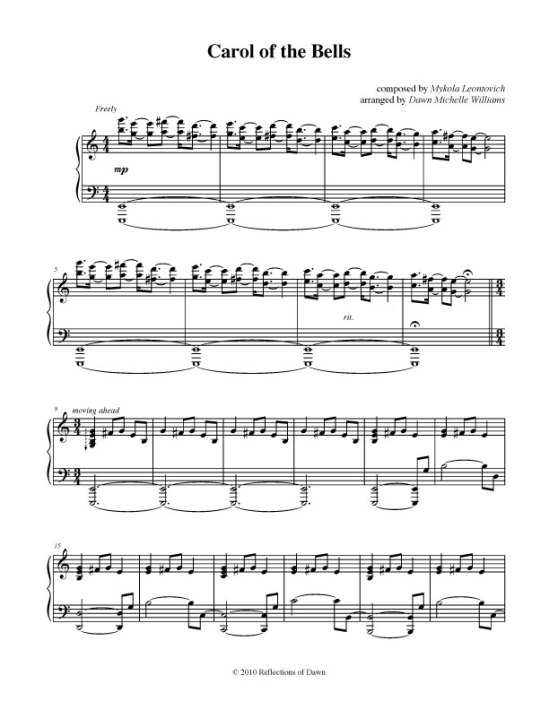
Carol of the BellsCarol of the Bells was composed by Mykola Dmytrovych Leontovych (1877-1921) in 1916. Originally titled Shchedryk, this Ukrainian folk song is sometimes called Ukrainian Bell Carol. “Shchedryk” which was associated with the coming New Year, originally celebrated in April.

Leontovych used this tune in 1904 along with lyrics by Peter J. Wilhousky to create the version that everyone knows today. It gained popularity during the 1920s and 1930s, and was introduced to an even wider audience when it was used in the movie “Home Alone”.

It was first performed in the Ukraine on the night of January 13, 1916, on the Julian calendar this is considered New Year’s Eve. In the United States the song was first performed on October 5, 1921 at Carnegie Hall.

This video is from the Christmas special of the Mormon Tabernacle Choir, presented at the BYU channel. Very beautiful sound of bells, the orchestra and choir, enjoy the video!

Not the standard version –

The O’Connor Music Studio has several versions of this Christmas Carol available for loan, including this version from the Mannheim Steamroller:


Christmas Music, Part 2 – Joy To The World

Joy_To_The_World-Antioch

Joy To The World

Joy to the World, the Lord is come!

Let earth receive her King.

Isaac Watts wrote  the words to “Joy to the World” in 1719, based on Psalm 98 in the Bible. The hymn originally glorified Christ’s triumphant return at the end of the age, rather than a song celebrating His first coming. Only the second half of Watts’ lyrics are still used today.

The music was adapted and arranged to Watts’ lyrics by Lowell Mason in 1839 from an older melody which was then believed to have originated from Handel. The name “Antioch” is generally used for the hymn tune.

As of the late 20th century, “Joy to the World” was the most-published Christmas hymn in North America.

There are versions of Joy to the World available at the O’Connor Music Studio for any level of playing, starting with Pre-Reading, all the way up through Advanced and duets.

Christmas Music, Part 1 – Sleigh Ride

Sleigh Ride

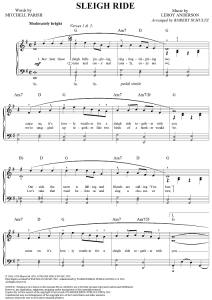
I’ve always liked Leroy Anderson’s Sleigh Ride as a secular Christmas song 🙂  It’s not technically a Christmas song since the words never mention Christmas but it’s often played now so it seems like a way to ease into the season.

Anderson had the original idea for the piece during a heat wave in July 1946;  he finished the work in February 1948.  Lyrics, about a person who would like to ride in a sleigh on a winter’s day with another person, were written by Mitchell Parish in 1950.

The orchestral version was first recorded in 1949 by Arthur Fiedler and The Boston Pops Orchestra. The song was a hit record and has become the equivalent of a signature song for the orchestra.

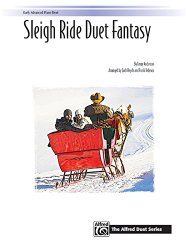
A new last year, fun arrangement has been made for piano duet.  I have copies here for loan and it’s available on amazon (of course! What isn’t?)

Dr. Maurice Hinson

hinson


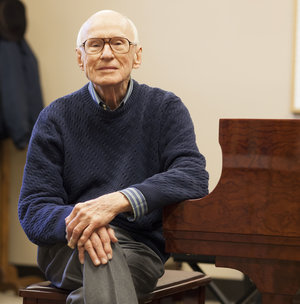
I have always respected Dr. Hinson’s work and his music.  So much so that I went to Connecticut to take a class on Piano Pedagogy with him several years ago.  I have also attended several local piano teacher workshops with him.  At one of them, he claimed to remember me from that Connecticut class.  Whether true or not, I treasure that comment and the signature on a piano book he gave me.

We have several of his books at the O’Connor Music Studio and many are available for loan.  If you are interested in buying any for yourself, amazon.com has a great selection.  In addition to those books he has authored, he has edited the works of many composers.  Amazon lists 270 works edited and annotated by Dr. Hinson.


From his page on alfred.com:

One of America’s most respected authorities on piano literature, Dr. Maurice Hinson received the Lifetime Achievement Award from the Music Teachers National Association at its Washington, D.C. convention in the spring of 1994, the Outstanding Alumni Award from the University of Florida in 1990, and the Outstanding Alumni Award from the University of Michigan in the fall of 1995. Hailed as a specialist in American piano music, some of his articles appear in the New Grove Dictionary of American Music in the United States.

Dr. Hinson received his Bachelor of Arts degree from the University of Florida and his Master of Music and Doctor of Musical Arts degrees from the University of Michigan. He also studied at The Juilliard School and the Conservatoire National in Nancy, France.

While a Senior Professor of Piano in the School of Church Music at the Southern Baptist Theological Seminary in Louisville, Kentucky, Dr. Hinson’s curriculum included teaching piano, piano literature, and piano chamber music. He performed, lectured, and gave masterclasses worldwide. His books and editions have become classic standards in the studios of serious piano teachers and students the world over.


From his obituary at legacy.com:

Hinson, Dr. G. Maurice, age 84 died November 11, 2015 in the company of his family. Dr. Hinson was Professor and Senior Professor of Piano at the Southern Baptist Theological Seminary from 1957 to 2015, and a member of Broadway Baptist Church. He was also organist-choirmaster of churches in Florida, Michigan and Kentucky from 1943 to 1980. Dr. Hinson received his BA degree from the University of Florida and his MM and DMA degrees from the University of Michigan, and also studied at The Julliard School and the University of Nancy, France (Conservatoire National).

He was the first president of the Greater Louisville Music Teachers Association, and president of the Kentucky Music Teachers Association as well as the Southern Division of the MTNA. He also taught “The Dorsey Class,” a group of selected piano teachers from 1963 to 2015.

Dr. Hinson is the author of 14 books mostly published by Indiana University Press, plus over 100 articles for music publications. He was a senior editor for The Alfred Publishing Company of California. He edited more than 300 editions of classical piano music and recorded five DVDs of piano music.

As Professor of Piano at the Southern Baptist Theological Seminary for 58 years, he taught and nurtured many pianists who now hold distinguished positions in churches and universities throughout the world.

Dr. Hinson received many awards in piano pedagogy and performance. He was awarded the Liszt Commemorative Medal by the Hungarian Government and the Medal of Excellence by the American Liszt Society for his research on the music of Franz Liszt. He was hailed as a specialist in American Piano music and some of his most recent articles appeared in the NEW GROVE DICTIONARY OF AMERICAN MUSIC. He gave recitals, lectures, and master classes in five continents and 50 states.

Hinson was the founding editor of the JOURNAL OF THE AMERICAN LISZT SOCIETY, past editor of THE AMERICAN MUSIC TEACHER, and contributing editor of THE PIANO QUARTERLY and PIANO AND KEYBOARD.

Sleigh Ride Duet

sleigh-ride


I have loved this version of Sleigh Ride since I first saw it on YouTube:

When I found out it was available in sheet music, I rushed to amazon to buy several copies for myself, my son, my friend, basically everyone I thought could play it.

Lots of fun to play and to hear.

Amazon says:

Leroy Anderson’s “Sleigh Ride” is a holiday favorite, and this setting for advanced piano duet gives it a fresh twist. It begins with Anderson’s jingling melody and some musical “banter” between the Primo and Secondo players, and then it launches into a series of variations which take the listener on a journey through a variety of styles—from gently swirling, impressionistic arpeggios to a triumphant coda with brilliant, virtuosic passagework. Audiences will enjoy a number of other musical surprises along the way.

If you want to borrow it, let me know early because someone at the studio may already be playing it!


maryOpianoplayer

Halloween Music: Toccata and Fugue in d minor by J.S Bach

toccata-d-minor


Johann Sebastian Bach’s towering monument of organ music, with its deep sense of foreboding, will forever be associated with Halloween.

Get a free copy of the sheet music at IMSLP or borrow a copy from the O’Connor Music Studio.  I have this arranged for organ, piano, duet, 2-piano, simplified…

If you want this in a book with other Bach transcriptions, amazon has this: Toccata and Fugue in D Minor and the Other Bach Transcriptions for Solo Piano, arranged by Ferruccio Busoni.

Here, Virgil Fox performs it on his Allen Digital Touring Organ.


Diane Bish plays the Massey Memorial Organ at the Chautauqua Institution and talks about this instrument.


Play along with pianist Cyprien Katsaris if you wish!


And, the most fun…