June 7 ~ Daily Listening Assignment


Today, we’ll be listening to the end of the William Tell Overture by Gioachino Rossini.  This piece, originally the overture to an opera, has been arranged for piano and is in several method books, including Piano Pronto Movements 1 and 2.  It’s also in Bastien Book 4 and Piano Maestro.
The original story

Maybe your grandparents watched the original Lone Ranger

Or you saw the newer Lone Ranger with Johnny Depp

Here’s the entire William Tell Overture played by an orchestra

Piano Solo

Franz Liszt made a really hard version for piano solo. See if you can follow along!

Piano Duet (1 piano, 4 hands)

Piano Duet arranged by Louis Moreau Gottschalk

Piano Duo (2 pianos, 8 hands)

Piano Quartet (4 pianos, 16 hands)

For pipe organ

For synthesizer

And then things get nuts with cartoons. Lots of cartoons used this music. Here are Mickey Mouse and friends

And Spike Jones

Handbells…

Poor Rossini – I think he’d have a fit if he knew how is music was being used.

Have a nice day!

June 4 ~ Daily Listening Assignment


I’m sure many have you have learned Twinkle, Twinkle Little Star by now.  Did you know its’ the same melody as the ABC Song?  You know…

Don’t believe it? Sing them both in your head or out loud.

The French melody first appeared in 1761, and has been used for many children’s songs, such as “Twinkle, Twinkle, Little Star”, “Baa, Baa, Black Sheep” and the “Alphabet Song”.

This is one of the first pieces a student learns in piano methods, since it has them reach just a bit outside their accustomed hand position on the word “little”.


Twinkle


I try to remember to let students know that Wolfgang Amadeus Mozart composed a set of twelve variations on the theme “Ah, vous dirai-je, Maman” for the piano and it started as the same basic Twinkle tune.

The sheet music is available at the O’Connor Music Studio if you want to borrow it or download it here about 1/3 of the way down the page under “Scores”.

I always enjoy these graphical scores.  Watch the colors as the melody gets more and more complex:

Who knew?  There’s an accordion version.

Have a great day!

June 2 ~ Daily Listening Assignment


This is the month for graduations of all sorts, college, high school, even preschool.  Perhaps you know someone who is graduating this year.  Maybe it’s you!

This piece by Sir Edward Elgar is called Pomp and Circumstance and usually heard at graduations.  It was featured in Disney’s Fantasia 2000.

Edward Elgar’s father was a musician who tuned pianos, owned a music shop and was employed as a church organist. The young Edward learned to play the organ and violin at a young age and composed his first short piece at the age of 10. His first job was as assistant organist to his father. His main love was composition, although his music was not successful until his Enigma Variations were published in 1899. This work made him famous.

Until Elgar, there had not been a major creative composer in England since Handel’s death in 1759. He became known as England’s greatest composer and was widely recognized in his day. Unfortunately, Elgar’s fame waned at the end of his life – he composed little music during his last fifteen years and withdrew from almost all musical contact. It was not until the 1960’s that his music again became popular.

More information about Elgar

Do you know your chords well?  If so, try this version:

If not, ask at your next lesson for a version at your level.


June 1 ~ Daily Listening Assignment


Today, we start with Spring from the Four Seasons by Vivaldi.  Many OCMS students have played this already in one of their Piano Pronto books.  It’s also available in Piano Maestro.

If you have it in your piano book, today would be a great day to review it. (HINT – there might be a quick review at your next lesson!)

Vivaldi was born in Venice, Italy, March 4, 1678 and spent most of his life there. His father taught him to play the violin, and the two would often perform together.

He taught at an orphanage for girls and wrote a lot of music for the girls to play. People came from miles around to hear Vivaldi’s talented students perform the beautiful music he had written.

Many people think Vivaldi was the best Italian composer of his time. He wrote concertos, operas, church music and many other compositions. In all, Antonio wrote over 500 concertos.

His most famous set of concertos is The Four Seasons which is a group of four violin concerti.  Each of which gives a musical expression to a season of the year. They were written about 1721 and were published in 1725 in Amsterdam.

Here’s a piano version similar to the one in Movement 1 but in a different key.


And the original with Itzhak Perlman playing and conducting!

Want to play a version of this but aren’t using these books? Just ask!

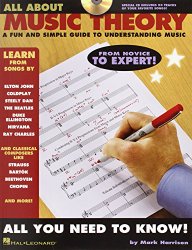
Music Theory – All you Need to Know!

theory


As all my students know, I teach theory with all piano and organ lessons.  Sometimes, it’s from a theory book that matches a lesson book, sometimes on the fly on an “as needed” basis.

This book looks like it would be interesting to use as a review or to look ahead and see what’s coming.  I have just ordered a copy for the studio if you want to check it out at the next lesson.

From amazon.com:

 If you wish there was a fun and engaging way to help you understand the fundamentals of music, then this is it. Whether it’s learning to read music, understanding chords and scales, musical forms, or improvising and composing, this enjoyable guide will help you to finally start understanding the structure and design of music.

This fun-filled, easy-to-use guide includes:
* Music notation
* Scales and modes
* Melody harmonization and counterpoint
* Chord progressions
* Song form and structure

Listen and learn with the CD that has 90 tracks, including over 50 popular songs such as:
* Beauty and the Beast
* Candle in the Wind
* Imagine
* In the Air Tonight
* Killing Me Softly with His Song
* Let It Be
* Message in a Bottle
* Misty
* Satin Doll
* Take the ‘A’ Train
* Unchained Melody
* What’d I Say
* and more!

maryOivoryandroses

Christmas Music: Adeste Fideles

“O Come, All Ye Faithful” (originally written in Latin as Adeste Fideles) is a Christmas carol which has been attributed to various authors, including John Francis Wade (1711–1786), John Reading (1645–1692) and King John IV of Portugal (1604–1656), with the earliest manuscript of the hymn bearing his name, located in the library of the Ducal Palace of Vila Viçosa.

The original four verses of the hymn were extended to a total of eight, and these have been translated into many languages. The English translation of “O Come, All Ye Faithful” by the English Catholic priest Frederick Oakeley, written in 1841, is widespread in most English speaking countries.
There are now several versions in the O’Connor Music Store if you are interested in learning this Christmas carol.


Christmas Music: Gesù Bambino


Gesù Bambino by Pietro Yon has always had a place in my childhood memories since my church choir sang it every Christmas.  Other than that, it didn’t seem to be too well known but this song has been turning up in piano books lately.  There are now several versions in the O’Connor Music Store if you are interested in learning this beautiful older Christmas carol.

Gesù bambino was written in 1917. The melody was used by Frederick H. Martens in his English language carol “When Blossoms Flowered ‘mid the Snows”. The melody and lyrics of the chorus are derived from “Adeste Fideles” (O Come All Ye Faithful).

A piano version

Piano and Organ


Sung by David Archuleta and the Mormon Tabernacle Choir

‘Intervals Roasting’ – The Most Educational Christmas Carol Ever

music-theory-song

Music theory has never sounded so catchy with this witty remake of the holiday classic The Christmas Song (with apologies to Mel Torme) Try not to laugh at the ending.

Though it is a bit humorous, this version titled ‘Intervals Roasting’, with lyrics by David Rakowski, attempts to encapsulate the fundamentals of music theory in just over two minutes.

It does a good job of explaining the intervals and harmonic structure of the song and also gives you an idea of how to use music theory to analyze or compose music.

The O’Connor Music Studio has a copy if anyone wants to learn this 🙂

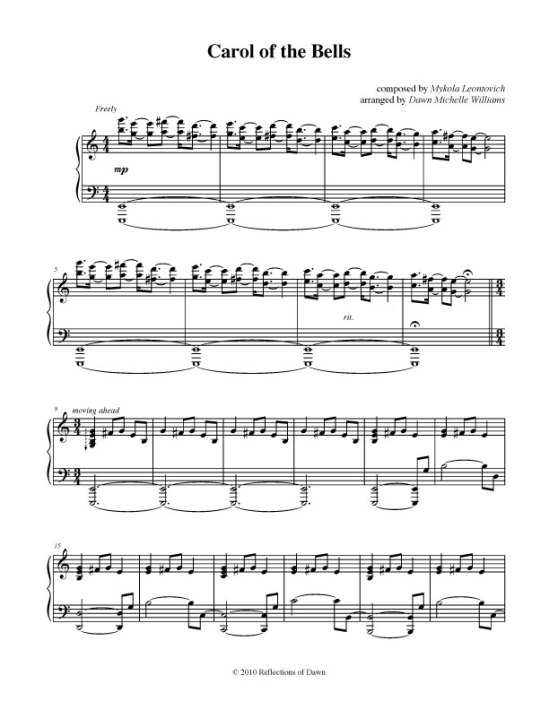
Christmas Music: Carol of the Bells

Carol of the Bells

Carol of the Bells was composed by Mykola Dmytrovych Leontovych (1877-1921) in 1916. Originally titled Shchedryk, this Ukrainian folk song is sometimes called Ukrainian Bell Carol. “Shchedryk” which was associated with the coming New Year, originally celebrated in April.

Leontovych used this tune in 1904 along with lyrics by Peter J. Wilhousky to create the version that everyone knows today. It gained popularity during the 1920s and 1930s, and was introduced to an even wider audience when it was used in the movie “Home Alone”.

It was first performed in the Ukraine on the night of January 13, 1916, on the Julian calendar this is considered New Year’s Eve. In the United States the song was first performed on October 5, 1921 at Carnegie Hall.

This video is from the Christmas special of the Mormon Tabernacle Choir, presented at the BYU channel. The orchestra and choir produce a very beautiful sound.

Not the standard version –

The O’Connor Music Studio has several versions of this Christmas Carol available for loan, including this version from the Mannheim Steamroller:


Christmas Music: Joy To The World

Joy_To_The_World-Antioch

Joy To The World

Joy to the World, the Lord is come!

Let earth receive her King.

Isaac Watts wrote the words to “Joy to the World” in 1719, based on Psalm 98 in the Bible. The hymn originally glorified Christ’s triumphant return at the end of the age, rather than a song celebrating His first coming. Only the second half of Watts’ lyrics are still used today.

The music was adapted and arranged to Watts’ lyrics by Lowell Mason in 1839 from an older melody which was then believed to have originated from Handel. The name “Antioch” is generally used for the hymn tune.

As of the late 20th century, “Joy to the World” was the most-published Christmas hymn in North America.

There are versions of Joy to the World available at the O’Connor Music Studio for any level of playing, starting with Pre-Reading, all the way up through Advanced and duets.