Why is Theory Important for Piano Students?

Music_Theory


Students at the O’Connor Music Studio know that music theory is always a part of lessons.  I strongly believe that theory is needed so that students understand what they are playing and why.

To me, theory work is just as important as playing.  A firm knowledge of musical structure makes playing everything easier.

Music knowledge learned through piano lessons transfers easily to other  musical activities.  Students in Fairfax County Public Schools, students learn to play recorder.  Students are sometimes surprised to learn that they already know all the notes – from their piano lessons!

When you sing in a choir, harmonize with Sweet Adelines, play an instrument in your school or community band/orchestra, join your church’s handbell choir (note:  Pender UMC has an excellent Handbell program), teach yourself guitar – theory will help in every instance. By learning to read, write, and understand this musical language, many more musical opportunities will be made available the rest of your life.

Most piano methods come with a theory book that matches page by page what concepts are being learned in the lesson books.  I actually recommend that students do the theory first when they get home, while the concepts are still fresh in their minds.

If the student is not in a piano method, I’m starting to use the Theory Time series.  Book One covers music alphabet, introduction to keyboard and staff, stem rule, steps & skips on a keyboard and staff, repeated notes, dynamics, treble clef lines & spaces, bass clef lines & spaces, quarter note & rest, half note & rest, whole note & rest, dotted half note, bar lines, double bar line, measures, time signatures, rhythm drill, vocabulary, ear training and a review test. Free ear training videos for each ear training exercise are hosted on the Theory Time YouTube channel. The Grade One workbook is appropriate for beginning 1st, 2nd or 3rd grade students. This workbook includes 51 pages, 13 lessons and 8 Fun Sheets.

For adults and more advanced students, I have a copy of All About Music Theory: A Fun and Simple Guide to Understanding Music which can be used as a review or a “try before buy”.

Stop procrastinating and go do your theory!

Ornaments Aren’t Just for the Holidays

OLYMPUS DIGITAL CAMERA

WRONG – this post, and others in this category, isn’t about ornaments at Christmas but about those funny looking marks over your music and how to play them.

The trill (or shake, as it was known from the 16th until the 19th century) is a musical ornament consisting of a rapid alternation between two adjacent notes, usually a semitone or tone apart, which can be identified with the context of the trill.

A trill provides rhythmic interest, melodic interest, and harmonic interest. Sometimes it is expected that the trill will end with a turn or some other variation. Such variations are often marked in the music.

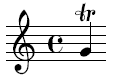
A trill in your music can look like thistrill

Or like this tr~~~~~~~~~~~~~

Trills can be played differently, depending on the period in which the composer was living so it is important to know the time period of your piece.

Baroque trills (aka shakes in this time period) have several ways to be played as shown in this chart:

A table depicting how to perform different types of trills when playing music from the Baroque period (1600-1750).[4] Note the similarity between the symbol for trill and that of the mordent.

A table depicting how to perform different types of trills (or shakes) when playing music from the Baroque period (1600-1750).

The Baroque trill continuing through Mozart’s time usually begins on the note above the main note.

In music after the time of Mozart, the trill usually begins on the principal note.

Often, your music will have suggestions about how they should be played written above the music.  If not, ASK!

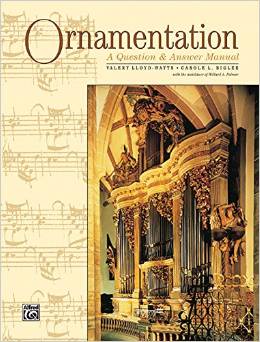
A really good book which explains about the trill and other ornaments is this one, available as a reference book in the O’Connor Music Studio:

ornamentation

Some trill exercises:

Questions?  Write them down and don’t forget to ask at your next lesson!

Exercises: Scales and Arpeggios

scales

PDF Article on Scales and Arpeggios

In music, a scale is any set of musical notes ordered by fundamental frequency or pitch.

An arpeggio (it. /arˈpeddʒo/) is a musical technique where notes in a chord are played or sung in sequence, one after the other, rather than being played together like a chord. This word comes from the Italian word “arpeggiare”, which means “to play on a harp”. An alternative translation of this term is “broken chord”.

Make any scale or chord here


Piano Exercises: Hanon

hanon

Since the first release of this classic Schirmer edition over 100 years ago, almost anyone who has taken piano lessons for more than two years has played from The Virtuoso Pianist. 

Most anyone who has ever played piano has a love-hate relationship with the “Hanon”.

The Virtuoso Pianist (Le Pianiste virtuose) by Charles-Louis Hanon, is a compilation of sixty exercises meant to train the pianist in speed, precision, agility, and strength of all of the fingers and flexibility in the wrists.

First published in Boulogne, in 1873, The Virtuoso Pianist is Hanon’s most well-known work, and is still widely used by piano instructors and pupils although some teachers are getting away from the mechanical playing these can produce.

Personally, I’ve sometimes played these on “auto-pilot” since all one really needs is to get the first pattern going, then move up a step, up a step…

hanon1

Notes by C. L. Hanon: Preparatory exercises for the Acquirement of Agility, Independence, Strength and Perfect Evenness in the Fingers. For studying the 20 exercises, begin with the metronome set at 60, gradually increasing the speed up to 108.

From Wikipedia:

The exercises are intended to address common problems which could hamper the performance abilities of a student. These include “crossing of the thumb”, strengthening of the fourth and fifth fingers, and quadruple- and triple-trills.

The exercises are meant to be individually mastered and then played consecutively in the sections they are placed in.

Apart from increasing technical abilities of the student, when played in groups at higher speeds, the exercises will also help to increase endurance. The exercises are divided in three parts:

  1. Exercises 1 – 20: Labeled “preparatory exercises”, these are also the most famous exercises, and are used to develop finger strength and independence. Each exercise contains a sequence of 8 semiquavers, beginning on C, which is then repeated starting on D, and so on across two octaves. The exercise is then repeated in reverse down two octaves to the starting C. The exercises are intended to be practiced in groups of three, except for the first two which are practiced together.
  2. Exercises 21 – 43: Labeled “further exercises for the development of a virtuoso technique.” This more difficult section is meant to be played after the pianist has fully mastered Part 1. Part 2 includes scales and arpeggios.
  3. Exercises 44 – 60: Labeled “virtuoso exercises for mastering the greatest technical difficulties.” Since this section is considerably more difficult, Hanon recommends the mastery of both previous parts before proceeding to this one. This part includes repeated notes,, and more.

After all three parts are mastered, Hanon recommends all exercises be played through daily to retain technique.

The O’Connor Music Studio has several editions of this work.

J.S. Bach’s Ornament Table

The following ornament table is a transcription of the one appearing in the Clavier-Büchlein vor Wilhelm Friedemann Bach, written by Johann Sebastian Bach for the keyboard instruction of his eldest son.

A scan of the original manuscript appears at Dave’s J.S. Bach Page.

The German title translates as “Explanation of various signs, showing how to play certain ornaments correctly.”{1} Bach gives the sign for each ornament on the upper of the paired staves, while the lower shows its execution directly beneath.

(This blog has) simply modernized the clefs in my transcription, since Bach’s manuscript uses soprano clefs, as several composers continued to do throughout the 18th century in place of the treble clef now used in all keyboard music.

After the transcription graphic showing the table, there appear clickable buttons which are keyed to AU sound files; you can click on any of the ornaments and hear a sound file play its execution.


ornaments

Read the original blog post with the ornament table and listening files at J.S. Bach’s Ornament Table.

Piano Maestro is Available at the O’Connor Music Studio

Piano Mania

The O’Connor Music Studio has a copy of this app if you (or your student) would like to try it during a lesson.

I see great potential with this app and think it could be useful for you at home.

It’s a fun game that can be used with a piano, the iPad or it can be hooked up to an electric keyboard.

Piano Maestro is free for all OCMS students to use on their own iPads at home.  Your student’s piano lesson books are most likely included to help the student learn the pieces – accompanied by a full backing track!


Read a review at Piano Mania Review » 148Apps » iPhone, iPad, and iPod touch App Reviews and News.

Why Work on Music Theory?

Music_Theory


Students at the O’Connor Music Studio know that music theory is always a part of lessons.  I strongly believe that theory is needed so that students understand what they are playing and why.

To me, theory work is just as important as playing.  A firm knowledge of musical structure makes playing everything easier.

Music knowledge learned through piano lessons transfers easily to other  musical activities.  Students in Fairfax County Public Schools, students learn to play recorder.  Students are sometimes surprised to learn that they already know all the notes – from their piano lessons!

When you sing in a choir, harmonize with Sweet Adelines, play an instrument in your school or community band/orchestra, join your church’s handbell choir (note:  Pender UMC has an excellent Handbell program), teach yourself guitar – theory will help in every instance. By learning to read, write, and understand this musical language, many more musical opportunities will be made available the rest of your life.

Most piano methods come with a theory book that matches page by page what concepts are being learned in the lesson books.  I actually recommend that students do the theory first when they get home, while the concepts are still fresh in their minds.

If the student is not in a piano method, I’m starting to use the Theory Time series.  Book One covers music alphabet, introduction to keyboard and staff, stem rule, steps & skips on a keyboard and staff, repeated notes, dynamics, treble clef lines & spaces, bass clef lines & spaces, quarter note & rest, half note & rest, whole note & rest, dotted half note, bar lines, double bar line, measures, time signatures, rhythm drill, vocabulary, ear training and a review test. Free ear training videos for each ear training exercise are hosted on the Theory Time YouTube channel. The Grade One workbook is appropriate for beginning 1st, 2nd or 3rd grade students. This workbook includes 51 pages, 13 lessons and 8 Fun Sheets.

For adults and more advanced students, I have a copy of All About Music Theory: A Fun and Simple Guide to Understanding Music which can be used as a review or a “try before buy”.

Stop procrastinating and go do your theory!
Scales and Arpeggios

scales

PDF Article on Scales and Arpeggios

In music, a scale is any set of musical notes ordered by fundamental frequency or pitch.

An arpeggio (it. /arˈpeddʒo/) is a musical technique where notes in a chord are played or sung in sequence, one after the other, rather than being played together like a chord. This word comes from the Italian word “arpeggiare”, which means “to play on a harp”. An alternative translation of this term is “broken chord”.

Make any scale or chord here

Practicing Piano Exercises

hanon1


These tips work for more than just exercises!

  • Practice each hand separately first.
  • Practice slowly in the beginning (metronome on 60 or less). If you played it easily, and precisely with the metronome, move the tempo up one notch. Continue to practice in this way until you reach your goal speed.
  • Practice with various dynamics. Practice soft, loud and everything in between.
  • As you practice, vary the touch. Play staccato, play legato, and play two-note slurs.
  • Practice in different rhythms.
  • Try to practice Hanon Exercises in  other keys, starting with the white keys (C, D, E, F, G, A, and B) and then going to the black keys (D-flat, E-flat, G-flat,A-flat, and B-flat).
  • And as Charles-Louis Hanon recommends it, practice his exercises by lifting the fingers high and with precision, playing each note very distinctly.

Hanon Exercises

Most anyone who has ever played piano has a love-hate relationship with the “Hanon” book.

The Virtuoso Pianist (Le Pianiste virtuose) by Charles-Louis Hanon, is a compilation of sixty exercises meant to train the pianist in speed, precision, agility, and strength of all of the fingers and flexibility in the wrists.

First published in Boulogne, in 1873, The Virtuoso Pianist is Hanon’s most well-known work, and is still widely used by piano instructors and pupils although some teachers are getting away from the mechanical playing these can produce.

Personally, I’ve sometimes played these on “auto-pilot” since all one really needs is to get the first pattern going, then move up a step, up a step…

hanon1


Notes by C. L. Hanon: Preparatory exercises for the Acquirement of Agility, Independence, Strength and Perfect Evenness in the Fingers. For studying the 20 exercises, begin with the metronome set at 60, gradually increasing the speed up to 108.