Piano Stores, Teachers Adapt to Decline in Interest in the Instrument

SALISBURY, Md. – Mozart, Beethoven and Chopin wouldn’t be thrilled to hear that fewer people are choosing to learn to play the piano than ever before.

At B&B Music in Salisbury, people have been shopping for pianos since they opened 60 years ago. One think you won’t see on the display floor in 2015 is a grand piano.

“We used to have actual string pianos at one time,” said store manager Mike Jarrell. “The way the economy was, it wasn’t very feasible for a lot of people. They can cost up to several thousands of dollars.”

The best year for new piano sales in the United States was 1909, when more than 364,500 were sold. Now that number has plunged to between 30,000 and 40,000 each year.

Denise Crothers is on her 36th year of teaching people young and old how to play piano. She averages about 60 students per week.

“I teach for half an hour, usually for each lesson and half of I teach them in the note because I think it’s important to still know how to read. Half of it would be like the praise and worship and learning how to chord and how to play by ear,” said Crothers. “They can play what they hear on the radio. Some of them don’t even need me anymore.”

Nationally, increased interest in sports or electronics is blamed for declining interest in learning to play the piano. Denise says lessons have evolved over the years in order to keep it fresh.

“I think it’s important for teachers to be able to apply the real world into their teaching. Not maybe strictly Classical. Classical is wonderful, you know, don’t get me wrong. I absolutely love it, but I think it’s important for them to do fun songs and stuff like that,” said Crothers.

Rather than smashing old pianos on the curb, B&B Music is adapting to suit a more tech-savvy generation.

“Our more common models are the digital style models with weighted keys so it’s more like playing a real string piano. Then you start getting into more production type keyboards which are more for making your own scores and hip-hop beats and that kind of thing. It’s more of a production opposed to performance,” said Jarrell.

Despite a national downward trend in piano purchases and lessons, those in the biz can’t stress enough how important it is.

“In the music business, you’re constantly learning. It’s a never-ending thing,” said Jarrell.

“Once you commit to something, really having the work ethic to keep going and keep learning, it’s really rewarding and that’s something I think our culture lacks sometimes, you know the ‘stick-to-it-ness’,” said Crothers.
via Piano Stores, Teachers Adapt to Decline in Interest in the Instr – WBOC-TV 16, Delmarvas News Leader, FOX 21 –.

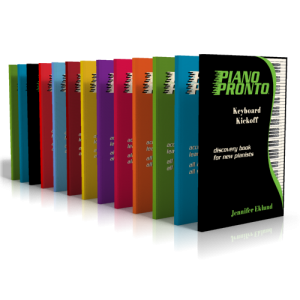
Piano Pronto

pronto

Some of you have noticed that I am switching your students (or yourself!) over to Piano Pronto and may have wondered why.

It was one of the first “method book series” to be integrated into Piano Maestro, so some of the songs have already been worked on using this iPad app.

I am in a Facebook group with the author/composer and many other participants have said that once their students have started in Piano Pronto, the students “forget” the other books at home or in the music bag.

So, a simple experiment was started here and the same thing happened.  Only the Piano Pronto book (Keyboard Kickoff) came out of the bag.

Then, another student got hooked, and another…

Even the young boys seem to love the duets, which are excellent at helping with counting and listening to other musicians.

A minor point but one that makes life easier for the teacher.  All books are $10.00 (plus shipping)  Other method books have varying prices in hard to find locations, some hidden in codes on the back.

Piano Pronto books can be ordered online at https://www.pianopronto.com/ and they are available at our local Music and Arts store in Oakton.  If something is needed fast, digital copies are available to print (or add to the iPad)

If you would like to look through any of the books, just ask!

From the composer, Jennifer Eklund, on Facebook:

Let me give you my fast 5 “things that makes us different from everyone else”:

#1 – On the staff reading day one (I take what I call a “total immersion” approach to note-reading/learning – watch the webinar for the full scoop)

#2 – Aurally pleasing music from very early on. I challenge you to find better and/or more consistently solid arranging in another method series. I don’t wait 2 years to introduce 8th notes. The tunes used in the series are strong and familiar and therefore we can get to more of the fundamentals earlier in the lesson process. Students practice with confidence at home because they recognize the melodies and therefore progress faster.

#3 – All-in-one integrated books (i.e. there aren’t 4 separate books per level the most you ever need is the method and maybe one supplement book)

#4 – The material is age and gender neutral. Clean layout with no illustrations to distract.

#5 – We start teaching how to *effectively* practice from the get-go with our “Pronto Prep” sections that pull out the difficult portions of pieces *before* a student learns the piece.

Other less important stuff:

#6 – The supplements are rooted in my “pop/jazz” background so while the method books are very “classically-based” the supplements are full of pop-style stuff that really creates well-rounded students

#7 – I challenge you to find more varied/interesting teacher duet parts.

#8 – I’m actively writing/creating new items constantly. I really listen to my customers and am writing to suit the needs of the market. If you need something and I don’t have it odds are I’ll probably end up filling your request.

#9 – I stay out of your way as a teacher. The material is extremely flexible. I wanted to give you a solid curriculum that is paced thoughtfully and you can augment the series with all the tools available in your toolbox. You will not feel restricted in any way by the material.

#10 – You can SEE and HEAR everything before you buy. There is NO guesswork involved with shopping with Piano Pronto.

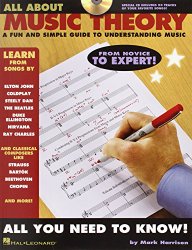
All About Music Theory: A Fun and Simple Guide to Understanding Music

theory


As all my students know, I teach theory with all piano and organ lessons.  Sometimes, it’s from a theory book that matches a lesson book, sometimes on the fly on an “as needed” basis.

This book looks like it would be interesting to use as a review or to look ahead and see what’s coming.  I have just ordered a copy for the studio if you want to check it out at the next lesson.

From amazon.com:

 If you wish there was a fun and engaging way to help you understand the fundamentals of music, then this is it. Whether it’s learning to read music, understanding chords and scales, musical forms, or improvising and composing, this enjoyable guide will help you to finally start understanding the structure and design of music.

This fun-filled, easy-to-use guide includes:
* Music notation
* Scales and modes
* Melody harmonization and counterpoint
* Chord progressions
* Song form and structure

Listen and learn with the CD that has 90 tracks, including over 50 popular songs such as:
* Beauty and the Beast
* Candle in the Wind
* Imagine
* In the Air Tonight
* Killing Me Softly with His Song
* Let It Be
* Message in a Bottle
* Misty
* Satin Doll
* Take the ‘A’ Train
* Unchained Melody
* What’d I Say
* and more!

maryOivoryandroses

It takes dedication to master piano keys | The Andalusia Star-News

keys

My piano teacher friend, Michelle, posted pictures of her students the other day. Apparently, they participated in some type of competition/recital, and with pride their teacher shared the results.

They stood smiling into the camera each holding a certificate that announced his or her status in the competition. Seeing them brought back my own memories of piano lessons and recitals. I smiled as I looked into the bright faces of those talented young people.

When I was a kid I wanted nothing more than to learn to play the piano. I had a favorite aunt who played so well and my daddy played by ear better than some folks who read music.

Oh yes, I imagined myself sitting at the keyboard, fingers flying while the family sang along to some favorite hymn or Christmas carol. Daddy would grin with pride and maybe join in playing his harmonica.

It was lovely dream. There was only one little glitch in this plan. I needed lessons in order to make it come true.

So, my parents signed me up with Mrs. Simmons who lived across the street. She was one of the best piano teachers in town and lucky me, all I had to do was cross the street for my lessons.

I’m not sure what I expected, but it was with great disappointment I realized I was not going to produce a beautiful song after only one lesson. Heck, I wasn’t going to produce much more than a repetitive playing of the scales after several lessons.

I recited, Every — Good — Boy — Does — Fine, All — Cars — Eat — Gas, FACE, GBDFA to help me remember the treble and clef lines and spaces. And I played the notes over and over until the sand in the hourglass timer told me it was time to stop. (I’m pretty sure Mother was overjoyed when that last piece of sand fell through the hole.)

When I finally got to the point of making a noise that sounded like something musical, it was, if I remember correctly, a little ditty about a frog — not exactly the moving hymn I imagined playing.

Eventually, I progressed to playing an entire piece of music. That meant I was ready to take part in the annual piano recital. I’d love to say I was excited at the prospect of publicly showing the great strides I’d made in piano playing. In truth, I was more excited about getting to wear an evening gown and lipstick.

For three years, I stuck with the lessons and with the practicing. For three years, I showed up for the recital and played the piece my teacher assigned. I have a picture of myself seated at the piano in my parents’ living room on the night of one of those recitals.

My hair is a perfect flip and I’m wearing a white gown that I imagined made me look like a cross between an angel and a fairy. I have my hands resting on the keys and I’m smiling into the camera like some diva about to launch into a classical masterpiece.

At some point, (probably had something to do with being a teenager and boys) I let go of my dreams of tickling the ivories. I did learn one Christmas carol, which my family heard until they were pretty much sick of it.

As I looked at Michelle’s students holding their certificates, I thought about the dedication it took for them to play so well. I also thought about all those teachers, like my friend and like Mrs. Simmons, who have the calling and the incredible patience it takes to try to teach another human to play a piano, especially when the student is not realistic about what it takes to master the instrument and more interested in evening gowns.

via It takes dedication to master piano keys | The Andalusia Star-News.

JoyTunes, Now Free For Music Teachers And Students, On Its Big Strategy Shift | Fast Company | Business + Innovation

Piano Mania


Yuval Kaminka was faced with a difficult choice. The Israeli entrepreneur had built a successful music learning app called JoyTunes, and he found that it was particularly beloved by professional music teachers. In the span of months, “we saw a vibrant community of teachers revolving around the apps,” he says. All the metrics were growing: retention, engagement, number of student profiles per teacher, and so on. “All these figures really blew up. We saw it was really making a difference.”

The accounts teachers were setting up for students–who use the app to gamify music learning–comprised a very significant part of JoyTunes’s revenue. Every time a teacher set up an account, either for themselves or their students, they paid either $10 a month or $60 per year. Power users wound up paying as much as $1,000 a month. Kaminka says that about 40% of his profits came from music teachers.

Read more at JoyTunes, Now Free For Music Teachers And Students, On Its Big Strategy Shift | Fast Company | Business + Innovation.

The Evolution of Music Clefs

When my students are first working with the Grand Staff, they are often confused about the placement of the various clefs.

In piano music, we generally use only the G-clef (Treble clef – not “trouble clef” as some think!) and the F-clef (Bass clef)  I try to show students how the curvy part of the G-clef wraps around the G above middle C and the F-clef looks sort of like an F marking the F below middle C.  I draw out G and F on the staff to show how these could have looked.

Originally, instead of a special clef symbol, the reference line of the staff was simply labeled with the name of the note it was intended to bear: F and C and, more rarely, G. These were the most often-used ‘clefs’ in Gregorian chant notation.  Gregorian chant developed mainly in western and central Europe during the 9th and 10th centuries, with later additions and redactions.

Over time the shapes of these letters became stylized, leading to their current versions.


Summer Schedules!

It’s hard to believe but summer is nearly upon us.  FCPS students are getting out later this year due to snow days, so the regular school year piano lessons are going a bit longer, as well.

Here’s the basic schedule from now through the start of fall lessons.  Please remember that students must take at least 6 summer lessons to hold a current school year lesson time for the fall.

The last day of school is  June 25, so there are no lessons week of June 23 (school age students only.  Adults continue, as always)

No lessons 4th of July weekend – July 3-5

No lessons after noon the week of July 7-11 (Pender UMC Music Camp)

No lessons August 15-Sept 2


Lessons (11 adult lessons, 10 school age students offered):

June 2 9, 16, 23 (except FCPS students – last week of school), 30
July 7 (mornings only), 14, 21, 28
Aug 4, 11

Sept 8, the fall semester begins


If you need to reschedule, please call, email or FaceBook me and with at least 24-hours notice. There are some open spots available on the schedule.  You can view them here: https://ocms.youcanbook.me/.   Those times are “more like guidelines.  I will contact you to confirm any changes.  As always, the PW is “piano”.


happy_summer