Keeping pianos, life in tune | Detroit Lakes Online

piano-tuning

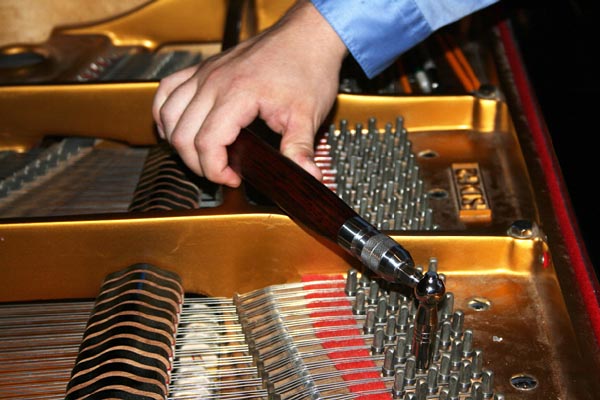
When it comes to tuning, every piano is different, even two pianos of the same style and make are different, and the humidity of the room makes a big difference, he said.

High humidity causes the sound board to swell, stretching the strings and causing the pitch to go sharp, while low humidity has the opposite effect.

In Minnesota, humidity can easily range from 80 percent in the summertime to 10-15 percent in the winter, if the home doesn’t have a humidifier. Wood-heated homes tend to be especially dry, he said.

“Pianos like it between 40 and 50 percent humidity in the house,” he said.

Even places that are supposedly “climate-controlled,” aren’t always. The heat might get turned down substantially evenings and weekends, for example.

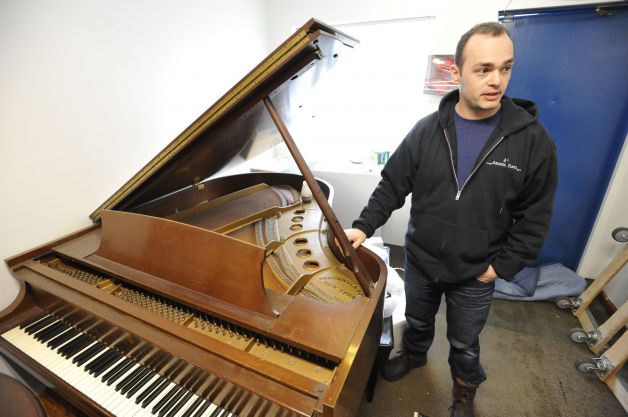
A new piano needs a few weeks to settle into its new home before tuning, Fry said.

“If they get a new piano, generally they call us the day before it gets in the house,” he said. “It should sit in the house a couple weeks just to acclimatize it to its new surroundings … brand new pianos stretch for a while. They go out of tune quicker. The wire stretches and they settle into themselves.”

Some people think they have to let a new, or recently moved older piano, sit six months or a year before it gets tuned. That’s not true, Fry said, but it does need a few weeks.

He recommends that pianos be tuned at least once a year (he tunes his own piano once a year, even though he no longer gives lessons) and the busiest time for him is before the holidays — September through December.

“Piano-tuning is something people can put off,” he said. “We noticed a real drop in tuning when gas got over $3 a gallon. I didn’t think it would make that much of a difference, but it did.”

Fry said he is looking for some kind of work to do in the summertime when his other businesses are slow.

He doesn’t give piano or guitar lessons anymore, but does enjoy tuning all types of pianos.

“It takes me a couple of hours. I have time,” Fry said. “I’m going to do the job that I like to do, and do it right.”

Read the entire article at Keeping pianos, life in tune | Detroit Lakes Online.
Winthrop Woman Has Played Old Time Favorites For 70 Years – Central Maine

piano-dream

Joyce Fessenden has been playing piano in public for 70 years. At the age of 83, she still plays four or five times a week at area nursing homes and assisted living centers. She has no thought of quitting.

“Music has always been a very important part of my life,” Fessenden said. “I’m very grateful for that. I don’t plan to quit playing.”

On a recent Tuesday, Fessenden played old favorites on the piano at the William S. Cohen Community Center in Hallowell. Her music blended in and enhanced the boisterous sound of lunchtime diners.

“I love it here because the food is good and the people are kind,” Fessenden said. “If somebody says ‘play the piano,’ the only thing I ask is where and when.”

Fessenden reads music rather than playing by ear.

Read more at Winthrop woman has played old time favorites for 70 years – Central Maine.

The Pitfalls And Perks Of Playing A Concert Hall Piano | Music | The Guardian

showroom284

Piano lore can be summarised thus: there are good and bad pianos. This is the basic fact in a pianist’s life. Both kinds are to be found in all sizes, from all manufacturers, at any price point. A concert grand costing more than £100,000 can be bad. Smaller can be better than larger, but between two good pianos, the sound of the larger will be richer and more present.

One can get used to any piano, even when the instrument is terrible, but the better the piano, the less time is required, and vice versa. Spending time with a good piano is rewarding: there is always something more to discover in its tone. A bad piano functions in what-you-see-is-what-you-get mode, producing the same sound even after hours of practice. And each piano is unique. Manufacturing involves hundreds of processes and adjustments, most done by hand, all affecting the final tone. As a result two pianos of the same model, made in the same year, will sound different to the untrained ear, despite their outward sameness. The contrast in sound between different models, or between pianos made in different years or from different companies will be even more apparent.

Read more at The pitfalls and perks of playing a concert hall piano | Music | The Guardian.

Crushed By A Piano

Do NOT try this at home!

Audiences bade adieu to long-running CBS sitcom Two and a Half Men after 12 seemingly eternal seasons. Creator Chuck Lorre (also the mind behind other network staple The Big Bang Theory) got the last laugh by killing off his sworn enemy, Charlie Sheen, once and for all … by a falling piano, no less!

The whole article is here: Watch “Charlie Sheen” Get Crushed By A Piano In The ‘Two And A Half Men’ Series.

Piano versus violin: the eternal battle to be the dominant player

Piano_Violin


The thought-provoking talk on February 10th was given by Keith Pascoe, second violinist of the Vanbrugh Quartet, in connection with tomorrow night’s violin and piano recital by Ray Chen and Julien Quentin. Pascoe came up with a great title, David and Goliath, The Ballet of Unequals: A Stradivari and Model D Steinway Recital. Using videos from YouTube as illustrations (which unfortunately allowed in snippets of a couple of unwanted advertisements), Pascoe began at the beginning, with the emergence of the piano and violin as instruments in their own right, and traced some of the changes they have both undergone in the centuries since.

The piano has become bigger, stronger and louder. Not only were extra notes added to the keyboard, but the early wooden frames were replaced with cast iron. The violin may not have grown externally, but the shape of the body was remoulded, the neck and fingerboard realigned, and internal buttressing extended, all with the intention of producing greater sound.

What composers did with the combination of violin and piano – and before that, violin and harpsichord – changed too. In the typical baroque violin sonata, the violin was to the fore. In the classical era, the roles were reversed, although this reversal has long been dishonoured by performers. And in the 19th century, the balance as we know it today began to take hold. That balance usually presents the two performers in a master-servant relationship, the violinist usually the boss whose bidding is carried out by the pianist.

Read the entire article at Piano versus violin: the eternal battle to be the dominant player.

It’s Never Too Late to… Take Up Piano – Telegraph

Schubert took piano lessons aged six, but don't let that put you off

Lionel Kelly, 78, may have come late to the piano – he took it up at the age of 73 – but it’s changed his life. “I first heard Mahler performed in London in the mid-50s, when he became very popular over here,” he says. “I’m currently working on a piano transcription of the Adagietta from his Symphony No. 5. It’s a beautiful piece of music, slow and passionate, and was used in Luchino Visconti’s 1971 film of Thomas Mann’s novella, Death in Venice. To be able to play Mahler now, all these years later, is a real treat.”

Kelly, formerly director of American Studies at Reading University, practises up to four hours a day. He has lessons in Reading with Janet Sherbourne, whom he describes as “an excellent, if strict, teacher”, and is not taking grades. “Janet reckons I’m somewhere between grade four and five level, but I’m just doing it for pleasure, because I want to learn and play,” he says.

Bach, Beethoven and Mozart are among other composers tackled by Kelly…

Read the entire article at It’s Never Too Late to… Take Up Piano – Telegraph.

Old World Craftsmanship /New World pianos

steinway-brown

Yury Feygin, owner of Amadeus Piano, shows off a Steinway piano on display at his business in Stamford, Conn., on Wednesday, Feb. 4, 2015. The piano company mainly deals with tuning, repairs, moving, storage, restoration and antique piano sales with locations in Westport and Long Island, NY.Photo: Jason Rearick


Yury Feygin likes playing with pianos — so much, in fact, that he occasionally forgets to eat and sleep.

Like his father, Mikhail, and grandfather, Semyon, Feygin is an expert at restoring, tuning and repairing antique pianos.

Feygin and his workers have built a first-of-its-kind double-decker storage system at their Lenox Avenue warehouse. They have stashed dozens of pianos in the racks, legs removed, filed side-by-side like massive dominos as they await restoration.

“Getting pianos off the ground isn’t a comfortable thing — you’ve got to worry about it falling when you’re handling it, but we have it down to a science,” said Feygin. “People were saying, my dad was saying, `Don’t do this, let me store your stuff.'”

Read more at http://www.stamfordadvocate.com/printpromotion/article/Russian-immigrant-brings-Old-World-craftsmanship-6083020.php

February 15 ~ Today in Music History

today

. 1571 ~ Michael Praetorius, German organist, composer and theorist
More information about Praetorius

. 1797 ~ Heinrich Engelhard Steinway, German piano manufacturer
More information about Steinway

. 1847 ~ Robert Fuchs, Austrian composer and music teacher

. 1905 ~ Harold Arlen, (Hyman Arluck) American composer of musicals and songs
More information about Arlen

. 1918 ~ Hank Locklin (Lawrence Hankins Locklin), Country singer

. 1932 ~ George Burns and Gracie Allen debuted as regulars on The Guy Lombardo Show on CBS radio. The couple was so popular that soon, they would have their own Burns & Allen Show. George and Gracie continued on radio for 18 years before making the switch to TV. All in all, they were big hits for three decades.

. 1941 ~ Brian Holland, Songwriter

. 1941 ~ Duke Ellington and his orchestra recorded one of big band’s all time classics on this day. Take the “A” Train was recorded at Victor’s Hollywood studio and became the Duke’s signature song.

. 1944 ~ Mick Avory, Drummer with The Kinks

. 1951 ~ Melissa Manchester, Singer

. 1958 ~ Get A Job, by The Silhouettes, reached the top spot on the music Tunedex. It remained at #1 for two weeks. Talk about sudden change in American popular music! One week earlier, the number one song was Sugartime, by The McGuire Sisters, a song that definitely was not classified as rock ‘n’ roll. Get A Job was replaced by Tequila, an instrumental by a studio group known as The Champs.

. 1959 ~ Ali (Alistair) Campbell, Guitarist, lead singer with UB40

. 1965 ~ This was a sad day in music, as singer Nat ‘King’ Cole died in Santa Monica, CA. The music legend was 45.

. 1986 ~ Whitney Houston reached the #1 spot on the music charts. Her single, How Will I Know, replaced a song recorded by her first cousin, Dionne Warwick (That’s What Friends Are For). Whitney is the daughter of singer Cissy Houston.

. 1992 ~ William Schuman passed away. Schuman was an American composer and arts administrator.

February 9 ~ Today in Music History

today

1885 ~ Alban Berg, Austrian composer
More information about Berg

. 1909 ~ Carmen Miranda (Maria do Carmo Miranda Da Cunha), ‘Brazilian Bombshell’, singer, dancer, actress

. 1914 ~ Gypsy Rose Lee (Rose Hovick), Actress, dancer, stripper, subject of Broadway show and film, Gypsy, sister of actress, June Havoc

. 1914 ~ Ernest Tubb, Country Music Hall of Famer, headlined 1st country music show at Carnegie Hall

. 1923 ~ Kathryn Grayson, Singer, actress in Kiss Me Kate, Show Boat, The Kissing Bandit, It Happened in Brooklyn, Anchors Aweigh

. 1937 ~ Hildgarde Beherns, German Soprano

. 1939 ~ Barry Mann, Songwriter, with Cynthia Weil on dozens of ’60s and ’70s ‘Brill Building’ hits, singer

. 1940 ~ Brian Bennett, Drummer with The Shadows

. 1940 ~ The old piano played for dances in the Tattersall house in High Forest for many year – as long ago as the Civil War period – will be played once more when the Olmsted County Historical association formally opens its museum in the basement of the Rochester, MN public library.

. 1941 ~ Carole King (Klein), American pop-rock singer and songwriter

. 1944 ~ Barbara Lewis, Singer

. 1963 ~ (James) Travis Tritt, Grammy Award-winnning singe

. 1964 ~ Several days after their arrival in the U.S., The Beatles made the first of three record-breaking appearances on “The Ed Sullivan Show”. The audience viewing the Fab Four was estimated at 73,700,000 people in TV land. The Beatles sang She Loves You and I Want to Hold Your Hand. One could barely hear the songs above the screams of the girls in the audience.

. 1966 ~ Liza Minnelli brought her night club act to the Big Apple. She opened in grand style at the Persian Room of the Plaza Hotel in New York.

. 1969 ~ A young lady named Roslyn Kind made her quiet TV debut this night on“The Ed Sullivan Show”. Ed said she’s “…America’s teenager who wasn’t protesting or playing a guitar.” She only appeared once. Her sister appeared many times. Roslyn Kind is the sister of Barbra Streisand.

. 1970 ~ Sly and The Family Stone received a gold record for the single, Thank You (Falettinme Be Mice Elf Agin). Sly (Sylvester) Stewart was a DJ in Oakland, CA.

. 1981 ~ Bill Haley died on this day in Harlingen, TX. He was 55. Haley, with his Comets, recorded what became known as the anthem of rock and roll: Rock Around the Clock, from the movie, “Blackboard Jungle”. The song turned into a multimillion dollar hit and one of many hits Haley and the Comets had, including: Dim Dim the Lights, Razzle Dazzle, Crazy Man Crazy, Rock the Joint, See You Later Alligator andShake Rattle & Roll. Bill Haley was inducted into the Rock and Roll Hall of Fame in 1987.